Leading industry experts look at the key challenges and talking points likely to dominate the label and package printing industry in 2024.

Industry leaders share predictions for 2024 | Labels & Labeling (labelsandlabeling.com)

The pressure sensitive adhesive labels and packaging industry is growing at a steady and rapid pace in India. It is now time that the contribution of those who have achieved success is chronicled so that those who wish to move ahead have a platform to look for information, news and interaction. This Website intends to provide all that along with inspiration and reference.

Leading industry experts look at the key challenges and talking points likely to dominate the label and package printing industry in 2024.
Industry leaders share predictions for 2024 | Labels & Labeling (labelsandlabeling.com)


Label waste contributes to environmental degradation. Effective management strategies can limit label waste going to landfills, leading to a healthy & safe environment. To learn more, join the LMAI event in Bangalore.
The event is free for LMAI members only. Nonmembers can register as members and join LMAI to attend the programs organized by LMAI!

While the Indian labels industry keeps evolving, adapting different printing and converting technologies, there is also a generational change happening in the leadership. Most of the founders, while still active as mentors, have passed on substantial decision making to their next generation who are now in the lower middle age group of 40 years, plus or minus 3 years. All those who I have covered belong to family managed companies. Though largely these young inheritors are the influencers or drivers of growth in their respective companies, yet, complying to the cultural heritage passed on in the Indian families, they give the credit to their parents or their mentors who founded the company. This is so heartwarming! These young men are professionally trained, well-educated and are always ready to adopt new managing systems. They do not hesitate to invest in new and innovative capital equipment to stay ahead of competition and drive expansion. They have come to establish themselves as the young czars of Indian label Industry.

Pragati Pack Pvt. Ltd., part of the Pragati Offset Printers group Hyderabad, founded by the legendary Paruchuri Hanumantha Rao in 1962, is led by his 37-year-old grandson Hemanth Paruchuri who is taking care of the packaging business in the group. The commercial printing business is taken care of by his brother Harsha Paruchuri. Hemanth is qualified Mechanical Engineer, an Alumnus of Purdue University Indiana USA, he has been mentored by his father Narendra Paruchuri who is an industry stalwart. Joining the company in 2007, he learnt the business hands-on practically, while working within Pragati. Presently, designated as director with responsibilities that include development, production, marketing and selecting areas of further expansion as well as identifying appropriate capex investment.
When Hemanth joined Pragati, packaging was just a small part of their business, which has now become 75% of the company’s overall business. Pragati is one of the highest awarded printing companies in India. Their annual calendar created by great teamwork at their commercial printing division is a piece of art that people preserve as prized collections.
Talking of future, Hemanth says, “Plan is to keep growing in packaging and in labels by doing more specialized labels predominantly self-adhesive.”
For labels and packaging they operate at multiple locations in Hyderabad and in Noida. As for roll labels they have three flexo presses and one HP Indigo label press, for sheetfed they have a small Konica Minolta digital press. For digital sheetfed packaging they may invest in larger sheetfed press in digital. Total manufacturing area for labels and packaging is spread over 440,000 square feet in Hyderabad, 120,000 square feet in Noida plus 80,000 square feet for commercial printing. The workforce for labels and packaging is 700, and 300 is for commercial printing.
Alumnus of Harvard Business School, UCLA Anderson and IIM-A 42-year-old Ankit Gupta, Joint Managing Director of Holostik India Limited, had pursued higher education after completing his BE in computer science. He along with his brother Shobhit Gupta took over the reigns of Holostik, a company founded in 1991 by their illustrious father Umendra Kumar Gupta who was leading personality in the Hologram and anti-counterfeiting label and packaging industry and passed away due to Covid in 2021. After a stint at A V Birla group as an IT engineer, he joined Holostik in 2005 as head of its real estate and chemical verticals. Thereafter, from 2007- 2020 headed the MarCom, HR, and Strategy followed by heading the Sales department. After taking over as Joint MD in 2021, he launched NaturTrust, the bio-degradable and compostable packaging business in the year 2022.
Ankit’s achievements include winning the prestigious Larry Wolfen Award for Entrepreneurial Spirit in 2006. Investing in multiple start-ups including Edukart – India’s leading education marketplace that was later acquired by Paytm and Bedrock Ventures and Mentoring and angel-investing in more than 15 successful startups across India.

For future he plans to keep working on innovation and integration of innovative technologies to fight the cause of counterfeiting, explore new markets and geographies both in India and globally and increase the use of sustainable technologies as their commitment to a green earth. Holostik India Ltd. is headquartered at Noida producing Anti-counterfeit security OVDs (Holograms), Security Labels, 3D Labels, Holographic Packaging Films, Induction Liners, Digital Supply Chain Solutions among many others. They operate with 450 employees out of the 100,000 square feet shop floor with three European Flexo label presses and 2 Screen Printing Presses besides a host of other equipment.

Thirty-eight-year-old Naveen Goel is the Managing Director of Noida based Any Graphics, founded in 1987 by his father Kuldip Goel, past President of LMAI. After completing his MBA, Naveen joined Any Graphics in 2009, beginning his career in printing and packaging as Director marketing, responsible for business development, client acquisition, customer relations and direct sales for the company. 14 years on, now as Managing Director, he is committed and focused to providing solutions to customers across all sectors providing innovations, value engineering or cost engineering. Naveen says. ”Leading the company from 60 people to 800 people over the last decade has been a satisfying journey. Being second generation, it was very important for me to sustain the founder’s vision to consistently innovate and handcraft solutions to diverse needs of the customers.”
Any Graphics has achieved exceptional growth through sharp focus on award-winning products and solutions that include Rigid Boxes, Labels, Mono Cartons, Dome Stickers, Panel Overlays and Decals. They employ an 800 strong workforce operating with 6 label presses and many sheet fed, screen, digital presses and a lot of other allied equipment from 250,000 square feet shopfloor in 15500 square meters of land.
Prakash Printers and Coaters Pvt. Ltd., established in 1975 by Thakurdas J Shivlani in Ahmedabad, is now led by his 40-year-old son Prakash Shivlani as Director. Prakash joined the family business while still in school as a salesperson. Those days they used to print on sheet Offset and were amongst the first ones in the Gujarat region for printing sticker labels exclusively. Transforming the sticker business to labels in roll form, they initially installed some smaller Flatbed and Letterpress narrow web presses machines Onda and Iwasaki. Later at the start of a new millennium, as business grew, they installed a CI Flexo from Etirama, Brazil.
After completing his undergraduate studies, Prakash joined the family business in 1997 sharing responsibilities along with his father, specialising in sales, however he now also takes care of production. Their production profile now includes Labels, Shrink Sleeves, Flexible laminates. They also produce silicone liners, Hotmelt adhesive label stock with diverse face stocks like Holographic/Metalized paper, Aluminum Foil , 2/3-layer substrates for In-house consumption. Prakash endeavors to expand into packaging in the near future. Presently they operate with seven European flexo presses besides other equipment from a 355,000 square foot shop floor with 150 employees.


29-year-old Krish Chhatwal is the grandson of late Narendra Chhatwal who migrated to New Delhi after partition of India in 1947 and worked for the famous Kwality Restaurant. In 1962 he set up his maiden venture, a printing press and nostalgically named it Kwality Carton manufacturing company. Later, the name was changed to Kwality labels unit of Kwality Offset Printers. Krish Chhatwal, a BBA in Finance and Marketing has been the director of Kwality Labels since 2017. He initially worked as a trainee in all departments of the company learning the nuances of printing. As for sales, he made cold calls, met potential clients and gained new ones for the company. Accompanying his mentor, his father Rajeev Chhatwal, visiting expos around the world, he realised the growth potential of labels industry.
After his active involvement, Kwality invested in a Xeikon digital toner label press, implemented ERP systems, Inspection systems, hybrid Xrite colorcert software for Density control of colours and software for pre-press. They have won awards for excellence from Printweek, NAEP, LMAI, Finat, Asian print excellence and many more. Krish plans to make continuous investments in equipment to produce highly embellished and security labels. They operate with 110 employees and seven label presses complementing their offset presses and allied equipment in a shopfloor admeasuring 35000 square feet, producing Self-adhesive labels, Anti counterfeit security labels, Wet glue labels, Variable data labels, Customized and Personalised labels, consuming more than 800,000 square meters of label stock.
Founded in 1992 by Hemen Vasa and Bhupen Vasa, Unick fix-a-form & Printers Ltd. Ahmedabad is a specialized producer of functional Labels, multilayer leaflet/booklet labels, piggyback dual labels, tri layer labels, scratch off labels, hanger labels, special peel and seal labels for pharma applications, shrink sleeves, etc. Heman Vasa’s 31-year-old son Priyank Vasa, a BE in Printing Technology from Manipal Institute of Technology, is now the youthful leader at Unick fix-a-form. He is designated as development & strategy director. Priyank specialized in Financial Modelling and Analysis. Before joining the company in 2014, he had spent his summer break as a trainee in the company while still pursuing his engineering. After joining, Priyank supported the sales team with new developments and innovations to venture into segments outside their comfort zone of pharma. He later also became part of the QA team to standardise inputs, ensuring error-free products.
Priyank has been instrumental in implementing ERP systems for smooth operations. Since their specialized labels lacked in aesthetics, he led the implementation of value additions like screen printing, embellishments, using special inks varnishes foils, metallics, touch and feel effects etc. The company has further undertaken projects to curb expenses, reduce wastage and optimise production processes. Unick operates from a 30,000 square feet shopfloor with 5 label presses and 250 strong workforce consuming 400,000 square meters of label stocks per month for their specialty labels.


41-year-old Aditya Kashyap is himself the founder and Managing Director of Baddi based Marks Emballage Private Limited and Marks group, that he established in 2011. An alumnus of the famous Ruia College Mumbai, he worked briefly in an international bank and later got trained in family-owned large Pharma companies for packaging development and purchase, followed by interning as a trainee in a label manufacturing unit before initiating his maiden venture. With Two Gallus label presses that he bought in one go, one Bobst Label press, AVT inspection system, Prati finishing machine, Pantec embellishing equipment, Xrite and much more, the company shopfloor is spread across 30,000 square feet having 60 employees. On his journey so far Aaditya says, “The journey has just begun, after setting the unit from scratch to what it is now.” He further adds,” “though we are setting up professional management, yet I am still involved to implement my vision of creating a world class company.”
As a part of its CSR initiative, Marks group has invested in sponsoring the annual “Printweek Student of the year” award to backup educational initiatives for encouraging young people to take up print as a career. Aaditya aims to grow the company multifold in coming years with his latest ideas. He aspires to roll out at least one new project every year for the next five years. He is pensive in his thoughts, ”this is the time for us to spread our wings before getting into a consolidation mode. “
A relatively new entrant in the self-adhesive labels industry 35-year-old Vatsal Vora Director of Asean Pack Ahmedabad, has achieved amazing success in just 5 years including the 2 years passed in covid. Asean Pack was founded by Vatsal in 2018 after completing his MBA. In a short span of time the company is producing Pressure Sensitive Adhesive labels, Shrink Sleeves and In-Mold Labels (IML) in a 40,000 square feet shop floor with 2 Bobst label presses and one HP Indigo Digital label press working with 115 employees.

He plans to add one more press in 2024 followed by yet another in 2025. Thereafter he aspires to make continuous growth to increase their product range to include flexible packaging focused in producing pouch packaging coming from the short run customized and personalized packaging by adding more flexo and digital printing equipment.

Tejas Tanna aged 42 years, had in 2005, joined Printmann Offset Pvt. Ltd. after getting a Diploma in printing technology and B.S. (Bachelor of Science) degree from Rochester Institute of Technology New York USA. Printmann was founded in 1987 by his father Bipin Tanna the Chairman and Managing Director of the company. While working in the company Tejas parallelly pursued studies for getting an MBA from NMIMS (Narsee Monjee Institute of Management Studies) followed by a crash course in packaging from the Indian Institute of Packaging. Tejas and his 36-year-old brother Ankit Tanna are directors at Printmann with Tejas looking after sales and marketing, quality assurance and new product development and Ankit taking care of supply chain and operations. Ankit is an MS in finance from Manchester. Printmann started with commercial printing but by 1991 they felt the need of diversification for future growth and since they were into marketing collaterals for FMCG sector they opted to concentrate on packaging focused on the pharma and health care segment.
Now, 80-90% of their business comes from this sector. They supply whatever these companies require in the printed packaging space, which includes cartons, labels, leaflets and foil. Tejas says ,”We are perhaps the only company to offer all the four verticals from just one source.” With European Pharma companies making tamper evident labels mandatory, Printmann is now producing these as well. They are three times winner of Printweek packaging company of the year award, including one that they got this year. For making capex decisions, the brothers become influencers and since their father is controlling finance the final decision is a joint call that is made by all three.
Printmann’s main factory is in Navi Mumbai, for expansion, they were looking for land outside Mumbai and fortunately the adjoining plot became available which they acquired, constructed during covid years and shifted their carton division there. They have another unit for blister foil manufacturing in Vasai. Between the three locations, they work out of 160,000 square feet shopfloor with over 300 employees clocking a turnover of Rupees 160 Crores last year which is expected to rise to 180 crores in this fiscal year. Summing up, Tejas emphasizes, “We understand our responsibility to remain sustainable and thus we have commenced our journey towards sustainability. We are implementing safety measures, EHS (Environment, Health, and Safety) systems and are tracking carbon footprints. We have hired PWC to advise and hand hold us in our endeavours on EHS.”
Janus International led by brothers Denver Annunciation 43 years and Janus Annunciation 36 years is a producer of a wide range of print and packaging products like PSA Labels, In-mold labels, Shrink sleeves, folding cartons, rigid boxes, eflute mono cartons, etc. The company was founded by their father Joe Annunciation in 1999. Both brothers are MBAs and alumnus of S P Jain Institute of Management and Research. Denver joined the company in 2001 and Janus joined five years later in 2006. “It has been an exhilarating experience running and growing the company so far, I am looking at much more” says Denver. He had joined the company when they had just 9 employees in a 500 square feet shopfloor. This has grown to 202 employees in three buildings at the same location in Thane spread over 55,000 square feet. Janus International has 7 flexo presses, one HP Indigo digital press and 3 offset presses.
Talking of the future, Denver mentions firmly that they endeavour to create a World class manufacturing company with ongoing stable growth. The company registered a sale of Rupees 83 Crores in the last financial year and they are confident to double it in 3 years.


Alpine containers Pvt. Ltd. Jammu is a company producing labels and packaging, at the northern most location in India for labels, founded by Harish Gulati who mentored his 40-year-old son Vipul Gulati from starting as a trainee to taking up a leadership role in expanding the company. Though Harish had set up the printing business manufacturing mono cartons in 1978 in an 800 square foot premises, but Vipul joined in 2003. The present company Alpine was established in 2008 when they expanded into corrugated board cartons. In 2012 they installed an automatic corrugation plant, the first one to be setup in entire region of Punjab and Jammu and Kashmir. Vipul Gulati did his schooling from Prestigious Maharaja Hari Singh School Nagbani and BBA degree from Lovely University. Vipul led Alpine’s venturing into label manufacturing in 2015 with installation of a Gallus ECS 340 label press then a Mark Andy P 7 in 2019 and another Label press in 2022 along with 3 inspection machines and screen-printing machine. As Executive Director of the company, Vipul is responsible for purchases, new developments, expansion and day-to-day operations. He is expanding label business beyond Jammu, setting up a manufacturing plant in Gujarat.
The company is now operating from two locations in a shop floor admeasuring 200,000 square feet employing more than 250 people. As for labels, they consume in excess of 400,000 square meters of self adhesive labelstock which is likely to increase exponentially once the expansions being undertaken are completed.
Written by Harveer Sahni Chairman Weldon Celloplast Limited, New Delhi-110008 December 2023


Prologue by author: In 2010 I wrote an article on Chandan Khanna, where he expressed, “I wanted to be different”! Six years later after visiting his label manufacturing unit in Thailand I wrote again quoting him in the title, “I am different”. He has time and again proved that he is not the one to stay stagnant and moves on in life. He sold his Indian operations at a pinnacle and moved into other arenas in pursuit of businesses pursuing passions other than labels. While his Thailand and Sharjah unit are still in good operations, he did not indulge personally but mentored and groomed a person who joined him in the initial stages of his career as an assistant manager. His protégé, Sachin Arya was a quick learner and a committed honcho who climbed the rungs in labels like an entrepreneur. Yes, Chandan Khanna, you proved you are different!
Sachin Arya, hailing from Faridabad a suburb of New Delhi joined Ajanta Packaging in 2008 as assistant Manager at their Baddi unit in the North Indian state of Himachal Pradesh. After short internships at a couple of international banks he did his MBA from IILM Delhi in 2005 and set up own startup for export and import business in partnership with a friend. While he and his partner were contemplating a foray in to labels industry by importing labelstocks, Sachin came in contact with Chandan Khanna. While he was still trying to understand the labels business, Chandan made him an offer to join his company and asked him to go for some time to his Baddi unit to learn and get a feel of things.

He went to Baddi for a week and the team at Ajanta made sincere efforts to teach him the nuances of printing and managing a labels unit. Sachin was a good learner and seriously indulged in getting a feel of all the processes. Though He liked the feel of the labels business yet his commitment to his friend with whom he was in partnership in the import export business was bothering him, leaving their startup suddenly was not sounding right. Since there were some projects that Sachin had initiated so he needed time to complete them before joining Ajanta fulltime. Chandan Khanna is a farsighted businessman, and he had the patience as he saw the potential in Sachin and thus for a year Chandan let him finish his projects and attend to Ajanta’s work for a couple of days each week shuttling between Delhi and Baddi. A year later Sachin completed his pending projects and amicably, both friends agreed to dissolve the partnership. Sachin gave up his share to his friend who still runs that business and himself joined Ajanta Packaging Baddi, full time.

Sachin’s father now retired, had worked as Finance Manager in Friends Auto India Ltd Faridabad for over 30-35 years. His son Sachin was born and brought up in Delhi and moved to Faridabad in 2004 after he finished his education. On joining Ajanta Packaging in Baddi he realised, his learning in labels was limited and he was almost a novice.
He did not have a thorough knowledge of fine printing and least of all managing a label manufacturing unit. It was a big change for him to move from a self-owned trading enterprise to working for a service-oriented industry. It was a time when Ajanta’s packaging’s Baddi unit was trying to qualify for P&G (Proctor and Gamble) and the unit was not yet ready for the qualification. Though they were in production, yet to meet the stringent requirements for P&G, there was a lot that needed to be done. Sachin’s original brief was that he was to be in marketing and rest, he needed to find his way around in the company. He was an indulgent worker from day one and initiated his work by putting together SOPs. He got help from the P&G team and his senior, the plant manager, who is an experienced industry professional. While the P&G audit was underway and had yet to be cleared, the plant manager who was heading the enterprise at Baddi suddenly quit the job, just days before the audit. Unfortunately, Ajanta failed that audit but with sympathetic consideration, P&G understood their situation and gave them another final opportunity on date just two months later for another audit. As all responsibility fell on Sachin and it was a challenging situation, he decided to meet the challenge head-on. He hired some knowledgeable people, revisited all parameters and finally got the audit cleared.
The learning: P&G gave them an artwork for “Pantene” a job which was tough, and which they were printing in Ajanta Thailand, on offset with a vignette in single colour from zero to hundred percent. That label was a real challenge. The label also had printing in gravure and screen, and they were to create that on their nine colour flexopress. They also had to print by flexo, the “Head & Shoulder” label by matching the metallic silver that was earlier done on gravure. Having no knowledge, Sachin took the challenge in his stride and worked on it contacting suppliers like Siegwerk and Eckart for support. He even spent a couple of days at the Siegwerk lab learning CIELAB and matching colours to print successfully.

The CIE in CIELAB is the abbreviation for the International Commission on Illumination’s French name, Commission Internationale de l´Eclairage. The letters L*, a* and b* represent each of the three values the CIELAB color space uses to measure objective color and calculate color differences. The L*A*B* stand for L* indicates lightness, a* is the red/green coordinate, and b* is the yellow/blue coordinate. He was required to match Delta E values and send ink drawdowns to the buyers. Delta E is measured on a scale from 0 to 100, where 0 is less color difference, and 100 indicates complete distortion. It was the first time in his life that he saw a spectrophotometer. When the Siegwerk lab staff showed him, the blue looking a little red, he was surprised how blue can look red? Sachin put in hard work to learn travelling daily from Faridabad to Siegwerk factory in Bhiwadi in Rajasthan, a distance of more than 90 Kms each way. Once back in Baddi, Sachin was able to successfully match the colours, adding more aniloxes to their existing anilox rolls library to get the finer output and at a time when HD flexo was not yet available. His biggest learnings came from all industry suppliers. He learnt the value of cleaner aniloxes so also requisitioned an anilox cleaner. When the challenge came for screen printing, he requested support from Stork. The P&G audit was cleared and then onwards there was no looking back. There was capacity enhancement at Ajanta and Sachin so rightly gives all the credit for his learning to his mentor and boss, the farsighted Chandan Khanna, who reposed full trust in Sachin’s capabilities and kept on investing on Sachin’s grooming as a technically sound person with leadership qualities. Chandan continued to invest in multiple label presses and increasing the capacity of the Baddi unit. This was beside his manufacturing facility in Daman in the west of India and the unit in Thailand. Sitting in faraway Mumbai, he reposed full trust in Sachin and his capability to come up to expectations.

Career journey: Chandan had seen and sensed the caliber of Sachin and training did not end at just making him technically sound. He further entrusted him with marketing, besides being the key account manager for P&G as well, to complete the leadership acumen in him with hands-on experience. Sachin set up his systems and a team at production and himself started travelling with marketing teams to brand owners and other customers understanding their requirements and explaining to them the intricacies of their capability to create labels that add value and enhance the sale ability of the product adorning them. Brand owners make artworks on a computer but how it must be converted on complex substrates from the conceptualised label design needs a lot of technical consideration. For this reason, his travel with the marketing and sales teams was an asset in converting efforts to orders. From his initial designation as an assistant Manager at Baddi Sachin rose became the general manager and his presence became necessary wherever in the group new press installation was being done, may it be in Baddi, Daman, Thailand or Sharjah in UAE.
Rising to the top: From 2008 to 2015, Sachin had transformed from a novice to an expert, though he firmly believes he has still to learn a lot but is sure that whatever is challenge, he can work his way with support from his mentor, suppliers, industry colleagues and his team, to meet it. If anyone can create an innovative label, he can also replicate. If there are processes that they don’t know or do not have the capability, with Chandan’s active encouragement and support in investment and Sachin’s own eagerness to learn, he could also do the needful. When growth prospects became evident in Sharjah, they had to get the qualification for P&G there also. Sachin with his experience was offered by Chandan to move to Sharjah more so because the team at Baddi was all set to take care, themself. Sachin and his wife had a growing child and wished to move from Baddi and this offer from Chandan suited his needs and after a smooth transition to team at Baddi, he moved to Ajanta Sharjah to work under the then General Manager. Six months after Sachin joined Ajanta UAE, Chandan found the unit was not doing well, the way he envisaged and at that time the then General manager resigned and quit Ajanta UAE. Since Sachin was already there the responsibility fell on his shoulders. As a first step he got the qualification done from P&G by replicating the success he had with them in Baddi. It took him a while to understand the laws and their implications in UAE and the way business was conducted in the Middle East. In 2016 he was formally handed over the full charge of the unit as general Manager of the UAE company. In two years by 2018 the company with day-to-day guidance from Chandan Khanna, achieved stability and was on it way to growth.


By this time, Chandan was restless and wished to move into other arenas and pursue other lines of business. He sold his India operations to Huhtamaki India retaining the operations in Thailand and UAE. Ajanta UAE was being run well and he adopted a hands-off approach and let Sachin run the company like an entrepreneur and being available whenever he was needed. The company became system driven and he was reached out only for capex or urgent approvals. In 2021 Sachin’s designation was changed to Managing Director, while Chandan is the group Managing Director and Chandan’s father the Chairman of the company.
Both Chandan and his father do visit Ajanta occasionally but since all is going well, they have given a free hand to Sachin to run the unit efficiently. Talking of the difference between his profile in Baddi India to now is rightly expressed by Sachin. He mentions that in India he was just a part of the team and was not responsible for the results other than those in his limited profile but here he is answerable for everything including profitability and growth of the company. He is proud to report that with the help of the team created, the turnover of Ajanta UAE has doubled in the last five years, and he targets another 100% growth in the next three years!
His vision and efforts have been to bring efficiency in production with existing equipment to achieve. He remains committed to achieving more with less. After his taking charge, two Omet Iflex and one Iwasaki have been added to the existing number of machines at Sharjah. Talking of digital label printing, he says the Khanna family and their company heritage is from offset printing business and for that they find the quality of Iwasaki intermittent offset presses that they have, as the preferred technology. As per the customer base they have, they do not accept very short runs but most of the jobs that are short runs for flexo process, they do it cost effectively with good results on the Iwasaki offset presses and they convert the longer runs on their flexo presses. Presently at Sharjah they have eight label presses out of which five are from Iwasaki, one Nilpeter and two Omets. The total workforce in the unit is 120 operating from 18000 square feet shopfloor. For future they are building a 100,000 square feet factory at Umm Al Quwain. In terms of sustainability, they are working on various things like Solar energy, working with brands to downscale the substance weights, switching to filmic liner thereby reducing tonnage and possibility of recyclability.

Sachin’s wife Sapna is a HR professional, but both are clear not to bring office to home and not take home to office and that is why they decide they will not work in same company. Their son Shamir is 10 years old and goes to Sharjah English School. Chandan’s farsighted approach has transformed a professional employee Sachin to climb the rungs of label industry and work like an entrepreneur doing justice to the trust imposed on him by his mentor Chandan Khanna.
Written by Harveer Sahni Chairman Weldon Celloplast Limited New Delhi Nov. 2023


LMAI, The Label Manufacturers Association of India has been spreading the message of an imperative need of implementing sustainability in their member’s products and manufacturing processes. Earlier this year in July 2023 for the highly successful and largely attended LMAI conference at Jaipur, the theme was, “Creativity Innovation and Sustainability”. Leading industry suppliers delivered presentations at the conference on how they were making their product offerings sustainable.
In my article titled “Sustainability and circular economy in manufacturing labels” and available on this blog, as also in my opening remarks during a panel discussion at the LMAI conference 2023 at Jaipur, I mentioned, “Sustainability in its simplest terms means, giving back to Mother-Earth or environment, society, or economy, whatever you draw from it. It ultimately delivers a message for us to leave a safer planet with minimum or no depletion of resources, for generations that follow, after meeting your own imperative needs”. Taking the initiative forward and reaching out to the label fraternity in the north of India, on the 13th of October 2023, LMAI organized an event titled, “4R’s of sustainability”. The 4 R’s stand for Reduce, Recycle, Reuse and Report which sum up the sustainability endeavors.
Avery Dennison was the main sponsor for the event and provided two out of the three speakers, namely Sumantha Das, a specialist in sustainability from Avery Dennison, Amit Saxena, an Operations Leader who has led Supply Chain, Capital projects and manufacturing in marquee companies like Hewlett Packard, Mondelez, Merck and in Abbott Healthcare as Director Operations and Raj Karodiya: senior executive-partner growth and a specialist on EPR(Extended producer responsibility) from “The Trash Company” who are consultants to Avery Dennison and other brand owners for EPR Registration.


Sumantha Das touched upon the four R’s of sustainability and goals targeted for achievement by 2030.

Amit Saxena , spoke about the drivers for sustainability in Operations of companies in FMCG, Chemicals and Pharma. He stressed on the need to cut wastages and save on all processes in operations which include, downtime, energy consumption, labour costs, packaging and logistics.

The final speaker Raj Koradiya gave eye-opening insights into EPR, its compliances and penal provisions.
Extended Producers Responsibility (EPR) regime is under implementation in Plastic Waste Management Rules, 2016, according to which it is the responsibility of Producers, Importers and Brand-owners to ensure processing of their plastic packaging waste through recycling, re-use or end of life disposal. Commenting on the implications of EPR which also impacts the label fraternity, Rajesh Chadha Director on board of LMAI and owner of Delhi based Update Prints said, “We have been given to understand that EPR registration is mandatory for all producers (including convertors) who generate plastic waste, irrespective of the size of the business. Only Micro and Small business brand owners are exempt from this and the onus for their waste generated also falls on the converters who are classified as producers.


The consequences of not registering in EPR are that the total plastic waste generation liability falls on the converter only, and heavy fines are there on per ton basis of plastic produced /converted. Further since the EPR portal is centralized by the CPCB (Central Pollution Control Board), data about converters can easily be obtained through labelstock producers who are already registered in the EPR portal like Avery, UPM etc. In view of the above it is requested of all label converters to come forward and comply by with the same as soon as possible, as time is short and deadline for registration is Oct 31st, 2023, this may or may not be extended.”
He also reiterated that on behalf of LMAI, “If we have a decent number of converters wanting to apply, LMAI can negotiate with this company ( or any other for that matter) to make the process economical and easier for all the converters and printers”. Adding to this Amit Sheth another Director and founder of LMAI says, “It is an important subject which all of us must pass through one day. Even machine sellers also must register for using plastics for machine covers and packing “. He further adds, “It will be a good initiative by LMAI for its members if they come forward in substantial numbers”.
As per the EPR portal; https://eprplastic.cpcb.gov.in/#/plastic/home/pibopwp
PIBO stands for producer, importer and brandowners. If you identify as PIBO and have your operations in India that uses plastic packaging as part of your operation, irrespective of your turnover or scale of operations you fall under the obligation of EPR. Under the current framework of EPR, PIBO are responsible to
The event at Chandigarh was organized by LMAI at Novotel Hotel in Chandigarh and was attended by over 100 delegates from Chandigarh, Haryana, Punjab, Himachal Pradesh and Jammu and Kashmir. The event was moderated by LMAI secretary Jaideep Singh who travelled from Hyderabad. Speaking about LMAI and introducing the industry association to the widespread audience he said;


“LMAI, the Label Manufacturers Association of India, is the representative body of the self-adhesive label printing fraternity of India. The ordinary members of the association are essentially producers of self-adhesive labels in roll form. LMAI was founded with just around 5 or 6 printers, by the efforts of Amit Sheth. Over the years LMAI has grown from strength to strength and now has around 400 members. LMAI regularly conducts seminars, panel discussions and culminating in the huge biennial LMAI conference. LMAI conferences in the past have been enormous successes at five- or seven-star properties at venues like Goa, Agra, Jaipur and Kochi. The last two events have recorded around 700 delegates from printer members , suppliers and their families. It is perhaps the biggest label industry event in the world with a spend running into Millions of Rupees.

LMAI has partnered with Tarsus UK, now a part of Informa, for promoting Labelexpo India and Tarsus supporting LMAI for their events for the betterment of Indian labels industry. LMAI is a part of L9, the confederation of World’s nine leading label association and is recognized by Finat, the joint global platform for the international labelling industry. LMAI regularly conducts the LMAI awards for excellence in creating labels. It has also interacted with the MSME ministry for getting benefits for label industry. The winners of LMAI awards automatically qualify for submitting their entries for world label awards. LMAI sends two judges for the judging of the World label awards. At the judging held last month in Brussels on the sidelines of Labelexpo Europe, our LMAI founder Amit Sheth and Harveer Sahni were judges representing LMAI.

LMAI has been making efforts to create knowledge delivery programs and organising events to bring leading FMCG buyers to express the needs of print buyers and for them to understand the printers. Our senior office bearers Rajesh Chadha, Vivek Kapoor, Amit Sheth, Harveer Sahni and Jaideep Singh, have travelled from Hyderabad, Mumbai and Delhi to be with you all today”.


Concluding his speech, Jaideep informed the gathering that the LMAI president Rajesh Nema had fallen ill and could not travel to attend this event. He also informed that with the label industry expanding it reach in smaller towns of India, LMAI Presidents in their terms, will include regional representatives in their management teams for a wider reach and conduct programs in all geographical zones of the country for the benefit of its members. The presentations ended with a vote of thanks delivered by Vishal Vohra of Stic Prints Chandigarh and followed by cocktails and dinner.
Written by Harveer Sahni Chairman Weldon Celloplast Limited, New Delhi in October 2023


Absence makes the heart grow fonder! There was a general perception that the impact of a fierce pandemic, the Finnish Paper Mills strike, Ukraine war, shortages and rising raw material prices, difficult logistics and increased travel costs have left the market sentiments bruised. There was strong narrative doing the rounds in the labels industry that Labelexpo Europe 2023 at Brussels will lose its sheen and may not deliver the desired results. Contrary to all perceptions the show was a huge success. The numbers may have been slightly lower than the previous years, but the quality of turnout brought cheer to the faces of exhibitors. The proof of that is given by the reported rebook rate for the next edition of this important event by Tarsus, announced at a whopping 96%! Labelexpo Europe 2023 was spread over 9 halls covering 35889 square meters. 36588 visitors flocked to the show, coming from 138 countries. Most stands reported robust enquiries or sales from established and serious printers from around the world. Though the aisles were not as crowded as in previous shows, the stands were busy. That is exactly what exhibitors expect from a globally renowned show. I cite a personal experience, I had to conduct an important meeting with one of our company’s several principals. Despite visiting their stand on all days at various times, the concerned person was busy with clients, finally I had to ask him to come to another meeting point other than his stand, so that we could discuss our project in peace. Such was the deliverance of Labelexpo 2023.

The Indian presence; The Indian labels and packaging industry has been continuously growing at steady pace to reach a position of stability and strength. The Indian visitors to labelexpo have also transformed. Earlier we saw many of those who mixed their visit with tourism, so the interest was diluted, and the enquiries lacked seriousness. This trend is seen as changing, given the increased travel costs and technologies evolving in different packaging segments, the smaller printers prefer to visit the domestic editions of Labelexpo.
In 2005, my company was the only one from India to exhibit at Labelexpo Europe in Brussels, over years the number of Indian exhibitors has been growing. Indian producers of materials, machines and tooling have improved in quality to match global levels and offer their products in the international marketplace.


From just the one exhibitor from India displaying labelstock in 2005 they reached 14 exhibitors in 2017, and in 2023 the number of Indian exhibitors grew to 26. This number included several label press manufacturers, manufacturers of coaters and laminators, raw material suppliers, tooling manufacturers, etc. In fact, registering their presence in all segments of label manufacturing. As for the visitors, it is an even more interesting result. In 2019 2% of the total of 37903 visitors were from India.
This works out to over 750 visitors. This figure has swelled! In Labelexpo Europe 2023. Indian visitors were 3.9% of the total of 36588 visitors and this works out to over 1400 visitors, almost double the number. We can imagine the dynamism and steady growth of “make in India” concept. The Indians are now quick learners who visit these shows and become adapters of global technologies to produce and offer to the world.
Diverse technologies displayed: Labelexpo global series was in the initial stages aimed at growth of stickers that had evolved as self-adhesive labels. The earliest web label presses were largely coming from eastern part of the World as 4 or 5-inch-wide flatbed letterpress machines for printing labels in roll form to eventually transform with development of label applicators, it led to automation in packaging lines.

Development and introduction of rotary flexographic label presses brought a paradigm shift as it provided better speed of printing.
Since the web width in the earliest stages was small, the industry eventually started being referred to as narrow web label industry. The rest is history. With evolution and development of prepress printing speeds and quality also improved making the technology widely acceptable. Printing widths increased to 10 inches or 250 mm and had for quite some time settled at 330mm.
Speeds that were just 5 or 6 meters per minute in the beginning with the flatbed presses, have reached up to 200 meters per minute and more. The narrow web label industry flourished and kept growing. With time label technologies have undergone a sea change. What was wet glue labels, transformed into self-adhesive labels but later the label grew towards various tangents. The label users started adopting a wide variety that includes wraparound labels, shrink sleeves, Inmold labels, heat transfer labels and many more. In the initial stages of transformation large multinational FMCG companies became users of wrap-around labels and shrink sleeves, because of the large volume they required, these became the product of the wide web rotogravure printing industry. With market changes happening, the need of smaller manufacturers and demand for short runs by marketing professionals, these diverse segments also became evident in the offerings of narrow web industry.

The narrow started growing wider still, printing and converting evolved exponentially and became suppliers of not only to wide spectrum of labels but also flexible packaging, Lami-tubes and folding cartons. The flexo presses also transformed to be hybrid ones employing combination of flexo, offset, gravure, screen and digital, etc.
At Labelexpo Europe 2023, one could witness displayed, a merger and combination of different printing technologies to produce excellence in print of labels and packaging. This was substantially exhibited by industry stalwarts like Gallus, Omet, Nilpeter, Mark Andy, Bobst, Weigang, Lombardy, etc. who displayed their finest web printing and converting equipment. It is interesting that waste reduction and sustainable manufacturing practices to reduce carbon footprint are becoming imperative for all responsible machine builders.
Overview: Material suppliers like Avery Dennison, UPM Raflatac and Fedrigoni displayed their vast ranges of labelstocks with an evident effort towards sustainability. Many did talk of linerless and the initial developments they have made but the actual linerless self-adhesive label for mass usage is still a far cry.

As mentioned before, from the just one Indian Labelstock producer in 2005, there were five Indian labelstock producers at the show, Jindal SMI, SticOn papers, MLJ, Shree Lamipack and Varshil. Looking at the number of visitors on stands it was clear that the focus of label fraternity is shifting from commodities to creativity, innovation and sustainability. While all labelstock companies had a steady flow of visitors, the Fedrigoni stand that offered specialty textured and decorative materials was extremely busy.


A similar situation was observed at the Cartes stand whose displayed equipment offered amazing embellishments with various combinations of digital jet screen varnishing and printing, screen printing, laser die-cutting etc. The electronic integration in labels is another field that attracted the attention of forward-thinking printing companies. RFID insertion options for labels and packaging were displayed by many, some of whom include Avery Dennison, Beontag, Muhlbauer, Delta Modtech, etc. Another aspect witnessed is the growing number of finishing equipment manufacturers, which clearly indicates the need for printing companies to produce more with less. The concept of printing at full machine speeds on their expensive presses and finishing offline makes available more time on their main printing presses. The futuristic digital printing equipment continues to evolve indicating it to become a dominant label printing technology in future, given the wider widths and faster speeds.
The hall number 8 with exhibitors led by HP, offered a vast variety of digital printing equipment. The increased display of finishing or digital finishing machines is also indicative of the increasing importance of digital printing, which in recent times has become a necessity for prosperous label printers. Running short runs needs offline finishing. else the digital presses with inline finishing will not only be expensive but will not be able to deliver production to their full capacity due to short runs and quick changeovers.
One thing that has become evident at Labelexpo Europe 2023 is that the narrow web label industry continues to go wider and evolve, increasing its footprints in other segments of packaging and it would not be out of place to mention that soon it will be referred to as “Web label and package converting industry.”

The end of show was a nostalgic moment, people bidding farewell to Labelexpo in Brussel where so many wonderful memories, stories of success and friendships had been scripted. The label fraternity now looks forward to making another beginning with Labelexpo Europe 2025 in Barcelona, Spain.


Pictures of my walk through Labelexpo 2023 and some of the events on the sidelines;
World Label Awards Judging:

One day before Labelexpo opened, the judging for label awards was held.
Same afternoon, L9 meeting was held, followed by L9-Dinner


The global Label awards evening!


On Wednesday 13th September 2023, fairwell dinner for Label Guru Mike Fairley was held


My Walk through!


Written by Harveer Sahni, Chairman Weldon Celloplast Limited New Delhi India September 2023


Prologue by the author : My family was in a business of producing stationery and selling under brand Weldon, founded by my father in 1939. During the start of 1980s, I wished to add ball pens to our range of products. Those days the Italian city Turin or Torino was one of the best and biggest ball pen manufacturing areas and the author used to visit Turin quite often. Because of that Italian connection, my company was a member of Indo Italian Chamber of commerce and Industry (IICCI). I had just ventured into the labels industry a few years back, by starting siliconizing operations. During the visit of an Italian business delegation which included industrialists from various industries, the IICCI was organizing one to one meetings of the Italians with Indians in similar field. I was called upon to be a part of Indian labels industry group as there was one Italian industrialist in that segment. Surprisingly, I was the only Indian from the Indian label industry to meet the Italian, Angelo Bartesaghi, owner of Omet Srl. Lecco Italy. I reproduce image of his card given to me 40 years ago as below;
We struck a cordial relationship from the word go and I took him around NCR Delhi, to visit label printing and machine manufacturing enterprises. All along the three days we spent together, he kept suggesting me to be his agent in India. I excused myself because as a silicone paper producer, label printers were customers of my immediate customers, and I did not want to be a supplier to my customers’ buyers. As life came full circle, in around 2007, Angelo’s son-in-law Marco Calcagni, Sales Director of Omet, carrying forward the legacy of Angelo Bartesaghi, decided to make my company Weldon Celloplast Ltd. as their exclusive agent in India. Today Omet has a wholly owned Indian subsidiary headed by my son Pawandeep Sahni as Managing Director.

I recently met Marco Calcagni and his wife Paola Bartesaghi, daughter of Angelo, in Omet’s new facility in Lecco near Milan in Italy for an interview about Paola’s father and founder of OMET. :Harveer Sahni Author

Beginning: Angelo Bartesaghi’s father Antonio used to work in a company called Fiocchi in the machine building department, Angelo also joined the same company in 1949. Angello had a sharp mind for creativity and machine design, but he became highly unsatisfied with his boss as his ideas full of creativity and innovation, were not being recognized, the excellent work that Angelo delivered would be owned by his boss as if it were his and not that of Angelo. Not to accept the situation, Angelo at the age of 29 years, quit his job to start his own maiden venture OMET in 1963 where he was later joined in the venture by his father and uncle Franco Gattinoni as the only workers. The family is proud to mention some of the machines designed by Angelo for Fiocchi are still in production!
The full form of OMET: OFFICINA MECCANICA E TRANCERIA (Factory for mechanical and sheering)
A big customer Noli Giuseppe owner of Milan based LOCSA , manufacturers of disposable paper products for restaurants and household use, approached Angelo Bartesaghi for a tissue converting machine. He was shown a picture of the machine needed. Angelo managed to see the machine in operation and thereon in 1965 he designed and built it. It was the very first machine that he built but unfortunately the equipment did not work properly and did not meet the customer’s satisfaction. This rejection landed Angelo in deep financial trouble, but he was a man of strong commitment and did not give up. He looked around for finance possibilities.

His own banker not only refused to extend more finance but also withdrew the existing facilities. Other bankers also followed the same process of refusing to fund him. Persistently trying, he fortunately found a considerate and helpful banker who saw the potential in this man and funded him. He even encouraged Angelo to go and repay off his debt to other bankers, which brought a surprising change in them, they offered double the finance. He then worked hard on the machine and with his penchant for creativity and innovation, he perfected the machine, once that worked, he did not have to look back. That was his first machine for converting tissue. When the machine worked, an excited Angelo bought a bottle of wine and celebrated the success with his creation by pouring the wine on the machine! Angelo learnt a very important lesson about how to manage his relations with the world of business and finance and that is what helped him through his successful journey in business.

A local company Eurolabel established in 1965 came to Angelo requesting him to make a label press similar to their existing one but wanted the same with many improvements. That was the first Label press, a die cutting machine which Omet successfully delivered with their own label on the machine. The Italian company Euro label is still there as a successful label company. Later they perfected their first printing machine a letterpress printing for EDP or computer labels and the first or one of the first such equipment was sold to the leading German label stock manufacturer Jacstadt, a company that was later acquired by Avery Dennison. That machine was a 16-inch fanfold computer label manufacturing machine, they also had a 10-inch version.
In 1997 they made the first water-based ink, flexo label press following which they continued to be a front runner in the evolution of label printing equipment. They lead the industry in waste reduction with short web path faster speeds by introducing new waste matrix handling system without breakages, automatic state of art registration system in both machine and cross directions and introducing a host of pioneering innovative label printing, drying and converting technologies. In between growing the label printing machine business Omet also set up a ball bearing manufacturing unit.

A high point of time in Angelo Bartesaghi’s lifetime was in 2010, the creation of a complex platform printing machine combining the mechanical and electronic technology, the “Varyflex Lottery” for a Hong Kong based multinational company to print tickets for the Chinese market. It was the most sophisticated press until that point of time, delivered with 22 printing stations 20 inch wide and capable of running at 150 meters per minute. The total length of the machine is 56 meters incorporating Flexo, offset and digital printing.
The more complicated machines with complex capabilities are now in production with amazing configurations all employing the diverse and latest printing, drying, embellishing and converting technologies. A single press can have flexo, gravure, offset, screen and digital along with embellishments and multiple die-cutting with a very high level of automation reducing operator intervention. According to Marco Calcagni, “We try to do something different and that the others are presently not able to offer.” Omet now has supplied around 2000 machines worldwide, they now are building an average of 200 highly sophisticated machines every year. Being local their biggest market is Italy. They are also very strong in Europe. Interesting complex and good markets for Omet are America, South America, North Africa and the Far-East. China used to be good a couple of years ago but is now very slow. Marco further states. “India is also looking up well. It is a very interesting market, but the time taken to decide an order is many months to a year or more, while in USA, decisions are made in a matter of a couple of weeks compared to a month or so in Europe.”

Aerial view of the Omet assembly shopfloor:
Post covid there has been a big change in the market, and it gave the company an opportunity to rethink and develop innovative technologies expanding into related printing and packaging segments. To start with they built and moved into a new building to trigger rapid growth and developments to cater to an evolving market. The focus, while remaining active in the label printing and converting segment, they did not just move into, but additionally expanded into the state of art printing and packaging converting equipment manufacturing. Important large customers in packaging recognize OMET equipment for its quality, reliability and capability to deliver the best with ease of use. Omet management asserts that they are at a stage to grow exponentially, yet they are not in competition to produce general products but offer innovative plants that will be able to produce innovations.

An innovation center has been created for labels and flexible packaging where 2 or 3 machines are installed for demo runs, test runs for customers, and also to train their operators and staff in running and maintaining the Omet equipment. In these days when good operators are short in availability, Omet endeavors to help train their people not only in running the machine but also with information on prepress, inks, aniloxes, dies, etc. OMET supports testing of new materials and creation of new products for customers using facilities available at their Innovation center.
Sustainability: Omet has designed one machine for linerless built as a prototype in cooperation with Ritrama which is now with Fedrigoni. They do understand that it is a topic of importance, and many people are interested. Creativity and innovation have been an inherent part of Omet’s strategy and being strong in that area, now sustainability is also added to their focus. Effort is to try and reduce the cost of energy in label or package converting by investing in better LED UV applications. As for reducing wastage, Omet has been on the forefront of developing technology. Years ago, they pioneered the short web path and still their teams are working on faster changeover and setup time, targeting to achieve a near zero waste in job changeover. Avoiding silicone release papers in PSA labels is still tough, yet they are working towards this.


Family: Angelo Bartesaghi passed away on the 29th of November 2011 at the age of 78 years. His legacy is carried forward by his family. His second generation is now in charge while the third generation has also started to work for the company. Angelo Bartesaghi has three children, two daughters and a son. Paola Bartesaghi is the eldest and looks after the finance. She is the wife of Marco Calcagni who is the Sales Director of Omet. Marco joined Omet as an employee in 1987 and a year later fell in love with Angelo’s daughter Paola. After three years of courtship, they married in 1992. They have three children, two sons and a daughter.
Their elder son Andrea is the third generation to join Omet and Luca the younger son is in school. Their daughter Sara is pursuing higher education and training in Switzerland. When Paola was asked about childhood memories of her father she says, “ he was a workaholic and we seldom got to see him at home, even when at home he was working!”


Angelo’s son Antonio now heads the company as Managing director, he has three sons and a daughter all still in school.
This picture is at the Omet’s 50 years celebrations when they released a book.

The youngest of the Bartesaghi siblings is Raffaella who looks after the group company OPAC where they manufacture Wet wipes and cosmetics. Raffaella has a school going son. When asked about the plans for the children in the family, Paola Bartesaghi said, “Though we do not force anyone, but I am sure all will eventually join Omet as it is a good and well managed family company.”
Present scale of operations: The new Omet factory which is dedicated to building the label and packaging machines is 20,000 square meters and the innovation park and technology center setup is 4000 square meters, then they have around 4000 square meters factory near Malpensa where they assemble the printing units for label machines, plus there are two buildings for Tissue manufacturing unit admeasuring around 5000 square meters. Additionally, a 2000 square meters plant is there in Luca for making tissue converting machines. They have another unit in Imola to make some special packaging machines like case makers, cartons and palletisers.
Omet also have their ball bearing division titled “System in Motion” with one factory in Lecco 2000 square meters and another 2500 square meters in China. Omet also has a unit titled “OPAC” for manufacturing wet wipes and cosmetics. Omet’s present turnover is 110 million Euros. Total group turnover, including that of OPAC, is 150 million Euros and on the rise. Total number of employees in the group is 500. Omet sales force includes a total of 40 agents around the world with some of them covering more than one country. They have own offices other than those in Italy, in Spain, USA and India.
After the day spent at Omet, the author and his wife spent an amazing evening with Marco Calcagni and his wife Paola Batesaghi


Written and compiled by Harveer Sahni Chairman Weldon Celloplast Limited New Delhi India in August 2023

Rajeev Nair’s meteoric rise from just a fresh engineering graduate, starting his career as a technical sales, and marketing person to now heading the Stallion Group, is not only incredible but also inspirational for young startups. The author always remembered him as a salesperson and employee of industry stalwart P C Jain of Great Eastern, from the time he met him as a youngster in the 1990s. It was amazing to meet him recently in June 2023, when he came to pick up the author from his hotel in Dubai in his Bentley for a meeting to narrate his fabulous journey from being a sales employee to setting up his startup enterprise and growing it internationally, aspiring to rise even higher. Rajeev Nair is a businessman to watch.

Rajeev is the youngest amongst five siblings, four brothers and one sister. His father was in the business of grocery retail in the old Super Mart format of retail that existed those days. In their childhood the children used to go to their father’s shop to help him, more so during the rush of shoppers during evenings and festivals. By the time the children grew up, their father had wound up that business. Rajeev was born in Trivandrum, now named Thiruvananthapuram, and later in life settled down in Kochi. After completing his schooling, he went to Chandigarh, for further studies specializing in Industrial electronics from CSIR-Central Scientific Instruments Organization (CSIO). He says it was a turning point in his life coming from Kerala and into the Punjabi heartland. Encountering the Punjabi culture was an experience and widened his outlook in life. After passing out he immediately joined Great Eastern Impex Pvt. Ltd. (GEIPL) in 1988 who were looking for an electronics engineer.
They were about to initiate their barcode business and fax machines business. GEIPL being the first one to introduce barcoding & fax machines in India, were very well supported by their principals Monarch Marking Systems with whom they had a very strong business partnership. Monarch Marking Systems, was acquired by Pitney Bowes Inc. in 1968. Rajeev was extensively trained by Monarch & Pitney Bowes to become the first trained person in barcode technology and fax machines. Leading bar code industry peers like A S Shekhawat, Anil K jain and many others were his colleagues at that time.
Ambition:

In 1992 Rajeev got married to Asha, also a Malayali but born and brought up in Delhi. The language spoken in Kerala is Malayalam and the local people are referred to as Malayali. After their first baby was born, Rajeev decided to move back to Kerala and to nature in God’s own country. He had difficulty in convincing Asha, who being a Delhi girl resisted, yet Rajeev’s mind was made. Firm ambition to start his own business took precedent over everything else.

In 1996 he left GEIPL and started his own company Stallion Onebyte Pvt. Ltd. in KOCHI, his brother who was a director in HCL helped him in the start-up. To start with, Rajeev followed the trusted principal, “for a rapid rise in business, copy the success already achieved!” He began by trading and selling barcode technology products as he was doing in GEIPL, because in his stint there as an employee he had introduced barcodes in the country, he understood the business and was known to prospective customers all over. At GEIPL he was a part of the team that had set up the marketing, sales, and branch network so experience was all there.
Karma:
After simply trading for two years, selling barcode printers alone, one eventually finds the pressing need to also sell consumables like labels. He initially outsourced labels but eventually set up his first small factory to make labels in Kochi with two second hand Japanese label presses. From day one of starting manufacturing, he was clear that he had to buy the best raw material.


He bought his label stock only from Avery Dennison, despite knowing that many in the industry were using cheaper stock lots to make better profits, his vision was farsighted. Stallion invested their time and effort in developing relations with Avery and have grown with them as major supplier-partners, till date. They initially started labels by offering plain labels only, but when customers demanded printed labels, they acquired a Weigang Chinese tower type 330 mm 5 color label press. There has been no looking back by the company thereafter.
Stallion kept on registering steady growth, increasing their presence all over India by establishing branches in major cities. In hardware they represent Honeywell for barcode printers and scanners and Datalogic Italy, Sunmi and Seuic as platinum partners. They also have partnered with Avery Dennison for their RFID products; in fact, they now offer total Solutions in the hardware along with consumables like labels, thermal ribbons etc. In the recent past moving forward, they have been working on project management basis for example for track and trace they supply end to end solutions like printers, mobile scanners, labels, ribbons, and implementation of the complete systems. “We have grown to be amongst the top few players in the barcoding industry” says Rajeev.
Around 2003, Rajeev decided and set up operations in UAE as well. Yet again copying his mode of success achieved from operations in Kochi where he started his business, he started in the same way in SAIF Zone, Sharjah which was an office area and they had initiated trading there. Once set up in UAE, Rajeev saw an opportunity that there was no one in GCC countries slitting and supplying thermal transfer ribbons for barcode printers. He decided to start the slitting operations immediately and Stallion became the first one to start slitting and supplying thermal transfer ribbon for barcode printing in GCC. Until then, all players were importing from China, India, and other places.


Stallion kept on expanding and the shopfloor area increased to 6000 square feet. Last year in 2022, they set up their own corporate headquarter for middle east. They bought a plot and built 35000 square feet bringing manufacturing and office in one place. For India, the head quarter remained at Kochi. Rajeev keeps shuffling between India and UAE. He spends more time in UAE to maintain his NRI status. The growth in Dubai was faster.
They invested in a Multitec eight color label press to enter the product label segment in around 2013, even before they did so to indulge in product labels in India. They found success and in 2021 they bought yet another Multitec label press.

Later, shifting focus towards business in India, they installed a flexo label press in their Mumbai factory. They did not invest to grow much in product labels in India earlier, as the number of players is already substantial and most of the label printing companies are well settled. He attributes slower growth in India due to not getting the right kind of people to manage the show. He feels there is a dearth of talented people in the label industry in India and the staff turnover is frequent. Rajeev is a hands-off entrepreneur and operates like a proper corporate entity, letting the team fuel growth. For future he is planning to indulge in product label manufacturing in India in a bigger way. Though he feels, given the big players already in the field, the labels business in India is challenging, yet he has decided to go ahead due to the sheer market size and expected growth potential. He was looking for the right person who can handle that part of the business and take it forward successfully, making it a valuable profit center. He reiterates, “I cannot handle all myself.” The team must be in a place to run the show. He already has one consumables business head who joined him a year ago and looks after the manufacturing and trading activities of that division.
Rajeev’s extended family had diversified into different tangents. His one brother retired as director from the central government owned company Hindustan Latex Ltd, another was commissioner of Kerala House in New Delhi, and the third brother is a Management Guru who was at no. 4 position in hierarchy in HCL, Hindustan computers Ltd. His sister is married, and the late brother-in-law was settled in Saudi with business. Rajeev and Asha are blessed with two children. A son and a daughter. His son Manav is an MBA from Australia and has joined his business now. His daughter Nimisha is studying film making from NYFA, Los Angeles, USA and will be graduating this year itself.
Success:

Both manufacturing and trading are poised to achieve continued growth. With the increase in organized retail a definite growth in sales is seen as happening. The steady growth over the past years has set an inertia which is providing them with natural growth each year for the entire group. They have three companies in India, the parent one is Stallion One Byte Pvt. Ltd. which is focusing on big end users’ complete projects like track and Trace, RFID, Bar Coding, Labels, etc. For his son Manav who has joined business, to get him started and get a feel of business, Rajeev started a company named Boxpush India Pvt. Ltd. It is a purely distribution B2B company to sell the products that they are manufacturing or trading in. Manav is the CEO of that company. They have third company in India called Makimpact India Pvt. Ltd. which is into manufacturing of hardware like printers, scanners. and supplying to OEMs. All the three companies in India, that in UAE named Stallion Labels Industries LLC. and those elsewhere are a part of Stallion group. They also have an Oman based company named Stallion Systems LLC. Another group company based in Qatar is Stallion Systems WLL. When asked by the author, “six companies?!” He laughed, “that is not all, I have other passions as well!” He is also into movies production and event organization with a company called “Impresario” which was started by three other people, he bought out the share of one and is one of the directors in that company. That is the reason his daughter Nimisha is studying film making in the USA. He also has a hand in the hospitality industry. He invested in a cardamom estate in the Munnar hill station, within which he has built a resort, it is a 3 hours’ drive from Kochi. From the estate they sell cardamom and have additional revenue coming from the resort, his hospitality venture.
They now have 300 plus employees in India alone and another 75 in UAE a total of 375 plus people. Once things were steady and in place, they had started expanding from just a small factory in Kochi and later they shifted to 15000 square feet facility. From another small factory set up earlier in Bangalore, they shifted to a larger factory in Bomasandra. Expanding in Mumbai as well, they bought a plot in Bhumi Industrial estate Bhiwandi and constructed a factory for expansion. The total shop floor area under production and warehousing is more than 55000 square feet. The group is managed through five divisions Consumables, Barcoding, POS, RFID and Software. Each division has a business unit-head, responsible for making it a robust profit center and reporting to Rajeev.
According to Rajeev, Stallion Group’s total turnover at present is more than Rupees 200 Crores!
Written by Harveer Sahni Chairman Weldon Celloplast Limited New Delhi-110008 August 2023


The much awaited sixth biennial LMAI label conference, held from 20th to 23rd July 2023 at the sprawling Leela Palace Hotel Jaipur, concluded as a highly successful event.
.JPG)
The event was organized following a hiatus of 4 years after an amazing showing at Kochi in 2019.

A Total of 580 delegates that included Printers from all over India, domestic as well as international suppliers and leading printing magazines. 212 delegates came from 100 label printing companies and 357 delegates came from 101 supplier companies. Indian delegates came from Bengaluru, Chandigarh, Mumbai, Nasik, Delhi, Chennai, Ahmedabad, Surat, Gandhinagar, Gurgaon, Faridabad, NOIDA, Vapi Kolkata, Hyderabad, Vizag and other cities in the states of Tamil Nadu, UP and Haryana. International delegates came from 10 countries like Germany, Japan, USA, Korea, UK, Italy, Israel, Indonesia, Denmark and Belgium.

The event began after registrations on the 20th July2023 evening with the LMAI Board of Directors adding the colour and vibrance to the inauguration ceremony in traditional Rajasthani attire, the Jodhpuri Blue Bandgala suit together with a typical red Safa (Rajasthani Turban).
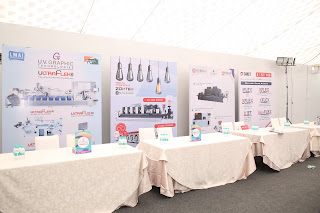
There were 38 sponsors who also had the display area for a table top for showcasing their catalogues and interacting with customers. All delegates were accommodated in two hotels, The Leela Palace and The Fairmont. The event was fully sold out.


After the lighting of lamp, Rajesh Nema, President LMAI, delivered the welcome address


This was followed by the opening presentation by Saurabh Agarwal Vice President & General Manager at Avery Dennison, South Asia who were the platinum sponsors for this largest labels’ industry event.

Saurabh Agarwal, Avery Dennison

Jade Grace, Managing Director of Labelexpo group, who are partners for LMAI along with Pradeep Saroha, Director Labelexpo India, spoke about the upcoming Labelexpo Europe at Brussels in September2023.
Manish Desai, Chairman LMAI conference committee then apprised the audience about the agenda and presenter guidelines.

Manish Desai, Conference Chairman

Ramesh Deshpande of Renu Prints Aurangabad was conferred the LMAI lifetime award
Thereafter LMAI felicitated the extensive list of 38 sponsors in a royal style titled, “Darbar-E-LMAI”.


On day2 After the welcome address by Jaideep Singh secretary LMAI, the extensive list of sponsors started to deliver their amazing knowledge-imparting presentations adhering to the conference theme, “Creativity Innovation Sustainability”.
What is most interesting is that the conference theme was dwelled at length, detailing past and envisaging future as regards to the industry imperatives for creating labels that act as marketing tool with innovations built into them but keeping in mind the need to be sustainable and for the planet to be safe for generations that follow.

Emphatic presentations were made by Vinod Vazhapulli of Jindal-SMI, Priyanka Rathi of Monotech and many others.


One of the most talked about, powerful and intense presentation came from Pawandeep Sahni Managing Director Omet India Pvt. Ltd. subsidiary of Omet Srl Italy.
To witness this presentation Click the link; https://1drv.ms/v/s!Ap6vcIHnSHydgYUKaMSlFMjP2L1wdg?e=vJhxaF
On the last day 22nd July, it started with a panel discussion moderated by author Harveer Sahni. Panelists included Ankit Gupta (Holostik), Umesh Kagade (HP), Hemantha Paruchuri (Pragati Pack), Upal Roy (Flint Group), Rajeev Chhatwal (Kwality Offset), Sajeev Sharma (Avery Dennison), Manish Kapur (Nilpeter) and Akshay Datta (Datta Press)

The presentations ended with concluding remarks by past president LMAI Vivek Kapoor. After Lunch, a special event titled “Round Table” was held whereby all sponsors were seated at a round table with seven chairs at each table, displaying their catalogues. Printers were required to visit each table to meet each sponsor and get stamped, a passport given to them. Those who visited all the sponsors qualified to participate in a random selection process to get three winners of the visitors to the round table.

Later part of the evening after a presentation by Dari De Meoof Bobst and Manish Kapur of Nilpeter, Celebrity actor and motivational speaker Boman Irani came on stage to keep the audience spellbound for over an hour.
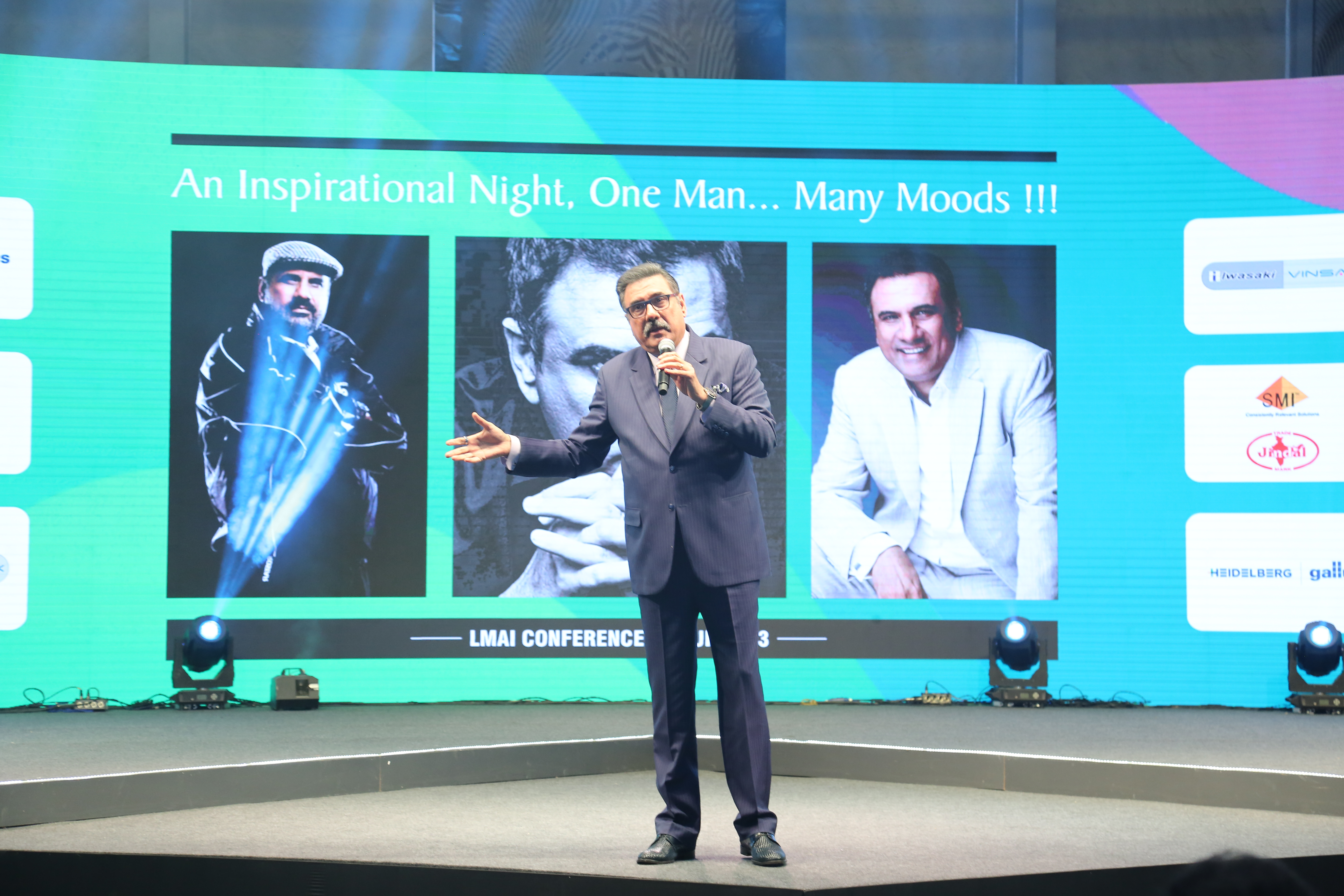

He summed up his lecture with an amazing delivery of a Frank Sinatra song, the audience was ecstatic, gave a standing ovation, cheered, applauded and exhibited appreciation. To hear his full song please click the link https://1drv.ms/v/s!Ap6vcIHnSHydgYUypk16kGTBPDPf6w?e=BTstKX
Gala Evening:
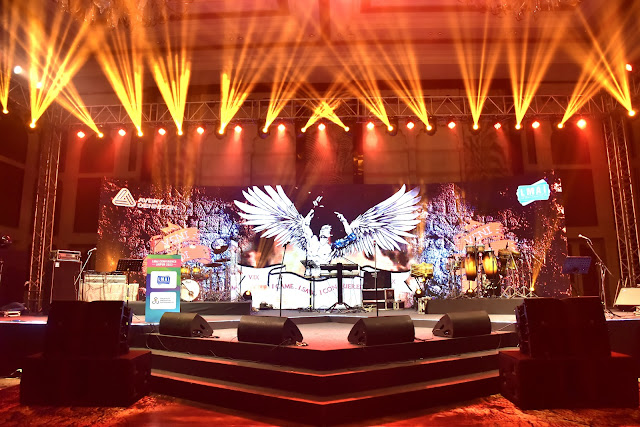

The last part of the conference was an entertaining Gala Evening and had been set up as Roman theme “Veni Vedi Vici”
Formally dressed Board of Directors with KD Sahni in picture

They later adorned the Roman look and made a grand entry.
The Roman attired Board!

After a vote of thanks by past President Sandeep Zaveri, the bar was thrown open, networking commenced, and the celebrity “Kakkar sisters, Sukriti-Prakriti” came on stage and the dance floor was rocking! The party went on till late in the night, participants to the event vowing to meet again at another LMAI event.
Wonderful Images from the event!


The next morning after breakfast, it was time to say goodbyes, and promise to meet again at another industry event soon, taking back wonderful memories of the three days with the virtual who is who of the Indian Labels industry and the number of global suppliers who supported the event at this property, The Leela Palace, portraying the great heritage of Rajasthan. The hotel management displayed good hospitality.

My coverage of the event would be incomplete if I do not mention the excellent job done by the event organizer Mercury Integrated team lead by the beautiful Hemal Solanki Bhagwat, who even in the most stressful situation was always managing to keep smiling! The author had the pleasure of clicking a wonderful picture with her.
Written and compiled by Harveer Sahni Chairman Weldon Celloplast Limited, New Delhi-110008 July 2023

The author is indebted to respondents who provided some important inputs for this article. They include Ajay Rao Rane of Domino, Shayyakk Mukherjee of Konica Minolta, Vikram Saxena of Xeikon, Jimit Mittal of Monotech, Venkatesh Selveraj representing Durst and Appadurai of HP.

Unlike the sudden spurt in growth of self-adhesive label industry that we witnessed in China some years back, Label printers in India have moved on steadily and cautiously. We are now considered to be either already a bigger population than China or about to surpass them in numbers, yet in times of growing demand of label and packaging, our label industry continues to exhibit resilience and achieve a steady double-digit growth.
Our printers have adopted the evolution of printing technologies with varying degrees of indulgence based on their customers’ need and wish to deliver creativity and innovation. Indian label printers moved on to adopt evolution as it occurred, from flatbed label printing to semi-rotary intermittent letterpress, flexo, digital flexo and combination printing with flexo, screen, gravure, etc. all in-line. However, when it came to digital label printing, the industry treaded this path-breaking technology with extreme caution and calculated steps. In January 2018, an article in Labels and Labeling mentioned that in around 2008 the first HP Indigo press was installed in China and by 2018 the number had swelled to 180 and thereafter registering almost 40 new installations, small and big, every year. While in India the first HP Indigo press was also installed at Janus International in 2008, the same time as in China, yet by 2023 the total high-end digital label presses are around 40-45 but with all small and big included this figure may have reached 60-65.
The author interacted with leading digital label press manufacturers to ascertain a percentage of growth of their installations, it was not possible arrive at a concrete number. This is so, because the base numbers are so small that the percentage growth rate may become misleading. Take for example; if a manufacturer has only two prior installations and just one in the current year, then it means a fifty percent growth in numbers. For sure it will not convey the actual scenario. The statement made by HP Indigo country manager Appadurai sounds more relevant. He says, “We have seen a Triple Digit CAGR in the Linear meters of Jobs printed with customers in India . This is the most important metric of our business.

We expect not only to sustain this growth but to scale it even further.” Appadurai’s statement does reflect a realistic look at the growth of digitally printed labels. However, to arrive at a realistic figure that will indicate the growth in the installed base of digital label presses, we need to dwell on the number of installations, which grew from 22 in 2017 to 60-65 in 2023. With these figures in hand, one can calculate that the CAGR rate to be 19%. Vikram Saxena of Xeikon, who mentioned the growth of installations to be 18-20% was the nearest to the figure that the author has arrived at. While at the higher end HP continues to lead in the number of installations and in the volume of investments, Monotech excels in the over all number of installations mainly due to the price advantage. Those entering the digital arena are looking for affordable equipment to start with and later upgrade. At the current rate of growth, we can expect 12 to 15 installations per year, it includes the big ones and the affordable ones.

“I believe the future of label printing is firmly in the realm of digital printing” says Shayakk Mukherjee of Konica Minolta commenting on future of digital label printing in India. The market of digital label printing, after the initial holding off until market matures, has been looking up and rapidly growing as more and more established label companies have invested in the technology that accords the ability to produce high-quality, cost-effective, and customizable labels in shorter runs. The growth of ecommerce has acted more like a catalyst for increased demand for personalized and customized labels at short notice.
Increasing focus in India towards the young population, with encouragement from Government, a whole community of startups is emerging giving a definite fillip to creation of jobs and innovating with new products that will appeal to their own generation-next. The startups need to have labels and packaging in smaller quantities in the initial stages of their journey into manufacturing. All respondents have mentioned the key advantages of digital label printing and its ability to enable shorter runs and faster turnaround times. The vision at HP is quite expansive, they state that digital label printing besides just labels is also increasingly being used for packaging. Appadurai adds, “The trend in the label printing industry is the increasing focus on sustainability, with many companies seeking to reduce waste and environmental impact. Digital printing technology can help in this regard by reducing the need for excess inventory and minimizing material waste.” Corroborating the view Ajay Rao Rane of Domino Printech says, “Labels and Packaging converters are engaging and trying to understand the benefits they would achieve through digital printing and taking a well-informed decision about investing in the latest technology.”

Most contemporary or emerging technologies initially face a lot of hesitation by investors but once they are able to establish their fruitful deliverance, they do find people who will adopt them, though the cost of end product so manufactured does play a definitive role in decision making. Labels too have faced a similar situation. The convenience of digital printing was an awe-inspiring development, triggering wish of ownership, but the cost of labels as compared to those produced by analogue process was, and still is, a deterrent.
With time the convenience of producing from computer to print without the need of extensive pre-press, plate making and long setup time, attracted many a printer’s attention. Coupled with the ability to produce customized and personalized labels with variable data many jobs became a necessity to be produced on digital label presses. Now when rapid growth in the number of installations there is some ease of pressure on input costs but still it is much more than those printed by flexo presses. According to Jimit Mittal at Monotech, with the increase in number of digital equipment, the cost of logistics and consumables can be optimised to a certain level. Digital is no longer just for short runs but can also satisfy medium runs cost-effectively delivering value addition to any customer workflow more than the run lengths only. The HP team agrees that the gap in cost of printing on flexo and digital will narrow with an increase in numbers while the thought process at Domino is that the cost comparison between digital and flexo printing will vary depending on the specific job requirements and should be evaluated on a case-by-case basis. Venkatesh Selveraj states, “In Durst digital solution the production cost gap is already narrowed down.” The gap in cost for both flexo and digital is substantial. Vikram Saxena at Xeikon sums it as, “This question is an irrelevant question. Both are not competitors but complimentary technologies.” Increasing print length does not mean that the job will become cost effective on digital on the contrary shorter runs are better. This is so because in flexo the prepress, plate cost make-ready and setup adds up on a small size of the job.
Most of the respondents in response to the author’s questions have expressed that digital label printing is now not limited to short runs. There are companies like Trigon Digital, Leap Digiprints, Digistick, etc. who are only committed to digital printing and have plans to stay invested in the same technology and expand in it. When asked if in future digital will replace analogue or flexo or Hybrid the general opinion was that there does not appear to be such a possibility in the near future, but in fact the two will be complimentary technologies to each other.

In the western countries, more digital presses have started being sold than conventional ones. But this may be because of a smaller base of installed digital label presses in comparison to conventional ones and the pressing need of printers to expand their capabilities and cater to needs of customized, personalized or variable printed labels. Most successful label companies will have these two technologies in their companies together.

The growth of digital printing gets enhanced when the equipment manufacturers promote their products. The standard procedure followed is to display their products at industry exhibitions. Labelexpo and other printing shows have been seeing an increased presence of digital printing equipment manufacturers in recent times. Being a technology that is still evolving, there is a lot to be learnt by the printing fraternity. The first knowledge about digital printing comes when new prospects visit the exhibitors stands at the printing shows, but the more detailed information comes when sales and technical professionals make presentations to printers at their own offices followed by showcasing existing installed running presses at other printing companies.
Unlike other printing technologies like flexo, offset, screen and gravure, there are many variants in technology as to how digital printing is done. The diverse types of technologies available leave the printers in confusion as to what is the most appropriate technology in which they should invest. Available technologies offered by various manufacturers of digital equipment are as follows;
Dry toner based.
Liquid toner based.
UV Inkjet
Water-based inkjet
Exhibitions, direct mail and personal reach-out to educate prospective customers about their equipment, remains the most preferred marketing process for digital label press manufacturer. However, the modus operandi by Domino and HP is stated to be a little different. Ajay Rao Rane of Domino states, “We also engage with the brand owners to evangelize the benefits of Digital printing to them.” HP goes a step ahead and Appadurai at HP sums it up, “We invest a lot into educating brand owners about the benefits of digital printing, we always look for creating more opportunities for our PSPs, apart from working with large brands in creating campaigns like share a Coke, Kit-Kat valentine pack, Dettol covid warrior pack, we also work extensively with many association of food & beverages, pharma, personal care to educate the brands associated with them on the benefits of digital printing, which saves them lot of cost, (better cashflow), faster time to market, while also helping them to use more sustainable printed packages.
The future of digital printing is growth oriented, and it will keep evolving as all electronic, IT based, or AI based products keep changing constantly. But then as it is said, “Change is the only constant!” As a matter of fact, the changes come so fast that the winners will be those who adapt to this change quickly to offer innovative products ahead of others.
Written by Harveer Sahni Chairman, Weldon Celloplast Limited New Delhi May 2023
