Nostalgia is an important trait of human existence. We have memories good and bad but if we live only the nightmares, life will not be worth living, essentially; we need to put the not so happy past, behind us and move on. On the other hand if we get nostalgic and sentimentally reminisce a part of the past that brings back smiles to us, remember the pleasurable moments that gave solace and whereby we made happy associations that have left yearning and longing for the time gone by; life becomes so much more meaningful. Evolution and nostalgia are inseparable. Imagine a time when we did not have cars, planes and other modern modes of transport. I can remember my father with a strange smile on his face talking about the early days of his business. Those were the days when he started his career in the 1930s; he peddled his stationery articles in retail markets on a cycle. Even though he bought his first car in 1947, yet the thought of times when he used his cycle, brought a look of satisfaction and euphoria on his being. I remember somewhere in the 1950s we got our first telephone. Before that when our father left for work each morning we knew we would see him or talk to him only in the evening without any communication in between. With evolution we have reached a pinnacle of connectivity, every member of the house has mobile phones and we can see and talk to the person in real time all across the globe. Now it is difficult to imagine a day without wives calling every two hours to check on you and ask, “Where are you?” Even though when through activated location services she can see where her husband is. When we got our first black and white TV in the 1960s there was only one TV channel broadcasting two hours in the evening. Neighbors used to come over and sit to watch the TV with us. It was like a mela (a village fair) each evening. Now with evolution of television which is history in itself, we see our neighbors maybe once in six months. Label printing in this country has also evolved from a very nascent stage in the 1970s to what it is now. I feel extremely nostalgic about this evolution that has taken place and continues to progress at a rapid pace, this so because I have grown and lived with it for most of these years in evolution of label printing. People who have contributed to the industry in the early years and have set the foundation of the industry have been very close to me and have shared their individual experience in the industry with me over the years. I personally believe chronicling the events that lead the industry to reach where it is today is a service that the industry at large will be appreciative in time to come. The generations that follow will have something to refer to when they wish to learn and take inspiration from the past. It is for this reason that I wrote my article, “History of Indian Label Industry” eight years ago in August 2006. For a long time now I have wanted to update the article but the exercise is arduous and calls for indulgence in time and money because of the industry having spread over the length and breadth of this country. When my elder son Pawan asked me to write this article on the “Ten most defining moments of Indian Label Industry” I agreed for various reasons like, it links me to my passion of writing about labels, it will be an extension of my article on the history and it will further trigger the mindsets to take evolution in this industry to another level.
My efforts to collate the events and defining moments has been possible with support from industry veterans like Bharat Mehta of Super Labels, Kamlesh Shah of Letragraphix, Sudhir Samant, Rajesh Nema, Manish Desai, Kusum Dunglay of Reydun, …. I appreciate their inputs and thank them for this. I have listed the ten most defining moments of the Indian label industry below.


1. For the label industry what more defining time than the time when the industry was actually initiated and came into existence. The credit of bringing self adhesive labels, in their present form, to India goes to a US multi-national, Johnson & Johnson. It was around 1965 that they entered into the manufacture of self adhesive labels. They installed a rotary label press. They sold only converted labels and did not offer any labelstock to others in the market.  The first self adhesive label produced by an Indian printer also started around the same time in 1965, almost thirty years after Stanton Avery produced the first self adhesive label in Los Angeles, California. Manohar Lal Bhatia, a screen printer, producing water transfers in his company, Sharat Industries, did pioneering work and produced what was the first self adhesive sticker in India. Using a PVC face stock with pressure sensitive adhesive supplied by Calico and a Polyethylene sheet as a release liner they manufactured their stickers. The reason they did not use paper as face material is that silicon release liners were not available and Polyethylene provided for a very tight release due to which the paper would tear off.  Thereafter these stickers became the forte of many screen printers. It was in the beginning of the 1970s that Shanti Lal Doshi & Co. started to produce self adhesive labelstocks in Mumbai. 1972-193 was a landmark year that lead to birth of the self adhesive labels made by Indians, in roll form. It was at this time Jeetubhai Shah in Mumbai imported a flatbed Iwasaki label press to produce self adhesive labels. In the second half of 1970s Super labels, Pressure Tags and R K Papers had started to produce self adhesive labels at Mumbai, Better labels in south while Liddles and Rikki Sales in New Delhi.
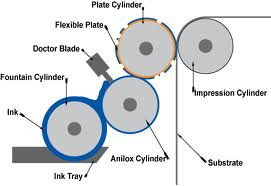


2. The initial growth of labels came from flatbed label presses followed by the semi rotary letterpress and then on to intermittent rotary letterpress. This intermittent letterpress printing technology that was and still is, in use, came from the eastern countries like Japan, Taiwan and then China. The shift from letterpress to flexo started in the 1990s. Though in 1983 Liddles in New Delhi had acquired a used Mark Andy press but it was in 1993 that Patel Printing Press in Ahmedabad bought a new Mark Andy Label Press. Around the same time Super Labels at Mumbai installed an Aquaflex. This shift from letterpress to flexo was indeed a very important and defining moment for the Indian label industry. As flexo printing came to India, with it in the mid 1990s Dupont introduced their photo polymer plates in India. At that time it was in the form of analog plates for conventional flexo printing. In 2002 Numex Blocks, Mumbai bought the 1st CDI (Cyrel* Digital Imager) in India and thus DuPont introduces digital plates in India, which brought revolution in high quality flexo printing in India.  Eventually with installations of ESKO CDI Digital imagers with the workflow (Software), India moved from conventional Flexo to Digital Flexo (Standard resolution) These exciting happenings brought the quality levels of label printing in India to the next level, matching Gravure and Offset quality.


3. With introduction of full rotary flexo presses in the 1990s the label stock consumption in India picked up pace and with that also started the setting up of coating and lamination plants all across India in Mumbai, Ahmedabad, Delhi and Chennai. Labelstock production technologies also started evolving.  It was during this period that the ordinary sticker started to become an engineered product called self adhesive label. At this moment I would like to quote Kamlesh Shah of Letragrafix, he says “Meanings of both the above words are different. Stickers” are used for publicity purpose whereas Self-Adhesive Labels are being used on products (Containers, Bags, Bottles, Information, etc.). One would not necessarily get repeat orders for stickers but will definitely get repeat orders for Self-Adhesive Labels”
The labelstock consists primarily of three components, the release paper, the adhesive and the face paper. As label dispensing technologies found automation in packaging plants across the nation, exacting demands were being made on the quality of labelstocks being produced. Silicone coating chemistries changed from the solvented tin catalyst system to solvented platinum catalyst systems to finally settle down with now largely used solvent free platinum catalyst silicone coating. This provided consistent and reproducible release levels required for faster converting and dispensing needs. A market that was passionate about using only glassine liners has evolved now to use different base papers like CCK, SCK, Polycoated, Polyester, etc.  At this time the adhesives also found a lot of shifting first from solvented to hotmelts and now to largely emulsion adhesives. Variants like permanent adhesives, high temperature adhesives and removable also started to be offered. A market that was predominantly limited to Semi-Gloss or Chromo Art paper and Woodfree or Maplitho paper, transformed into using face stocks like, high gloss paper, BOPP, PE, PET, etc. Such changes in the Indian label scenario brought India in the focus on the international stage. At this time in 1996-97 the world’s largest labelstock producer Avery Dennison moved into India by setting up manufacturing facility in Gurgaon in North India. This was followed up by Raflatac setting up slitting facilities in India. This entry of multinationals into India was indeed a very defining moment that changed the way labels and labelstocks would be sold in the country.
 
4. The Indian label printers are unanimous about one change that defined its future till date. All the leading printing companies who I approached for their inputs came back so strongly to reaffirm that this was the most defining moment that I felt like researching more on this and writing in detail about it. However due to the space constraint I will just present here some of the comments of various printers who responded. Now the defining moment! “The switch over to UV Flexo”.
 
The comments; 

Bharat Mehta of Super Labels: “It was a game changing time and Super Labels was the first in India to install an all UV label press Gallus EM280 in 1997” This was reconfirmed by industry veteran Sudhir Samant.
Kamlesh Shah of Letragraphix: “U.V. Printing is a “Must” in all printing Methods!”
Rajesh Nema of Pragati Global: “I went from sheet fed offset to full rotary water based flexo. In 1996, I started with water based flexo and the learning curve was too big. The color matching of each job (even when it was a repeat) was a big problem because of the ever changing viscosity of the ink in the shelf & in the pan (while running on the press). Changing temperatures did also affect the print quality hence there was a lot of changes. Around 1999 I heard of full UV flexo and studied the press as also availability of inks. I could sense that UV Flexo would change the flexo printing scenario at one go and this is what happened. Although the ink costs were prohibitive and availability was a big question mark, I decided to go in for this technology. The learning curve was extremely small and from day one, my operators could operate the machine, handle the inks without any difficulty whatsoever. Gone are the days of measuring ink viscosity, ink pH, color variation, setting time (to get the exact color), and the wastage stands reduced. Because of higher strength of UV inks vis-a-vis water based inks, I could use higher line count aniloxes which enabled me to go to higher plate screen line count, finer print and reduced ink consumption (and higher speed too). Although the overall power consumption is higher in comparison to water based inks (this also is being taken care of by new UV technology), other advantages are far more than higher energy costs and more than compensates the higher energy costs. Any company moving from offset/letterpress to flexo is well advised to straight away move to UV flexo to get the grip in shortest possible time.”
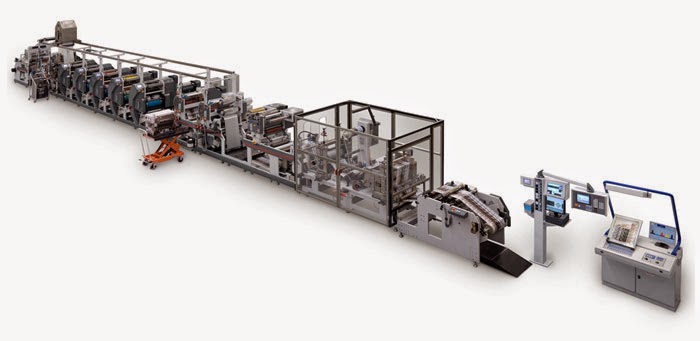

5. Like “makeup” is an important part of a woman’s finishing touches to her appearance before she presents herself in front of an important audience, "finishing" as we term it in label converting, is a very essential part of creating a label that will attract the all important attention of a consumer. A label needs to be decorated before it actually becomes the engineered product that will become the inevitable sales tool for any product. It needs to have the right makeup on its face. To decorate it so we need more than just printing in flexo; a higher ink deposition of a particular ink, a shining gold/silver on it, an embossing that will catch the eye, a metal effect, a gloss and so on. India’s young and literate middle class is turning out a young middle class that is more demanding in value from the consumer products in modern day retail. Label printers wanting to deliver a product need to equip themselves with capabilities to dress up labels appropriately and for this, different print technologies need to be incorporated. An offset printer who is used to moving piles of paper from machine to machine in large factories may be able to do it but the effort is too cumbersome and in the end the labels will be in sheets and not in rolls. A narrow web label printer who is used to converting self adhesive labels into labels in a single pass would need to do this online in one go. Combination printing presses now provide the answer. Introduction and installation of the first combination presses in the first half of the new millennium, the decade of 2000, is another defining moment in the Indian label industry. Wintek in South India was one of the first to install a press with a combination of flexo and screen printing, Goodwork Company in New Delhi with letterpress and screen and Veekay Graphics in Mumbai with a combination of flexo and offset pioneered this change. The combination technology has continued to evolve and culminated with Pragatipack in Hyderabad opting for flexo with gravure, Zircon following it up similarly and then to top it all it is Renault Paper, part of Manohar Packaging group, who have installed a press with capabilities to print flexo, offset, screen and gravure along with foiling and embossing capabilities! The advent of combination presses being installed is another defining moment.
6. As the label industry started to evolve and printers aspired to meet global standards in quality, there was need to look around for machines and equipment that will help them print quality that would excel. Some printers would travel to Labelexpo in Singapore or to the main show in Brussels to see the machines displayed and evaluate where to invest. The smaller printers could not afford the exercise. As the last millennium was coming to an end, the need to have a label show in India was being felt. At the same time there appeared an imperative need for an industry association.  In 2002 Amit Sheth of Label Planet in Mumbai took the initiative and gathered a few printers in Mumbai and announced the formation of Label Manufacturers Association of India. The very same year Anil Arora organized the first label show in India, “The India Label Show” at Nehru Centre Mumbai. I am proud of my association and support I gave to Anil for making this show a huge success. I also managed to get Andy Thomas Group Managing Editor Labels and Labeling and another colleague from Labelexpo group part of the holding company Tarsus UK to visit the show.

It is history there after that by the time India Label Show reached its third edition it had been taken over by Tarsus and two years later it was renamed Labelexpo India. Nowadays exhibitions have become an important part of label industry in terms of technology up gradation and networking opportunities that they accord. The success of LMAI conferences in GOA have proved that the label printers look forward to such opportunities. The formation of LMAI and launch of India Label show (renamed Labelexpo India) was another defining moment.
7. As flexo and other Label printing processes continued to find up gradation in technologies around the world, printers in India also were looking out for adopting such changes that would make them globally comparable in quality. Like the defining moment when UV Flexo came in, similarly changes in machine design by international label press suppliers came to be noticed to become unique defining moments. Set up time for a job in a regular label press would waste at least 100 running meters of labelstock. Press manufacturers innovated to produce presses with short web path and chill drums and then further innovations brought in automatic registration control. These changes not only reduced material wastage to single digit but also reduced manual intervention in register control decreasing dependence on operators. Operators are already a commodity that is becoming difficult to source in times of increasing label press population. Similarly gear, marks wearing shafts, difficult changeover times tension controls were a consistent cause for worry for the quality conscious label printers. Servo motor technology changed life for printers as these are welcome changes.
8. As mentioned in the beginning of this article, a multinational Johnson and Johnson initiated label production in this country. Thereafter the Indian indulgence started at a very basic stage in screen printing, evolving and progressing into flat bed letterpress and then on to flexo and combination printing. Printers grew in size and stature as the economy and population grew. With the world’s eye on this huge growing young workforce creating a mind boggling marketplace for retail in consumer and industrial products, the multinational large players in label world turned their attention towards India. We are coming to a full circle. While many small deals brought in some international players like Brady’s-USA, Reynders-Belgium, Nordvalls-Sweden, Printcare-Srilanka, etc to India it was in 2012 that controlling stake in India’s largest label printing company Interlabels was acquired by European label company Skanem. This was indeed a defining moment that changed the way the larger Indian label companies would move ahead. This acquisition was followed up by ITW acquiring Wintek in Bangalore, Positive packaging acquiring SGRE in Bangalore and Huhtamaki acquiring Webtech in Mumbai. One goes on hearing rumors of other foreign companies on prowl but another positive sign is that Indian label companies have also dared to venture out. Ajanta Packaging has set up units in Daman, Baddi, UAE & Thailand. I would not be surprised if his next step is Europe! Syndicate labels, Prakash Labels and Stallion are some of the other label printers who have offshore manufacturing in UAE besides India.

9. A growing market registering double digit growth consistently for many years is always susceptible to investment beyond its natural growth. When such happens, it creates capacity higher than the demand which in turn results in intense competition. Even though the market is there and volumes are there yet margins come under pressure making ROI (return on Investment) a difficult proposition. Even when one continues to see expansions and investments in new equipment yet printers are found complaining of difficult times. At such time there is always a need felt for innovation and indulgence in new technologies. The need became an imperative in the middle of first decade of the new millennium. Somewhere around 2003-2008 printers began to actively indulge and experiment in innovation. One such initiative that has impacted my mind is a butterfly promotional label in film pioneered by the late Kartar Singh Dunglay at Goodwork Company. These were defining times when printers broke away from the custom stickers turned into labels and moved on to produce booklet label, multilayer labels, Security labels, customized promotional labels, etc. This change brought the much needed margins to the indulgent printers who dared to innovate. Evolving further printers are today buying presses with additional capabilities so as to produce unique and innovatively converted label products.

10. Printing Technologies in label printing have undergone a sea change from the time of inception. For the last two decades we have seen most of the development in flexographic printing. It surely remains the predominantly used label printing technology today. With continuous enhancement in plate technology, aniloxes, machine design, etc. this technology has become comparable to the best today. At this time one cannot ignore the entry of Digital printing and converting. Year after year at print shows around the world we see and ever increasing presence of digital printing technologies and equipments. While the digital seems to have impacted and succeeded in the sheet fed segment, it still has not found widespread acceptance in the label printing. Looking at the technology from computer to print without the plates, aniloxes, doctor blades, etc., pared with digital laser die cutting without the needs for magnetic cylinders and dies, it all looks and sounds so interesting. However the forbidding price structure for short runs in roll form, the cost of equipment, inks, etc indicates that the technology will need to evolve further and it will. The convenience in application hints that the time when this printing technology will find widespread usage in labels may not be too far. Pioneering efforts of label printers like Janus and Webtech in Mumbai and Reydun in Delhi, who acquired digital label presses, will go down in history as a defining moment.
The label industry in India has still a long way to go, as consumerism is on the rise and retail selling gains in significance; label usage is set to rise steadily. The per capita usage in India is still a fraction of what it is in Europe or USA. For a large population base a small increase in the per capita usage will amount to a huge amount in numbers. As volumes grow the waste generated by this industry is also going to grow manifold. It is an industry in which almost 50% of the product ends up in landfills. We have a gigantic problem at hand and need to address this problem is an imperative. Government legislations when they come will make life difficult for the industry. It is better that the industry leaders both users and converters of labels as also the users, apply their mind on this problem. At present we are just reading and watching what is happening in the western world. The local industry associations and other forums need to debate on it and find innovative solutions for the self adhesive label industry. If they do find solutions on this front, it will be the next most defining moment that will deliver a better environment for generations that follow.

Written by Harveer Sahni Managing Director Weldon Celloplast Limited, New Delhi October 2014 and was first published by Printweek India Vol VII Issue 7
 Helmut Schreiner who has seen life from being a destitute in the era, post world war II to the time when his father started his label factory in their 45 square foot garage, went on to eventually retire as Managing Director/CEO from that same company that he transformed into “The Schreiner Group” with a sales turnover of over 130 million Euros in 2012. Helmut Schreiner is now 75 years old and believes in the capabilities of the next generation. In September 2012, he handed over the reigns of the Schreiner Group to his only son 43 year old son Roland. Helmut, after 55 years of service to the family-owned company — with 38 of them in the role of managing director/CEO – is now serving on the advisory board. In may 2013 I wrote in detail about Helmut and his life in this blog and can be read at http://harveersahni.blogspot.in/2013/05/helmut-schreiner-adversity-to.html
 
He is now devoting a substantial part of his time to social activities and charities. He lives his philosophy, to be honest and true to himself. In retirements he is rediscovering himself and his inner passions by also devoting time to his passion for poetry. In July this year he sent to me a translation of his poetic expressions relating to Autumn. I found it an extremely pleasurable expression of time being spent in retirement. So I decided to share with the print fraternity, it is available at http://harveersahni.blogspot.in/2014/07/helmut-schreiner-from-labels-to-poetry.html , 
 
As the season begins to change and festivities approach, Helmut felt it is time to make yet another poetic expression. He wrote another poem expressing himself beautifully, He sent the poem to me and his communication says,, "While currently enjoying the autumn we approach wintertime and, with this, the turn of the year. The question, what will be changed and what will this mean to me I dealt with my new poem – as well as the question how we will celebrate the upcoming festivities." 

I reproduce the poem for my readers;


The winds of autumn chase the days,
Nature shows change in myriad ways.
As fog subdues my pondering mind
I muse what time will bring, will it be kind?
 
I could of course just wait and see
With guarded hope or cheerfully
What will be budding in myfield
Will flowers or green cabbage be my yield?
 
I start to sow the things to be,
Fill visions with my energy.
Change will invigorate my heart and soul
Fulfill my wish, achieve my goal.
 
Sowing as well as cultivation
Can both be joyful, bring elation.
Acting with purpose is divine
Even turns water into wine.
 
While we may celebrate in diverse ways
Tradition-bound or in the style of modern days
Our workings are the things that count
The star we choose to reach the mount.
 
Helmut Schreiner

The above can be reproduced by giving credit to presenter Harveer Sahni, Managing Director Weldon Celloplast Limited. November 2014
 
 
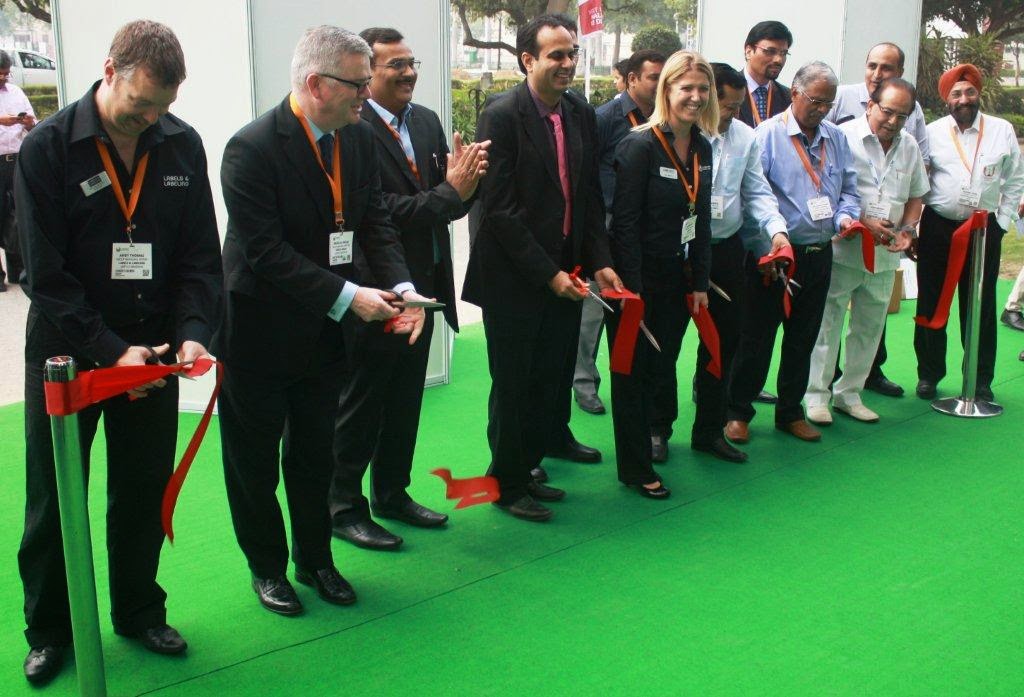
Inauguration of Labelexpo India 2014
The seventh edition of Labelexpo India opened in New Delhi on the 29th of October 2014 and ended on 1st November 2014. It is the most important show for the label industry in India and is attended by all leading label manufacturers in the country. India’s only label association LMAI (Label Manufacturers of India) is a supporter and sponsor for this important event which continues to gain prominence in the Indian subcontinent. As per the information received from Tarsus, the show grew in space by 10% with 176 exhibitors though number of exhibitors was down from 200 at last event yet the space grew due to bigger and better stands. The number of visitors was almost same, in fact marginally less at 7927 as compared to 8037 at the last show in 2012 due to timing of the event explained later in this post. However the show gains importance from the fact that international awareness has increased with visitors coming from 54 countries! Detailed analysis of the visitors this time has put forwarded some very interesting facts. The most important being the quality of visitors has improved, bringing in an extremely focused lot of printers spelling value for the exhibitors. Also the number of visitors who came to the show for more than one day has increased by a whopping 42%.  It shows that that show has been successful in getting an extremely focused clientele. It was a good show!
 
Most of the renowned international narrow web press manufacturers with the exception of Gallus
were present, however still the number of European flexo label presses displayed at the show was down to just Omet, Nilpeter and Rotatek. 


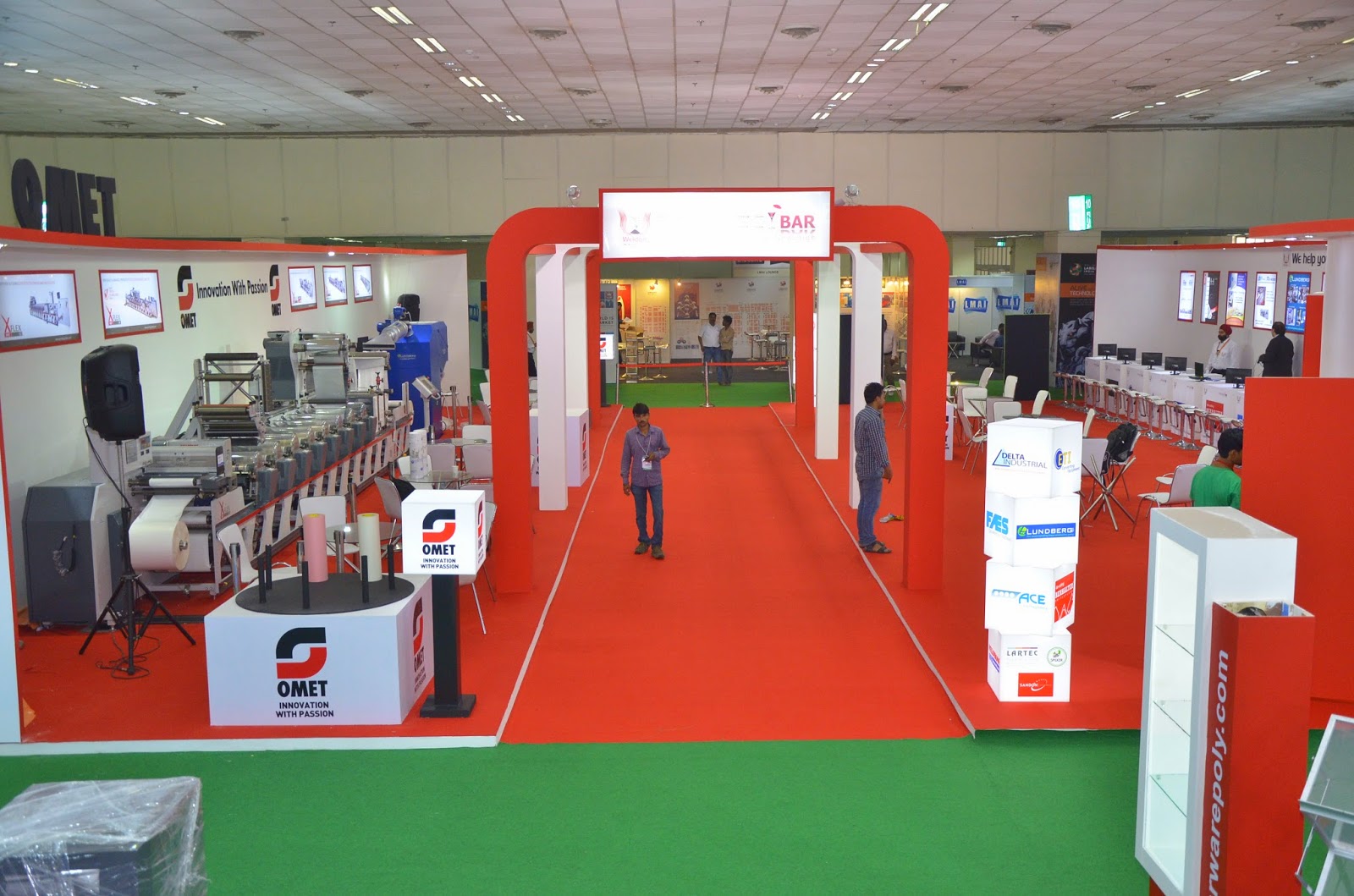
 Weldon-Omet stand labled as Technology Bar


 The Nilpeter Stand


Multitec Stand
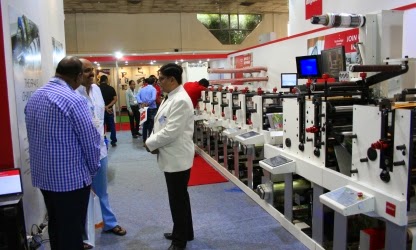
Surprisingly the Indian Label press manufacturers made an impressive presentation with Multitec leading the way with display of three presses including one that was a full servo and full UV flexo. Other prominent Indian press manufacturers at the show were Alliance, Webtech, R K Label machines and Jandu.


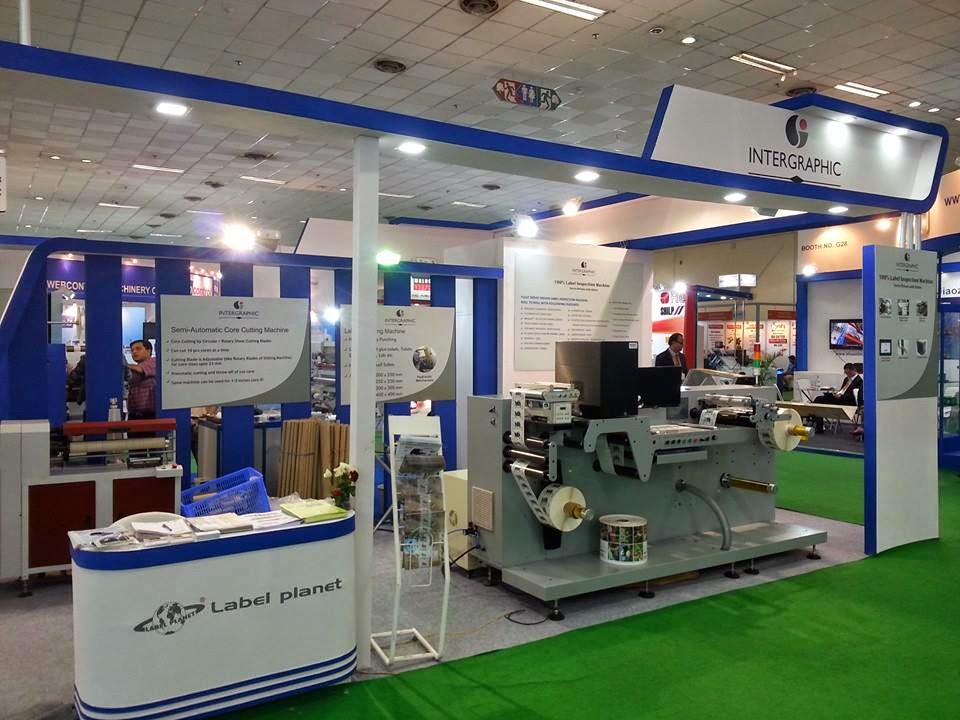
Label Planet


The Amit Sheth lead Label Planet group of companies also put up an interesting bouquet of offeringsfrom label presses, slitter rewinders to other allied equipment.


The Esko-Dupont stand displayed the possibilities of supporting printers bring out qualities comparable to Offset. The samples printed at Zircon left all in awe especially for the metallic effects brought about without use of any metallic inks. While international die and tooling manufacturers like Rotometrics, Lartec, Kocher & Beck, etc. were present yet it was interesting to note that Indian magnetic cylinder manufacturer Precise Graphics and flexible die manufacturer Diehard dies also displayed yet again. Vinsak, Kumar Labels and Precise also displayed their slitter rewinders.
 
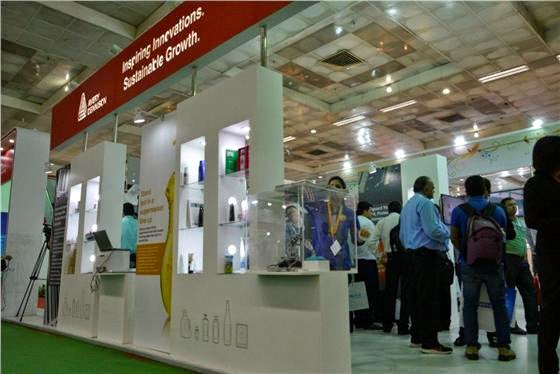
Avery Dennison Stand


While international labelstock producers Avery Dennison and UPM Raflatac were at the show, Indian manufacturers SMI, Weldon Celloplast, Shree Arihant and SticOn Papers also had a smart showing.  It is difficult to write about all the exhibitors I have still tried to communicate that India surely is now presenting itself well alongwith international producers.


The time of the show as regards weather was quite appropriate as summers had come to an end, yet the dates on which the event was held were expressed as uncomfortable by many printers. Diwali, the biggest festival in India is celebrated with lot fervor just as Christmas is celebrated in Europe, USA and rest of the world. Diwali preparations begin weeks in advance. People had just two working days after Diwali festivities ended before Labelexpo India began on the 29th of October 2014. Moreover being end of the month the printers were under pressure to deliver labels to customers so that they can meet their sales targets. These reasons indicate that there may have been many printers who due to the timing were forced to miss the event or came for a very short time as they were compulsively required to be in their workplaces. This information was brought to the notice of the Tarsus leadership who has in turn assured to look into the possibility of rescheduling the next edition of the show so that it does not clash with Diwali celebrations and there is a reasonable gap for exhibitors and visitors to get settled back in business after this important festival. Another point is that exhibitors have not been happy with the quality of services provided by ITPO (India Trade Promotion Organisation) despite the excellent organizational skills of the seasoned Tarsus team. Coupled with high handedness and rigid monopolistic stand of ITPO, it is expected the show may move to another venue. It is a little premature to say at this stage. However still I will mention here it is my personal view.

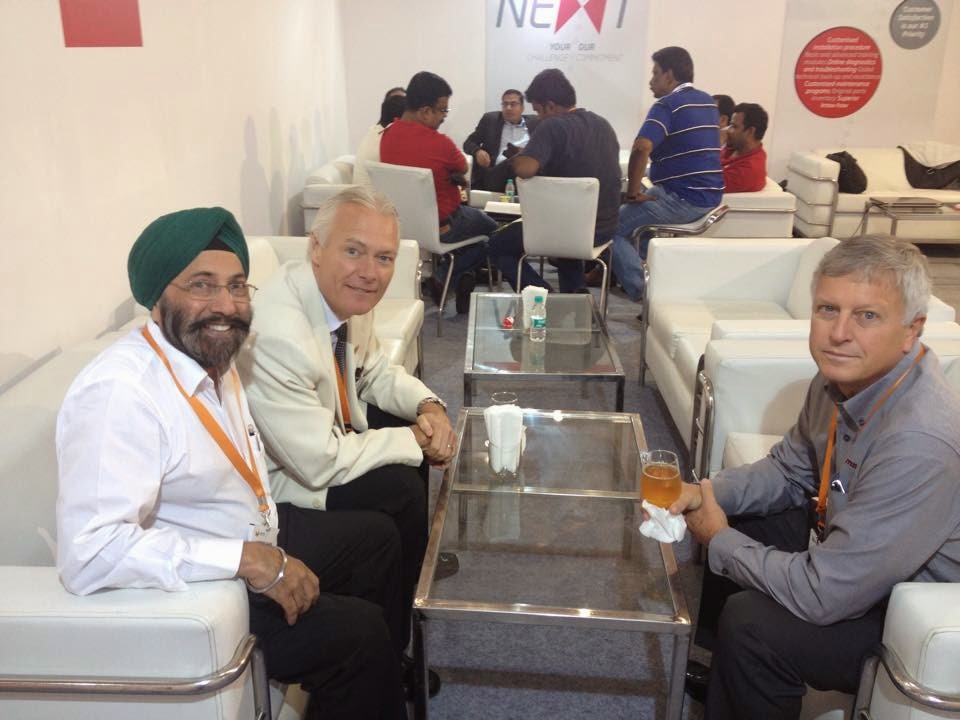
It was interesting to meet international friends and colleagues;


I had the pleasure of holding a meeting with Jakob Landberg Chairman FINAT membership committee to set targets in the Finat Membership Committee.


Another meeting at the Nilpeter stand with Jakob Landberg and Mike Russel of Mark Andy. Global friendship finds new meanings at such occasions


 On the sidelines of Labelexpo India there always has been a fun part. Many suppliers organize parties for their customers. This time there were three main parties, the one organized by Avery was the theme party for the Indian industry, the LMAI Avery Dennison Label awards evening; the second was the UPM Raflatac party and the third and very focused small party organized by Weldon Celloplast at the Weldon residence.

The LMAI Avery Dennison Awards Night:
 
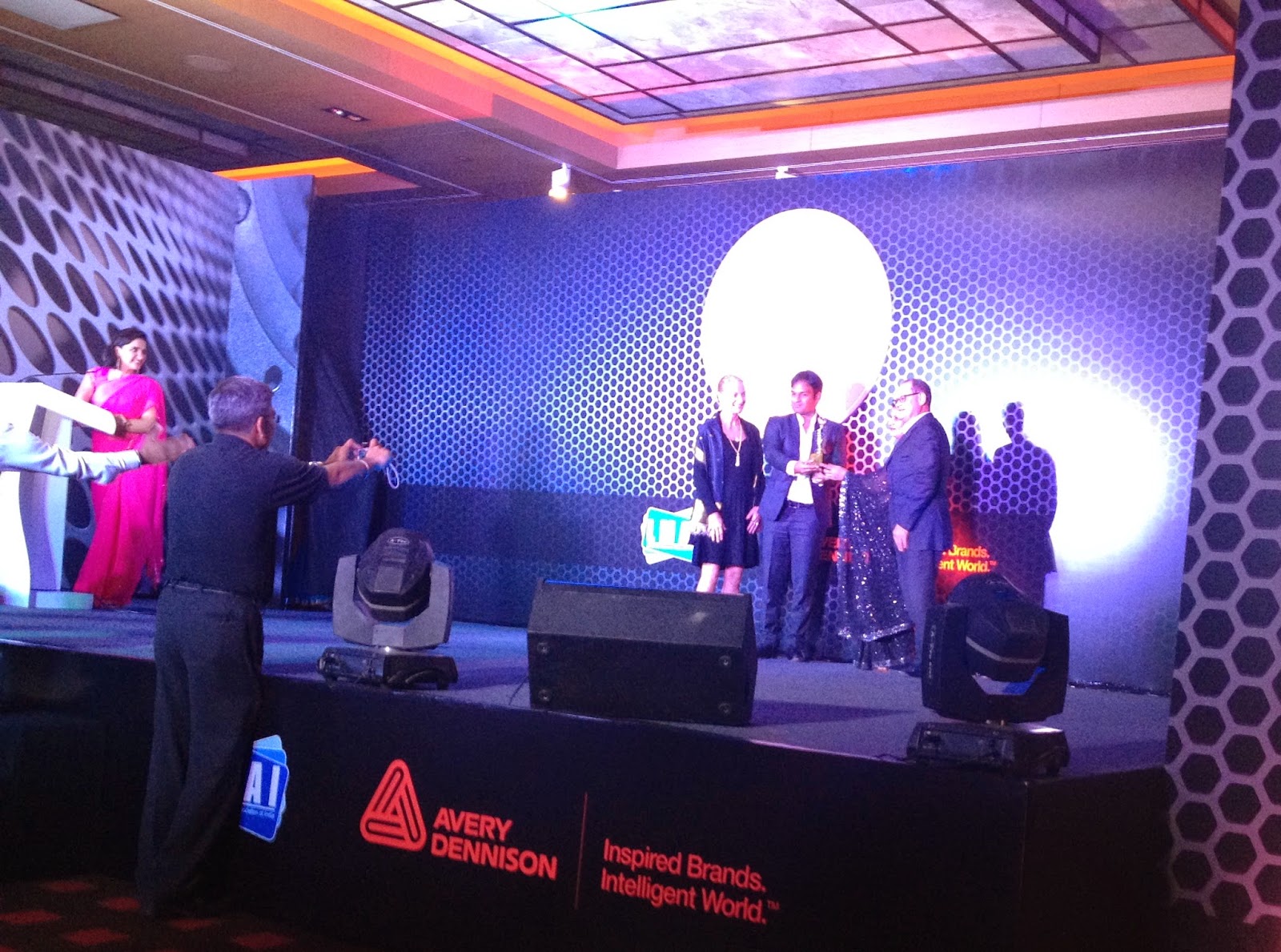
Ferdinand Ruesch of Gallus handing award to Anygraphics
 
SMI team with Wolfram(Kimoha) & Mrs. Ruesch
 
Frank Burgos FlexoGurukul shakes a leg with Pawandeep and KD Sahni


Weldon Party:
 
 
The Weldon evening was for all their participating foreign principals including Omet, ETI, Link Label, Berhalter, Martin Automatic, Lartec, FAES, Lundberg, Vetaphone, etc. There were some leading printers like Hemant Paruchuri of Pragati Pack, Chandan Khanna of Ajanta Packaging, Sanjeev Sondhi of Zircon, Mahendra Shah of Renault (Part of Manohar packaging Group), Ahmad Kavoosi of Parsian labeling Iran and Thomas Mathews from Kimoha UAE. The Tarsus team was represented by Group Managing Director Douglas Emslie, Labelexpo group Managing Director Lisa Milburn, Group Managing Editor Andy Thomas and Event Director Claire Comery. Also present was Frank Burgos the President of FlexoExchange USA and heading the FlexoGurukul training program in flexo printing.  I could not attend the UPM Raflatac party despite invitation as the date clashed with our own evening. Maybe the next time we can co-ordinate better.
Douglas Emslie Group MD Tarsus in a turban


Paolo Grasso(Omet), Frank Burgos(FlexoExchange) & KD Weldon


Chandan Khanna & Mahendra Shah of Renault with KD


Sanjeev Sondhi Zircon with Pawandeep and Kavneet Sahni


UPM Party!

Pictures from the UPM Raflatac Party;


LMAI President Vivek Kapoor!


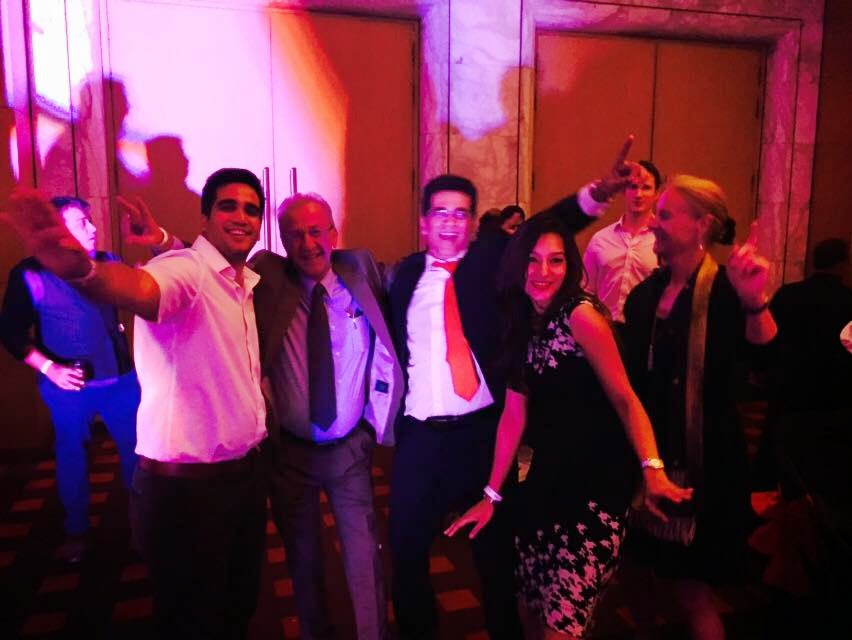
Meanwhile the biggest attraction of the Labelexpo India fun part is the LMAI awards night held at Hotel Le Meridian on the 31st of October 2014. Right from the opening day there was talk of tickets or passes for the event being in short supply. No one wanted to miss! The Tarsus team, LMAI leadership and Sponsors Avery were under pressure. Last time the pressure was seen and since it lacked control at the venue of the awards night, this year even though the controls were tight yet the demand for tickets was over bearing. This was because of a sudden growth in membership of LMAI in the last two years. The members were resenting just one ticket per member. It is also on agenda that for the next time a bigger venue maybe considered also additional tickets may be made available on sale. The evening started with speeches from LMAI president Vivek Kapoor and Lisa Milburn followed by an entertaining program and then on to the announcement of winners for the best labels. It was a great surprise to see Kuldip Goel lead Anygraphics bagging 10 out of the 20 awards followed by Rajesh Chadha lead Update Prints. Once the awards were over and the LMAI managing committee felicitated, it was time to party. The printers were all on the stage dancing with gay abandon and pulling colleagues to join them. Ferdinand Rüesch of Gallus who was a sponsor for one of categories of awards celebrated his birthday that evening and joined the dancing printers on stage along with his wife. Sometime closer to midnight I decided to go home but I am told the party went on for much more time and toward the end the charming and ever smiling Managing Director of Labelexpo Group Lisa Milburn sang on stage. Wow! I missed that… 
 
The above article is written by Harveer Singh Sahni, Managing Director, Weldon Celloplast Limited New Delhi in November 2014
This is a very large subject and a whole big book can be written on it as exhaustive information is availabel and needs to be dwelled upon. However still I have tried to reconstruct the gist of an article that I wrote in 2002 and have moderately updated it. I hope it benefits all the producers, converters and end users in Labels to understand the self adhesive materials.
 
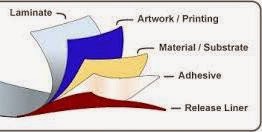
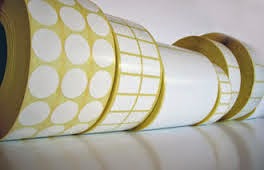
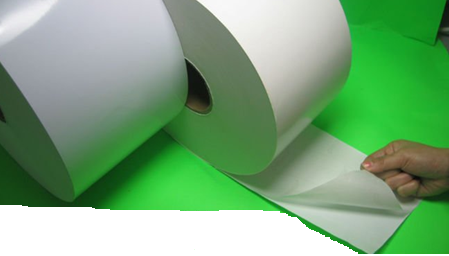
The labelstock which is the starting material for self adhesive labels consists primarily of three main components.

1. The facestock: Which can be paper, film, foil, fabric, etc.
2. The adhesive: This is anchored on to the face stock.
3. The release liner or the protective backing: This can be paper or film.

We shall discuss each of the components separately and dwell on their impact in the process of label converting. There was a time here in India, not long ago, when with just one multi-purpose coater you could cater to most of the label printers, making release liners and then coating and laminating with adhesives on the same equipment. Alternatively silicone liners were outsourced but intense competition made in house siliconising an imperative. Though this may still hold good for many a labelstock manufacturer, yet things have changed at the higher end for the better. Specialized equipments for coating the newer silicone technologies, different adhesives like hotmelts, emulsions and solvented systems and other equipments to technically upgrade the labelstocks are finding place in the manufacturing units.

Face stocks: Paper remains the most widely used face material for labels, though in recent times filmic stocks
have gained substantial market shares. The most predominantly used varieties of paper initially were the uncoated matt, the one side or two side coated semi-gloss popularly known as the chromo art paper and the cast gloss also known as mirror coat paper but in recent times semi-gloss or one side coated C1S paper is the most used variety. The usage of woodfree or uncoated paper variety is also substantial but seems limited to plain price labels, mailing labels and VIP labels. With the advent of UV curable inks and varnishes which also provide high gloss attributes to labels, the usage of Mirror coated or cast gloss paper has not grown in labels or has decreased. Moreover because of stiffness of this paper, a self adhesive label may have edge lifting defect at higher ambient temperatures.  It is advisable that for tightly curved surfaces flexible varieties of face stocks be used. Now with customer needs getting to be more specific, it is necessary to use more modified varieties of paper. General requirements of the paper include the surface and mechanical characteristics. Printability is a function of the paper surface quality while mechanical properties like lay flat property, dimensional stability and flexibility, influence the processes of printability due to curling, die-cutting, waste matrix removal and label dispensing. While papers are largely used as they are supplied directly by mills however films need to be modified if not already done so by the suppliers. Modifications of the surface characteristics include top coating, metalizing, laminating, etc. For non contact printing like inkjet on films, a relatively porous surface would be needed requiring special coatings that will make ink dry by absorption. Various pigments, compounds, fillers, binders and primers are used to coat the surface. Different pigments possess different surface energies and ph stabilities, the binders which are vehicles to carry pigments; influence the anchorage of the ink or topcoat, the stiffness, the porosity and ink absorbance. Depending on the requirement of the printing process i.e. offset, letterpress, Flexo, gravure, screen, inkjet, laser, thermal transfer, digital, etc. the top coatings are designed accordingly. The top coatings for paper are mostly done at the paper mills where the paper is produced however some coaters develop their own coatings and coating methods to achieve different qualities in face papers but this is getting to be rare. Sometimes paper is coated with a barrier or a primer on the reverse side to prevent any migration of the plasticizer from the adhesive to the face or for acting as an anchoring agent for the adhesive. However the adhesive technologies have improved to an extent that this process is not largely required now. Other surface improvement techniques include latex impregnation for weather resistance, laminating with films to achieve hi-gloss, varnishing, top coating for frozen food and long life labels, special coatings with colorless leuco dye and acidic colour developer for producing direct thermal printing paper, etc. Due to requirements of producing in line to achieve economies of scale, now paper surface modification at the level of labelstock production is almost not there. Specialised converting companies supply modified paper for thermal transfer printing, direct thermal printing, etc. Labelstocks with textured surfaces are also in use in Europe and USA, especially for wine and gourmet food labeling. Some printers in India have become innovative and use special dies to emboss and deboss paper while converting on their label presses to produce textured effects. For mechanical properties requirements, (a) the strength of the paper is important (high for faster conversion and waste matrix removal requirements and low for security labels to achieve tamper evidence), (b) Bulk and moisture content of the paper influences the dimensional stability. An ideal paper would have 6% humidity. Most widely used face papers are in the range of 70-85 GSM. Today most of mechanical properties are left to mills and labelstock manufacturers just need to select the mill from which to source paper and decide on the grammage of paper that will deliver the desired mechanical strength. The label printers use from films of 15 microns to boards of 300GSM.

Synthetic face materials are finding extensive usage, given the requirement of the no label look and the better aesthetics exhibited by the film labels. Consider a shampoo bottle and the harsh environments it has to encounter in its lifespan. The heat, steam, cold, and sometimes dry conditions all exist in the bathrooms. Add to that the continuous squeezing of the bottle, well you can understand that paper will not do the job, it will not stretch with the bottle and return to its shape, you will end up having a wrinkled label, so you really need a film label and that to a flexible one maybe like Polyethylene. To get the right kind of printing the surface properties of the film are of very high importance. The surface properties required include, the surface tension to be higher than 40 dynes. The ideal would be to have an online corona treater. Films generally have better surface finish, good gloss or matt as required, excellent aesthetics and chemical resistance. Film manufacturers now offer improved surface properties by supplying top coated films for better printability. These films come with a print receptive primer coating. This however makes the product more expensive. Labelstock manufacturers do offer pretreated film stocks but the level of treatment falls on extended storage and leads to reduced anchorage of the printed matter. It is for this reason that an online corona treater is recommended. The ideal still would be a film top coated for print receptivity. As regards mechanical properties, the films have generally improved die cutting and faster waste matrix removal provided proper dies are used. The filmic materials require a sharper angle for blades than paper. Take for example LLDPE which is neither foldable nor stiff and difficult to die cut due to increased elasticity. One ends up blaming the release liner even though the problem lies with the selection of the filmic face stock or the flexible die. For automatic label dispensing the film has to be stiff enough and flexible enough to conform to the shape of the container to resist deformation. Today companies are using multilayer construction of films or hybrid films to achieve the correct properties in terms of printability, die-cutting, dispensability and squeezabilty.

Adhesives: As regards adhesives, again here the scenario is fast changing in India. Gone are the days when you could coat only the general purpose permanent acrylic emulsion adhesive and keep servicing all the segments in labels. With surfaces becoming diverse and the usage of labels becoming complex, a label printer needs to offer a wide variety of adhesives namely acrylic emulsions, solvent borne acrylics, Hotmelt adhesives, rubber resin adhesives, etc. with different grades such as permanent, removable, low-tack, medium tack, high tack, delayed action, deep freeze, high temperature resistant, etc.
The selection of adhesive is of prime importance and needs the continued partnership between the labelstock manufacturer, label printer and the label user. Consideration of the substrates, the conditions of application, the converting process, the storage and usage conditions is imperative before deciding on the adhesive. The adhesive cannot be such that it does not anchor on to the face or the substrate on which is to be applied. In either case it will create a non acceptable situation whereby either the face will come off leaving the adhesive on the substrate or the label will not adhere well on the substrate. Another point to consider would be that die-cutting is better in emulsion adhesives as compared to hotmelts. Also the high initial tack of hotmelts make the die-cut adhesive to rebond on keeping making waste matrix removal difficult. Hotmelt adhesives have very high initial tack while emulsion adhesive attain final tack over a period of time, so if a label has been fixed wrongly in case of acrylic adhesive, it can be instantly removed and refixed but it cannot be done so with hotmelt adhesive. As it will bond immediately and removal will amount to a damaged and wasted label. It is for this reason that companies who use large sized labels prefer acrylic emulsion adhesive to have less wastage due to wrongly affixed labels.

Release Liner: These are the most performing part of the labelstock. Unfortunately they land up in the dustbin as soon as the label is dispensed and starts its journey as a part of the final product. The types of substrates being used to produce release liners are:

1. Glassine, which is the most popular in India
2. SCK or super calendered Kraft
3. CCK or Clay coated Kraft
4. Saturated papers or papers impregnated with saturants.
5. Polycoated papers
6. Synthetic liners like BOPP, PET, LDPE, etc

The above mentioned substrates are coated with silicone formulations to become release paper or release liners. The silicone chemistries available and there evolution so far is as follows:

1. Solvented silicone with Tin catalyst and thermal curing: This is a cost effective product having post curing reaction and the cross linking reaction, triggered by the heat in the drying chamber, could go on for days. In this the consistency in release levels is always in question. The usage of this chemistry has reduced substantially in recent times. In fact the technology has virtually become obsolete and is on the verge of being phased out. The usage of Tin catalyst and solvent in the system is a deterrent for any converter due to suspected toxicity of Tin compounds and Toluene. The solvent in the system is a perpetual fire hazard. A small spark due to static build up could cause massive damage by catching fire.

2. Solvented Silicones with platinum catalyst and thermal curing: It is better than the tin system as it has no or little post cure reaction but use of solvents is continuous fire hazard besides being toxic and not friendly to the environment. Many Indian siliconisers had shifted to this system as it could be coated on their existing equipments but due to the problems mentioned more development in this product cannot be expected. I am not aware of this product being used in India by anyone.

3. The solvent less platinum catalyst system with thermal curing: This system came to be implemented in India around 2003 and requires specialized equipment to coat the materials from a 100% solvent free bath. It gives a much enhanced performance with improved surface gloss ensuring increased area of contact for the adhesive, consistent and controlled release levels and is reproducible. Weldon Celloplast Ltd. was one of the first amongst the Indian labelstock manufacturers to report a shift over to solvent free silicone coating in the latter part of 2003. Today all new installations are being made employing this technology.

4. Solvent less silicone with platinum catalyst and UV curing: It is much quicker but not widely used in India. Some installations have been made in recent times and this is the preferred technology for heat sensitive films. It also eliminates the need for solvents or long heating chambers. Caution again here because the normal UV curing results in inconsistency in release levels. The UV curing of silicone needs to take place in an inert nitrogenous, oxygen free environment. The availability of this silicone is at present also an issue as the silicone has to be imported and is not formulated locally.

5. Solvent less silicone with platinum catalyst and Electron beam curing: It is an improvement on the UV curing system. Again this chemistry has not reached India as yet. There are perhaps just one or two installations at present in the country.

The additional advantages of the shift towards platinum catalysts systems is that the reaction is not post curing. All the curing is done in the heat chamber itself and the reaction comes to a stop when the substrates return to ambient temperatures. Also there exists the additional possibility of achieving different release levels by employing Control release additives.
 
With evolution of the label usage, selection of the right base paper or liner is also now of utmost importance. In the earlier days Indian label printers, end users and labelstock manufacturers would only want to use glassine based liners. Everything else was considered lower in quality. As the market has matured, CCK (Clay Coated Kraft) are preferred liners for the sheeted labelstock market. The base paper experiences high temperatures in excess of 150 degrees C for thermal curing of silicones and at this temperature the paper loses moisture and shrinks. On adhesive coating and exposure to atmospheric moisture the release paper expands bringing curl to the gummed sheets. This is not acceptable in offset printing. For this reason now CCK is advised because it has a porous back due to which the paper quickly regains moisture to stabilize and impart flatness to the converted sheets. In case of glassine which is a highly calendered paper which will not absorb moisture quickly even when subjected to inline humidification. Glassines are the preferred liners for barcode labels where the transparency is a necessity for sensing the labels and also in auto label dispensing glassine is preferred due to consistent caliper for die-cutting, better release levels and higher tensile strength. All these applications are for labels in roll form. These properties aid higher speeds with lesser web breaks. Similarly other varieties need to be considered for demanding applications.

Die cutting and other issues:
Die cutting is a technical operation transforming web like materials to discrete items like labels. It depends on solid state components of the laminate like face material and the release liner. Their quality and combination are important. For a good clean cut it is necessary to have a uniform caliper, densified paper liner. The thickness and density of the face paper are less important. Best results are obtained by having a highly densified paper, like glassine as liner. However where lay flat properties are of importance it is advisable to use the densified Kraft liners with porous backing. Dimensional stability of the liner is of utmost importance. As mentioned earlier in this article, if a liner is exposed to high temperature without rehumidification while siliconizing it loses its moisture content. This can cause wrinkles or curling. It is always advisable as far as possible to maintain the moisture level at 6-7% for both the face paper and the release paper. Printers often encounter problems like
 
1. Over cutting: This occurs if the die punctures a little into the release paper, the rest of the paper will split itself causing a thru punch.
2. Undercut: If the die blade cuts only the face and does not go though the adhesive, there is the possibility of labels coming off with the waste matrix. This happens because the adhesive has also cohesive properties due to which the adhesive film stays together. It is important to cut the adhesive layer also.
3. Clean cut: In an ideal situation the die blade should cut through the face paper and the adhesive and come
to stop just before and on the surface of the release paper. Dies employed for die cutting also play an important role in die cutting. For example in case of paper if the angle of the blade is wider the waste matrix removal becomes better. However this may not be applicable for films as for a clean cut a different angle of blade is necessary. This is a very technical issue and needs the close cooperation of the printer and the die manufacturer.
As for face stocks the best cutting is that of paper followed by PET which is quite similar in cutting to Paper and then we have BOPP and PE.


Waste matrix removal is a highly technical operation. It depends on a variety of issues. The strength of the face material is of prime importance and equally important is the release levels of the release liner. But here one has to strike a balance. If the release is too easy the labels may lift with the matrix and in case of computer labels they may come off while passing over rollers and stick to the print head and damage the same. In case the release is too tight the waste matrix will keep breaking, making converting a painful process. Other issues that confront the label printer are tensile strength requirements of release paper for the automatic label dispenser, residual moisture in the adhesive, adhesives tend to lose tack in winters due to hardening of polymers, emulsion adhesives attaining peak performance over a period of time, lack of adhesion to low energy surfaces like HDPE and a host of similar requirements. All these can be addressed effectively when all the three, the labelstock manufacturer the label printer and the label user put their brains together as partners and design the product.


The above article is written by Harveer Singh Sahni, Managing Director, Weldon Celloplast Limited New Delhi. Presented at India Label Show 2002 and updated moderately in October 2014


Note: Print publications are free to reproduce the above article in their magazines by giving due credit to the author.
In the first of a series of articles being written , I dwell on the background of packaging and package printing, and assess the role played by labels.
 
Over the years packaging experts continue to draw inspiration from nature. Nature has provided packaging for its creations and has ensured its protection from dust, pollution and maintaining its freshness for the lifespan that nature has attributed to the product before it is consumed. There is no shortage of examples; bananas, oranges, coconut, nuts, eggs etc. Carefully observe each of such products, it has a covering depending on its need for keeping qualities and freshness. Furthermore, the packaging is organic, environmentally friendly and bio-degradable once it has delivered its purpose and is ready to be disposed off. To have an orange juice we have to use packaging that is polluting the environment and adding to unnecessary waste. It is though no real necessity, as a fresh orange is more nutritious and has all the good values that we need, yet modern day urbanisation has brought with it the need to process foods and create products such as orange juice to substitute peeling off a fresh orange and eating it fresh. Hence there is the need for attractive packagings that will enhance the shelf life of product and tempt the consumers to buy the processed/packaged products. In earlier years these natural packagings solved our purpose and it was all that was necessary because people bought fresh and ate fresh. Not long ago in India the street vegetable or fruit vendor would come to the colonies each morning after the men have left for offices. They would be shouting, “Aloo lo, Piaz Lo, Tamatar lo!” (Means take Potatoes, Onions or Tomatoes) and instantly you would have women popping out of their balconies and asking the vendor to wait. They would then be seen around the vendor’s cart, gossiping with their neighbors, buying vegetables and fruits from the street vendor. This is still prevalent in many semi-urban and rural areas in India. I am sure in the earlier part of the last century this kind of selling must have been existing in the western countries also. With evolution, literacy levels in urban India started to rise resulting in increased employment and higher disposable incomes, bringing about a change in lifestyles. As more members of urban households started to venture out to seek gainful employment, time became a commodity that was in short supply. There arose a need to buy for many days in one go. Initially the refrigerator was enough to store food but as the need to store food for a week, fortnight or a month was felt, scientifically created packaging that could prolong the shelf life as also tempt the customer to lift the products off the shop shelves  in modern day retailing, became an imperative. With this also emerged the need for a highly decorated and eye-catching labels!


When we walk in front of the shop shelves of any big retail store, it is observed that each time there is an urge to lift a product off the shelf it is because of the label that we establish the first eye contact with the product as a consumer. The label is the most communicative part of a package as it stirs the initial impulse to lift and read it. The label establishes the identity of the product, and it is the direct link between the product and the consumer. Once the consumer has taken the product in hand there is an instant desire to read the label and know more about the product. A good label makes the product identifiable and delivers the desired communication from the manufacturer to the targeted consumer. It is the unique selling tool once the product is in the buyer’s hand and delivers more value than a salesperson may by having the consumers focused attention while perusing the label. Consider any product, let us say two liquor bottles or shampoo bottles. Put them on a shop shelf without any label. We can be sure there will be hardly any person who will pick the product. Even if people do reach out for them, they are likely to go back on to the place where they were sitting. Today’s consumer is very well informed even in countries like India where still large number of consumer durables is sold unpacked. With the advent of television and mobile phones information is reaching out to smaller towns and villages in the remotest parts of every country. This situation has given a boost to the organized retail and with that as I explained, the importance of label has escalated.


A package in totality would consist of a primary packaging that would contain or hold the product being sold, a secondary packaging that would hold the primary packaging carrying the main product and finally the tertiary packaging or the shipper carton that would be used to transport the finally packaged consignment to destination. The label as we refer to it as the face of any product is affixed on the primary packaging. However, it also finds use on the secondary and tertiary packaging, serving various end purposes. The primary packaging is the most important part which is designed and decided depending on the product whether it is a powder, liquid, semi solid, solid or tablets, etc. The all-important label must be on the primary packaging and stay with it during the lifespan of the product in use. At times, the label becomes an integral part of the primary packaging. In case of pharmaceutical tablets, they would be blister packed in strips and the foil or laminate covering the strips would become the label. In case of toothpaste the tube itself would be printed to serve as a label. However, most other products especially liquids whether in food, pharmaceuticals, liquor or FMCG segment are packed in plastic or glass bottles. These must be labeled suitably and call for high end decorative design and production. Flexible packaging also is employed but largely in food and lubricant segment. Here again the packaging itself is printed to serve as a label, however flexible packs once opened need to be used in full and cannot be stored. In recent product innovations, flexible packs also come fitted with pouring devices and caps so that the packaging is not destroyed immediately but has an extended shelf life. In case of a secondary pack, here again most of the time the package, in case of consumer products is printed, same is the case with tertiary packaging however a large part of the shipper cartons is made of brown Kraft corrugated board with none or minimal printing. While the secondary packaging is imperatively printed or decoratively labeled, the secondary and tertiary packs also need to be labeled depending on the need. These labels can be barcodes, for inventory control, product information labels, simple logistic labels or mandatory for some products; track and trace labels.


The package


In urban organized retailing the package itself plays a very vital and sensitive role. Every housewife now wishes nice looking packages containing sauces, juices, milk, and other food item to adorn the shelves of her kitchen and the refrigerator. Designers continue to innovate and create packaging to catch the shopper’s fancy. I cite an example of changes in the packaging of shampoo in India. Initially it was glass bottles or shampoo bottles. In an endeavour  to increase the reach of the product to rural areas and make it affordable, someone decided to package the one-use shampoo in a small, printed plastic sachet to retail at just Rupee one(1.1 cent Euro) per piece. The product was an instant hit and marketers were talking about it and felt it was the brightest of ideas. It did not take long for people to realize that they were tasting shampoo each time they tried to open the sachet. Try opening one in a shower, it is a nightmare! Invariably you will end up using your teeth to cut open the pack and will taste some of the shampoo. Health concerns came to the fore with changing lifestyles and fancy shampoo bottles with highly decorated fancy labels were back in the bathrooms across the nation. Indians across the nation, make their local bread “ROTI” fresh each time they sit for a meal. The dough is kneaded fresh and the rotis come fluffy and blown to the table while they are hot! The floor for the bread or ROTI, locally called, “ATTA” used to be a passion to source at one time. Each household used to buy whole wheat from farms and take to the local colony floor mill to get freshly ground. They used to tell their guests with pride that their ROTIs were fresh and healthy! With a burgeoning literate middle class, all that is changed, the atta comes nicely packed and for the busy working executives. Pre-rolled semi-cooked rotis come vaccum packed and labeled with enhanced shelf life. They are available on shop shelves of retail stores. One could go on writing about packaging developments and innovations, but all these products need to be well labeled to deliver information to the consumer. An urban consumer today decides the quality of the product by perusing the packaging, its aesthetics and finally by reading the label. Growing health awareness makes them ascertain the manufacturing date, expiry date, contents, quality certification, brand authentication and calories, before they make a buying decision. A discussion and study on the package remain incomplete if the label is not discussed in same line of thought hence having dwelled on the package we now move on to labels.


 Labels


I have in the preceding paragraphs emphasized the role that label plays as an important part of the package. Before we dwell on the construction and development of labels, we need to understand the types of labels. We have wet glue labels, wrap around labels, shrink sleeves, in-mold labels and Self-adhesive labels. The subject of labels is quite exhaustive but for this series of articles I will try to restrict myself to self adhesive labels. Self adhesive labels or pressure sensitive adhesive labels as the name suggests are pre-gummed labels. These labels have contact adhesive that is sensitive to pressure and get activated on application with normal pressure. When manually applied, thumb pressure is adequate. The labels are broadly spread into three main sub-categories.


1.       Paper labels

2.       Filmic Labels

3.       Other special labels

The paper labels could be diverse types of papers like Matt uncoated, Coated semi-gloss, High gloss, Coloured papers and Textured papers. The selection primarily depends on the product and application. We shall discuss in detail as we move on to the designing of labels. Filmic labels find application for cosmetic and toiletries where high level of decoration is imperative. Transparent film labels are used for applications that call for a clear no-label look. The special labels can be anything that is coming out of a designer’s mind. One could have a cork sheet as a label material for a wine or liquor bottle. Other label face materials employed could be textile, aluminum foil, foam, multiple layered laminates, etc. 

In the following parts of this series, I will dwell on construction of labelstocks, important inputs needed before designing the package and label, the final label design and innovations in labels with examples.

 
Written by Harveer Sahni, Managing Director Weldon Celloplast Limited, New Delhi August 2014 
 
 
Vivek with his ECS Label Press
Vivek Kapoor, Managing Director of Navi Mumbai based Creative Labels, is the current and longest serving President of LMAI (label manufacturers association of India). With his office in South Mumbai and factory some 40 km away in Mahape, Navi Mumbai, one is left wondering how Vivek manages to control his one man show and still find time for the label association and also indulge in an extremely busy lifestyle.  “I operate by delegation” says Vivek, he further adds, “If I have to be in the factory all day long then I would not be able to do anything else”. It is interesting to note that Vivek‘s mentor and a close relative Surinder Kapur was the founder President of LMAI. The large extended family of Kapoors has given two out of the four Presidents to LMAI since inception. The Indian label industry is appreciative of their contribution. In April 2011 I wrote about Surinder Kapur whose grandfather Lala Jai Dayal Kapur, with support of his friend Lala Karam Chand Thapar founder of Ballarpur Industries, started their paper trading business at Amritsar where they had relocated from Lahore after partition of India. Around the same time Jai Dayal Kapur’s brother Ram Lal Kapoor also started his business in paper trading with distribution agency from the then British owned Titagarh Paper Mills. Today the large extended families of both the brothers are spread in various cities around India and well established in paper and printing business. Pyare Lal Kapoor, one of the four sons of Ram Lal Kapoor had six sons who were, in typical Punjabi tradition expected to join the joint family business but one of his son Shashi Mohan Kapoor who had pursued education in chartered accountancy, drifted away from family business. Initially it was out of curiosity to try his hand in practicing he moved to Mumbai as big business was there and eventually with a successful practice in place, he never actively returned to the family business, though he remains a part of it even today passively. Shashi Mohan wanted his son Vivek to also become a chartered accountant and take over his well established practice but it appears the influence of cousins in business and the traditional Punjabi business traits of a large extended business family prevailed. Punjabis are people who hail from the north Indian state of Punjab. Vivek completed one group of in Chartered accountancy and also prepared for the 2nd group but never appeared for the final exams, because he knew if he did, he would have to be a CA like his father. He did not wish to take up that career as he feels, “it is postmortem of accounts”.
Shashi Mohan like any caring parent was a worried man, now that his son Vivek wanted to be in business. He was worried because Vivek did not have any experience. It was only his interaction with his large extended family that this decision had been made. Initially they toyed with the idea of going into textiles but the number of processes involved to reach a finished product was a deterrent. With passage of time Shashi Mohan started discussing with family and friends the options available. It was when he discussed with his cousin Surinder Kapur who was already in production of labels that Surinder suggested Vivek also make labels. Shashi mohan had been very close to Surinder’s father and also took care of their tax matters. He thought since he was in know of their suppliers and customers this would be unethical. Surinder and his father assured Shashi Mohan it was not an issue with them and they even took upon themselves to train Vivek at their Taloja factory, R K Papers. With this decision made, Vivek trained for 4-5 weeks at R K Papers and thus started his journey into the world of labels. Vivek and Shashi Mohan to this date are indebted to Surinder Kapur and his father Raj Kumar for initiating Vivek in labels. Vivek took to the label industry as if it was made out business for him, the online converting in a single pass suited his temperament and appealed to him immensely.
In 1996-97 a young 28 year old Vivek Kapoor setup his startup venture Icon prints at Navi Mumbai with a cousin as partner.  They bought their first label press, a four colour semi rotary Iwasaki. Yet, he was a novice in printing. When he went to show a printed sample to one of his earliest customer, the customer asked him to bring LSD. Vivek was stunned, thinking the guy was asking for some drug! It was eventually explained to him that LSD in print meant “Light Standard Dark”. Another nightmare happened when he was on the verge of losing a pharma customer as each time he printed, the colour would smudge. The customer wondered if Vivek could ever get it right. The solution when it happened makes him smile at how simple it was. Instead of printing orange first and then black, he printed black first and the problem was over! He was a fast learner and thereafter progressed to buy their second label press and this time an Etipole in the year 2000. Initial years were tough for Icon Prints as they started to sell plain labels which were sold mostly in the unorganized market and had to be competing with small timers who sold without invoicing on cash. The very first year they ended up with a cash loss and considered closing the business. It was only when they started to print and add value to their product that the venture started to look up. Vivek is nostalgic about his first label that he printed was for a multinational consumer goods company. At that point of time FMCG (Fast Moving Consumer Goods) companies were importing labels and winning an order against quality coming from foreign lands was a very satisfying accomplishment. Vivek further draws pleasure in being first person in India to produce labels for seamless tubes for packaging “Brylcream” as the brand owners were finding it difficult to print the logo, this started the trend of tube labels in India.
Ten years after starting Icon Prints, restlessness and differences between the partners started to surface. Vivek wanted to expand against the wishes of his cousin who was his partner. Expansion calls for additional investment and borrowings. Most of the time partnerships come under stress due to such differences. One would want stability and the other, expansion and action. Family differences also started showing up. Finally in 2007 the partners separated and Vivek quit Icon Prints to start Creative Labels Pvt. Ltd. at a 4500 square feet rented premises in Navi Mumbai with a new LR3 7 colour Iwasaki. This indeed was a turning point in his career so far. It was struggle from scratch once again. Giving up all that was achieved at Icon prints and building a new customer base after a gap of almost six months was like establishing his startup venture all over again. Ethically, Vivek did not want to start a business in parallel, while the partnership was in separation mode at Icon so it became all the more indulgence and hard work to succeed when eventually he started his new venture. He soon realized that if he had to bring success to his new venture, he had to adopt and accept technological changes and developments in narrow web label printing. Initially he expanded his startup by installing a Gallus EM 280 but as Creative Labels got a foot hold in the marketplace, Vivek recognized the need for a short web path in narrow web label printing to reduce wastages and reduce operator intervention and thus he decided to buy a Gallus ECS label press. Vivek like most of the other label printers feels digital will one day change the scenario but yet it is time to keep a close watch on the technology and the plunge will be taken at an appropriate time. According to him, one has to change with time. When asked where he sees himself and his company in five years, he says, “We grow as we grow. We make our efforts and growth will come naturally”. However end of the day the Chartered Accountant in him, inherited from his father says it all, “The bottom-line will be the guide”.
In 2013 Creative prints acquired an industrial plot close to their first rented factory and built it to accommodate their expansion. They now operate out of a total production floor area of 12000 square Feet 7500 in the new factory and 4500 in the old factory. They employ a work force of 60 employees and possess three label presses. Vivek’s family also has partnership interest in Kapco Prints (Offset Printers) at Chandigarh and Baddi (H.P.) in North India. It is interesting to note that Vivek’s father Shashi Mohan and his brothers, all the six of them are still partners in the printing business.
 
Shveta & Vivek Kapoor with Lisa Milburn MD Labelexpoat Goa  
Vivek Kapoor, the only son of Shashi Mohan Kapoor, is an alumnus of Campion School, Mumbai. He graduated in Commerce from H R College also in Mumbai.  His wife Shveta is a unique pleasant personality, always seen wearing the best jewellery… a smile! She is essentially a homemaker. After completing her education in commerce, she pursued an advanced course in Jewellery design. After teaching for some time at the Indian Institute of Jewellery, she now designs jewellery privately. Their only son Vidur is a fine young teenager. Though Vivek insists that he does not see him as a label printer in the future but it appears Vidur is already there. Vidur is a part of every label event and is recognisable by most of the established printers.  We will leave the prerogative for his future to be his very own for this young man!
Vivek has taken keen interest in industry association and as the President of LMAI has been
instrumental in creating a unique platform for the Indian Label Industry, “The annual LMAI label conference”. I remember when the first conference was being organized at Goa, the kind of effort put in was gigantic and sitting at Mumbai, Vivek was coordinating all the time. Since I was a member of the managing committee then, I used to get Vivek’s call every other day. He would talk endlessly on the planning and my family would ask, “Does Vivek have a free mobile phone?”LMAI has successfully organized two conferences at GOA with global attendance from most of the reputed suppliers. The LMAI Conference is now declared to be held regularly every two years. Under Vivek’s leadership the members of the label association LMAI have been able to get subsidies on investments, on travel and participation in premier trade shows abroad like Labelexpo, from the Ministry of MSME (Micro Small & Medium Enterprises) Government of India. Vivek has also taken initiatives with support from leading industry suppliers to support schooling of operators for label presses. This is an area that is a cause of worry due to shortage of trained operators to run the high-end sophisticated presses. If his efforts succeed this will help increase the operator availability in India.
Each time I interview a leading label printer, I ask a question that is important for us and our environment. Given the fact that 50% of all the label material that label printers use, goes to landfills impacting the environment adversely, I wish to know the initiatives that they have taken in this direction. The question becomes all the more important in case of Vivek as he heads the label association. He has tried various initiatives with industry suppliers on waste management but success has been evasive. He says,” We firmly believe that it is for the better of future generations that we leave behind a cleaner earth. I will continue to find ways to implement systems and environmentally friendly production processes.”
Written by Harveer Sahni, Managing Director, Weldon Celloplast Limited, New Delhi-110008 India, July 2014

The above article can be reproduced by publications after taking permision and giving due credit to author.
Hoessein Hadaoui
Some years ago Hoessein Hadaoui of Telrol and I were in an inconclusive discussions for a deal to supply self adhesive paper to Telerol. Thereafter he visited us at the Labelexpo India and we have been friends ever since. 


At the last Labelexpo in Brussels while I and Dean Scarbrough, President & Global CEO of Avery Dennison were congratulating Tomas Rink, Chairman Ritrama, on his receiving the Life time achievement award, Hossein almost ran across to take a memorable picture of us. Then last year Hossein, while informing his expansion  plans also expressed his desire to consider investing in India. Yesterday he sent to me the following press release;


Hansol Paper today announced the acquisition of the shares in Telrol B.V., a European leader in self-adhesive labels from Telrol Management B.V. The founder  ( Ton Jacobs ) will leave the company for retirement and Hoessein Hadaoui will remain CEO / part owner of the Group. Together with the Schades Group which Hansol Paper acquired in September 2013, this additional acquisition will create a one of kinds in the servicing of POS receipts and self-adhesive labels for the retail business across Europe.
Mr. Sang-Hun Lee, CEO of Hansol Paper: “The objective of this acquisition will be to enter into the fast growing label business and to ensure Telrol’s further growth with Hansol Paper’s experience and core competency. To strengthen its business portfolio,  Hansol Paper became the first Korean paper manufacturer to enter into European market after acquiring the Schades Group, a European market leader in POS  thermal paper converting and label manufacturing.  As its future business plan, Hansol Paper aims to grow its label converting business to its core business all along with the paper converting of the Schades Group.”   
Hoessein Hadaoui, CEO of Telrol Group: “This acquisition will enable the company to further strengthen its competitive position and become a part of a significant pan-European group, as well as Hansol’s competitive advantage and high quality standards will strengthen our position. Our growth strategy will include large scale national and international acquisitions in the label industry and the current employees will be retained and new opportunities for job creation are part of the future growth strategy”.  
Peter Møller, CEO of Schades Group: “The acquisition by Hansol will clearly strengthen the competitive advantage not only for Telrol but surely also for Schades and with the two legs in POS paper and Self-adhesive Labels, Hansol Paper will become one of the leading and most progressive partner for the European retail business. It will surely be beneficial for all parties; customers, employees and shareholders”.  About Hansol Paper Hansol Paper is the largest subsidiary of the Hansol Group, which was spun out of the Samsung family in 1991. Having operated for 50 years, Hansol Paper is Korea's largest paper manufacturing company with annual revenue of USD 2 billion and total assets of USD 3 billion as of Dec 2013. Hansol Paper has made vast amounts of plant and equipment investments and now has become a global top 3 thermal paper manufacturer.
Hansol Paper is capable of annually producing approximately 2 million tons of Printing & Writing Paper, Duplex Board, Container Board, Specialty Paper, Thermal Paper and several other types of papers. 
Hansol Paper has successfully grown to become a global paper manufacturer. Hansol Paper exports more than 50% of its products world-wide. Its mid-term goal is to generate sales revenue of USD 3 billion by 2016 through differentiated products and services.
About Telrol  The Company was founded in 1995 with its headquarter based in Almere, the Netherlands. The Telrol Group comprises of Peha Labels, BioLabel, HACCP Label, LMG Ribbons, Kolibri Labels and Q-Tronics, and  is the market leader in the Benelux in self-adhesive labels. It services the markets for food, retail, cosmetics, pharma, home and personal care, logistics and the chemical industry.
Leveraging years of experience and an extensive range of converting machinery, the Telrol Group has the flexibility to succeed in these markets. The Group operates on a national and international level. 
The Telrol Group now employs 230 people and features over 60 printing and converting machines and virtually unlimited technical possibilities. 
About Schades The company was founded in 1916 in Skive, Denmark where it is still headquartered. 
Schades Group converts thermal paper for its customers, including receipt paper rolls for cash registers and self-adhesive labels and enjoys a market-leading position in Europe and with a unique customer base including; retail, office stationery, distributors in food and non-food retail as well as logistics. During the past many years, Schades has invested heavily in production facilities, and combined with a strong local presence in the major European markets this has enabled the company to build competitive strength. Schades Group manufactures its products and serves customers from highly advanced factories in Germany, Denmark, the UK and France. The company also has sales offices in Finland, Sweden, Switzerland and Belgium. 
Currently, the combined group of Telrol and Schades represents an annual turnover of approximately EUR 150 million, employs more than 400 people, converts approximately 1 Billion square meters of paper annually and has offices in Germany, Denmark, the UK, Belgium, the Netherlands, France, Switzerland, Finland and Sweden.
Video's about the Hansol group are available on our website www.telrol.nl or at The Labelmakers Group YouTube channel. 
For more information, please contact:
 
 
Hoessein Hadaoui, Telrol Group CEO        Peter Møller, Schades Group CEO 
Hoessein@Telrol.nl                                     pm@schades.com
Tel: +31 (0)6 51458997                               Tel: +45 28 45 19 20

Web:        Web: www.Telrol.nl                     www.schades.com 
Hansol Paper www.hansol.com/english/ www.hansolpaper.co.kr/eng/  
 
This is a very interesting story of an Indian Sandeep Lal and his family from Allahabad, a city in the most populous North Indian state of UP. They left India after having lost their business and travelled to foreign lands where they worked their way up to glory from scratch! I wrote about Sandeep Lal President Metro Label in Canada  in April 2009 for a magazine, but somehow it escaped my attention to post it on this blog. Metro Label is now a celebrated company headquartered in Toronto Canada. Recently they celebrated their 40th anniversary which was covered by the world press. I reproduce first the article printed in newspaper "Toronto Star", a link to the video on them and then the article that I wrote on them in April 2009. 
 
 
 At the last labelexpo in Brussels 2013 many of our Indian label printers attended a dinner at my apartment alongwith Sandeep, it was a fun evening when we cooked ourselves and exchanged stories of our inheritance and the way forward. I also reproduce one of the pictures of that evening.


‘Green’ firm marks milestone 

SCARBOROUGH’S METRO LABEL COMPLETES REBUILDING JOB AFTER BEING HIT BY U.S. ECONOMIC WOES

 AS ONE OF THE COUNTRY’S LEADING LABEL MANUFACTURERS SCARBOROUGH’S METRO LABEL HAS A LOT TO CELEBRATE AS IT MARKS ITS 40TH ANNIVERSARY.

AARON HARRIS/TORONTO STAR Metro Label president Sandeep Lal, left, vice-president Nandini Chaudhary, Curran Chaudhary in charge of marketing and design, and chairman Narinder Lal are part of a family business that has become a top player in label manufacturing.
 
The company, which Narinder Mohan Lal founded in the family basement in 1974, has blossomed into one of North America’s top players. In addition to the main 132,000 square foot Progress Ave.-Hwy 401 facility, the 180-employee firm also has locations in Vancouver and Napa Valley.They produce pressure sensitive labels for a wide range of consumer goods, including internationally known cosmetic and liquor brands and the private labels of big Canadian grocery chains.“They have a very good reputation as progressive and eco-friendly manufacturers; and a tremendous reputation for customer service,” said Canadian Packaging magazine editor George Guidoni.
“The label market is roughly a $35 billion market worldwide, but there are hundreds of label printers around the world trying to get a piece of that market, so they do have to be competitive,” said Florida-based packaging strategist Michael Ferrari, founder of Ferrari Innovation Solutions LLC, who lauded Metro’s “culture of innovation and constant renewal.“There are mergers that happen all the time in this industry and obviously they are strong enough to stand on their own rather than either going under or having to sell out. Mergers and acquisitions have been rampant in this industry in the last four years.”
The family business, which transitioned from wholesaling to manufacturing on the strength of a $15,000 machine in 1976, realized exponential growth in the 14 years ending 2006 when revenues peaked at $63 million. The firm’s holdings include a golf course and residential development in Panama where they are considering launching a label business. But there have been hiccups. Business fell when the economic decline, price deflation and competitive pressures forced the 2011 closure of a fourth location in Montreal.“The U.S. recession cost us a lot of jobs; many of our customers got acquired which also cost us business,” said Sandeep Lal, who took over as president from his father in the early ’90s. “In the last two years we’ve grown our business by 30 per cent again. We’re climbing up to where we were and to get past that.”
He identified growth areas as pharmaceuticals, cosmetics and beverages, more so than supermarket perishables — meat, deli, bakery — which once commanded as much as 85 per cent of their output.
The offerings have also expanded to include glue applied labels, seen on water bottles; mould labels which are part of the container like on detergent containers; and shrink sleeves typically found on beverages.Differentiation is tough in such a competitive industry, noted Lal.
“Being green was one way to do it and the rest is all about service; and today price is also important; it never used to be,” he said. “We’re trying to be more efficient in manufacturing with newer product lines that can operate at higher speeds and then produce lower waste.”But there’s no compromise on environmental aspects. The 999 Progress Ave. HQ, completed in 2005 for $13.5 million, was designed to cut energy use and emissions. Among the initiatives: rainwater is collected to flush toilets; the use of waterbased inks instead of solvent-based inks; and exhaust from printing machines is filtered to heat the building in winter. The firm is currently awaiting building permits to install solar panels on the roof.“We wanted a green plant because we wanted a good place for our employees to work,” said Lal, 59. “It may sound corny but as an entrepreneur I feel I’m responsible for the health and welfare of the people that work for me, that I have a responsibility to them.”The eldest of four children, he dropped out of university to work with his father who had been a pharmacist in India, but couldn’t get similar employment here.
“As immigrant families we all arrive here and you want to somehow get to a point where there’s some financial security for the family. I remember late at night when my parents didn’t think I could hear them talking about how the bills were going to be paid this month or next month. “Those are difficult discussions to hear. You make choices to be part of the solution. For me working in the business rather than continuing in my studies was being part of the solution.”
Narinder, 85, comes in for an hour or so each day. He signs cheques, mingles with the staff and lights incense. His daughter Nandini Chaudhary is vice-president and her son Curran Chaudhary, who joined the company full-time in January, oversees marketing and design.
“Time will tell whether he has the skills and the motivation and the determination, but definitely it would be good if he does,” said Lal of the recent graduate and only member of the third generation at the firm.Curran, 23, has been pushing Metro’s online presence through social media, search engine optimization and Google advertising.“I want to see how it goes; obviously I’d be more than happy to continue the legacy but it depends on what’s best for all of us,” he said of his tenure.
His grandfather’s daily visits are a constant reminder that “hard work is everything; and determination and perseverance are enough to achieve anything.”


http://www.thestar.com/business/2014/08/14/metro_label_40th_anniversary.html 

What I wrote in 2009:


Recession or slowdown…it is time to innovate!
 
 
In 2002 I was on a trip to Toronto, Canada and had the opportunity to visit Metro Labels, owned by my friend Sandeep Lal. It was an impressive factory with a huge investment, latest presses and a great setup, producing an equally innovative and awesome product range. One of the many labels samples he gave to me was an interesting shampoo bottle label. On the very face of it, it was a very normal looking well printed and decorated label. It had all the statutory information, along with good branding on it. The interesting part is that it had a small diagonal half-cut on one of the top corner. Once a user had bought a shampoo bottle having such a label on it and had placed it on the counter in the bathroom, the user could lift the corner and peel off the top layer of the two layered label. With the top layer came off all the commercial information and the branding, leaving behind a nice bottle having a label with just a good looking floral design on it, nothing else! It served the need of such users who did not wish to make their private domain an advertising space for the manufacturer of toiletries. This maybe an issue for debate on label related laws but the point I am making is the innovation involved. Such endeavors appear to be the need of the hour in the present market conditions.
At this point of time, recession is hitting the global economies and making adverse impact on industry. In India it is cautiously being referred to as a slowdown. The economic figures being reported for our country do not put us into that category falling under the definition of recession. Fortunately our GDP is still showing positive growth. However still in the present circumstances most printers, press suppliers and industry suppliers maintain a restrained optimism on revival of the markets. It is a situation that generally appears after a bout of rapid growth and expansion. I would term it as time for consolidation. There was a spate of investments in label presses during the last couple of years much beyond what had been invested in the preceding years. This seems to have led to a state of overcapacity and fierce competition. When you look back and assess the situation, you are left wondering if it is really the recession or the slowdown or the after effects of growth in installed capacity which happened because of the euphoria of inflated projections of the rate at which the market was expected to grow. Anyway, it is time to consolidate. Label printers at this juncture should use the opportunity to innovate and use the full capabilities of their equipment to develop new products that would add value for them as well as for the users.
From being a country where traditionally labels were printed on conventional flatbed presses, we have seen the gradual shift to rotary flexo printing. Lately printers have indulged in high-end combination presses with a variety of advanced printing, decorating and converting capabilities. Ironically many of them have not exploited the full potential of their equipment. This is so because of their imperative need to break even and keep their machines running. In such a situation they continue to produce the same labels that they were producing on their older equipments. Now when it appears that they have a little time on their hands, they need to indulge in development and innovative products that will give the much needed profitability adding to their bottom lines. At the time of the last LMAI Label Awards, we noticed a vacuum in many segments of the label industry. While there were a lot of entries in the letterpress and flexo segment but when it came to offset there was only one company for all the awards. The case was same in the booklet label segment and the ultimate was when there was no entry in the electronic label segment and the award was given to a company who made a pioneering investment in an HP Indigo label press to produce labels in roll form. Evidently there is still room for investments in new segments as also the need for new products. It is time printers invested in new research and developments and spent some quality time quality time with professionals involved in packaging product development to create innovations in labels.
 
In the beginning of this column, I mentioned my friend Sandeep Lal of Metro Labels, Toronto, Canada. It is the success story of an Indian who travelled to foreign lands and worked his way to glory. Long years ago, Sandeep helped his father at their chemist shop in Allahabad, UP. Being the only successful and reliable chemist in that area, their business was good, growing and flourishing. Many smaller shops tried their hand in the same business but never succeeded in competition. They were envied by those who wished to copy their success but were unsuccessful. Then came a day when a protégé of a local politician managed a complaint against them and they were raided for drug law violations. Their business was sealed and they had to fight it out for six months before they could get to reopen their shop. Meanwhile the damage had been done! The competitors had firmly established themselves. The Lal family was dejected and disgusted, they just locked up the shop as it is and left for Canada to try their luck in foreign land. That was sometime in the early seventies. They started by selling labels sourced from other label printers. They worked hard to make their business grow and eventually started to produce labels themselves.  The first flexo press that they had used was displayed as a show piece in their reception area when I visited them. They have since moved to a much larger facility which has to its credit a host of awards.  By far it is perhaps the most impressive label factory setup in recent times. The unit has been recognized by the city of Toronto and TLMI in 2007, FTA and Label Expo in 2009 for environmental leadership awards. The company now ranks amongst the largest Label companies in North America and the largest producer of pressure sensitive labels in Canada. Recently they have been recognized as one of Canada's 50 Best Managed Companies for 2005, 2006 & 2007. They have taken over other units and are now operating from many locations. With Sandeep Lal aggressively heading the company, Metro Labels continue to grow and make worthwhile acquisitions. I wish more and more Indians work hard to take their companies the Metro label way!
 
Written by Harveer Sahni in April 2009
 
Story collated by Harveer Sahni Managing Director weldon Celloplast Limited New Delhi Indian August 2014
Helmut Schreiner who has seen life from being a destitute in the era post world war II to the time when his father started his label factory in their 45 square foot garage, went on to eventually retire as Managing Director/CEO from that same company that he transformed into “The Schreiner Group” with a sales turnover of over 130 million Euros in 2012. Helmut Schreiner is now 74 years old and believes in the capabilities of the next generation. In September 2012, he handed over the reigns of the Schreiner Group to his only son 43 year old son Roland. Helmut, after 55 years of service to the family-owned company — with 38 of them in the role of managing director/CEO – is now serving on the advisory board.
 
The Group now operates out of a total workspace of 70,000 square meters with over 850 employees. The company exports 60 % of their turnover and have a backup unit in the State of New York with 50 employees. 55% of the total group turnover comes from Medipharm catering to medical applications, 35% from Protech catering to automotive and technical fields and 10% from Printrust catering to security applications. Prosecure is a sensitive data & Technology maintenance and competence centre, in simpler terms it is the R&D centre. LogiData is the R&D centre for RFID.
 
He is now devoting a substantial part of his time to social activities and charities. He lives his philosophy, to be honest and true to himself. In retirements he is rediscovering himself and his inner passions. He recently sent to me a translation of his poetic expressions. I found it an extremely pleasurable expression of time being spent in retirement. So I decided to share with the print fraternity, I reproduce it as below;
 
The above can be reproduced by giving credit to presenter Harveer Sahni, Managing Director Weldon Celloplast Limited.
FINAT Congress 2014 was recently held from 5-7 June in picturesque destination, Monte Carlo, Monaco. The Principality of Monaco is a sovereign city-state, located on the French Riviera in Western Europe. It is bordered by France on three sides; one side borders the Mediterranean Sea. It continues to be an ideal tourist preference. 


The Finat Congress with its theme “The Battle for Shelf Appeal – Winning Strategies for the Label Industry”, attracted many stalwarts of the label industry. Modern day retailing across the world indicates that success in the battle to catch the eye of the consumer is of prime importance. There is an imperative need for the most attractive yet cost effective product decoration solutions. For label printers to excel and stay ahead of competition, they need to be in tune with emerging trends, developments, legislations and customer preferences. They need to take decisions to enhance their own competence as also invest in alternatives to meet the ever growing competition and challenges. Finat endeavors to empower the label printers across the globe. 
 
FINAT is the world-wide association for manufacturers of self-adhesive labels and related products and services. It was founded in Paris in 1958, and since then has been representing the whole self-adhesive supply chain. With 600 members in over 50 countries around the world, FINAT has much to offer to label converters and all suppliers to the labeling industry in terms of information exchange and the opportunity to network internationally. Over the years, the FINAT Congress has served as a vehicle for knowledge exchange, networking and inspiration among current and future label business leaders, suppliers, analysts and observers of the self-adhesive supply chain. 
 
I fondly remember my first Finat Congress at Paris in 2008. It was the year in which YMC was launched and it was also the 50th year celebrations of Finat. It has been a memorable event when I made the maximum number of global Label Friends! That is what a Finat congress does, it brings you in contact with peers around the world. Your vision and connection to the world of labels gets wider. Also unlike label shows, it is not restricted to a single destination and provides an opportunity to label printers to meet at exotic tourist spots in Europe.
 
Jules Lejeune, Managing Director Finat, while commenting on the Congress says, “Many useful business takeaways under the header 'The Battle for Shelf Appeal – Winning Strategies for the Label Industry'. From the '5 star diagram' of brand appeal (Cartils) to a 360 degrees overview of the label industry in France and Europe, via the future of product decoration in the eyes of the applicators, the mix of packaging and labeling technologies according to the brand industry, going beyond the shelf into 'mass customisation' (Mike Ferrari), helped by A.O. printed electronics (McClelland), right into the 'grand finale' of 3rd generation Swiss adventurer Bertrand Piccard.”


Andrea Vimercati past president of Finat says, “For me it has been one of the most interesting congress since 2001, my first one in Rhodes. We had high profile speakers and two panels full of ideas for the attendance, especially the one with end users. The Friday night at the Villa was great! All our guests were very surprised by this stunning place. Last but not least the experience of Piccard has left a cherry on the cake. This is the way the Finat Board intends to project the future events, in order to give more bullets to our members so they can help their customers to win the battle for shelf appeal!” Bertrand Piccard, Swiss aeronaut and explorer delivered the Keynote closing address.


With increasing number of exhibitions, events and conferences for labels taking place around the world, Label printers seem to have been stretched as to how much time and money they should spend on travelling to these premium shows around the world. Domestic event organizers in their respective countries also take away a lot of the committed indulgence that printers make in this respect. For this reason we see a decline in the number of printers coming to such events even though there is promise of constructive value in the content. Finat has always been able to offer extremely important content at their congress and thus I feel it is time to restructure the event so as to bring in a bigger number of printers from across the globe. This year ironically the number of printers was quite low as compared to suppliers. The suppliers are bound to get demotivated eventually as it is the printers for whom they invest. Even though the visit to Monte Carlo has been a satisfying experience for Isidore Leiser of Stratus Packaging, France yet he too feels it is time we dwelled on ways to improve attendance. He says, “I found the Congress very interesting and with many interesting topics the atmosphere was very cool. The places were exceptionally beautiful but there was one big thing that was missing is the number of label printers. How can we improve our industry if we, as members of this label printing fraternity are not indulgent and are not involved?”
 
 
Lisa Milburn, Managing Director of Labelexpo was at the show with her team along with the Label Guru, Mike Fairley. In her words, “The FINAT Annual Congress 2014 held in Monte Carlo was a great event. We had a wonderful opportunity to meet many industry colleagues and friends in beautiful surroundings. The conference programme was very informative and the signals of positive growth that were shared were extremely encouraging”. 
 
 
Jakob Landsberg, Chairman Finat membership committee and Sales director. Nilpeter summed it up as, “Last week FINAT conducted its annual congress in Monaco with 280 visitors from the entire value chain of the PS-industry. The growth in M2 seems to be back to pre crises with +3,5% from 2012 to 2013 – and optimistic projections of +6,4% 2013-2104 Europe wide. The congress was a great success with the theme "Battle for shelf appeal". How can we as the PS-industry help brand owners to create stronger brand awareness and shelf appeal?  The speakers came from sectors downstream in our industry and all expressed the importance in working together for success.  We managed to introduce a new interactive format with top panel participants – they represented application technologies in one panel and brand owners in the other. They both gave positive and inviting feed back to the PS-industry to keep close to them and to keep innovative. I have never seen so many questions from the audience at any congress before. The congress at the same time introduced the new FINAT Radar – a half yearly industry report with trends, statistics and bench mark information – to converters and suppliers members of the organisation. Finally the congress ended at a high with the inspirational speaker Bertrand Piccard, a Swiss pioneer that will fly the world in 2015 in his solar powered airplane, Solar Impulse. His message to all of us: "Welcome to those who believe in the power of dreams and who would like to join me in my exploration of life.  "Think the impossible possible" and "drop your ballast – it doesn't make you happy only heavy". We must all look for ways to improve the quality of the world we hand over to next generations – but same time bear in mind that good sustainability is profitable sustainability”
 
Gavin Rittmeyer of Martin Automatic USA says"Great Congress in Monaco. Good balance of speakers to inspire ideas for good leadership and practical measures to be creative and effective." Iban Cid of Germark Spain said, "The venue, Monte Carlo! with nice Ferraris but very expensive city! Socially it was very nice to meet all the industry friends. Specially the American's who have joined us. I had the opportunity to celebrate my 50th anniversary with them. In terms of presentations it was one of the best I remember. The most remarkable were the end users panel with L'Oreal, Reckit Benkiser, Lego and a guy of a big US winery. I could summarize it in two sentences: all of them love to have innovations from their label suppliers but they are not willing to pay a penny more for the labels!" Mikael Dahl of Nordvall's Sweden commented, "As usual, a very well organized event and as always it was nice meeting and networking with all friends within the industry. The working program at this year event was a little different to previous ones, in my opinion I must say it was to the better.The panel discussions, was an interesting concept. I think it is a very important issue to improve and engage our industries end users to learn what they think about printers and what they expect we can improve, so that we can do better.This kind of an event is a tremendous opportunity, when all stakeholders in the supply chain are gathered.The grand young man Helmut Schreiner, patriach of Schreiner Group said, "Finat Congress was a great experience. Especially for the Schreiner Group; also because of the number of awards."
 
Finat Congress is a premier global Label event! Printers worldwide need to congregate in big numbers to draw the benefit of what this unique institution provides. It is a platform that unites the label fraternity to a destination once each year in a fantastic networking environment with no barriers. It brings about the opportunity to interact with and exchange ideas with peers in different countries and explore the possibilities of alliances for mutual benefit. Many a joint ventures internationally owe their origination conceptionally at the Finat congresses. Printers return from Finat Congress with memories of good times lingering their minds. As luck would have it I regret I could not attend the conference this time but it gives me extreme pleasure that my friends missed me at the congress. Steve Katz editor Label and Narrow Web tweeted so. Calvin Frost President Channeled Resources wrote, “Everyone missed you at the Congress and hope you will make it next year” Yes I will make it next year!

Magazines or online websites may use this post by giving credit to the author!
 
Written by Harveer Sahni, Managing Director, Weldon Celloplast Limited, New Delhi India June 2014