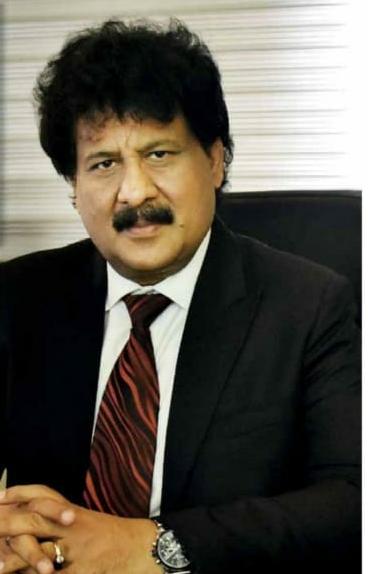
At the Labelexpo Europe, Brussels in 2007, Tarsus UK, the owners of labelexpo group, announced the acquisition of India Label Show, founded by the husband wife duo Anil and Neetu Arora. It was time to celebrate for Anil, who with industry friends that included the author, industry veteran Amit Sheth and a few others were doing the rounds in the bars and eateries at Grand Place. Grand place in Brussels had a nostalgic connection for the label industry at large, where the printers and suppliers partied each evening after the day-end at the show. The show has since moved to Barcelona in Spain in 2025. That evening, Amit Sheth had brought along a customer, a tall quite man who did not talk much but was extremely attentive, he had business in Nigeria and had finalized his first purchase of a label press from Amit’s company Intergraphics, at the show. He had a unique name, Yudhviram Solanki, which in real terms means ceasefire.

According to Yudhviram, “People are often fascinated by my name which also carries a small story. I was born on 20th September 1965, during the height of the Indo-Pak war. My grandfather was in the Indian army during the war and stationed in Jodhpur. My arrival, I have been told, brought a moment of calm amidst chaos, and just three days later, on 23rd September, a ceasefire was declared by the prime minister of India Lal Bahadur Shastri. That is how I came to be named Yudhviram by my grandmother, it means the end of war.” Yudhviram grew up in a humble family living in the Mafatlal Colony in Thane District of Mumbai. To support a family of six, his father Harisinghji Solanki took on part-time business besides his regular job. His mother Kanchan Solanki was the binding force and a pillar of strength for the family.

As a young boy, Yudhviram Solanki would often watch his aunt sell tiny tidbits to students from her small stall near their school. The way she spoke to customers, the little tactics she used, the energy she carried with each transaction, resulted in profound wish to be a businessman. The joy of creating value, one sale at a time, awestruck him at a very young age. As founder director of Sicon Packs Pvt. Ltd., his journey has been one of resilience, balance, and meaningful relationships built with ambition to grow.

His initial schooling was from St. John, The Baptist High School Mumbai followed by a B.Sc. Degree from BNB College Thane in 1987. Prior to taking up a steady career in the multinational Phillips in 1989, he took up various odd jobs to supplement the family income. The years spent at Phillips were his training ground and learning the fundamentals of achieving excellence in sales, that eventually supported his entrepreneurial journey later. Though Solanki made many friends, one of his college friends Shridhar Prabhu, owner of Dolly packaging, manufacturing corrugated cartons, encouraged him to initiate his maiden venture as an entrepreneur of manufacturing carbon paper in 1995 and supplying to industry leaders like Kores and Camlin, later adding stationery to his range of offerings. They even developed their own brand of carbon Paper “Swan” and “Sailing Boat” to sell in Middle East, European and West African markets.

Manufacturing was from the two factories they set up, one measuring 10,000 square feet at Navi Mumbai and the other 20,000 square feet at Mumbai. Despite carbon paper being a product that was losing market share fast, Solanki successfully ran it for the next 15 years, gaining experience as an entrepreneur. The receding demand for carbon papers made the decision to exit carbon paper manufacturing in 2013. During this time another friend Milind Deshmukh, who was his colleague in Phillips and had moved to Nigeria in 1998, mentored him to start exports to Nigeria. Solanki travelled to Nigeria in 2001 and as life would have it, he suffered a malarial attack on arrival there. He almost decided not to come back to that country, but once he recovered and started working, he was thrilled to find success in shape of an order for two container loads of carbon paper. This was his beginning of business journey in that country. This taught him the nuances of doing business in the West African markets. It was a country with personal safety concerns and lacking infrastructure like power. He started to import stationery from Mumbai and sell there and during the course he also started to trade in labels imported from Mumbai.

Soon he became aware of an increasing demand for labels in the country which was largely being met by imports. He started to sell labels on “stock and sell” basis to provide ease of purchase for customers by buying and paying in local currency instead of imports and dollar remittances. The success this brought, Solanki took the next landmark step in his entrepreneurial journey from trading to manufacturing by establishing Perfect Packaging Ltd.(PPL), one of the first roll form label manufacturing company in Nigeria. Earlier people were producing labels in sheet form, and the quality was not good. Their first order came from Mr. Shekhar Ghate, former Director of Holborn and now Managing Director of Apple and Pears Nigeria. Nigeria has been a difficult market. Over the last decade, the local currency Naira’s drastic devaluation has posed a constant challenge. In 2015, 1 USD was equal to 150 Nairas, and today it stands at nearly 1,600 Nairas. This volatility made expansion and reinvestment incredibly difficult. 

 Additionally, being an import-dependent economy, Nigeria’s planning and payment cycles are complex and unpredictable. Yet, despite these hurdles, the resilience and warmth of the Nigerian people kept the PPL team motivated. The first major breakthrough came when PPL successfully cleared the SMETA 6-Pillar Audit, an achievement that opened doors to multiple international clients. Within just two months, they onboarded one of Nigeria’s largest alcobev brands as a premium customer, setting the tone for many successes that followed.

Following the success in Nigeria, the yearning for replicating it back home, Solanki with advice from industry leader Mahendra Shah of Renault Paper Products Pvt. Ltd. returned to India and with Gautam Shah of Atlanta Forms as a partner, he established his Indian venture Sicon Packs Pvt. Ltd. He reminisces it as a memorable start, the first order for a promotional label came from pharma giant Cipla, though what followed in operations in India had other challenges. These included rising input costs, complex labour laws, intense competition, taxes, and sustainability norms, all of which demand careful navigation.

Early in his career when he started carbon paper business, he married Manjiri in 1995 who has been a support and part of his professional journey. Since the carbon paper business entailed vigorous travel, Manjiri held the fort for him, managing the factories while he travelled for over three weeks every month from 2001 onwards, providing much-needed support. 

They are blessed with two children. Their son Devendra is a qualified computer engineer. Devendra started his career at “Teach for India” where he met Shivani and the relationship flourished leading them getting married, Devendra now leads Sicon Packs into diversification and expansion. Their daughter, Kashish Solanki, holds a Master’s in Analytics and Management from the London Business School and currently works with Apple in Mumbai. Her husband Pratik Dubal is a Research Engineer at Meta.

Sicon Pack’s operations in Nigeria and India have grown. In Nigeria, they operate out of a 40,000 sq. ft. facility with 5 flexo machines employing over 100 people. The Indian plant is spread over 30,000 sq. ft. more than 40 employees and 2 letter press and 3 flexo label presses. Both units specialize in the manufacturing and conversion of self-adhesive labels. The India plant is ISO 9001 & 14001 certified and recently achieved the GMI certification from SGS, enabling them to serve premium brands with strict color and shade compliance standards. Solanki says, “I am grateful to Amit Seth of Intergraphic, who has been a supporter since 2007. All label presses and finishing equipment have been sourced through him. Their quality has been rewarded with LMAI label awards consistently since 2010.

Expansion remaining a key focus they are actively exploring opportunities in Ghana, a neighboring market to Nigeria, and even evaluating possibilities in the United States with an innovative technology base, though this is still at an early stage. They are also contemplating expanding their range of products to include shrink sleeves, IML (In-Mold Labels), Wet glue labels, Mono cartons and eventually, digital label printing at both locations. Committed to sustainability, they aim for at least 20% of total production to use eco-friendly, sustainable label stock. They look at a lot of diversifications in the next 5 years that may also include B2C products.

Outside of work, Solanki’s biggest dream is to go on a 145-day world cruise. He has always loved cruise travel, having been on three cruises already. The last cruise through Alaska in 2018, has been the longest yet. A world cruise looks like the next big adventure and an exciting challenge!

Written by Harveer Sahni, Chairman Weldon Celloplast Limited, New Delhi December 2025

Loupe is a simple, small magnification device used to see minute details more closely. They generally have higher magnification than magnifying glass. It is a small tool in the hands of most precision-oriented printers to check the print registration and quality of print. The magnification of content and its spread to other printing technologies envisioned through the loupe by the new owners of Labelexpo group made them expand the gamut, by renaming this premier event to include multiple segments of printing and packaging and be named Loupe! On the 15th of September 2025, on the opening day of Labelexpo 2025 at a new venue Fira Gran Via Barcelona Spain, Informa Markets the present owners of the event announced that Labelexpo had been transformed and renamed to be known hereafter as Loupe.

The Labelexpo exhibitions held in Europe, USA, China and India over the years have come to be referred to as the Mecca of successful label printers around the world. The Labelexpo exhibition was founded by Clive Smith in the year 1979, a year later in 1980 the first Labelexpo exhibition titled Labelex at that time, was held in London’s Royal Horticultural Hall, in a net area of 1000 square meters with just 44 exhibitors. Three shows later in 1985 the show was renamed as Labelexpo Europe and moved to Brussels and in 1998 it was sold to Tarsus who expanded the labelexpo to global destinations including India by acquiring the India Label Show in 2005 and renaming it as Labelexpo India in 2008. After growing the brand multifold in 2023, Labelexpo Global Series was acquired by Informa, the world’s largest B2B event organizer, commanding 800+ brands and 14,000 employees across 30 countries. On September 15th, 2025, Labelexpo not only moved from Brussels, its traditional venue of 20 years and moved to Fira Gran Via Barcelona Spain but also was transformed by the new owners to a different format. From being primarily a label event, it will now encompass the companies in various technologies that include besides labels, flexible packaging, cartons and various forms of packaging. While no mention is made for the total area covered by Labelexpo 2025, but it is mentioned that the show had 650 exhibitors from 138 countries.

Trying to get opinion of visitors, a questionnaire as follows was sent to some visitors and exhibitors;

  • What is your response regarding the shift of Labelexpo from Brussels to Barcelona? Is it better or was Brussels better ?
  • The shift of management from Tarsus to Informa Markets, was it a better organised event? Your opinion
  • The change of name from Labelexpo to Loupe, do you like it? Change of format from labels to packaging.
  • If sheet offset is also in the new format,  labels will be a miniscule portion. Your take?

Analysing the responses as an overview; At the very outset it will be pertinent to mention that this was a premium show where largely exhibitors drew value for money. It delivered the results envisaged!

However, being a predominantly European show, the larger number of visitors appeared to be more from the same region. As per the author’s personal perception there appeared to be a smaller number of visitors than before from the Indian subcontinent. Although the total number of attendees seemed lower, this observation is also based on perception, as Informa Markets has not released an official statement or press release to this effect. The city of Barcelona was amazing, but many would have loved to be on holiday in Spain and not just for an exhibition. As regards the change of venue from Brussels to Barcelona, the industry getting together and the camaraderie amongst peers at Grand Place in Brussels was missing, yet a majority of respondents feel it is a good move, and the show will settle down well in Barcelona. 

While change of management from Tarsus to Informa is a matter of record, in this edition of the show, there were problems in organization of the event. The signages were not only bad but unacceptable. The meticulous planning at Brussels was missing . Even the Gala dinner was a damp affair as compared to the grand sit down, well planned formal dinners at Brussels with great pomp and show. And there were no proper signages leading to the dinner venue. The author had to climb 3 floors to be told by the girl at the door that one has to go down 3 floors and come up another way after checking the wrist badges which we already adorned, even though the main hall was just a few steps from where she was. Not even caring for senior citizens! The air conditioning in the exhibition halls was inefficient  and in Hall 3 it was unbearably hot. Again, it is felt these are transitional glitches and will eventually be addressed.

The labels community at large has expressed that Labelexpo was a preferred name as it was their show and would wish it had continued so. However still, it is understood to be the prerogative of the show owners to change the name. It will probably settle down with time. The change of format from narrow web self-adhesive labels to include flexible packaging pouching in mold labels, and so, is acceptable. In fact, the roll form narrow to mid-web printing and converting appears to be the relevant format to extend the show towards. My last question, “ If sheet offset is also in the new format,  labels will be a miniscule portion. Your take?” drew the strongest response from a majority, “We cannot be a part of such a show where we lose our status as a part of the vibrant label industry.”

Reproduced below are some of the important comments of all the respondents. Producing all comments would make the article too long. 

Kuldip Goel CMD Any Graphics Noida India and past President LMAI: “Our experience of Brussels was better. I would not be repeating visit to Barcelona though I see that  Informa is doing a great job. I do not think  that the change in name is going to impact much, but Label Expo looks better. Label should be treated differently. Inclusion of Sheetfed Offset may make the event loose its uniqueness.”

Isidore Leiser, Owner Stratus Packaging, Brussels, Belgium: “Personally, I like a label show to remain focused on labels. If someone wants something broader, they can always go to Drupa.”

Naveen Talwar, Director Skypack India Pvt Ltd Faridabad India: “I prefer the Barcelona venue; it is closer to airport. It is a cleaner city compared to Brussels. I felt safer. Personally, I feel the show should stick to ‘roll to roll” converting. Sheet fed will make things totally different.”

Raul Silvestre, Lartec, Alicante Spain: “The change of venue to Barcelona is good but it was badly organized. Access for exhibitors was not allowed by own cars. We had to handle all boxes from door 4 to the stand, manually. Very Bad exit doors, only 2 available when the show has a lot to go out. I do not like the change of name and the format change. It should remain an event focused on labels. The change will result in lesser share for label industry visitors to have opportunity to contact and spend time with exhibitors.”

Amit Sheth, Director Intergraphics Mumbai India: “Frankly, the new organiser was not as efficient as the previous one . The signages were missing; the assistance desks in every intersection were missing; the maps of all the halls at each intersection were missing . As for format change from Labels to Packaging, Label being the primary subject should not be unfocussed. Merging packaging up to mid web  is fine but SHEETFED OFFSET OR ANY SHEET FORM MACHINES OR APPLICATIONS SHOULD NOT BE ENCOURAGED.”

Nitin Garg, Managing Director NBG Printographics Faridabad India: “The shift to Barcelona seems to be a good decision and will boost international participation. The event was well organized, with no complaints. This change of name is logical from the management’s perspective and aligns with the broader industry shift from labels to packaging. The success of Labelexpo stemmed from its clear focus on the label industry and the strong connections its management had within the sector across different countries. With the current shift toward packaging, it remains to be seen whether the same success can be replicated, as packaging is a much broader and more complex domain. The core focus should remain on labels.”

Ankit Gupta Managing Director Holostik Noida India: Barcelona was okay for us though I missed the weather and vibe of Brussels. The Expo was organised well but I neither like the change of format nor the change of name. Sheet offset should not be a part of this landmark show. It will lose its unique identity.”

Sandeep Sharma Director at Acme Rolltech Pvt Ltd Ahmedabad India: Barcelona was good as it creates new positive enthusiasm amongst the exhibitors as well as the visitors. Both Tarsus and Informa are good organisers. Except for the air conditioning issue which needs to be taken care of going forward, overall, it was a good show for us.

Nalani Jaichandra Director VeePee Graphics Bengaluru India: ´It is better in Barcelona, much safer than Brussels. The show was well organized but the name Labelexpo was more apt. Yes, this format widens the target market, which will bring in more visitors and as Labels is a part of packaging having everything under one roof will be better. Sheetfed offset should be kept out, the focus should be only on flexo and digital.

Dinesh Mahajan, Managing Director Prakash Labels Noida India: “Barcelona is as good as Brussels! Unfortunately, the event was not that well organized compared to what it used to be in Brussels. The name Labelexpo when spoken gives clear impression of what event we are talking about, though Loupe is not that explicit. Change of format seems all right, but Sheet offset should be resisted to be displayed in this event.

Mahendra Shah, Director at Renault Paper Products Pvt ltd. Mumbai: “After initial adverse reactions, once settled, the venue looks good. Organisational glitches will eventually be taken care of and sure to settle down. As for the name, I would prefer Labelexpo, it connects us to the event. The change of format is way forward. For the sheetfed offset segment, web converting is the future, and they should be visitors to the show.”

Summing up, it is generally felt the venue in Barcelona is acceptable or will gradually settle down with visitors from industry. The organization of the show will improve given the stature experience and capabilities of Informa Markets and the changed format restricted to web converting, preferably up to mid-web, will be widely welcomed but to include sheetfed offset will make it a replication of the many shows like Drupa. The wish to make it to specially focused labelexpo and meet label industry peers will diminish. We will wait to see how Labelexpo, renamed Loupe, will actually transform and find acceptability from the label fraternity.

Note: One day prior to the show that opened on 16th September 2025, on the 15th, Amit Sheth and the author Harveer Sahni, representing LMAI were the judges for World Label Awards and also attended the meeting of L9 the confederation of nine leading label associations of the world.

My short pictorial walk through the Labelexpo 2025:

Written by Harveer Sahni, Chairman Weldon Celloplast Limited New Delhi September 2025

For advertising on this blog and on website www.labelsandpackagingworld.com please email to

info@labelsandpackagingworld.com 

This was the first Labelexpo India after the holding company Tarsus PLC, the erstwhile owners of Labelexpos were acquired by Informa markets, a global organizer of events in various global verticals. Since the new owners decided to retain the same team of labelexpo,  the smooth transition and continuation was evident. 

It was the largest show until now. The show was held at India Expo Mart, Greater Noida with a 30% higher floorspace than the 2022 edition. The largest ever number 13724 visitors came to show from, besides India,  many countries including those in Middle East, Russia and Africa. Normally we see only label printers and non-exhibiting suppliers as visitors to the show, this time it was a welcome change to see quite a few brand owners/Print buyers as visitors studying the nuances of label manufacturing. It is felt that with the growing need for customized runs and increasing number of startups, some label buyers may be considering captive label production as well. 

Inaugurating the Labelexpo India 2024, Jade Grace Managing Director welcomed the visitors to this important event. In his welcome address, Rajesh Chadha President LMAI assured LMAI’s continued support  and delivering value to the label fraternity.  After consultations with LMAI and other stakeholders, Informa Markets have decided to hold the next edition of this important event at the same venue in 2026.

For the past two consecutive editions of Labelexpo India we have witnessed the absence of European and American flexo label presses running live at the event, though some made their presence felt through their local agents or Indian subsidiaries. However still, there were many flexo label presses displayed, and most of them were Indian made ones followed by a few from China. It is an indication of a transformation that one can expect Indian and Chinese manufacturers of flexo presses, tooling and consumables will have increasing number of exhibitors at Labelexpo Europe.

The transformation is happening by the evolution of technologies taking place in these Asian neighbours. Fewer Chinese companies came as exhibitors due to Visa restrictions, which may change with thaw in the relations between the countries. Of course, we cannot write off the western manufacturers who lead the way to evolution by creating equipment that transforms from production of only labels to produce multiple products like Flexible packaging, Lami tubes and Folding Cartons. Their focus is now moving to wider presses, which are hybrid, incorporating diverse printing and converting technologies resulting in lesser wastages, quick changeovers, increased embellishments, sustainable production and processes. The presses now being offered integrate flexo, offset, screen, gravure and digital inline in a single pass.

Digital label printing has also continued to grow in India. Most prominent companies including HP, Domino, Durst, Xeikon, Konica Minolta, Pulisi, etc. displayed their digital presses and label printers’ interest was seen in with serious intent. Indian label industry being mostly dominated in numbers by family managed middle and lower end companies find the high-end digital presses being beyond their immediate reach even though their desire to acquire digital printing capabilities was seen in substantial measure. Printers exhibited a lot of interest in entry level tabletop digital printing equipment. These digital printers though are priced lower, but their higher printing cost confuses converters. Those who understood the power of digital making its necessity felt in label manufacturing, did make purchase decisions at the show.

Given the trend of the middle level label companies looking at entry level equipment, it indicates that it is just some more time before they graduate to the bigger digital label and package printing equipment. The transformation has begun. The industry is and firmly marching towards digital label printing and converting.

On the material side while the global leaders Avery Dennison displayed their innovations and advances especially in the RFID label technologies and linerless labels. UPM too exhibited their new and sustainable product offerings. A substantial number of Indian labelstock manufacturers put their best in front rubbing shoulders with the multinational material producers. Prominent amongst them were SMI, MLJ, Capri, Stic-on, Dubble, Desmat and many others. Silicone liners specialist Loparex exhibited their diverse range of backing papers, films and linerless materials.

Sustainability seems to be catching up the attention of all in the self-adhesive label’s ecosystem. From equipment suppliers to material suppliers are now talking of sustainability endeavours and the imperative need for the 4R’s, reduce, reuse, recycle, and recover. Indeed, this is a welcome transformation. Yet, there is a lot more needed, and the onus is also on brand owners and print buyers to impress suppliers to implement sustainable manufacturing practices and to use FSC certified products and to conserve energy.

In the second half of 14th of November, the opening day of Labelexpo India 2024, the author’s book titled “Untold stories of Indian label industry” was launched at the HP stand in presence of Industry leaders and media. Prominent were Yoav Lotan, Appadurai and team from HP, Anil Sharma, Pankaj Bhardwaj and Saurabh Agarwal from Avery Dennison, Rajesh Chadha president and his leadership team of LMAI, Media presence included Labels & Labeling, Printweek, Packaging South Asia, Packman, Press Ideas along with a host of industry friends and supporters of the author. The Hp team hosted the event supported by Avery Dennison, LMAI (Label Manufacturers Association  of India and Pragati Pack. 

The book UNTOLD STORIES OF INDIAN LABEL INDUSTRY”  Author: Harveer Sahni, chronicles history of Indian labels industry from the very beginning when the first self-adhesive label was produced manually. It covers success stories, lives of leading  label printers and coverage of important label events in India. It also dwells on the most defining moments, the young czars of label industry and the women who lend glamour to the vibrant label Industry. It is the first of its kind of endeavor anywhere in the world. It is a 320-page coffee table book with rare pictures.

On the second evening of Labelexpo India the LMAI Gallus-HEIDELBERG Label Awards night was held to commemorate the finest of label printers in India. An outstanding event curated under the exacting and fine detailed planning leadership of event chairman and past president of LMAI Kuldip Goel. The virtual who is who of Indian label industry was present. The event interspaced with entertainment slots was attended by over 700 delegates from the global label industry. 

A touching part of this evening was bidding farewell to Industry stalwart Ferdinand Ruesch IV, senior vice president, global key accounts at Gallus, popularly known as Ferdi who is retiring after 40 years of dedicated service to the global printing and packaging industry. It was a nostalgic moment and will remain memorable forever. 

The evening ended with music, dance and partying, looking forward to yet another vibrant LMAI event.

 More images:

Written and compiled by Harveer Sahni Chairman Weldon Celloplast Limited New Delhi November 2024

The last Labelexpo India 2022 was witness to an interesting evolution in the display of high-end label printing presses. For the first time since the inception of this show, the European and American presses running live were missing.

However, the flexo presses displayed at this all-important label exhibition were made in India. This was an indicator towards the Indian press manufacturers to have come of age. These Indian manufacturers are now, not only announcing sales in India but also succeeding in the global label arena. An interesting part of this evolution is that most of the successful brands of flexo presses that have been developed come from Faridabad, the neighboring industrial suburb of New Delhi. Faridabad is a part of NCR Delhi and a major industrial hub of the state of Haryana. It is famous for henna production from the agricultural sector, while tractors, motorcycles, switch gears, refrigerators, shoes, tyres and garments constitute its primary industrial products. There is reason why most of the leading brands of Indian made flexo presses are from this city. These presses include Multitec, Webtech, NBG, Label Flex and many other smaller ones. Even UV Graphic technologies now headquartered in NOIDA, started their manufacturing in partnership with Faridabad based Multitec. 

The credit of printing equipment manufacturing industry flourishing and growing in this city goes to the establishment and transformation of a company founded by Kishan Das Kohli, a man who fought for the independence of India prior to its partitioning.

The Printers House now renamed as TPH Orient group was founded by Kohli in 1946 as an agency house bringing global printing technology to India. He was responsible for installations, commissioning, providing technical expertise and operators for the imported equipment. For the pioneering work he did for the printing industry in India, he received numerous awards that included the Kohinoor Ratna award. An enterprising businessman, he started manufacturing printing presses in India in the mid-1960s initiating his maiden startup manufacturing unit in Faridabad to build letterpress and offset printing presses there. Around this manufacturing unit, an ecosystem of mechanical engineering professionals and engineering companies was built and went on growing. Many companies now making flexo presses or any other type of presses in Faridabad first started out as their vendors. Making any type of press requires components such as frames, cylinders, etc.

The Printers House helped create the infrastructure and this supply chain in Faridabad, which is what makes it ideal for printing press manufacturing hub. Later another company Sud and Warren led by Baldev Sud, Arora and Ahuja  also commenced manufacturing  slitting machines and later web-based computer stationery. The company did not grow as envisaged and some of their ex-employees are now narrow web label press manufacturers

I, the author, having had two factories in Faridabad since the 1960s, producing stationery and silicone release papers under the brand Weldon, had  heard a lot about The Printers House and the kind of work they had done. Weldon’s vendors in earlier days used to print their packaging on the old traditional treadle presses and when the Mercedes automatic presses from TPH were launched, it was a game changing moment. The author reminisces an evening during a party in connection with Printpack India in 1991, he was introduced a tall smart man who was surrounded by print industry stalwarts of that time. He was  Manmohan Kohli, heading The Printers House (TPH) and was the son of the founder K D Kohli. Manmohan was an alumnus of ETH Switzerland, a university of science and technology from where he passed out as gold medalist engineer.

He pioneered the evolution of printing technology in India. Under his leadership TPH became a name to be reckoned with globally, having installations in over 60 countries. Manmohan Kohli, a legend in Indian printing equipment industry,  passed away in June 2022 at the age of 83 years passing the reigns of the company to his only young son Rishab Kohli who now aged 28 years heads TPH as Managing Director.

The first few years of Rishab’s schooling were at New Delhi based Sanskriti School and thereafter he was sent to Gordonstoun school in Scotland. Finishing school in Scotland, he joined Georgetown university in Washington DC where he studied economics and had the opportunity to go through numerous internships in Washington DC including prominent lobbyist firms and international organisations. Completing his education at university, he initiated his career in the United States in finance/investment banking in the US where he worked between the US and Europe extensively. Thereafter he returned to India and in 2020 he took over the reigns of The Printers House now renamed The TPH Orient group, as CEO. Backed by his experience and pedigree in business he envisioned to create a group of companies in India that would cater to the printing , packaging, and other industries.

On assuming the leadership in TPH, Rishab worked with numerous partners across the globe to acquire technology and bring it to India. He saw the label segment growing rapidly and felt there is high reliance on imports on capital equipment in this segment. On his indulgence, TPH  launched their flexo and inkjet label press, extending their application to packaging as well. Given the infrastructure available at TPH, Rishab has decided to produce equipment with economy of scale to make it cost effective and such that customers feel secure with their investment and service. He felt the technical expertise to produce flexo and digital label presses of global standards was still needing upgradation, so he or his team travelled to acquire appropriate technologies.

Rishab mentions that development of the first fully digital ink delivery system made by them in India that successfully printed a full color label at high speeds is huge achievement for TPH. Being the first of its kind developed in India, it will remain as one of the most memorable moments. With the ability to print at 1200 DPI with in-house dynamic RIP (RIP stands for Raster Imaging Processor software), it is a prime competitor to the established leaders in the field of digital label printing. He gives credit for support, guidance and help to the late Ramani Vishwanathan who was a pioneer in digital printing in India. He helped Rishab create this technology. Justifying his move into Digital label printing equipment he states that Inkjet is crucial for label printing due to several macroeconomic factors and market forces. With the rise in short run jobs and customization in packaging, a roll fed digital press is crucial to meet the needs of end clients. Additionally, with the speeds of inkjet presses increasing and head technology advancing at the pace that it is, the mid to long runs may also be catered to by inkjet.

As regards the flexo press developed by them, he asserts, “It is the fastest Indian made machine of its kind at this moment. Additionally, we offer sleeve technology and narrow web along with wider width options.”

The TPH Orient group is now a diversified group of companies and a market leader in printing machinery, packaging machinery , printing consumables , engineering services for defence, aerospace, and solar. They have 800 employees spread over a 20-acre campus and 6 factories in Faridabad working in numerous segments. They also now manufacture inkjet presses, flexo presses, folder gluers, web offset presses, printing chemicals etc. They have one of the largest CNC machine shops in north India and perhaps largest in Faridabad. According to Rishab, TPH Orient group is the largest Indian exporter of printing machines with exports to 60 countries. They have service engineers and offices in 12 locations in India and presence worldwide. They are considering extending manufacturing operations in foreign locations.

Talking of challenging times in his short career, Rishab says, “Covid was a tough period, but we got through it, taking every day at a time. But a lot was learnt, and we came out of it stronger.” In his journey so far, a key member of TPH board of directors, Naveen Chahal, has been a mentor to him. Being an extremely experienced person, his guidance has helped the turnover grow to over 15 times the figure when Rishab took over. In printing and packaging Rishab acknowledges the guidance of Christoph Mueller, director Koenig and Bauer, for his guidance in quality enhancement of their products.

Rishab Kohli sums up his vision for the future as, “The key for Orient in the printing and packaging industry is to provide a holistic solution to the printing and packaging community worldwide. We have a simple goal which is to be the largest equipment supplier in our field coming out of India and ideally Asia in this segment. With our infrastructure , scale, and history this is a realistic and an important 5-year goal.”

 Written by Harveer Sahni, Chairman Weldon Celloplast Limited New Delhi August 2024

Absence makes the heart grow fonder! There was a general perception that the impact of a fierce pandemic, the Finnish Paper Mills strike, Ukraine war, shortages and rising raw material prices, difficult logistics and increased travel costs have left the market sentiments bruised. There was strong narrative doing the rounds in the labels industry that Labelexpo Europe 2023 at Brussels will lose its sheen and may not deliver the desired results. Contrary to all perceptions the show was a huge success. The numbers may have been slightly lower than the previous years, but the quality of turnout brought cheer to the faces of exhibitors. The proof of that is given by the reported rebook rate for the next edition of this important event by Tarsus, announced at a whopping 96%! Labelexpo Europe 2023 was spread over 9 halls covering 35889 square meters. 36588 visitors flocked to the show, coming from 138 countries. Most stands reported robust enquiries or sales from established and serious printers from around the world. Though the aisles were not as crowded as in previous shows, the stands were busy. That is exactly what exhibitors expect from a globally renowned show. I cite a personal experience, I had to conduct an important meeting with one of our company’s several principals. Despite visiting their stand on all days at various times, the concerned person was busy with clients, finally I had to ask him to come to another meeting point other than his stand, so that we could discuss our project in peace. Such was the deliverance of Labelexpo 2023.

The Indian presence; The Indian labels and packaging industry has been continuously growing at steady pace to reach a position of stability and strength. The Indian visitors to labelexpo have also transformed. Earlier we saw many of those who mixed their visit with tourism, so the interest was diluted, and the enquiries lacked seriousness. This trend is seen as changing, given the increased travel costs and technologies evolving in different packaging segments, the smaller printers prefer to visit the domestic editions of Labelexpo. 

In 2005, my company was the only one from India to exhibit at Labelexpo Europe in Brussels, over years the number of Indian exhibitors has been growing. Indian producers of materials, machines and tooling have improved in quality to match global levels and offer their products in the international marketplace. 

From just the one exhibitor from India displaying labelstock in 2005 they reached 14 exhibitors in 2017, and in 2023 the number of Indian exhibitors grew to 26. This number included several label press manufacturers, manufacturers of coaters and laminators, raw material suppliers, tooling manufacturers, etc. In fact, registering their presence in all segments of label manufacturing. As for the visitors, it is an even more interesting result. In 2019 2% of the total of 37903 visitors were from India.

This works out to over 750 visitors. This figure has swelled! In Labelexpo Europe 2023. Indian visitors were 3.9% of the total of 36588 visitors and this works out to over 1400 visitors, almost double the number. We can imagine the dynamism and steady growth of “make in India” concept. The Indians are now quick learners who visit these shows and become adapters of global technologies to produce and offer to the world.

Diverse technologies displayed: Labelexpo global series was in the initial stages aimed at growth of stickers that had evolved as self-adhesive labels. The earliest web label presses were largely coming from eastern part of the World as 4 or 5-inch-wide flatbed letterpress machines for printing labels in roll form to eventually transform with development of label applicators, it led to automation in packaging lines.

Development and introduction of rotary flexographic label presses brought a paradigm shift as it provided better speed of printing.

Since the web width in the earliest stages was small, the industry eventually started being referred to as narrow web label industry. The rest is history. With evolution and development of prepress printing speeds and quality also improved making the technology widely acceptable. Printing widths increased to 10 inches or 250 mm and had for quite some time settled at 330mm.

Speeds that were just 5 or 6 meters per minute in the beginning with the flatbed presses, have reached up to 200 meters per minute and more. The narrow web label industry flourished and kept growing. With time label technologies have undergone a sea change. What was wet glue labels, transformed into self-adhesive labels but later the label grew towards various tangents. The label users started adopting a wide variety that includes wraparound labels, shrink sleeves, Inmold labels, heat transfer labels and many more. In the initial stages of transformation large multinational FMCG companies became users of wrap-around labels and shrink sleeves, because of the large volume they required, these became the product of the wide web rotogravure printing industry. With market changes happening, the need of smaller manufacturers and demand for short runs by marketing professionals, these diverse segments also became evident in the offerings of narrow web industry. 

The narrow started growing wider still, printing and converting evolved exponentially and became suppliers of not only to wide spectrum of labels but also flexible packaging, Lami-tubes and folding cartons. The flexo presses also transformed to be hybrid ones  employing combination of flexo, offset, gravure, screen and digital, etc.

At Labelexpo Europe 2023, one could witness displayed, a merger and combination of different printing technologies to produce excellence in print of labels and packaging. This was substantially exhibited by industry stalwarts like Gallus, Omet, Nilpeter, Mark Andy, Bobst, Weigang, Lombardy, etc. who displayed their finest web printing and converting equipment. It is interesting that waste reduction and sustainable manufacturing practices to reduce carbon footprint are becoming imperative for all responsible machine builders.

Overview: Material suppliers like Avery Dennison, UPM Raflatac and Fedrigoni displayed their vast ranges of labelstocks with an evident effort towards sustainability. Many did talk of linerless and the initial developments they have made but the actual linerless self-adhesive label for mass usage is still a far cry. 

As mentioned before, from the just one Indian Labelstock producer in 2005, there were five Indian labelstock producers at the show, Jindal SMI, SticOn papers, MLJ, Shree Lamipack and Varshil. Looking at the number of visitors on stands it was clear that the focus of label fraternity is shifting from commodities to creativity, innovation and sustainability. While all labelstock companies had a steady flow of visitors, the Fedrigoni stand that offered specialty textured and decorative materials was extremely busy. 

A similar situation was observed at the Cartes stand whose displayed equipment offered amazing embellishments with various combinations of digital jet screen varnishing and printing, screen printing, laser die-cutting etc. The electronic integration in labels is another field that attracted the attention of forward-thinking printing companies. RFID insertion options for labels and packaging were displayed by many, some of whom include  Avery Dennison, Beontag, Muhlbauer, Delta Modtech, etc. Another aspect witnessed is the growing number of finishing equipment manufacturers, which clearly indicates the need for printing companies to produce more with less. The concept of printing at full machine speeds on their expensive presses and finishing offline makes available more time on their main printing presses. The futuristic digital printing equipment continues to evolve indicating it to become a dominant label printing technology in future, given the wider widths and faster speeds.

The hall number 8 with exhibitors led by HP, offered a vast variety of digital printing equipment. The increased display of finishing or digital finishing machines is also indicative of the increasing importance of digital printing, which in recent times has become a necessity for prosperous label printers. Running short runs needs offline finishing. else the digital presses with inline finishing will not only be expensive but will not be able to deliver production to their full capacity due to short runs and quick changeovers.

One thing that has become evident at Labelexpo Europe 2023 is that the narrow web label industry continues to go wider and evolve, increasing its footprints in other segments of packaging and it would not be out of place to mention that soon it  will be referred to as “Web label and package converting industry.”

The end of show was a nostalgic moment, people bidding farewell to Labelexpo in Brussel where so many wonderful memories, stories of success and friendships had been scripted. The label fraternity now looks forward to making another beginning with Labelexpo Europe 2025 in Barcelona, Spain.

Pictures of my walk through Labelexpo 2023 and some of the events on the sidelines;

World Label Awards Judging:

One day before Labelexpo opened, the judging for label awards was held.

Same afternoon, L9 meeting was held, followed by L9-Dinner

The global Label awards evening!

On Wednesday 13th September 2023, fairwell dinner for Label Guru Mike Fairley was held

My Walk through!

Written by Harveer Sahni, Chairman Weldon Celloplast Limited New Delhi India September 2023

Born to Malayali parents in the south Indian state of Kerala, Hari Nair CEO of Digital Labels in Toronto  does not sound like a Malayali, on the contrary he sounds like a typical Mumbaikar (Local longtime residents of Mumbai). The Malayali people are a Dravidian ethnolinguistic group originating from the present-day state of Kerala in India, occupying its southwestern Malabar coast.

They are predominantly native speakers of the Malayalam language. They constitute the majority of the population of Kerala. It is pertinent to mention here that Hari is proud of his Indian heritage and firmly believes in the oneness of being an Indian rather than be recognized as a part of separate religious or caste-based segment of the society. Long years ago, Hari’s parents had moved residence to Mumbai, where he grew up. They lived in Santa Cruz, close to airport. He did his schooling from Kalina Education Society and  college in Parle college. He followed this with Masters in Organic Chemistry from Bombay University. Finally, he completed his MMS (Master of Management Studies) from Sydenham Institute of Management Studies, Mumbai. Post education in 1989 he along with a few others were hired by Suresh Gupta former Chairman Huhtamaki-PPL, which at that time was Paper Products Limited (PPL) promoted by the late Sardari Lal Talwar and his family. Paper Products Limited or PPL was later acquired by multinational Huhtamaki. Sardari Lal Talwar’s son in law, Suresh Gupta had joined PPL when it was facing tough times. Suresh Gupta fondly called SG, was in the process of transforming the company from purely owner driven to  professionally managed one. An elaborate program of in-house training was put in place. The program was designed by SG and his colleagues to suit their specific needs, may they be technology, sales, customer or people handling. They were transforming the company to project their acumen in offering the latest in packaging. So, he hired these youngsters and trained them. He would not let them to take it easy. They were initially trained in flexible packaging, learning every part of the process including slitting. Hari mentions, “SG had long term vision.” He achieved success by implementing his ideas. These new incumbents included 6 or 7 persons to be groomed as his core management team. Hari Nair was one of them and who considers Suresh as his mentor and remains in awe of his capabilities to transform a company that was just Rupees 35 Crores when Hari joined and under SG’s leadership PPL had crossed Rupees 2300 Crores when SG retired.

Hari started his career at Thane (Mumbai) plant of PPL in flexible packaging division. When SG introduced Shrink Sleeves 1993-94, Hari was sent to Fuji seal Japan for training him and taking other persons from the company along with him, for training. In 1997 he was moved as General Manager to Hyderabad plant of PPL. Hari came to Canada in 2001 from his last posting in India at PPL Hyderabad. When asked why he moved to Canada, he is not sure, but then says, ”I always thought it will be good for his daughter plus I was fascinated by the west.” Each time he visited these countries on his business trips, he was in awe of the infrastructure, the roads and facilities.

Comparatively, he felt India was always “work in progress” and in his lifetime, it will never be like this in India. He yearned to live in these countries and drive on these roads, though today he says, these were stupid reasons. He feels as one matures and looks back; the realization comes that they were not the right reasons however his vison for his daughter Mythili getting better education has worked well. Since so many children are coming to Canada to study, she would also have had to do that but now that she is here, it is working out for her, she is a doctor and moving on well with her life. When they shifted to Canada his family had no clue what they were going to be up against, on arriving in Toronto they were all holed up in one room of a town house in which four families were living, sharing kitchen. It was an extremely challenging situation from the life they had been leading back in India.

On landing in Toronto, he tried looking for jobs in the field that he was experienced in and approached companies in similar fields. Sandeep Lal the then owner of Metro Labels called him for an interview and in response felt Hari was overqualified and he did not have a position for him at that time. For a full year thereafter, Hari did not get a break and he was so distressed that he even sent a message to his mentor SG that he might want to come back to PPL. The experienced mentor and a professional management leader that he was, SG advised him that while he was welcome to return, yet he did not want Hari to regret later and feel he did not try hard enough. SG asked him to wait for some more time and try some more, things will work out. That was the motivation coming from a mentor that made him hang on, it was the encouragement that changed his mind. A year later while he was contemplating moving out of the packaging industry, he saw many youngsters joining banks as the jobs were there on offer. On a suggestion from a friend, he did a course in financial securities hoping to get a bank job. He was then living at Kingston Ontario and met almost all the bank manager there, looking for a job.

While he was searching for a job in banks, Hari stayed connected and following up with Sandeep Lal at Metro Labels. A year had elapsed and one fine day he got two calls, one from a bank offering him a teller’s job for 10 dollars an hour and that too for just 10 hours each week which was not enough to feed a family, and the second job offer came from Sandeep Lal which Hari accepted and joined Metro Labels as an estimator. The job was entirely different from what it was in  India, the workload was heavy. One of the first lessons he learnt was that in India if you are dealing with large customers the price for a particular customer remains same for all quantities of same label but in Canada, each job is estimated and quoted separately. In 6 to 8 months, he became the plant manager for Metro Labels. A year down the line he felt the discomfort as the environment was a lot different from the time, he worked in Paper Products in Mumbai. After having spent over two years  there he quit Metro Labels and joined another label company Labelad. He joined as a supervisor and gradually moved up and stayed there for the next 7 years. While in PPL he had worked a General Manager and had handled from production to selling more like as an entrepreneur but in Canada the work system was entirely different and here Hari worked completely in production.

During his tenure at Labelad, while he was attending a Fasson seminar, the speaker mentioned that there were two big opportunities in North America and those were flexible packaging and digital printing. Sitting at a round table along with his colleague Chris Henderson from sales in Labelad, referring to digital printing, Hari said to Chris, “this is the future.” They parted on that note and forgot about the incident. Six months later Chris was at Hari’s office asking him if he remembered his comments on digital and whether he wished to start something. With an affirmative reply, both indulged, and Digital labels was born. Chris had spent 14 years in Labelad and it was an ideal combination with Hari as the production person and Chris as the Sales expert. From experience Hari felt that the HP Indigo 4000 series could not sustain a business expense but when the 6000 series came it became a different story and once it was two years of launch of that model, they felt comfortable to buy the press. Within six months they came in contact with Charlie Maclean President from ASL Printfx and decided to get into an association with ASL investing in Digital Labels, taking a small part of the ownership. Since they also had interest in digital. It was a win-win situation as ASL could use the digital capabilities of Digital Labels who could in turn have access to ASL’s sales network. ASL has grown and is very focused in high-end jobs like wine and spirits and for short runs and personalized variable print jobs, Digital Label’s capabilities are an important resource.

Digital labels are into manufacturing of all segments of labels, shrink labels and decals, but mostly concentrating on short and specialized runs. To start they had huge challenges as both partners were into service before and had no business background, so banks were reluctant to fund them. Working capital dried up soon. Once they got over the initial hiccups and proved their capabilities it became smooth sailing. The first 6 months were tough as buyers did not trust them since they were new in labels business but then a Godsent opportunity came to them when a scented candle manufacturer who was having trouble with current vendors of labels, approached them. That business came to them as a big saviour. Once orders from that customer came in, they were operating better and later when ASL came into the picture, things changed for good.

Chris and Hari have worked tirelessly, and their efforts have been fruitful as Digital Labels has been growing in the last few years at around 25% each year. Their business is now around 7 million Dollars, and they plan and make efforts to reach 10 million in the next 3-4 years  from organic growth alone. They presently operate from a premises admeasuring 8000 square feet and the space it is fully utilized. Due to shortages faced following the pandemic, they had to increase their inventory. They rented a lot of space around their present premises so that they could maintain enough stocks to service their customers well. They operate with 25 employees, presently working 8-10 hours basis. They are a slim trim enterprise who are very careful with expenses and very focused to grow their business. Commercial real estate in Toronto is expensive so they feel that for any expansion that becomes imperative, they will try to rework their present setup and increase the working shift for the time being.

His wife Surekha with whom Hari got married in 1994, is from Goa. She is a social worker by training and now since 2007, she is working for the social services division of the city of Toronto. Their daughter Mythili was born in 1995. Hari remains connected with all his friends in India. But has no business with India. He still remains in awe of Suresh Gupta whom he looks at as a mentor and feels he has yet to meet anyone as smart, knowledgeable and professional as him.

Nostalgically and pensive in thoughts he says, “Whatever I learnt in my journey in profession so far, it has been from him”!

Written by Harveer Sahni Chairman Weldon Celloplast Limited, New Delhi December 2022

Covid-19 or Corona virus that has struck populations in countries across the globe creating a scare that has impacted adversely most affluent economies in the world. Governments are taking very strong measures to curb the proliferation as also find remedies for curing and containing this virus which is already declared a pandemic. Increasing numbers of affected people and deaths have created an alarming situation whereby vast geographical areas are being cordoned off, schools are shut, travel has become restricted, congregation of people is being restricted and businesses are suffering. The global printing industry at large is also facing the brunt of the impact. Important printing events where major buying decisions are taken and seminars that enhance knowledge besides providing networking opportunities have been postponed. Millions have been invested in planning the event by the event organisers, exhibitors and the visitors. Some of the important events that have taken responsible decisions to postpone in view of public safety concerns are as below.

Sri Lanka Print 2020 Colombo
FINAT Technical Seminar Barcelona
Labelexpo SEA Bangkok
LMAI Digital Label printing event Mumbai

PackPlus South 2020 Hyderabad India

Interpack Dusseldorf Germany
Drupa Dusseldorf Germany
FESPA Brazil 2020 Sao Paolo
Fespa Global Print Expo 2020 Madrid
FINAT European Label Forum 2020, Rome is under consideration

The label industry has been greatly impacted by the spreading virus. China and Italy are two major producers and suppliers of label manufacturing equipment, both countries have been hit badly. Covid-19 originated in China and Italy became one of the largest sufferers of this spreading pandemic with tremors of this being felt by label printers across the globe. Even though China has indicated containment of the virus at their end yet since the virus has spread to other countries, governments around the world continue to make travel advisories and entry restrictions to contain the spread in their respective countries.

These travel restrictions or self-control in avoiding travel has greatly impacted the events business. With news of Covid-19 spreading to Spain; FINAT, the European association for the self-adhesive label industry postponed their FINAT Technical Seminar Barcelona. According to Chris Ellison, President of FINAT “Apart from the public health risk, the virus is now also spilling over into the real economy, and members of the label industry are taking measures to contain the risk for their staff’s well-being and their business’ continuity. In some cases, more far-reaching measures are taken than those recommended or enforced by local governments and public health institutes.” He further adds, “We are also reviewing the scenarios for the European Label Forum in Rome next June”.

Tarsus which was looking forward to a successful second Labelexpo southeast Asia at Bangkok has also announced its postponement. According to Lisa Milburn, managing director of Labelexpo Global Series, “We have taken the difficult decision to postpone Labelexpo Southeast Asia 2020 in May due to coronavirus/COVID-19.

This is an unprecedented situation and given the vast amount of preparation that goes into our shows, not a decision we have taken lightly. However, the health and safety of our exhibitors, visitors and staff is our top priority, and working on the advice of our local partners and BITEC, we feel the best course of action is to postpone the show until September.” 

Drupa is the world’s leading trade fair for printing technologies. The last Drupa saw 1828 exhibitors from 54 countries, 260,165 visitors from 183 countries with the largest group from outside Germany coming from India totaling at 5% of the total visitors.  

Until a few days back the Drupa website stated that the event will be held on the stipulated dates and that the organisers were taking adequate steps to screen the visitors as also to sanitize the venue for safety of all. Then on 13th of March 2020 came the press release from Messe Dusseldorf stating that both Drupa and Interpack are postponed. 

A resilient Indian label industry has had its own share of voes over the past few years. Every time it is faced with a challenging situation it recovers to face yet another tough situation. First came the demonetization, hardly had the effect of that had worn off came the implication of GST.

The industry took its time to reconcile and adjust itself on to a growth path but as 2019 was coming to an end the country was facing an economic slowdown stemming the rate of growth. The resilience of this industry segment still makes it go on, sometimes rapidly and other down at a slower pace. Now the Corona virus has brought with it a new kind of situation whereby travel is curtailed, and expansions have gone on hold. With the Indian label industry starting its move in to digital label printing in line with trends in the western world, India’s label association LMAI had planned its 2nd event, “”DIGITAL PRINTING IN LABELS – THE WAY FORWARD” to be held in the evening of March 16th, 2020 at Hotel ITC Maratha Mumbai. The interest in the event got a huge response and was fully sold out two weeks in advance. As the situation of Corona Virus became alarming the LMAI management decided to postpone the event. Amit Sheth founder member of LMAI requesting postponement had said, “The way it is seen it is better to postpone the event. I think this is a National concern!” Commenting on the cancellation Kuldip Goel President LMAI said, “It is so unfortunate that immense effort had gone in preparation but for a humanitarian cause, it was needed to take precaution.!”

While the corona virus goes on unabated it is hoped that the containment happens soon bringing relief to the vast humanity that has got affected. While efforts go on by health authorities globally to find a vaccine, yet it is prudent for all to practice safety as suggested by bonafide governments and certified health authorities.

TLWritten by Harveer Sahni Chairman Weldon Celloplast Ltd. New Delhi India March 2020

LMAI Board of directors


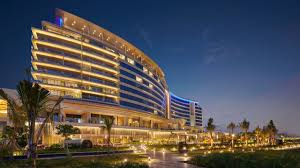
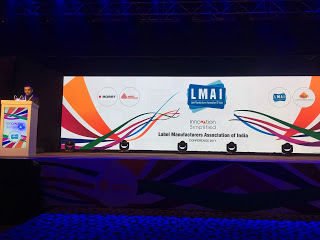
The 3-day LMAI label conference from 25th-27th July 2019 was an event that was efficiently organized and delivered the promise of comradeship, entertainment and knowledge sharing. From the time of landing at Kochi to the time of departures on 28th, it was all done with clockwork precision. It was a gigantic task of hosting over 550-600 delegates from all over India and various parts of the world attending this biennial event. They were put up in 317 rooms spread across 3 hotels The Bolgatty Grand Hyatt, The Marriot and The Taj. The event was held at Grand Hyatt, perched on 26 acres of plush green land on the serene Bolgatty Island, Grand Hyatt Kochi Bolgatty is a waterfront urban resort overlooking the backwaters of Vembanad Lake.

After a smooth check-in and registrations, the delegates reassembled for start of conference. 

It all started with traditional lighting of the lamp.

Welcome address by Kuldeep Goel President LMAI followed next.

Pankaj Bhardwaj Senior Director and General Manager Avery Dennison delivered the thought-provoking keynote address, setting the tone of the conference. Pankaj, while referring to the growing Indian market mentioned, “Diminishing divide between urban-rural population in India and an aspiring middle class means a growing demand of consumer products and also label”.

Due to a delayed flight, special guest Lisa Milburn Managing Director Labelexpo Group UK could not reach in time to deliver her address and in her absence, Pradeep Saroha country manager Labelexpo spoke to update the audience about the forthcoming Labelexpo Europe in Brussels, it being the 40th anniversary of Labelexpo additional features included will be on sustainability, flexible packaging, digital printing and a host of other technologies.

Manish Desai Conference chairman spoke on the flow of events at the conference.

Shahidi Ainain Director SIES School of packaging who was moderator for the event gave the guidelines to be followed while making presentations and advised speakers on the need for time management.

The audience dispersed to re-assemble again later for welcome dinner with Thallaavia theme.

L to R: Ajay Mehta, Amit Sheth, Dinesh Mahajan, Raveendran, Harveer Sahni
Pankaj Bhardway-Avery, Kuldip Goel, Rajesh Nema, Sandeep Zaveri,
Vivek Kapoor, Ramesh Deshpande and Amar Chhajed

The conference being held in Kerala, it was an imperative to give it a local theme on the very first evening. All the Board of Directors of LMAI and Committee members dressed up in the local Malayali traditional dress, giving the evening a local celebratory touch. After felicitation of sponsors by committee members and their walk on the ramp there was Carnatic band playing, networking and dinner.

A surprise announcement was made for bestowing upon Amit Sheth of Label Planet and Intergraphic a lifetime award for contribution to the Indian Label Industry! After an emotional thank you speech, Amit walked the ramp with wife Rupa and their two daughters.

Next day after breakfast the audience reassembled for a busy day full of presentations by eminent sponsors and of very high standards. Past President Vivek Kapoor’s welcome address was followed by presentation by Manoj KM and Parag Bagade of Avery Dennison. While Manoj spoke on futuristic labelstock offerings, Parag spoke on the sustainability endeavours by Avery including collection and recycling of liner and self-adhesive waste.

Presentations made were as follows;
Avery Dennison India, Manoj KM and Parag Bagade, “Emerging Technology & Sustainability”Pulisi Technology, Olive Liu, “Relationship between Technology and Life”SMI Coated Products: Ajay Mehta and Rohit Mehta, “Technical Aspects of Applications of Label Stock Solutions”Domino Printech India: David Ellen, “Advantages of HYBRID systems for labels and Packaging converters”Vinsak India: Ranesh Bajaj, “Future Based Solutions”Retail Solution and Technologies: T. R. Ravishankar, “Trends in Barcoding and Enterprise Mobility”WEIGANG: Spring Xu, “Features enhancing to choose a good flexo machine”Luster LightTech Group: Carrie Duan, “Mining your potential”Nilpeter India: Manish Kapoor, Indian Label Indusrty – “The question of Scale and Scalability”Insight Print Communications: Ajay Aggarwal, “Transition to Digital – Now and for Future”Loparex: Manish Jain, “Future Sustainability”Heidelberg and Gallus: Samir Patkar, “The Power of 2 – when conventional meets digital (hybrid technology)”DuPont Advanced Printing: Shyamal Desai, “End user benefits”Flint Group India: Shailesh Kumar Sharma, “New Gen Color Management”HP India Sales: Appadurai, “Future is Now”BOBST Firenze SRL: Ludovico Frati, “Connectivity”Dragon Foils – Inter Films India: Raymond Lu, “Innovation and frontier of cold foil technology”

Two interactive and knowledge imparting Panel Discussions moderated by LMAI Board member Harveer Sahni of Weldon Celloplast were held after lunch. The first one was with printers where the topic was, “Creating the future vs embracing the future”.

Panelists included Priyata Raghavan Sai Security Printers, Tejas Tanna of Printmann, Aaditya Kashyap of Marksfine, Mahendra Shah of Renault Paper, Shakti Jain of Great Eastern IDTech, Yudhviram Solanki of Sicon Packs and Anurag Mohan of Interact.

The second Panel discussion was with industry suppliers as panelists and titled, “Evolving trends in Labels manufacturing!” Eminent suppliers who were in the panel and gave thought provoking inputs included;

Bhupinder Singh of Avery Dennison, Samir Patkar of Heidelberg Gallus, Appa Durai of HP, Ranesh Bajaj of Vinsak, Pawandeep Sahni of Omet, Manish Kapoor of Nilpeter, Prasenjit Das of Dupont and Sreenivas Goud of Flint. Time being a constraint the audience wished there was more time for these engaging discussions but since the schedule for the conference was so packed that there was no room for extension

After the day’s presentations ended, there was an excellent talk sponsored by SMI and Pulisi on “Secrets of Impactful Success” by motivational Guru, Gaur Gopal Das which left a full packed hall of almost 600 people spellbound and in awe of what he delivered. 

The evening ended with yet another program sponsored by SMI and Pulisi, a musical performance by the visually impaired performers from the National Organisation of Disabled Artists. They sang old Bollywood songs so well that it left the audience full of awe and at that moment, compassion turned into joy, watching their special abilities to deliver so well to a large audience.

The label printing fraternity was up on its feet and on to the dance floor enjoying the renderings of this awesome group. Towards the end, the President LMAI on behalf of his team announced an additional sum of Rupees one lakh over and above what they had contracted for.

This was followed by many in the audience committing large sums to support the social cause of encouraging disabled artists.

On the final day after a welcome address more presentations as mentioned below followed;

Apex Asia Pacific: Carl Brock, “Nothing short of revolution in flexographic printing”Flexo Image Graphics: Ian Pollock, “Future of Printing Technology”ROGLER International Sàrl: Hannes Rogler, “Future based solution”Multitec Aids: Amit Ahuja, “Life beyond labels”RotoMetrics: Cain Harper, “It’s about more than the die”Brotech Digital Graphics: Ramon Lee, “The future of hybrid printing and finishing”GEW: Marcus Greenbrook, “Upcoming Technology”Numex Blocks: Supachai Theravithayangkura, “Innovative Flexo Plate Solutions for Narrow Web Printing”JN Arora presentation

A panel discussion jointly hosted and moderated by Ajay Mehta of SMI Coated papers and Amit Sheth of Pulisi Technology was conducted with young panelists that included Hemanth Paruchuri of Pragati Pack, Vidur Agarwal of Veekay Industries,

Krishh Chhatwal of Kwality Offset, Denver Annunvciation of Janus International and Naveen Goel of Any Graphics titled “Young printer’s perception on future of label industry”

After the presentations concluded that afternoon it was time for a “Sadhya” typical of that area. Sadhya in local language Malyalam is a feast of Hindu origin and of importance to Hindu Malayalis, consisting of a variety of traditional vegetarian dishes usually served on a banana leaf in KeralaIndia.

Sadhya means banquet in Malayalam. It is a vegetarian feast prepared by both men and women, especially when needed in large quantities, for weddings and other special events. Sadhya is typically served as a traditional dish for Onam, the state festival of Kerala. It was a feast for the eyes to see, a diverse gathering Indians and foreigners relishing the local cuisine and eating with bare hands.

Past president Sandeep Zaveri updated the audience about the next program of Round tables, the interaction between sponsors and Printers.

“Round tables” program with all sponsors attending to a rotating groups of label printers was a much-appreciated part of this conference. 

It gave the sponsors opportunity to interact with existing and prospective customers. This program was highly appreciated by the sponsors.

The final evening sponsored by Avery Dennison was themed “The Great Gatsby!”. 

American author F. Scott Fitzgerald that follows a cast of characters living in the fictional towns of West Egg and East Egg on prosperous Long Island in the summer of 1922. Fitzgerald—inspired by the parties he had attended while visiting Long Island’s North Shore—began planning the novel in 1923,

desiring to produce, in his words, “something new—something extraordinary and beautiful and simple and intricately patterned.” In the novel the character Gatsby throws very extravagant, excessive parties with hundreds of guests, all for the purpose to attract a lady’s attention. The evening had the settings of the 1920s.

The evening began with a vote of thanks by LMAI treasurer Dinesh Mahajan of Prakash Labels.

It was then time for SMI Managing Director Ajay Mehta’s talented daughter Nikita Mehta who trained in the USA and is all set to go professional in the Indian singing arena, to go on stage and give a melodious heartwarming singing performance.

Finally, while people enjoyed photo ops and networking over drinks.

Bollywood singer Nakash Aziz took the stage while the LMAI conference delegates hit the dance floor and enjoyed the fun until late in the night.

Credit goes to Hemal Bhagwat who heads the event management company Mercury Integrated along with her husband and a dedicated team. “Thank you Hemal for making this a memorable event, memories will linger on till it is time to plan yet another better and bigger LMAI CONFERENCE”

Written by Harveer Sahni Chairman Weldon Celloplast Limited New Delhi July 2019

Magazines are free to reproduce by giving credit to author.

At the last, Indian label industry event, “LMAI  Conference” in 2017 at Jaipur I promised to write the 2nd part of my first article titled  “History of the Indian Label Industry” which I wrote in 2006. It is available in this blog at https://harveersahni.blogspot.com/2010/08/history-of-indian-label-industry.html
I have now written the 2nd part. This is brief reporting so I plan to complete a book on the subject with a lot more expanded information in the near future. In a large country with industry spread over such a vast area and a huge population, it is difficult to chronicle all in few words. Being a long article, the part 2 of History of the Indian Label Industry will be posted on my blog in a series of four articles. The first part of series numbered  2A is as below;

The first decade of new millennium was very eventful for the Indian label industry. After 2006 a global economic recession surfaced and kept growing, affecting businesses across the world.

It even impacted many industries in India where we saw companies reducing manpower, which in turn affected spending in all segments of retail. Surprisingly while printers in India as well, were complaining of recessionary trends and difficulty in operations, yet the Indian label industry overall, continued to grow steadily. Capacity enhancement kept on being made, though it was a little reduced. The Indians became indulgent not only as label printers but also as diverse product and equipment suppliers to label printing companies. For the first time an Indian company Precise Graphics, later renamed PGI Technologies in 2005 produced a magnetic cylinder that worked on a label press. Dhiresh Ghosalia led Jesons, manufacturers of emulsion pressure sensitive adhesives for the label industry at their large factory in Daman, expanded and moved northwards in India and setup an additional manufacturing capacity at a 100,000 square feet facility in Roorkee. Kaygee Papers was promoted by Pranay Godha in 1997 to produce silicone coated release papers. In 2001 they made a Joint Venture, Kaygee Loparex Pvt. Ltd. with Loparex, a member of UPM group and world’s largest commercial Siliconiser. They continued to grow and became an important part of the Indian label industry in the first decade. In 2015 Loparex assumed 100% of the company and rechristened it as Loparex India Pvt. Ltd. In August 2007 Diehard Dies, based in Guntur Andhra Pradesh, started operations to become an indigenous manufacturer of flexible dies for the printing, packaging and label industry. By middle of 2019 Acme Rolltech a company led by 3 young entrepreneurs Parag Patel, Sandeep Sharma and Parag Koradiya started the first Indian facility manufacturing Ceramic Anilox Rolls. Sandeep, came to the partnership with 15 years of experience having worked with Avery Dennison, Kurz India and Domino Printech, Parag Patel and Parag Koradiya came from entrepreneurial background of manufacturing Gravure Cylinders. 

In 2007 the largest indigenous labelstock producer Ajay Mehta’s SMI Coated Products initiated an expansion program that would eventually place SMI as an undisputed leader in labelstock production by a wholly Indian owned company, not only in India but also in many international markets.

They procured a 6540 square meter plot in MIDC, Ambernath near Mumbai, constructed 2200 square meter shed, shifted all plant and machinery from Daman to Ambernath, added two silicon coating machines and one Acrylic Coating machine. In 2014 they increased the production area by another 3000 square meters and installed a Hot Melt coating line, following it up by installing yet another hotmelt adhesive coater later.  

In 2017 they purchased the adjoining plot admeasuring 9820 Square meters, constructed 1000 square meters to install Schaeffer moving racks for better handling of an increasing volume of goods in their expanding stores.

In 2019 they completed construction of another 3000 square meters shed and moved all coating machines to new premises along with a new emulsion adhesive coating tandem machine to do inline siliconizing and adhesive coating in a single pass, 1350 mm wide to run at a speed of 150 meters per minute, reaching an installed capacity of 19 million square meters per month. They celebrated their 25 years in grand style by hosting over 200 guests to visit their works besides take part in the celebrations. Other indigenous labelstock manufacturers also grew in their own respective regions. Stayon Papers and Sticon in Hyderabad, Million papers and NG papers in Chennai, Capri Coating Solutions in Mumbai, Shree Arihant, STP Paper, Gj Industries and many more in Delhi were some of the active and visible manufacturers. Some of the earlier leaders in the Labelstock manufacturing segment pulled back or shifted focus in view of depleting margins, intense competition and unviable credit terms.

Indian label press manufacturers transformed in this period to produce label presses that were comparable to international products and made their mark not only in India but internationally as well.

Amit Ahuja led Multitec is the front runner who had exhibited their first modular rotary flexo label press in partnership with Abhay Datta of Datta Press Delhi at the first India Label show in 2002 at Nehru Centre Mumbai. The association of Multitec with Datta came to an end around 2008. Multitec redesigned their label press as a competitive product with all basic features. After renaming the press, “Ecoflex” they relaunched it. Two year hence they launched yet another version of their label press and continued to upgrade their offerings and grow phenomenally. By the end of 2018 they had achieved outstanding success producing label presses from a quality accredited design and a fully integrated manufacturing facility spread over 26,000 square meters. At the time of writing this article their website reports having sold over 300 Label presses to over 25 countries through a team of agents spread across the world. Other Indian press manufacturers who also made their mark are mostly from Faridabad, south of Delhi, the same city as Multitec. They are Alliance Printech, Webtech Engineering, NBG Printographic Machinery Co. Pvt. Ltd., M Tech Industries, etc. Other than these, Ahmedabad based RK label machines claimed to have sold 150 rotary plus 600 flatbed label presses and Noida based Jandu Engineers had sold about 135 rotary flexo presses. Jandu is also a leading manufacturer of coating and laminating machines and has a large presence amongst local labelstock manufacturers and according to Baldev Singh Jandu, they have till date sold over 150 coaters.

The Indian label market was growing at a steady double-digit growth rate and interest of international label fraternity in India also kept on growing with it. Avery Dennison who had found success in the country had in 2007 invested in land admeasuring 22 acres at Ranjangaon near Pune for expansion.

In 2008 the facility was with a one-meter wide hotmelt coater having capability to run at 500 meters per minute with inline silicon coating, this compared to the first one-meter coater at Gurgaon that could run at 250 meters per minute. The then global CEO and President of Avery Dennison Corporation Dean Scarborough specially flew in to inaugurate the facility. In 2010 Raj Srinivasan who had established Avery’s foothold in India returned to USA handing over reigns of the Indian operations to Anil Sharma. New wave of professionalism descended in the working of Avery; more expansion followed with installation of a 1.5 meters hot melt coater in 2011 at Pune. In the same year a slitting facility was commissioned in Bangalore in 2011 to serve the southern customers effectively. To help the cause of a limited number of trained press operators in India in face of a growing label press population,  Avery Dennison Knowledge Centre was also set up in Bangalore to train people for becoming press operators, but later in 2018 the centre was moved to Pune, next to their research and development centre. In 2014 an emulsion coater of 1.5meter width was added at the Pune facility. In 2015 Anil Sharma was elevated for bigger responsibilities and handed over charge to his teammate Pankaj Bhardwaj. Amongst international Labelstocks companies UPM Raflatac had established a substantial foothold with their slitting facilities in India while Lintec, Ritrama, flexcon and a few others sold through agents or directly.

Increase in number of visitors to labelexpo Europe in Brussels was a positive indicator of a growing label market in India and the interests of printers to invest in globally acknowledged label presses. In 2005 Weldon Celloplast Ltd. was the lone Indian exhibitor and by 2011 edition of the show, the number of Indian exhibitors had swelled to fourteen, up from four in the previous show in 2009.

At Labelexpo Europe 2009 there were 338 Indian visitors and this figure had swelled to 429 in 2011. The number just went on increasing, there were more Indians then before at successive labelexpos.

In 2007 at Labelexpo Europe in Brussels Tarsus announced their acquisition of India Label show, a show that was set up by Anil Arora and his wife Neetu Arora.

The next edition of India Label show 2008 in New Delhi’s Pragati Maidan was held in the aftermath of terrorist attack in Mumbai and in the middle of a huge recession, yet the show stood its ground proving the strength of growing Indian label market. In 2010 the show was rechristened as Labelexpo India. The show owners Tarsus UK made a strategic alliance with Indian Label association LMAI for the event and to have an awards night and a gala dinner organised by Tarsus at every Labelexpo India. LMAI was to conduct the LMAI label awards which became a regular feature thereafter. In 2009 under the leadership of Vivek Kapoor, the longest serving president of LMAI who completed 3 terms of 2 years each, it was also planned to hold biennial LMAI conference in alternate years, the trend has carried on till date. The first LMAI conference was held in Hotel park Hyatt Goa in 2011 and the event grew to be held again in 2013 at Grand Hyatt Goa and at Hotel Jaypee Palace in Agra in 2017. 

In 2010 leading global associations came together under the aegis of FINAT and formed the federation of global associations called L8. Later with one more association joining it was renamed L9, the confederation of nine leading international label associations.

The alliance consisted of LMAI (India), JFLP (Japan), FINAT (Europe), TLMI (North America, LATMA (Australia), PEIAC (China), AMETIQ (Mexico), ABIEA (Brazil) and SALMA (New Zealand). Sandeep Zaveri of Total Prints took over the presidentship of LMAI in 2015 and handed over the charge to Kuldip Goel of Any Graphics in 2017.  At the 2017 conference in Agra 550 delegates attended making it the largest gathering of label printers at a single conference. A proud moment for me at the Agra conference in 2017 came when I was announced as the first and only recipient till then of a lifetime award for support to the Indian Label industry.  

In 2016 Labelexpo was moved to the Expo Mart in Greater Noida outside Delhi, a part of Delhi NCR (National Capital Region) due to non-availability of dates at New Delhi’s Pragati Maidan.

In 2018 also it was held at the Expo Mart as the venue, Pragati Maidan in Delhi, was under redevelopment. In 2018 for the first time LMAI hosted a very successful L9 meet in India on the sidelines of Labelexpo India.

The evolution of label industry in India has been a continuous process, from the earliest days of screen-printed labels in sheeted format in the 1970s to roll form labels to be converted on very narrow width flatbed Japanese presses and then over to rotary flexographic printing label presses in the early 1990s.

Until the end of 1990s the flexo printing process used water-based inks with hot air drying.

The polymer plate making technology was also evolving. The process was evolving but it had shortcomings. It was faster than the flat bed machines but lacked consistency due to drying and viscosity changing issues. Better prepress and improvements in platemaking technologies brought flexo printing to almost at par in quality to offset printing. This led the rapid growth in flexographic label printing. As demand escalated, investments in equipment also witnessed increase with printers demanding wider presses for increased productivity and reduced wastages. By end of the last century UV curable inks became available and changed the way flexo printing grew. Originally, UV technology was introduced to the world in the 1960s. The drying effect for water-based inks is brought about by evaporation of volatile components. The required energy is supplied via IR-radiation and/or hot air. A loss in the dried coating thickness will appear depending on the amount of the evaporated components. The volatile components must be removed by an extraction. However, in case of the UV inks, the drying effect is due to polymerization, i.e. on cross-linking of long molecular chains. The energy required for cross-linking is supplied via UV radiation. For 100 % solid body systems the thickness of the dry coating corresponds to the thickness of the wet coating. There are no losses due to evaporation. By 2010 new UV inks came with enhanced ink transfer properties as well as faster reactivity to UV curing, meaning speeds over 200 meters/min. were achievable. Towards end of 2009 the conventional UV started to evolve to low power consuming LED UV with longer life lamps that had surfaced internationally, though the system had yet to be widely accepted in India due to non-availability of parts and inks, but it was being investigated and expected to grow substantially in demand or replaced on existing presses.  Some of the international equipment manufacturers had already introduced alternatives such as LED UV and even Electron Beam curing technology as an alternative. From the middle of first decade of 21st century onwards there grew a demand for high end hybrid presses with increased features like automatic registration, multiple printing processes for combination printing and decoration capabilities. As sustainability and environmental concerns became an imperative; waste reduction, and waste management became a necessity when an investment in equipment was being made.End of Part 2A, To be continued…
The remaining parts will be posted in gaps of 7-10 days 
Note: No one is authorised to reproduce, copy or reprint this article until permitted by the author in writing. 
Written by Harveer Sahni Managing Director Weldon Celloplast Limited New Delhi July 2019


Grand Hyatt Kochi
India’s label association LMAI’s 5th biennial conference is planned to be the biggest and most successful event of Indian label industry. The event is scheduled to be held at recently opened property, HOTEL GRAND HYATT, KOCHI, BOLGATTI from 25th – 28th July, 2019. Perched on 26 acres of plush green land on the serene Bolgatty Island, Grand Hyatt Kochi Bolgatty is a waterfront urban resort overlooking the backwaters of Vembanad Lake.


Grand Hyatt Waterfront


Leading label printing companies and suppliers will meet to discuss, evaluate opportunities, learn and strike business partnerships that shape the future of their businesses in relaxing ambience and surroundings. LMAI conference has been growing in strength and numbers over the years.


2017 LMAI Conference at Agra


The last conference was held at Agra with 550 delegates. The LMAI leadership is expecting the attendance to jump up to 600 delegates. An elaborate knowledge sharing, entertainment and technical program is being put in place to deliver value to the LMAI members coming from all over India.


About the city Kochi: Kochi (formerly known as Cochin) is a city in southwest India's coastal Kerala state, fondly referred to as “God’s own country”. It has been a port since 1341, when a flood carved out its harbour and opened it to Arab, Chinese and European merchants. Sites reflecting those influences include Fort Kochi, a settlement with tiled colonial bungalows and diverse houses of worship. Cantilevered Chinese fishing nets, typical of Kochi, have been in use for centuries.


St.Francis Church Kochi
St. Francis Church was the original site of Portuguese explorer Vasco da Gama’s burial when he died in Kochi in 1524. Santa Cruz Basilica is known for its pastel interior, including an imitation by Fra Antonio Moscheni of Leonardo da Vinci's "The Last Supper." Paradesi Synagogue, founded in 1568, features imported Chinese blue-and-white ceramic floor tiles. The surrounding quarter, once home to a large Jewish community, is now filled with antique shops and old spice warehouses. Mattancherry Palace, built by the Portuguese in the 16th century and later renovated by the Dutch, showcases vivid Hindu murals.


Label Manufacturers Association of India, LMAI has a strong support of the label industry suppliers as sponsors which has been growing steadily, making their conference, the most important label event in India. 


The following leading industry suppliers from across the world have registered as sponsors and there are still a few more on the waiting list;

SR. NO

NAME OF SPONSORS

CATEGORY

1

AVERY DENNISON INDIA P LTD

PLATINUM

2

SMI COATED PRODUCTS PVT. LTD 

DIAMOND

3

PULISI INTERGRAPHIC

DIAMOND

4

GALLUS

GOLD

5

VINSAK INDIA PVT. LTD.    

GOLD

6

HEWLETT-PACKARD INDIA SALES PVT LTD.

GOLD

7

DOMINO PRINTECH INDIA LLP

GOLD

8

MACDERMID

GOLD

9

PERFORMANCE SPECIALTY PRODUCTS (INDIA) PRIVATE LIMITED

GOLD

10

J N ARORA & CO. PVT LTD

SILVER

11

NUMEX BLOCKS INDIA PVT.LTD.

SILVER

12

APEX ASIA PACIFIC PVT LTD

SILVER

13

FLINT GROUP INDIA PVT LTD

SILVER

14

MULTITEC AIDS PVT LTD

SILVER

15

LOPAREX INDIA PVT LTD.

SILVER

16

INTER FILMS INDIA PVT LTD ( DRAGON FOILS)

SILVER

17

FLEXO IMAGE GRAPHICS PVT. LTD.

SILVER

18

BALDWIN VISION SOLUTIONS PVT. LTD.

SILVER

19

INSIGHT PRINT COMMUNICATIONS PVT LTD

SILVER

20

GEW

SILVER

21

BOBST FIRENZE SRL

SILVER

22

ROTOMETRICS INDIA PVT LTD

SILVER

23

NILPETER INDIA PVT. LTD

SILVER

24

ZHEJIANG WEIGANG MACHINERY CO.,LTD.

SILVER

25

WELDON CELLOPLAST LTD ( LUSTER)

SILVER

26

WELDON CELLOPLAST LTD ( BROTECH)

SILVER

27

ROGLER

SILVER

28

WELDON CELLOPLAST LTD ( MARTIN AUTOMATIC)

BRONZE

29

COSMO FILMS LIMITED

BRONZE

30

LINTEC INDIA PVT LTD

BRONZE

31

ACME ROLLTECH PRIVATE LIMITED

BRONZE

32

HUBERGROUP INDIA PVT LTD

BRONZE

33

MONOTECH SYSTESM LTD

BRONZE

34

REPRO GRAPHICS PRIVATE LIMITED

BRONZE


The LMAI leadership will soon be closing the registration of sponsorship for this, three nights four days event.

Kuldip Goel


LMAI President Kuldip Goel says, “Unlike exhibitions, the LMAI conference intends to bring together the Indian label fraternity at one venue for four consecutive days. The suppliers get a chance to spend full time with their prospective customers in a relaxing atmosphere” he further adds, “Since many delegates come with family, it brings about a unique bonding within the industry, creating the feel of belonging to a large entity, the Indian Label Family!”.  


Marriott Kochi


The conference registration process has started from 1st April 2019. In the first phase registration has been opened for LMAI ordinary or printer members so as to give them the first option for accommodation in the main event venue i.e. Hotel GRAND HYATT, KOCHI, BOLGATTI. Registration will be on first come first basis. Registration for Associate or supplier members will begin a little later. Once the main hotel venue is full, additional delegates will be accommodated in another property i.e. MARRIOTT, KOCHI a short distance from the main event venue. Adequate arrangements are being made to transport delegates to and fro, between the two hotels.


Manish Desai
LMAI Conference Chairman Manish Desai says, “We have already held the previous conferences at Goa in western India, Jaipur and Agra in North India and this time we moved it to South delivering value to our members. LMAI being a pan national association is committed to bringing value and fellowship amongst the Indian label community spread across the length and breadth of India”.  He also mentioned that the south India based members who found it inconvenient travelling long distances to north will also be able to attend conveniently and bond with their peers around the country.

Only members in good standing who have paid their membership fees are allowed to register. Non-members can only register by first becoming members of LMAI. This conference is slated to be better and bigger than ever before.

It is time yet again for the vibrant colourful world of labels to congregate in Kochi to experience the friendship and fellowship with global suppliers and competitors.

Contact for conference registration;
Event Organizers – Mercury Integrated
Contact Person – Felicia Lobo
Mob No – 9152326871/ 022-26115502
Emai Id – lmaiconferencekochi2019@gmail.com

Contact for membership registration:
Manish M. Panchal
(Admin Secretary)
Label Manufacturers Association of India
A-418, Mayuresh Trade Center,
Plot no: 04, sector-19, Vashi Turbhe Road,
Vashi, Navi mumbai: 400 703
Ph No : 8097333995

 Written by Harveer Sahni Chairman Weldon Celloplast Limited New Delhi India April 2019