Introduction
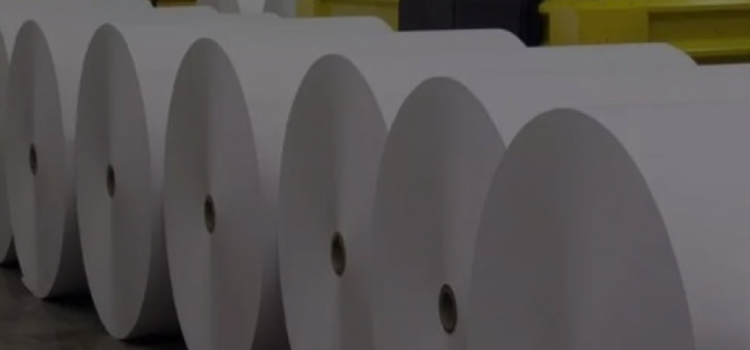
For over four decades the author worked with paper as labelstock manufacturer. Reels of paper received fresh from the mill were often cool to the touch, a sign of higher moisture content, since evaporation causes cooling. Paper is hygroscopic: made of cellulose fibres with a natural affinity for water, every sheet, reel, or board continues to exchange moisture with the surrounding air throughout its life. This never-ending “breathing” lies behind more printing and converting problems than almost any other variable—curl, cockle, misregistration, static, brittleness, poor lamination bonds, weak corrugated boxes, and inconsistent print quality all trace back to moisture, directly or indirectly.
This article covers why moisture content (MC) matters, ideal levels for different papers and boards, and its effects on costing, printing, converting, storage, and incoming QC.
1. What “Moisture Content” Means and Why Paper Holds Water
Moisture content is expressed as a percentage of total paper weight:

Cellulose fibres have hydroxyl (–OH) groups that hydrogen-bond with water in the air. As relative humidity (RH) and temperature change, paper absorbs or releases moisture until it reaches its equilibrium moisture content (EMC); where it neither gains nor loses water relative to its environment. Due to hysteresis, paper drying down settles at a slightly higher EMC than paper wetting up to the same RH, so the sheet’s moisture history matters, not just current room conditions.
Equilibration moisture content time scales with thickness: thin sheets typically take 30 minutes, typical offset sheets 2–4 hours, thick boards considerably longer—which is why acclimatisation matters before running paper.
2. Ideal Moisture Content by Paper and Board Type
There is no single “correct” level; it depends on grade, coating, and process. General benchmarks:
| Paper / Board Type | Typical Ideal Moisture Content |
| Digital printing papers | 4.5% (minimises curl, aids toner adhesion) |
| Offset (sheetfed) papers | 5.5–6% |
| Coated woodfree / art paper & board | 4.5–5.5% (higher risks heatset blistering) |
| Uncoated woodfree | 5–6.5% |
| Newsprint | 7–8% |
| Tissue | 2–7% |
| Corrugated medium/liner | 7% |
| Kraft paper (sack/wrapping) | 6–8% |
| General stock before conversion | 4–6% |
Most commercial papers are made to 4–6% absolute MC and expected to stay stable in a 45–55% RH environment. The right number should ultimately come from the mill’s technical data sheet and your own experience, these are starting benchmarks, not universal law.
3. Moisture, Weight, and Costing
- Paper is sold by weight, so moisture is sold too. A reel at 6% MC holds more water-weight than the same reel at 4%, despite identical fibre content—buyers effectively pay paper prices for water.
- Paper gains or loses weight after leaving the mill depending on warehouse, transport, or pressroom RH relative to its EMC (picking up moisture in humid monsoon transit, losing it in dry heated winter storage). This is why mills use moisture-barrier packaging and why unwrapping paper to sit unconditioned is risky.
- Wrong moisture is a hidden cost centre even at correct invoiced weight: it surfaces later as makeready waste, wash-ups, misfeeds, static downtime, rejects, and rework—costs that hit the job sheet, not the paper invoice.
- Conditioning (45–55% RH air handling) costs energy, but unconditioned press halls usually cost far more in spoilage.
Worked example: A modest labelstock maker converting a million m² uses approximately 70 tons of face paper. At 6% moisture that’s 4.2 tons of water versus 2.8 tons at 4%, a 1.40-ton difference. At Rs. 75/kg, that’s a loss of Rs. 1,05,000 per month (Rs. 12.60 lakhs per year). The bigger the consumption, the bigger the loss when paper is supplied above EMC.
4. Expansion, Shrinkage, and Effect on the End Product
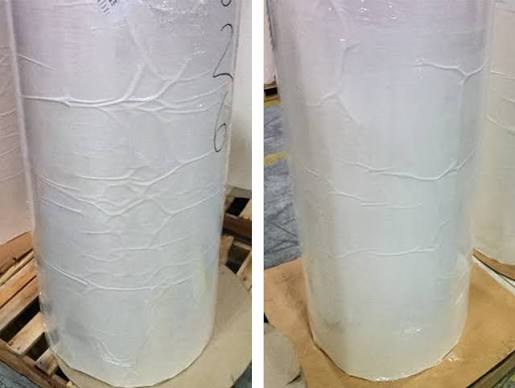
Paper is hygroexpansive—it expands when it gains moisture and shrinks when it dries. Critically, this is non-uniform: expansion is far greater across the width (cross-direction, CD) than along the length (machine-direction, MD), because fibres align predominantly in the MD during manufacture.
In labelstock siliconizing, paper passes through a hot tunnel up to 160°C; width visibly reduces from 1020 mm to 1010 mm from moisture loss, though it substantially regains width after rehumidification.
- A 10% RH change shifts width by roughly 0.1–0.2%—tiny, but on a large sheet or long run enough to throw off image size, panel fit, and diecut register.
- Paper that swells (from pressroom, water-based ink/coating, or ambient humidity) then shrinks when dried, but rarely back to original dimensions and rarely evenly.
- Consequences: labels/cartons that no longer fit their container; folding cartons whose panels misalign; laminates that curl or blister as paper shrinks against dimensionally stable film; and text/image creep front-to-back in a bound book block.
- This is why the same sheet behaves differently on a humid morning than a dry afternoon—operators aren’t imagining it.
5. Moisture’s Effect on Edges: Cutting and Slitting
Edges are the most moisture-sensitive part of a sheet or web, exchanging moisture faster than the interior.
- Wavy (“cockled”/loose) edges: edges picking up more moisture than the centre expand and become baggy, causing uneven feeding, slitting drift, and telescoping rolls.
- Tight edges: dry edges relative to a moist centre pull tight, creating a dished “tight-edge” curl that jams sheetfed gear and causes web breaks.
- Cut quality: overly dry paper turns brittle at the edge, micro-cracking, dust/fibre “fluff,” and ragged feathered cuts that contaminate blades and downstream units, showing as pinholes in solid-ground printing.
- Dimensional creep: cross-width moisture variation makes slit widths vary edge-to-centre, failing width tolerances in narrow-web converting.
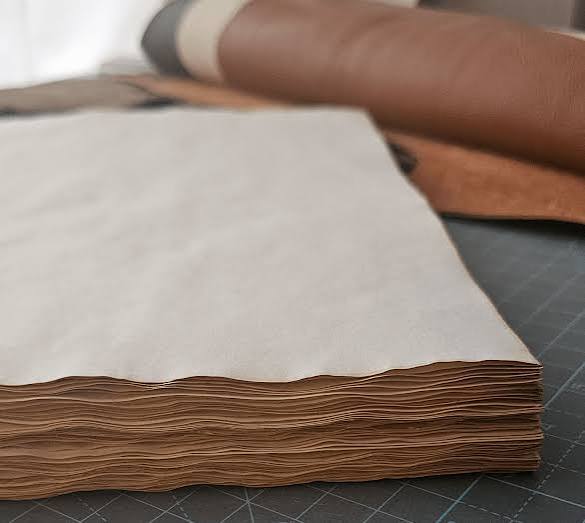
Edge trimming and re-conditioning, or simply acclimatising wrapped paper in the pressroom before opening, is standard best practice.
6. Overdried Paper: Brittleness and Static
Too-low moisture brings two linked problems:
- Brittleness: dry fibres lose flexibility, giving hard papers that break on the web, lack print cushion, and crack when folded, showing up as cracked folds, split scores, and web breaks on high-speed presses.
- Static: dry air and paper are poor conductors, so friction from feeding and separation builds static rather than dissipating it. Below 40% RH, sheets can build electrostatic charge, sticking together and attracting dust.
Combined converting impact: double-feeds/misfeeds, dust-attracted print defects and coating pinholes, poor stack squaring, brittle cracking at creases, and increased scrap and downtime for static-bar adjustment.
7. Dimensional Stability, Curl, and Strength
These three properties are tightly linked to moisture and each other:
- Dimensional stability—holding size and shape as conditions change, is governed by fibre orientation, moisture variation, and any bonded coatings/films.
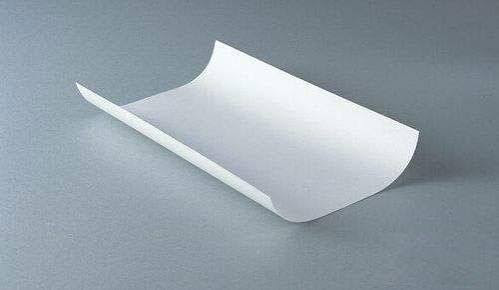
- Curl occurs when moisture differs between a sheet’s two faces, common with coated papers (one-side barrier coating) or one-side-printed sheets (ink/press water wetting one face). The wetter side expands more, curling the sheet toward the drier side. Uneven face/liner movement in a laminate can cause tubing, rendering product unusable.
- Strength (tensile, tear, burst, fold endurance, edge crush) peaks within a specific moisture band: too little makes fibres brittle and fracture-prone; too much softens fibre-to-fibre hydrogen bonds, cutting stiffness and compressive strength, that is why corrugated loses stacking strength in humid warehouses.
Good register, flat delivery, and consistent folding all depend on keeping moisture and moisture uniformity in a tight band.
8. Moisture Effects Across Paper & Board Types
| Substrate | Moisture-Related Behaviour | Applications Affected |
| Uncoated woodfree | Forgiving; absorbs press moisture, prints predictably, curls if imbalanced | Stationery, books, forms |
| Coated paper/board | Surface-sensitive; excess moisture blisters in heatset drying, too little cracks on creases | Labels, cartons, magazines |
| Kraft paper | Strong, tolerant of swings, but wets and expands significantly | Bags, sacks, wrapping |
| Corrugated board | Very sensitive; flute geometry and adhesive bond weaken as MC rises | Shipping cartons |
| Label stock | Multi-layer—each layer moves differently, causing curl, edge lifting, register drift | Pressure-sensitive labels |
| Tissue/lightweight | Very fast equilibration; needs tight humidity control | Hygiene products |
9. Moisture and Printing Processes / Inks
Sensitivity varies by process:
- Offset (litho): most moisture-sensitive, since the process adds water via fountain solution. Too-dry sheets absorb solution unevenly and pick less ink; too-moist sheets upset ink-water balance and slow drying. Run at 40–60% RH (optimum ~50–55%) to avoid curl, creasing, and dot doubling.
- Letterpress: no fountain solution, but fully subject to dimensional, curl, brittleness, and static effects.
- Flexography: water-based inks make substrate moisture affect absorption/drying directly, especially on absorbent papers and kraft.
- Rotogravure: less humidity-sensitive (fast-drying inks in engraved cells), but web tension and register on long runs still shift with moisture.
- Digital laser (toner): sensitive via the heat-fuse step, excess moisture flashes to steam causing curl/blistering/poor adhesion; too dry, static disrupts feeding. Needs 50–55% RH.
- Digital inkjet: absorbency and moisture affect dot gain and drying; prefers 45–55% RH to prevent ink spreading.
Ink type matters: oxidative/absorption-drying inks (litho, letterpress) depend on paper absorbency and fountain-pH interactions; water-based flexo inks depend on absorbency; solvent inks resist sheet moisture but not dimensional movement; UV inks are least sensitive during cure, though the substrate still moves and curls.
10. Does Moisture Impact UV Printing?
UV inks cure by photoinitiated polymerisation, not evaporation or absorption, so moisture doesn’t interfere with the curing chemistry—a key UV advantage. But moisture still matters indirectly:
- The substrate still expands, shrinks, curls, and builds static exactly as for any process.
- Poor ink holdout on moist, absorbent sheets can cause uneven gloss or mottle.
- Static from dry/brittle stock still causes feeding and stacking problems.
- Intense lamp heat can flash off surface moisture unevenly, occasionally causing localised curl.
11. Moisture, Registration, and pH
Registration: Multi-colour jobs need the sheet to hold a precise, repeatable size pass-to-pass. Since moisture-driven change is mainly cross-direction, uneven moisture between passes—or drying over a long run—shifts dot position. Tolerances are often ±0.1%, yet a 15°C temperature change at constant humidity can shift EMC by ~0.5%, enough to cause visible misregistration or ghosting. Sheetfed printers therefore often run paper slightly above final EMC, letting the press’s own heat and fountain solution move it toward equilibrium predictably.
pH: Water is the medium through which acidic/alkaline components become chemically active.
- Paper pH ranges ~4.0–8.0; most modern (alkaline-process) paper falls at 6.0–8.0.
- Acidic paper slows ink drying—below pH 5 drying can nearly stop, worsened at high RH as extra water drives hydrolysis. Strongly acidic paper can emulsify ink and cause scumming.
- In offset, control temperature (20–23°C) and RH (50–60%) to manage acidity/moisture drying issues.
- Highly alkaline paper (pH >9) neutralises the fountain solution’s acidity, causing its own press-control problems.
- For archival work, neutral-to-slightly-alkaline (pH ~7) is preferred, since acidic paper yellows and embrittles over time.
12. Moisture and Coatings (Water-based, Solvent, Hotmelt, UV)
Each system interacts with substrate moisture differently:
- Water-based: rely on the substrate absorbing water to set, a near-saturated (high-MC) sheet accepts it slowly, extending drying, risking blocking, and increasing curl; an overly dry sheet absorbs too aggressively, causing mottle.
- Solvent-based: less affected during drying (solvent evaporates, not water), but residual water pickup and solvent-driven fibre swelling still cause curl/register shift.
- Hotmelt: set by cooling, but application heat flashes surface moisture unevenly and trapped moisture can steam-blister the bond.
- UV-curable: most moisture-tolerant at cure, but substrate moisture still governs wetting/holdout and dimensional stability.
General rule: coatings interact with a substrate actively gaining/losing water, so substrate moisture control before coating is as important as coating chemistry.
13. Impact on Corrugated Box Compression Strength
One of the most commercially important and measurable effects:
- Stacking strength depends on edgewise compressive strength of liner and fluting (ECT), and high humidity softens fibres and directly reduces that strength.
- Corrugated fibres gain/lose moisture rapidly in warehouse climates, and even minor RH shifts change flute stiffness and liner compression strength, which is why ECT (Edge Crush Test) standards condition specimens at 23°C and 50% RH for at least 24 hours before testing.
- The scale is large: at 50% RH a box retains rated strength, but at 80% RH it typically falls 30–40%, and at 90% RH by 50% or more, because moisture breaks the hydrogen bonds giving corrugated its stiffness.
- Kraftliner and fluting are less moisture-sensitive than recycled-fibre materials, and recycled liners absorb moisture faster, accelerating short-term strength loss.
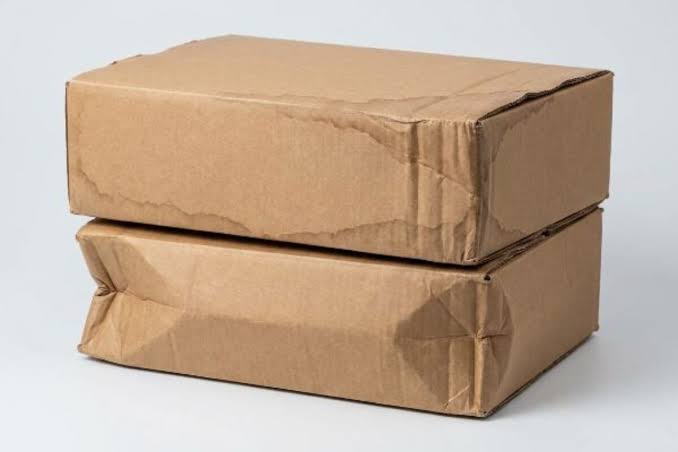
Implication: a box rated in the lab may be far weaker in a humid warehouse or ocean freight—hence building in safety margin and keeping pallets off damp floors.
14. Storage Conditions
Storage is a first line of defence, not an afterthought:
- Store at 20–24°C and 45–55% RH; most papers are designed to be stable in a 45–55% RH environment at 72°F, close to the 23°C/50% RH conditioning atmosphere used for testing.
- Keep reels/reams wrapped until use—mill wrapping is a moisture barrier; once broken, paper moves toward room EMC immediately.
- Avoid storing directly on concrete floors or against exterior walls (cooler/damper, risk condensation).
- Stack away from doors, docks, HVAC vents, and sunlight.
- Acclimatise paper in the run environment before unwrapping (hours for sheets, longer for boards), especially when moving between different-RH environments.
- Rotate stock (FIFO) to avoid seasonal humidity pickup.
15. Does Moisture Impact Caliper (Thickness)?
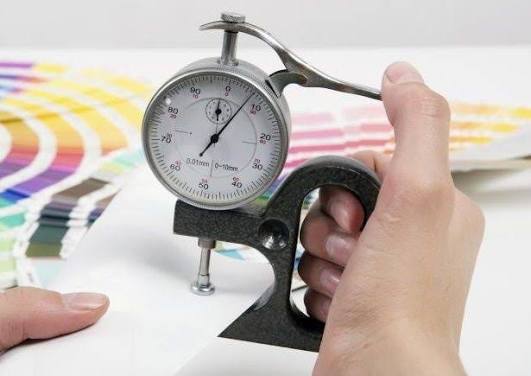
Yes. Absorbing water swells fibres in the Z-direction (Basically referring to the thickness) too, so the same board reads higher caliper at high MC than when conditioned drier—independent of basis weight. This affects:
- Spec compliance—caliper checks on receipt should be done at (or corrected to) standard conditioning.
- Bulk and rigidity—moisture-swollen caliper is less stiff per unit thickness, so a “thicker” wet sheet can feel limper than a thinner conditioned one.
- Feed and register—off-spec caliper (from moisture, not fibre) affects nip pressures, gripper settings, and die-cut depth.
16. Environment on Printing and Converting — Summary
Ambient temperature and RH influence every stage:
- Feeding/handling: static (too dry) or blocking (too humid).
- Printing: ink/water balance (offset), dot gain (inkjet), toner adhesion (laser), colour registration.
- Drying: blistering on coated stock (too-high MC into heatset ovens); poor drying on moist or acidic sheets.
- Finishing: cracked folds/scores (too dry), curl (imbalance), bond failures, die-cut defects.
- Packaging/shipping: reduced box compression and dimensional creep.
Common thread: stability matters as much as the exact number. A plant steady at 50% RH out-performs one swinging 30–70% even at the same average—because change, not a static condition, drives dimensional and strength shifts.
17. Tests on Receipt of Paper and Board
A structured incoming-QC routine catches problems before press-time:
Physical checks
- Basis weight (grammage): confirms ordered weight/thickness.
- Caliper: checked for uniformity across the lot (ideally under standard conditioning).
- Moisture content: verified against the mill’s target (commonly 4.5–7% by grade).
Structural/strength tests
- Bursting strength (Mullen): rupture pressure, key for packaging.
- Tensile and tear: predicts high-speed, high-tension performance.
- Ring Crush / Edge Crush (RCT/ECT): edgewise compression for box stacking, read alongside moisture state.
Surface/print-quality tests
- Smoothness (Sheffield, Bekk, Bendtsen): surface uniformity.
- Cobb test: surface water absorption over time.
- Wax pick: surface fibre bond strength.
pH check: a low-cost surface test flagging slow-drying, scumming, or fountain problems before the press.
18. Packing and Storing Converted Products
Finished products are still hygroscopic:
- Re-wrap or shrink-wrap promptly to slow moisture exchange, especially before long storage.
- Palletise off the floor and away from walls using slip sheets/pallets.
- Maintain the same 45–55% RH, moderate-temperature storage—finished goods are as vulnerable to curl, shift, and compression loss as raw stock.
- Keep products away from transport temperature extremes (unheated trucks, non-climate containers).
- For corrugated cartons, avoid prolonged high-humidity exposure (outdoor storage, humid ports)—compression can drop 30–50% at high RH.
- Store label/pressure-sensitive stock flat, away from heat—uneven laminate pickup causes curling and adhesive failure.
Key Takeaways
- Paper never stops moving, it exchanges moisture with its environment for its whole working life.
- Every grade has an ideal moisture band; there is no universal number.
- Moisture costs money directly (sold by weight) and indirectly (spoilage, downtime, rework).
- Dimensional change is uneven—more across width than length—so problems appear as curl, cockle, and register drift, not uniform stretching.
- Too much moisture weakens bonds; too little makes fibres brittle and static-prone. Both extremes cost you.
- Environmental stability matters as much as the exact target.
- A disciplined incoming-QC routine—moisture, caliper, strength, surface, pH—catches problems before downtime.
This article is a technical overview for printing and converting professionals. Confirm specific moisture targets, test methods, and tolerances against your supplier’s technical data sheets and relevant standards (TAPPI, ISO) for your grade and application.
Authored by Harveer Sahni Chairman Weldon Celloplast Ltd. New Delhi July 2026