Self Adhesive Labels Industry In India and The World
The pressure sensitive adhesive labels and packaging industry is growing at a steady and rapid pace in India. It is now time that the contribution of those who have achieved success is chronicled so that those who wish to move ahead have a platform to look for information, news and interaction. This Website intends to provide all that along with inspiration and reference.
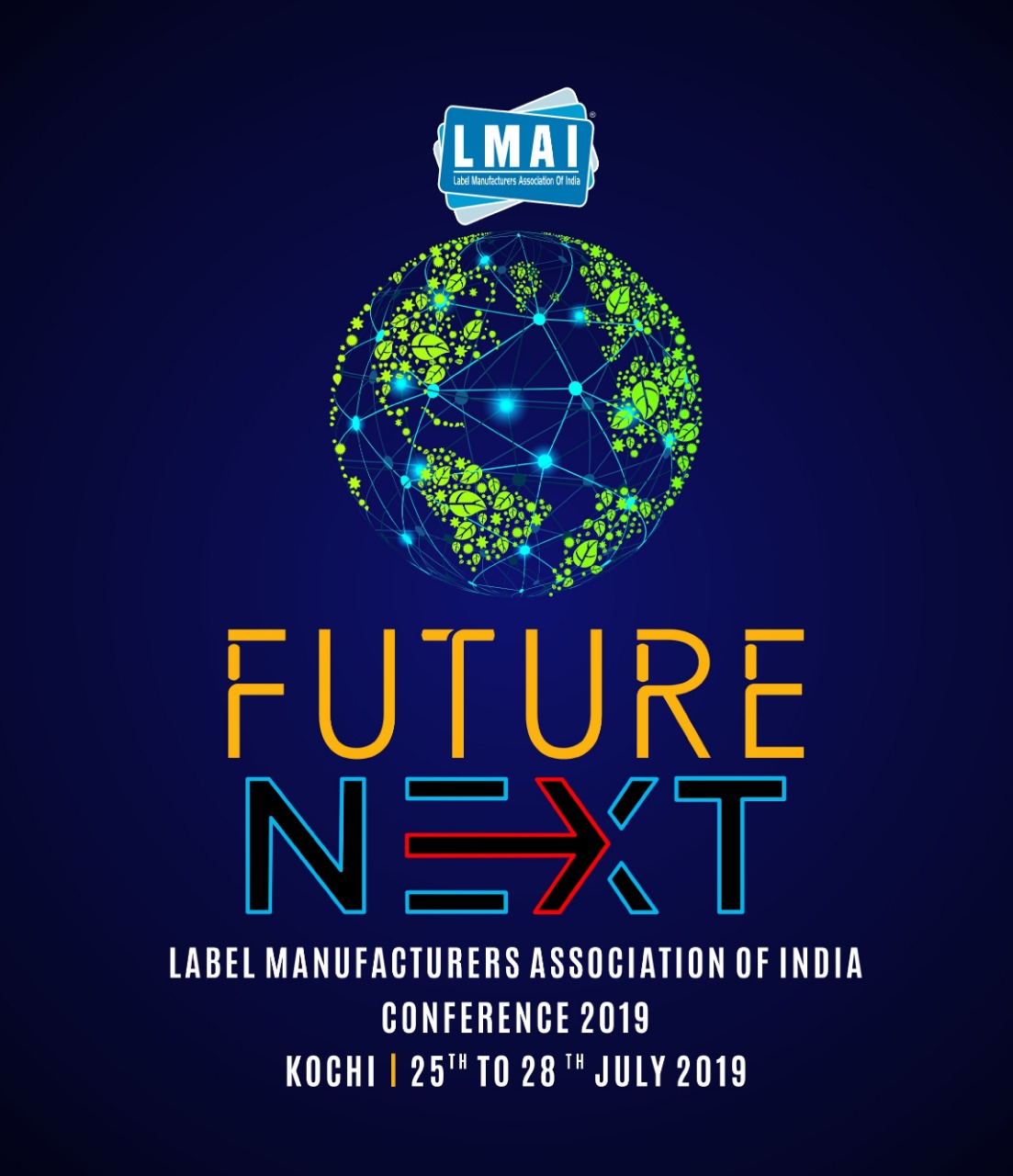
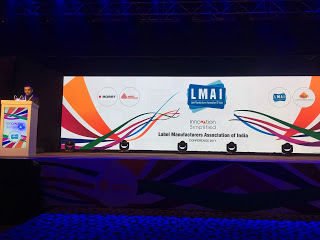
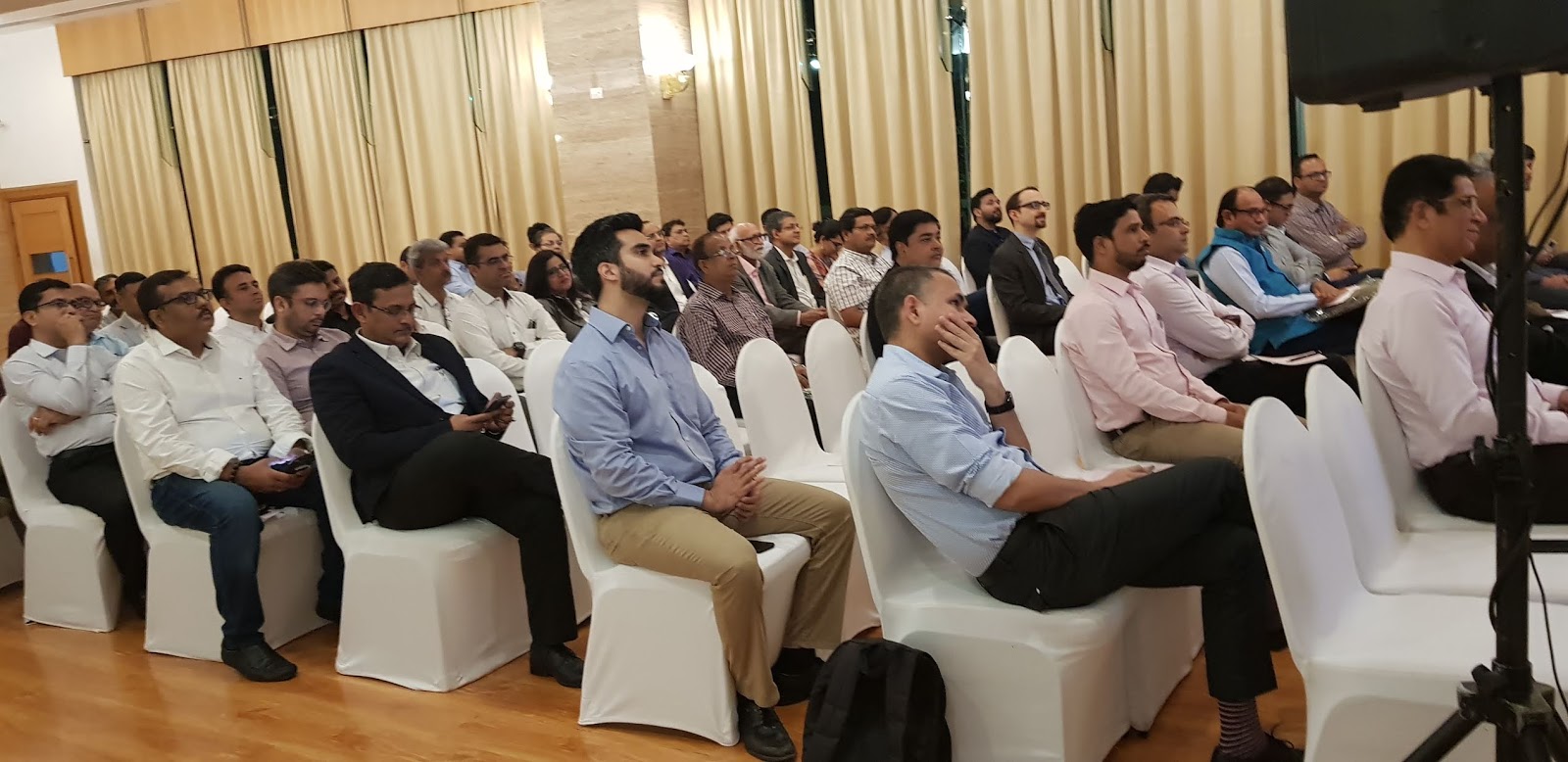
In effort to provide a platform for interaction between Brand Owners and label printers; leading to evolution, creativity in labels, understand the needs of buyers, discuss statutory requirements and evaluate sustainability in labels, the Label Manufacturers Association of India (LMAI) has been organising events. Senior packaging development professionals from leading brands in different segments like Pharma, Cosmetics, Liquor, Food, FMCG, etc. are invited to address India’s top label companies and to interact with them in panel discussions and network in a relaxed atmosphere. Printers from all categories and get to meet the people who drive the evolution and set trends for the future of labels. The 3rd such event titled, “Future-Next: Brand owners’ perception of Labels” was held on 29th June 2019 at Hotel “The Park, New Delhi”. The event was also intended to be a precursor for the LMAI conference slated to be held at Kochi in a little over three weeks. Though the LMAI Brand Owners event is restricted to only label printers yet this time all the sponsors of the forthcoming conference at Kochi, Kerala were given the option to attend and many leading suppliers to the label industry were seen together with printers and brand owners. Over 100 delegates and media persons attended a very successful event.
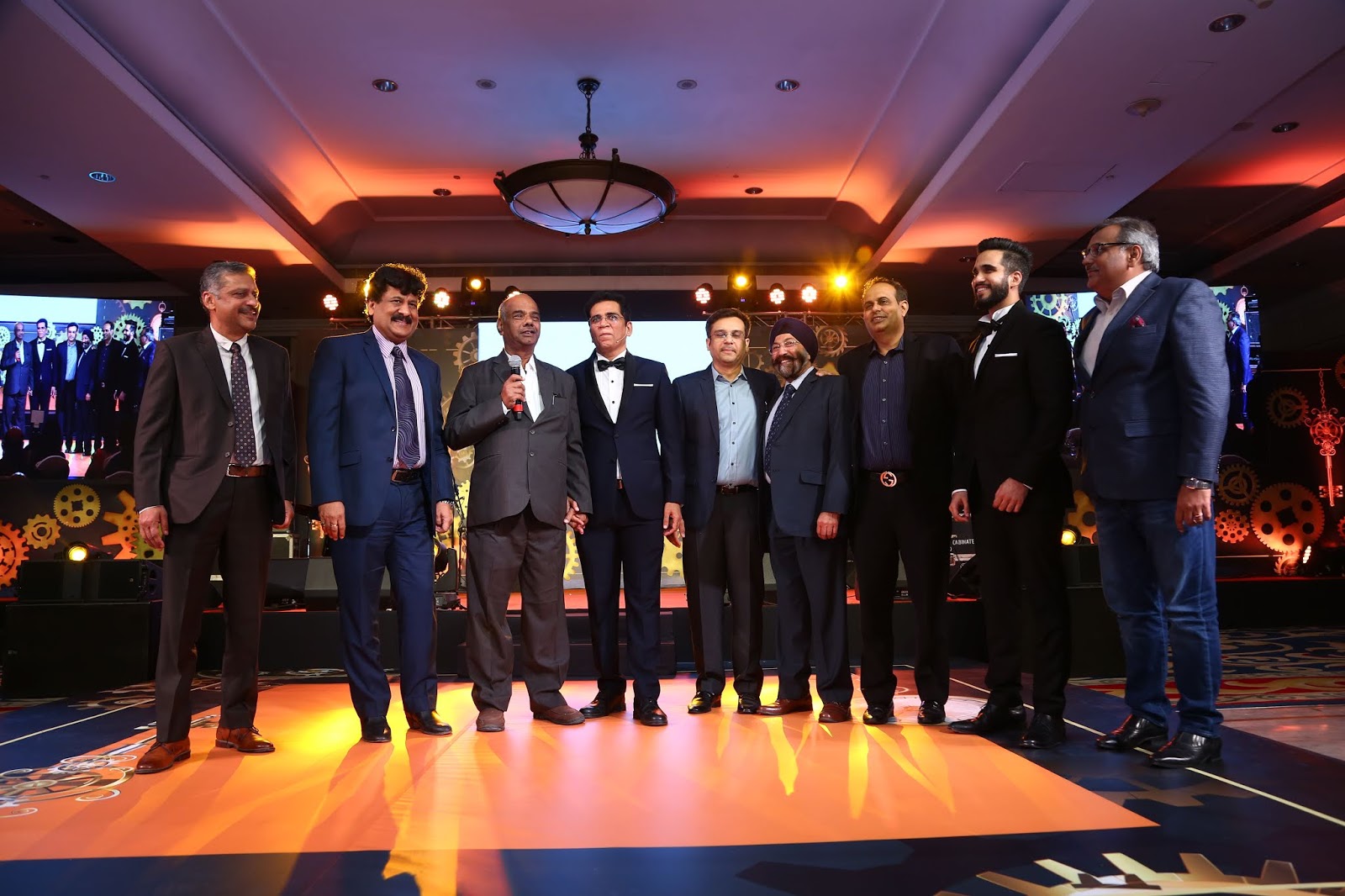
The evening was moderated by past LMAI President and Managing Director of Mumbai based Creative Labels, Vivek Kapoor. Other LMAI board members who flew in from Mumbai specially for the event include Ajay Mehta Managing Director SMI Coated Papers, Amit Sheth of Label Planet and LMAI Kochi Conference Chairman and past President LMAI, Manish Desai.
After a brief welcome speech by President LMAI, Kuldip Goel, Pavankumar Chougule Associate Director, packaging development, Dr. Reddy’s Laboratories made the first presentation.
He informed the audience about the expectations of the pharmaceuticals industry with emphasis on Regulatory compliance and Patient Safety, Smart Packaging, Secure Supply Chain, Data Security, Personalization, New Developments and Sustainability.
Santanu Chowdhury, Senior general manager, global packaging development, Sun Pharmaceutical spoke on interactive labels which he asserted is the future next for labels. Explaining the nuances of creation of embedded code on the labels and how the technology works, he dwelled on possibility of data management with integration on the servers of an organisation.
He also stressed that interactive solutions create brand loyalty. Technology offers great opportunities to digitally connect your physical products with your consumers, tailored to business goals. The consumer experience is converted into data business intelligence.
Soumyanath Mishra, head packaging development at Mankind Research Centre a part of Mankind Pharmaceuticals spoke on the requirements for pharmaceutical labelling, especially for exports. He also mentioned that Packaging & Labelling have a significant role to play as it provides the first point of contact with the patients or customers.
It provides important communication and help to build a credible brand as well. Proper Labelling helps in creating a good first impression of your product on the customers since the customer is procuring through on-line.
“Today we are a part of Generation X” said Naveen Stuart, packaging development manager, Reckitt Benckiser, he also mentioned that there is a demographic and cultural shift which is witnessed in today’s world. The generation is now moving towards a digital world.
There is an imperative need to look beyond decoration of labels, Label needs to play an extensive role in package design process and convey the whole brand story. As regards digitalization he said; behavior of consumer is paramount to brand owner’s decision, error free smart label process, quick turn-around time and consistent quality. Also, digitilization in pre-press process aids error free production.
A very interesting presentation was made by Tamal Ghosh, strategic packaging development leader, corporate packaging development, Dabur India whereby he spoke on Brand Owner’s perspective, on labeling trends and their expectation and requirements that they need from converters.
These expectations include need for thinner filmic release liners contributing to sustainability as they can be recycled and lower tonnage of liner waste, flexible filmic label substrates for contoured shapely containers and label decoration capabilities.
The last presentation was made impromptu by none other than Somnath Chatterjee GM procurement in Pernod-Ricard India, he spoke on the imperative decorative and brand security needs of liquor industry. He asserted, it was an imperative to deliver genuine and safe products to consumer customers who trust them.
A panel discussion followed, moderated by the author, Harveer Sahni of Weldon Celloplast. A very interactive session that dwelled on various aspects of label industry. Barun Banerjee, Head of Packaging Nestle, gave very important inputs as regards government regulations and sustainability.
All speakers and guests on the panel enlightened the audience. Final comments of Kuldip Goel President LMAI and Managing Director Any Graphics were “We need to mentor our generation next for the label industry to move on”
All sponsors to Kochi conference were invitees and many like Avery, SMI, Label Planet, Vinsak, Reifenhauser, Weldon, etc. attended. Leading printers besides those in LMAI management from various locations in India included, Manish Desai-Mudrika Labels Mumbai, Sanjeev Sondhi-Zircon Dehradun, Priyata Raghavan-Sai Security Faridabad, Yoga Murthy Chromaprint Coimbatore, Mohit-Encana Baddi, Ankit Kapoor-Printrays Jalandhar, Parshav and Rishab Jain, Jain Transfer-Noda, Aditya Chadha-Update Prints Gurgaon, Gurpreet Dilawari-Printwell Haridwar and so many more.
Networking
The evening ended looking forward to getting together again at KOCHI! Written by Harveer Sahni Chairman Weldon Celloplast Limited New Delhi July 2019 Print publications are free to reproduce this article by giving credit to author
India’s label association LMAI’s 5th biennial conference is planned to be the biggest and most successful event of Indian label industry. The event is scheduled to be held at recently opened property, HOTEL GRAND HYATT, KOCHI, BOLGATTI from 25th – 28th July, 2019. Perched on 26 acres of plush green land on the serene Bolgatty Island, Grand Hyatt Kochi Bolgatty is a waterfront urban resort overlooking the backwaters of Vembanad Lake.
Grand Hyatt Waterfront
Leading label printing companies and suppliers will meet to discuss, evaluate opportunities, learn and strike business partnerships that shape the future of their businesses in relaxing ambience and surroundings. LMAI conference has been growing in strength and numbers over the years.
2017 LMAI Conference at Agra
The last conference was held at Agra with 550 delegates. The LMAI leadership is expecting the attendance to jump up to 600 delegates. An elaborate knowledge sharing, entertainment and technical program is being put in place to deliver value to the LMAI members coming from all over India.
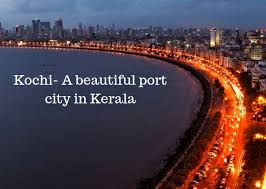
About the city Kochi: Kochi (formerly known as Cochin) is a city in southwest India's coastal Kerala state, fondly referred to as “God’s own country”. It has been a port since 1341, when a flood carved out its harbour and opened it to Arab, Chinese and European merchants. Sites reflecting those influences include Fort Kochi, a settlement with tiled colonial bungalows and diverse houses of worship. Cantilevered Chinese fishing nets, typical of Kochi, have been in use for centuries.
St.Francis Church Kochi
St. Francis Church was the original site of Portuguese explorer Vasco da Gama’s burial when he died in Kochi in 1524. Santa Cruz Basilica is known for its pastel interior, including an imitation by Fra Antonio Moscheni of Leonardo da Vinci's "The Last Supper." Paradesi Synagogue, founded in 1568, features imported Chinese blue-and-white ceramic floor tiles. The surrounding quarter, once home to a large Jewish community, is now filled with antique shops and old spice warehouses. Mattancherry Palace, built by the Portuguese in the 16th century and later renovated by the Dutch, showcases vivid Hindu murals.
Label Manufacturers Association of India, LMAI has a strong support of the label industry suppliers as sponsors which has been growing steadily, making their conference, the most important label event in India.
The following leading industry suppliers from across the world have registered as sponsors and there are still a few more on the waiting list;
The LMAI leadership will soon be closing the registration of sponsorship for this, three nights four days event.
Kuldip Goel
LMAI President Kuldip Goel says, “Unlike exhibitions, the LMAI conference intends to bring together the Indian label fraternity at one venue for four consecutive days. The suppliers get a chance to spend full time with their prospective customers in a relaxing atmosphere” he further adds, “Since many delegates come with family, it brings about a unique bonding within the industry, creating the feel of belonging to a large entity, the Indian Label Family!”.
Marriott Kochi
The conference registration process has started from 1st April 2019. In the first phase registration has been opened for LMAI ordinary or printer members so as to give them the first option for accommodation in the main event venue i.e. Hotel GRAND HYATT, KOCHI, BOLGATTI. Registration will be on first come first basis. Registration for Associate or supplier members will begin a little later. Once the main hotel venue is full, additional delegates will be accommodated in another property i.e. MARRIOTT, KOCHI a short distance from the main event venue. Adequate arrangements are being made to transport delegates to and fro, between the two hotels.
Manish Desai
LMAI Conference Chairman Manish Desai says, “We have already held the previous conferences at Goa in western India, Jaipur and Agra in North India and this time we moved it to South delivering value to our members. LMAI being a pan national association is committed to bringing value and fellowship amongst the Indian label community spread across the length and breadth of India”. He also mentioned that the south India based members who found it inconvenient travelling long distances to north will also be able to attend conveniently and bond with their peers around the country.
Only members in good standing who have paid their membership fees are allowed to register. Non-members can only register by first becoming members of LMAI. This conference is slated to be better and bigger than ever before.
It is time yet again for the vibrant colourful world of labels to congregate in Kochi to experience the friendship and fellowship with global suppliers and competitors.
Labels in today’s time have become the face of a product and gained immense importance being the first point of contact between the manufacturer of a product and its end user. It maybe a piece of paper, film, cloth, metal or another sheet of material on which information about the product is written, printed etched or embossed and the label so created is affixed to the package or the product. At times, information is printed or engraved directly on the product to perform as a label. Systematic and conscious writing started in the middle of the 4th millennium B.C. and with it started a demand for improved writing materials.
The first written words are found etched on stone, later the Egyptians invented papyrus or parchment from which the name paper is derived. Papyrus was an early nonwoven fabric. Reeds 12 to 20 feet high and 3 inches in diameter were cut in thin slices, laid side by side, and beaten with a mallet, after these were brushed with a floor paste, fresh slices were placed at right angles and the beating was repeated, the finished papyrus, was luminous brown. Before the invention of paper in A.D. 105 by Tsai-lun, a minister of agriculture in the court of Ho Ti, the Chinese wrote on silk and thin fibres of wood and grass. Woodblock printing, which is a technique for printing text, images or patterns on paper, originated in China around 200 CE (Common Era, a modern alternative for AD). It is process by which blocks of wood are chiselled to create images that are inked and pressed on to paper to transfer an image of text. The earliest use of paper as packaging was in Egypt during 1035 when it was observed that vegetables, spices and hardware were wrapped in paper while selling. In middle of 15th century a German goldsmith Johannes Gutenberg assembled the first mechanical printing press that would apply ink on a block and press it on paper or cloth to transfer the image. The earliest labels designed in Europe were simply small pieces of parchment tied with a string to the neck of wine bottles, even though the Egyptians had started using gum Arabic from Accacia trees, or resins from trees for various decorative uses including pasting labels on to products. By 1700, labels started being designed by engraving on stone, ink applied on it and a roller was used to transfer the image on to paper. By 1798 Lithography had been invented and labels started being made in large quantities evolving further to be produced in colour with flat bed printing. This was the initiation of what is today known as wet glue labels. The wet glue labels have been used till the beginning of 20th century after which other forms of label production surfaced. Various printing technologies to print are employed, these include letterpress, offset, Rotogravure, Flexo, Screen Printing, Digital printing, etc. This article does not intend to dwell on the technology of these processes but on the changes that came about in evolution and usage of diverse label technologies.
Wet Glue Labels
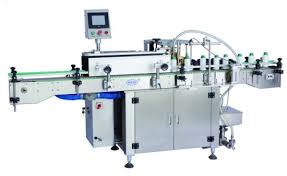
wet glue Label applicator
For hundreds of years paper labels printed with different printing process like lithography, letterpress, screen, offset, etc. have been in use by affixing with a variety of adhesives. These varied from floor pastes, to fish glues, gum Arabic, animal glue, etc. This was majorly for manual labelling applications. With the development of starches and dextrin-based adhesives, these started being extensively used for labelling. As volumes started to grow steadily, need was felt for automatic high-speed wet glue labelling where fast drying was a challenge. At this time, high solids dextrin based quick drying adhesives were successfully developed. The automatic label applicator industry developed and prospered. Till date many wet glue beer and liquor labels are still applied with dextrin-based adhesives. These do have a shortcoming of shifting on high speed applicators while packing when still wet, shrinking or warping in presence of moisture or falling off when chilled. Synthetic adhesives with over 50% solid content have also been developed to overcome these issues but accurate placement and the labels shifting due to being packed while still wet is not aesthetically approved in modern retail. These adhesives still contain 50% water to dry. Also, the need for clean room production facilities needed, has now made wet glue labels a deterrent.
Self-Adhesive Labels:
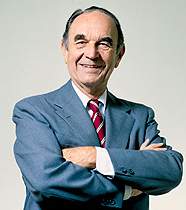
R Stanton Avery
A story that led to a development of self-adhesive or pressure sensitive labels given below, changed the way labels would be known eventually:
Living in a rented chicken co-operative, a young American poverty-stricken man in his early 20s worked as a night clerk to fund his education. He stopped school and went to live for a year in China, where he gained experience working with a printing press. He returned to USA after the year, graduated and desperately tried his hands at various business options, he even sold smoked bananas! He then took on a morning job at a flower shop and later in the day started to experiment on various small things in a 100 square foot place nearby. He came up with the idea of making self-sticking labels. With the printing press experience behind him he saw the vision to start his new venture. With no money of his own, he borrowed 100$ from his fiancée, Dorothy Durfee, who later became his wife, to invest in his start-up business. Using a washing machine motor, parts of a sewing machine and a saber saw, he developed the world’s first self-adhesive label cutting machine. In 1935 he started his maiden venture Kum-Kleen Adhesive Products Company which would be the mother enterprise of the world’s largest labelstocks company Avery Dennison Corporation and this poor man was "Ray Stanton Avery!".
This pioneering development made by him, evolved over the years with need of labels to be made in roll form to dispense automatically on faster packaging lines as PSA labels make an instant bond on application and do not need drying time. Initially the label face used was only paper, but the release liners needed to be developed further to provide for easy release and dispensing. Over the ensuing years, silicone coating and their chemistries were worked upon to reach perfection in dispensing the labels on high speed packaging lines. Adhesive technology also advanced to adhere to various substrates, withstand varied application or service temperatures and diverse weather conditions. The face material also has now a wider variety with many filmic and non-conventional face materials like cork, fabric, and foil being used. The printing and converting over the years have also undergone a sea change from simple flat bed printing to now advanced flexographic printing in combination with multiple printing processes and decoration processes like lamination, varnishing, cold foiling, hot foiling, embossing etc. All these processes, inline in a single pass. The pressure sensitive labels have evolved in different tangents to produce barcode labels, RFID labels, Security labels, removable labels, etc.
Screen printed labels and containers;
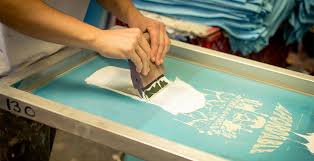
Though types of labels and not printing technologies is the point of discussion in this article yet screen printing gains importance as it evolved to be used as a stand-alone label on products without any carrying substrates. For this reason, the origin of screen printing is dwelled upon. The idea of screen printing originated from stencilling used in Japan when designs were cut in banana leaves and ink was pushed through the holes to transfer images to substrates. In the start of 20th century when silk screen became available the screen printing evolved further. Later as the process developed, Nylon or Polyester bolting cloth of different mesh was used to make printing screens on wooden or Aluminium frames. As chemical evolution took place Chromates like Potassium Bichromate were dissolved in a PVA solution and coated on the screen, dried in dark and then placing the negative or Positive of the design on the screen was exposed to UV lights. Earlier the exposure was done in Sun light, but later high intensity lamps were used. The screen was then washed so that the parts that were exposed became insoluble and the rest of the design opened. Using a squeegee or a blade the ink is pushed on to the substrate forming a perfect image. Later photo sensitive films became available eliminating the need for the bichromate chemicals. For more colours, multiple screens are used. Screen printing directly on products eliminated the imperative use of paper as substrate as machines were developed for printing directly on round containers. This enabled 360 degrees print visibility on the products. For short runs of paper labels screen printing was also used. With increasing demand for attractive labels and development of increased decoration capabilities available on flexo label presses and alternate printing technologies, screen printing on containers lost the market substantially in product labelling segment.
Wrap around Labels
Wrap around labels
Once the idea of 360 degrees print visibility, people started to use offset printed paper labels to manually label round bottles using starch-based adhesives. The size of the labels was kept such that the label went all the way around the bottle. These labels worked well on glass bottles but when it came to HDPE plastic bottles, being a low energy surface, the adhesive would not anchor on and with time the labels tend to fall off. This problem was initially over come by increasing the length of the label such that there was an overlap after wrapping around of the label and the bond was between paper to paper. Label printing evolved to be produced on flexo presses with capabilities to decorate them in line both in paper and films. With filmic labels being made available in roll form it enabled their usage on automated packaging lines and label applicators for wrap around labels as well. The label applicators for wrap around labels are fitted with hotmelt adhesive dispensers to glue and form instant bonds at label ends in high speed packaging lines. Wrap around labels are now being extensively used for beverage bottle labelling.
Heat transfer labels
Heat transfer is a labelling technology branded as Therimage, was developed in the 1960s by Dennison manufacturing company based in Framingham USA, in which reverse printed labels on film or paper are transferred off on to a container using heat and pressure. These labels are printed by rotogravure printing process and transferred with help of Therimage heat transfer applicators. Once applied, the labels are permanently adhered to the container. Dennison Manufacturing begun in 1844 by Aaron Dennison, a Boston jeweller, it grew into a large enterprise offering from graphics and packaging, to variable imprinting and automotive, to home and office products. In 1990 Dennison manufacturing was merged into Avery and the new entity came to be known as Avery Dennison Corporation. The stationary and graphic business became the stationery division of the new entity but the Therimage division was sold to MCC (Multicolour Corporation) It is believed that this division was not grown further as it was in contrary to the vision of Stan Avery, the man who invented pressure sensitive labels. In recent time we see this labelling technology being adopted by some companies as it does away with the release liners and the label can be recycled along with the plastic container. Pens and other small radius containers use this technology because a decorated image is transferred without the problem of edge lifting as in self-adhesive labels on tightly curved containers or products. The technology provides a seamless, aesthetic, “no-label” look and offers 360 degrees print visibility.
Shrink sleeves
Shrink sleeves surfaced many years ago but they started being used as 360 degrees visible labels due to pioneering development done by Fuji Seal of Japan in 1965. Shrink labels are printed on a specially formulated film with unique characteristic, that shrinks on application of heat to form and fit to the special shape and contours of the product, container or a package. Each design is unique in creation as a special software helps create the prepress to account for distortions and make the label, legible, attractive and in symmetry with the shape of the package. Since the printing is done on the reverse, it remains protected under the film. The shrink sleeve market started to grow at a faster pace only in the 1980s. In USA its growth from 75 million dollars in the year 2000 to 700 million dollars in 2014 is proof of this technology’s success. According to market report by “marketsandmarkets” the global market size is projected to reach USD 13.20 Billion by 2020, at a CAGR of 5.5% from 2015 to 2020. The Asia-Pacific region accounted for the largest share in terms of value, followed by Europe and North America in 2014. In recent years, the Asia-Pacific region has progressed significantly in the shrink sleeve & stretch sleeve labels market, which primarily includes emerging economies such as India and China
In Mold Labels
Paper or film printed labels (mostly filmic) are placed inside the moulds during the molding process. After placing the label, molten plastic is injected into the mould. On cooling the label is fused with the resin, takes the shape of the so molded container and becomes an integral part of it. The labels referred to as IML can be printed and decorated by any of the processes i.e. Offset, Flexo Gravure or digital. The end result is a highly decorated container. These IML applied containers are used for Ice cream, butter, paints, food packaging, etc. According to research firm MarketsandMarkets, the global in-mold label (IML) market is projected to grow from $2.58 Billion in 2015 to $3.23 Billion by 2020, at an estimated CAGR of 4.54%. It is the fastest growing segment amongst the various label segments.
Digital printed labels
The history of digital printing is rather short. Xerox introduced photo copying in 1960 but it remained a document managing equipment company for long. In 1977 Benny Landa known as father of digital printing setup his company Indigo to produce faster photocopying machines. He soon realised that the ink used in photocopying machines could be used in printers. Developing the idea further he launched the world’s first digital colour printer to make computer to print possible. Digital printing captures images from a matrix of dots, called pixels in a process called digitising. These digitised images are then used to control the deposition of ink, toner or exposure to electromagnetic energy to reproduce the data. In 2001 Benny Landa’s company Indigo was acquired by Hewlett Packard Company (HP). The digital printing market according to Smithers Pira has been growing steadily ever since to reach a figure of 120.9 billion US Dollars in 2012 and estimated to reach a whopping 387 billion by 2024. Digital printing is broadly categorised in two processes i.e. electrophotography or dry toner-based technology and Inkjet printing using liquid inks. Also, as per Smithers Pira report, Electrophotography is the major contributor to the digital market. However, inkjet is the sector which is growing more rapidly. Inkjet is forecast to overtake electrophotography after 2019 and by 2024 inkjet will account for 56% of the value and 53% of the digital print volume. The digital printing technology will spread to fields of labels and packaging. Cartons, rigid packaging, flexibles, metal and corrugated are sectors that will largely take up digital production method.
Helmut Schreiner
Digital printing is now recognised the most disruptive technology in the field of printing. According to Vandagraph report about its impact on labels industry, “Digitally printed labels is a market seen as already mainstream, although with plenty more scope for growth. Narrow web inkjet presses are already used for labels and packaging options including small folding cartons, flexible packaging, pouches and sachets, form-fill-seal and blister packaging. European Label Industry Association Finat has also revealed that European digital label press installations overtook conventional press sales for the first time in 2017. Digital printing is the future, with continuous growth it is already registering a faster CAGR than other technologies in many geographical zones around the world. In 2013, the author while interviewing Helmut Schreiner, former Chairman of Schreiner Group had asked him about the new label technologies impacting PS labels, his reply was, “All technologies will coexist. The customer today is very knowledgeable and knows about the increasing number of options available. Labels are a necessary decoration for any product, innovation is the need of the hour. For example, one can design a label such that if you touch a label, it plays music.” He added, “I am a fan of innovation. If everyone sells tomatoes, I would like to sell peaches!” Adding a word of caution, “Printing directly on products is dangerous, it reduces cost and could decrease the demand of labels”. He was hinting at Digital printing directly on products.
Written by Harveer Sahni Chairman Weldon Celloplast Limited, New Delhi India April 2019
Label manufacturing continues to evolve into different tangents involving diverse technologies. The retail selling scenario is undergoing a sea change as also the need to make consumers repetitive buyers of branded products. The times of shopkeepers promoting sales of their preferred brands is transforming rapidly into one where the consumers decide on their own what to lift off the shelf, given the modern retail growth. In view of growing need for printers having capabilities to produce decorative and innovative labels that catch the consumer’s eye providing brand security and enhancing the brand’s image as well; there is an imperative need for brand owners to connect with the label converters. In such a scenario, India’s label association, Label Manufacturers Association of India (LMAI) organised a program exclusively for label printers titled, “Brand owners’ perception of labels in changing scenario” at hotel, The Orchid, Mumbai. The program was attended by over 100 delegates comprising mostly of top end label printing companies, packaging professionals of renowned brands, sponsors and LMAI board members. It was an effort to promote the positive escalation of labels in a changing scenario bringing the stake holders at a single platform to strategise a win-win solution.
Following prominent speakers shared their thoughts:
Prabir Das Head – Packaging Tech. Services Mylan Laboratories Limited segment: Pharma
Ainain Shahidi, Director SIES School of Packaging was special invitee who moderated the event
Other Packaging industry professionals who attended the program include Fazal Farooqui DGM Packaging Development Zydus Wellness formerly Kraft Heinz Company, Sunil Patil-HPCL and Ms. Koel Bhadra-Packaging development Professional.
Delivering the keynote address Suresh Gupta, former Chairman Huhtamaki-PPL expressed his philosophy of success for the entrepreneurs present, “Sound fundamentals are enshrined in Good values; being Good compassionate people, knowing knowledge is power to be used with integrity, ever improving quality and service and continuous innovation makes for happy customers. Be the flag bearer of standard in your industry” He further cautioned printers to be ready; for the present equipment to become outdated in 5 years due to fast evolving label technologies and be ready to invest in new equipment after properly understanding the technology. Impressing upon the fact that Digital printing is the future.
Prabir Das, Head Packaging Technical Services (OSD) of Mylan laboratories spoke about Importance and effectiveness in Product-People Connectivity where packaging is the connector and labelling is the communicator. It is a necessity therefore to design the packaging that establishes the connection and the regulatory and statutory information is communicated through the label.
Somnath Chatterjee, General Manager Procurement of Pernod Ricard said that labels must appeal delivering a lifestyle message. He also stressed the need to reduce wastages. Referring to the increase in counterfeiting in liquor, Somnath invited printers to offer them unique solutions even though they themselves are already implementing security measures to safeguard the interests of there consumers. He felt that it is important to get all stakeholders in label production to ponder over the needs with the end user consumer in mind.
Ajay Bapat, associate director packaging development, Emcure Pharmaceuticals informed about the necessity of right information, cleanliness and the need for smart labelling.
Anil Choubey Head of Packaging Development Patanjali Ayurved Limited spoke the need for effective, sustainable and eco friendly labels and would be looking forwards to printer suppliers offering such products.
Vishwas Jangam Packaging Development Manager of Future Consumer Enterprises Limited the company that owns Big Bazar chain of retail malls and stores spread across India, dwelled on specific needs of designs for labels on the shop shelves. Modern day retail that is growing at 21% CAGR needs the attention of the consumer who makes an impulsive buying decision in just about 12 seconds.
The event was moderated by Ainain Shahidi a packaging industry professional and now the director of SIES School of Packaging. He enthralled the audience with his amazing Urdu poetry and couplets while leading the flow of event. He also apprised the audience about the activities of SIES School of packaging.
Before presenting vote of thanks Manish Desai past President LMAI, announced the next LMAI conference at Grand Hyatt Hotel, Kochi on July 2019, the Indian label Industry’s most important and biggest event.
The event was sponsored by Avery Dennison and SMI Coated Papers as gold sponsors and Creative Graphics as silver sponsors. Manish Desai while thanking the audience felicitated with mementos the speakers, the moderator Ainain Shahidi, the packaging professionals who attended and Harveer Sahni who curated this event with help of LMAI leadership team. Leading printers who attended included Amar Chhajed from Huhtamaki-PPL, Vivek Kapoor-Creative Labels, Chandan Khanna-Ajanta packaging, Manish Desai-Mudrika Labels, Tejas Tanna-Printmann, Arvind Shekhar-Sai Packaging, Aditya Patwardhan, Mahendra Shah-Renault Paper, Sandeep Zaveri- Total Prints, Naveen Goel-Any Graphics, Rahul Kapoor-JK Fine prints, Patricia-Letragraphix, Sandhya Shetty-Synergy Packaging, Anil Namugade-Trigon Digital, Sanjay Purandre -Shree Ganesh Graphics and so many more. The event was media covered by and attended by Naresh Khanna and his team from Packaging South Asia, Pradeep Saroha Country head for Tarsus, Aakriti Agarwal- Indian editor of Labels and labelling UK and Noel D’Cunha and his team form Printweek!
Written by Harveer Sahni, Chairman Weldon Celloplast Limited New Delhi March 2019 Print Publications are free to reproduce this article giving credit to author Harveer Sahni
Almost forty years ago, when Iwas just a commercial siliconiser, people at large did not understand what release paper or silicon paper was. I would jokingly explain it was a product, a protective paper behind a sticker, that would eventually go into wastepaper basket. In real terms the release liner, would be disposed-off in landfills or burnt adding smoke and gasses to the environment impacting it adversely.
Time has changed, concern for environment is a necessity and cannot be taken lightly as a joke. We are responsible for leaving behind a legacy of a cleaner and liveable environment for generations that follow us. We need to make our manufacturing programs, sustainable. Sustainability means giving back to mother earth what we take from it or reduce drawing the resources that we cannot replenish forthwith cut down generation of industrial waste. Unfortunately, 50% of all that self-adhesive label industry produces goes as waste in terms of waste matrix and release liners. While globally many endeavours are being adopted to reduce liner waste yet in India a lot needs to be done. Switching over to liner less labels where-ever possible, helps but not much work is done in this direction. Using thinner filmic liners does result in reduced tonnage of liners and their recyclability. During this period many a top-end printer has started using clear on clear filmic label materials aiding sustainability to some extent. Global leaders in Labelstocks Avery Dennison has initiated a program to collect and recycle silicone release liners in India, it is a step in the right direction. But given the size of the country and geographical spread of label units, it is a gigantic task. Other than this some printers have adopted waste management by shredding waste and compacting it for use as fuel in boilers and other applications, this is only a miniscule portion of the Industry. Largely, the waste is still sent to landfills or is incinerated. In times to come legislation will come to make sustainability and environment safety an imperative. It is time that the label and print fraternity at large must understand that not only the need but also the larger implications terms sustainability, recyclability, circular economy, environmental protection, etc.
The 2030 Agenda for Sustainable Development, adopted by all United Nations Member States in 2015, provides a shared blueprint for peace and prosperity for people and the planet, now and into the future. At its heart are the 17 Sustainable Development Goals (SDGs), which are an urgent call for action by all countries – developed and developing – in a global partnership.
They recognize that ending poverty and other deprivations must go together with strategies that improve health and education, reduce inequality, and spur economic growth – all while tackling climate change and working to preserve our oceans and forests. The Sustainable Development Goal number 12 states; worldwide material consumption has expanded rapidly, as has material footprint per capita, seriously jeopardizing the achievement of Sustainable Development Goals. Urgent action is needed to ensure that current material needs do not lead to the over extraction of resources or to the degradation of environmental resources, and should include policies that improve resource efficiency, reduce waste and mainstream sustainability practices across all sectors of the economy. In our labels and packaging industry this is an imperative that needs to be attended to because the percentage of waste generated is high, going to landfills. Some companies do incinerate or send the waste generated as matrix or side trim to kilns for use as fuel. This may look good management but in the longer run we are putting gasses into the air from the different materials going into the manufacture of labelstocks viz.; paper, film, primer coats, silicone, adhesive etc. Each component will produce different type of emissions that have in unison no single solution to treat them. Thus, there is a need for reducing the waste generated, use recyclable materials, reduce the energy consumption etc. to become more sustainable.
The label industry globally has been looking at the possibility of recyclability and reusability of the waste matrix or that of the different components of labelstocks. Since release paper is one item that has its usability only until the label is dispensed to be applied on to the product, after that it ends up as waste. Over the years there have been many solutions tried to reduce the impact of this liner waste on the environment. The used liner would either go to landfills or incinerated and in both cases it its impact was adverse. Due to the silicone coating on the paper biodegradability in landfills was an issue as silicone after crosslinking becomes inert.
For the same reason paper mills would not buy this waste for re-pulping and making fresh paper. Initial steps taken in reducing the liner waste were replacing the paper liners with thinner filmic liners thereby reducing the tonnage of paper and moreover the waste liner can be remoulded. This was a positive sign, but large-scale shift has not happened in a long time because of additional increased investment in equipment and tooling. There have been efforts to go linerless in producing labels but the inability to do custom shapes die-cutting and high-speed label dispensing on automatic packaging lines have not produced a lasting solution. Efforts and development in this direction are going on and we hope one day the industry can shift to self-adhesive labels without having release liners to dispose off, becomes a reality. At Labelexpo Europe 2019, four companies Ritrama, Omet, Spilker and ILTI came together to offer their “Core Linerless Solutions”, other companies like Catchpoint are also making strong efforts in this direction, only time will tell how many brand owners move in this direction and prompt their label vendors to offer the linerless label solutions. Some paper mills in Europe have now devised process of de-siliconising release paper and then re-pulping it to make fresh paper but the collection and delivery to the mills from the printing companies widely spread over large geographical locations is a logistic challenge. However still substantial volumes have started to be reprocessed. In India in recent times as mentioned above Avery Dennison has initiated support to a program in which collection of release liners is outsourced to a vendor and then sent to a mill who have devised a process to re-pulp and convert to paperboard. These are positive steps.
The menace of waste is gigantic and it has become an absolute emergency to counter it. Governments have woken up to act against generation of materials going to landfills. It is preferred that whatever waste is generated in industrial process should be gainfully recycled for usability to achieve the benefits as described in circular economy.
As per a report published in thehindubusinessline.com of 19th September 2019, leading consumer products companies such as Coca-Cola India, PepsiCo India and Bisleri among others have decided to come together to launch a first-of-its-kind packaging waste management venture in the country. The venture, which is called Karo Sambhav, will focus on creating a formal eco-system for collection of post-consumer packaging and optimising material recycling processes. Commenting on the endeavour, T Krishnakumar, President, Coca-Cola India and South-West Asia added, “Through our vision, World Without Waste, we want to ensure that all our packaging material goes for recycling and not to landfills.” Another report appearing in Live Mint 2nd October 2019 states; The government may soon roll out stringent norms and impose heavy fines on corporates, including hospitality industry, mobile manufacturers and packaging industry, for failing to stop use of plastic. Under the Extended Producer Responsibility (EPR) scheme, which the government plans to implement effectively, manufacturers, brand owners, and importers of products should realise and bear responsibility for environmental impact of their products through the product life-cycle. Many of the large FMCG companies have started adopting the requirements of EPR. These are other positive steps taken to eradicate waste to landfills to a great extent.
Besides the liner there is the waste matrix which has the adhesive and various kinds of face materials that include uncoated, coated, metallised, coloured, metallised papers, laminates or films with metallisation or topcoats. Side trims are also generated at some label converting units and most labelstock manufacturing units. With increasing prices of real estate besides an environmental issue, the side trims and matrix call for large amount of space to store until disposed off, putting additional pressure on resources. For this reason, larger label companies are shredding and compacting the waste to sell as fuel for boilers, furnaces and cement kilns.
There are some innovative entrepreneurs who convert this waste into pallets, floor tiles, wall panelling and some small furniture items. It is interesting to see such endeavours.
Circular economy packaging is another buzzword when we talk of sustainability and environmental protection. A circular economy is an economic system aimed at eliminating waste, continual use and recycling of resources to re-engineer products that are preferably not downgraded. It is contrary to the earlier system “traditional linear economy” according to which the aim was ‘take, make, dispose’ model of production to achieve increased usage of all inputs.
Labels are the face of any product and in time of growing organised retail and in view of stringent consumer protection laws labels provide the much-needed statutory information, besides becoming the marketing tool for any product. In such a scenario we need to design labels in manner that they are able, to be a part of recycling process of the package. For instance, on a PE (polyethylene) container we should have a PE label only so that the whole package is mono-polymer and can be effectively reprocessed and recycled. Multi-polymer plastics are neither recyclable nor biodegradable. It is normal in India that we see ragpickers collect the mono polymer milk pouches but leave behind the fancy multi-layered pouches of instant foods and snacks littered around. This is because the monolayer plastics are resaleable for convenient recycling. Similarly, a paperboard carton should have a paper label.
Sustainability or circular economy must be in the conscience of all manufacturers, it does not advocate compromising safety or user experience of any product. It also does not mean increased cost of inputs. It is a mindset to create products that make life sustainable and do not deplete resources available to humans. There is need to replenish what we extract from our environment and establish a legacy for generations that follow for staying committed to the cause. It is a cause that is impacting humanity across the globe and all efforts to make public of all races and countries aware of the situation and need to contribute towards this issue in unison are necessary. Written By Harveer Sahni Chairman Weldon Celloplast Limited, New Delhi India February 2020
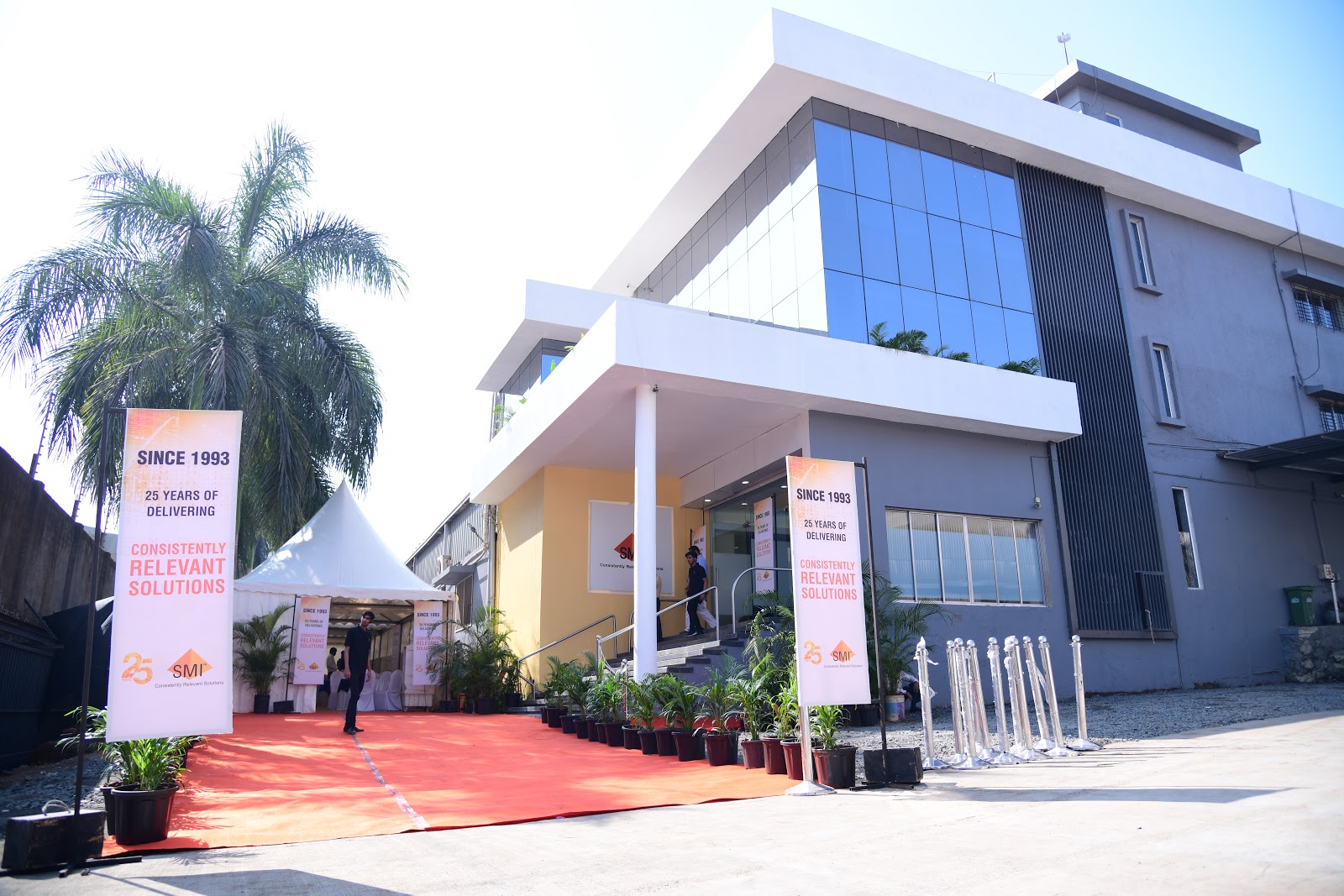
On the 2nd of February 2019, India’s largest indigenous labelstocks manufacturer Ajay Mehta led SMI Coated Products Pvt. Ltd. headquartered in Mumbai celebrated their 25th year of existence, in grand style. Over two hundred guests who were shown their impressive factory were in awe of what they saw and felt proud that their industry mate could set an example of success impressing the mantra; “Make in India”! The event also exhibited the typical Punjabi will and firm resolve to work hard and find success even while starting from scratch. Ajay’s father Om Prakash Mehta suffered the first jolt of leaving home in Multan, now in Pakistan, empty handed he came to Delhi after the partition of India and then moved to Kolkata where he set up his print lamination business. He had settled down well there with business growing when the second jolt hit him, once again he had to leave everything in Kolkata due to the turbulent days of Naxalite movement in the 1960s. Leaving behind all that he had made he with his family moved to Mumbai when his son Ajay was just 10 years old. Om Prakash Mehta was a very brave man and took all the adversity in his stride and moved on in life. He re-established his print lamination business as S M Plastic Industries in Mumbai named after his wife Shakuntala Mehta. In 1983 Ajay joined business and they started fabric lamination but when the business stopped growing the Mehtas decided to quit that business and establish a new business in 1993 producing self-adhesive labelstocks in their new enterprises S M Industries which was later renamed SMI Coated Products Pvt. Ltd.
They started production with a 20inch coater. Ajay Mehta, his son Rohit, wife Swati and daughter in law Saloni. All contributed their efforts in growing SMI to where it has reached today. Ajay and Swati’s daughter Nikita, after training in vocal music in USA is pursuing a career in singing also in USA.
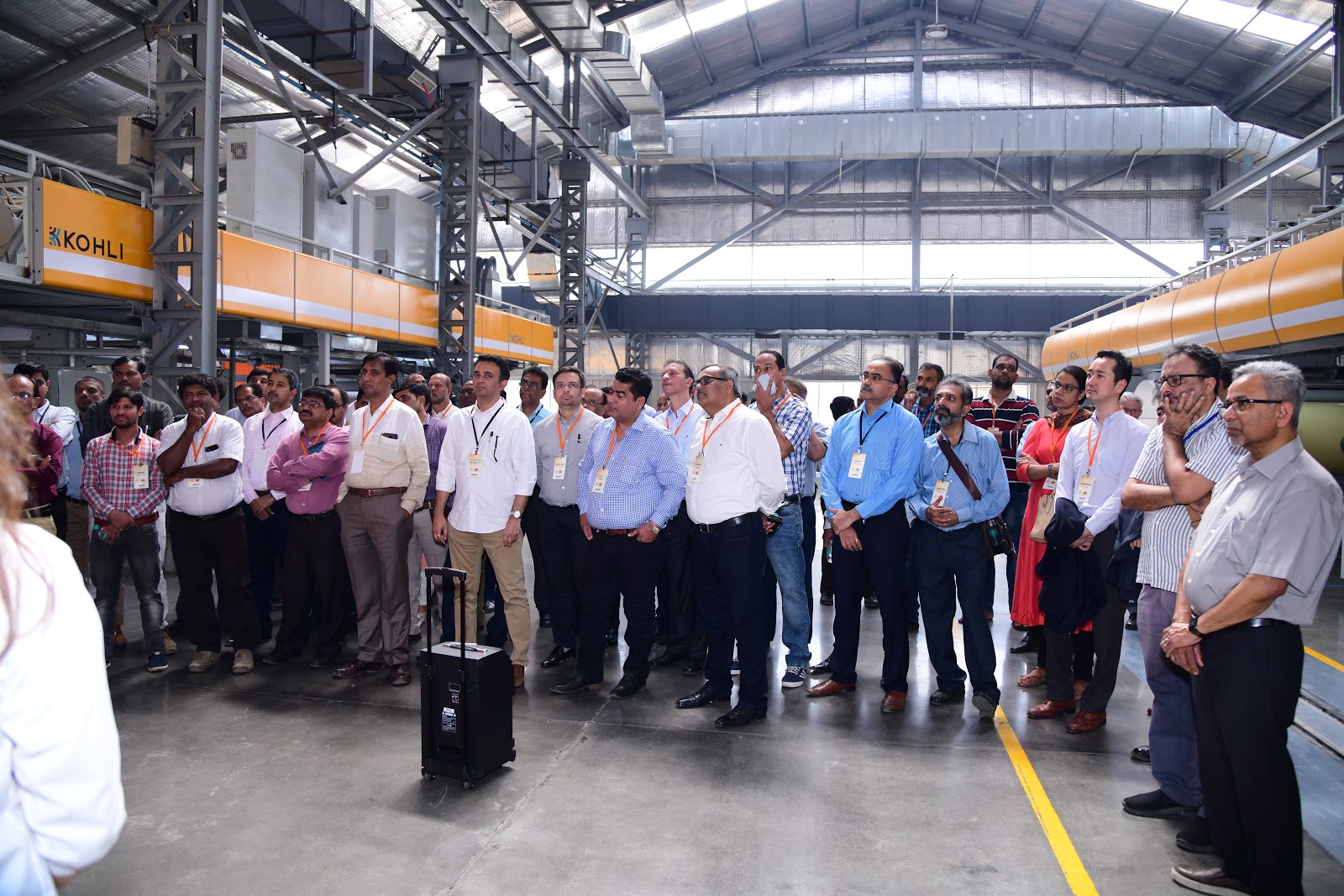
For the 25th year celebration SMI invited the virtual who is who of the label industry to showcase their manufacturing facility. The outstation guests were all put up in the iconic ITC Grand Maratha Hotel. On the 2nd morning multiple groups in different buses were taken to Ambernath for factory visit. Earlier in the preceding days they had arranged for the local label printers of Mumbai and surrounding areas to visit their factory.
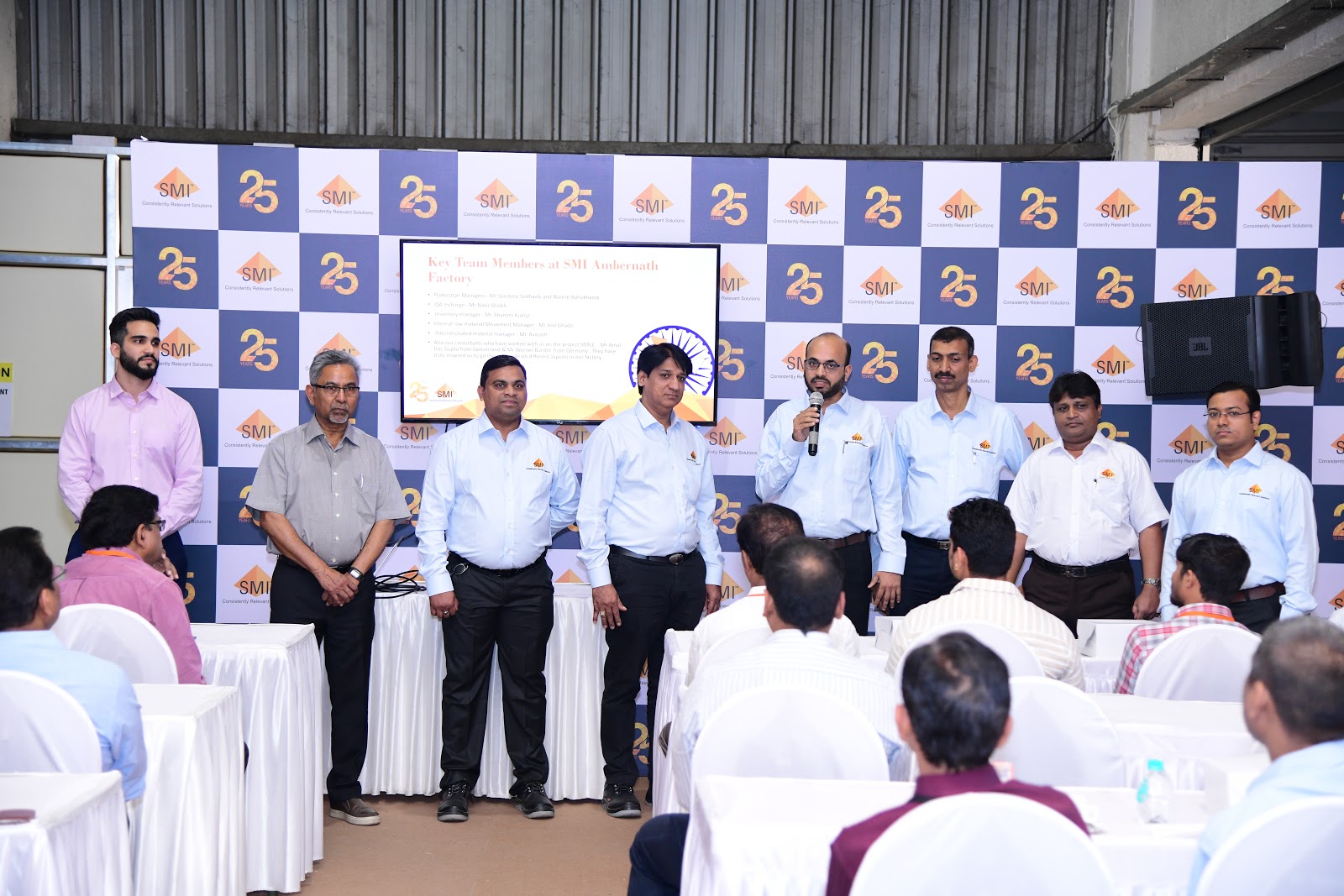
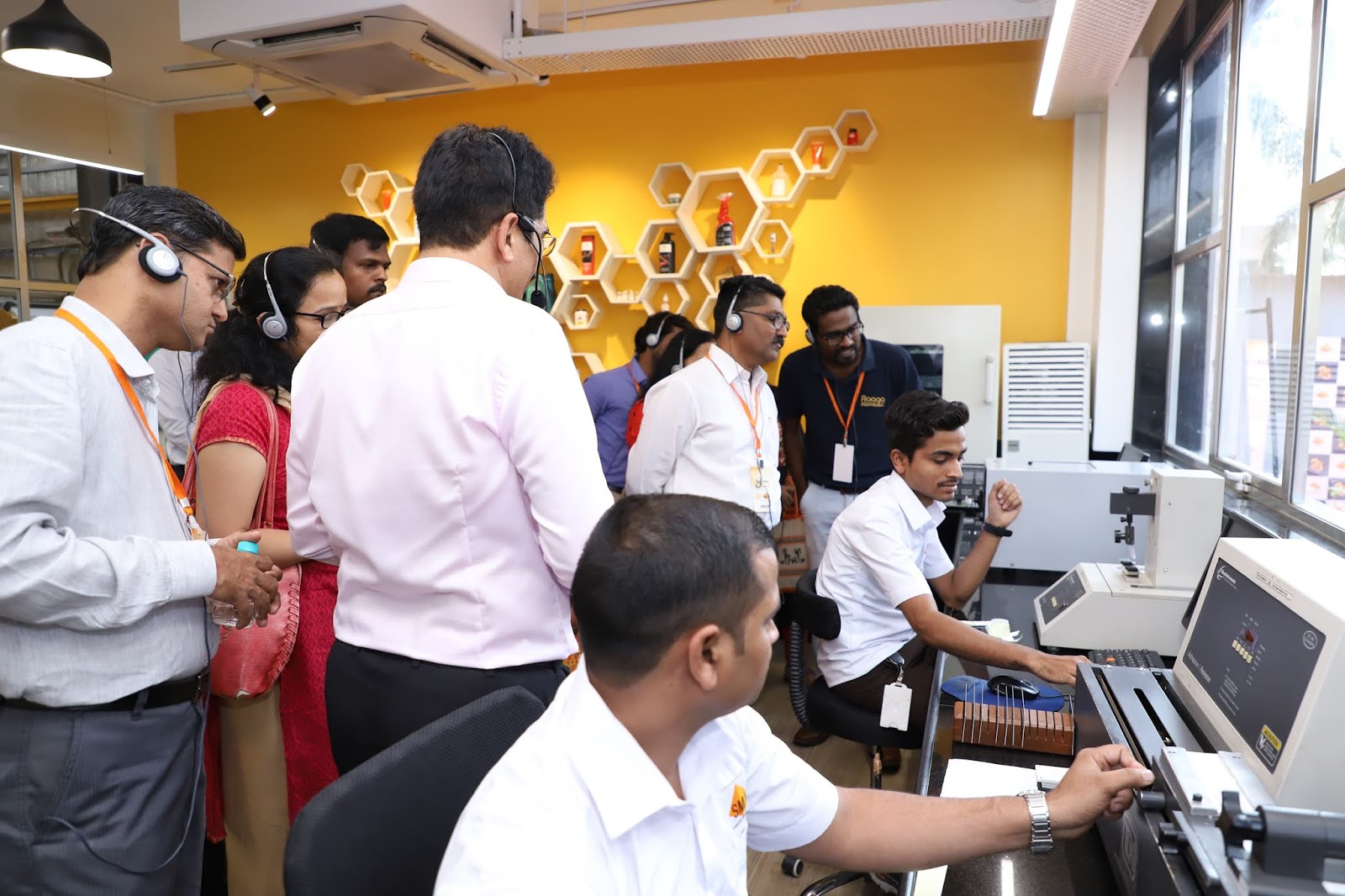
The event was extremely well managed so that smaller groups were taken around for a one-hour factory tour so that everyone got a chance to visualise and understand the capabilities and manufacturing as well as quality control systems employed by them. On arrival the guests were first given an impressive presentation of SMI’s journey, achievements and awards. SMI has been recipient of over 20 domestic and international awards.
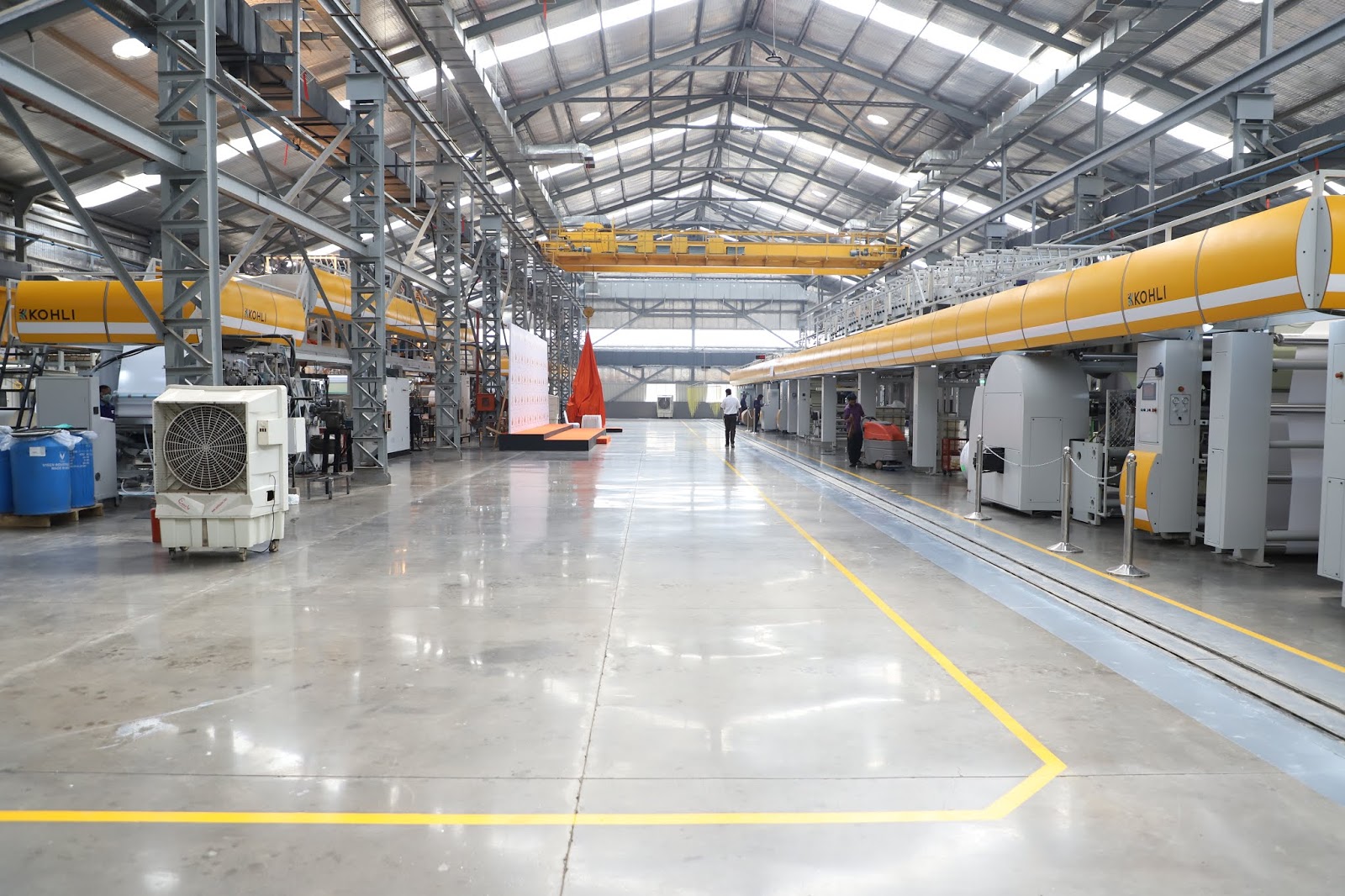
The factory is set up in a 25000 square meters plot with a 13000 square meters shop floor. With seven coaters; two hotmelt adhesive coaters, two acrylic emulsion adhesive coaters, two silicone coaters, one recently installed tandem coater and a host of finishing and material handling systems they consume 1350 tons of paper each month to produce 100 million square meters of pressure sensitive labelstocks per annum.
The Tandem coater recently installed is capable of coating silicone and adhesive in-line in a single pass with automatic turret reel changing for continuous production.
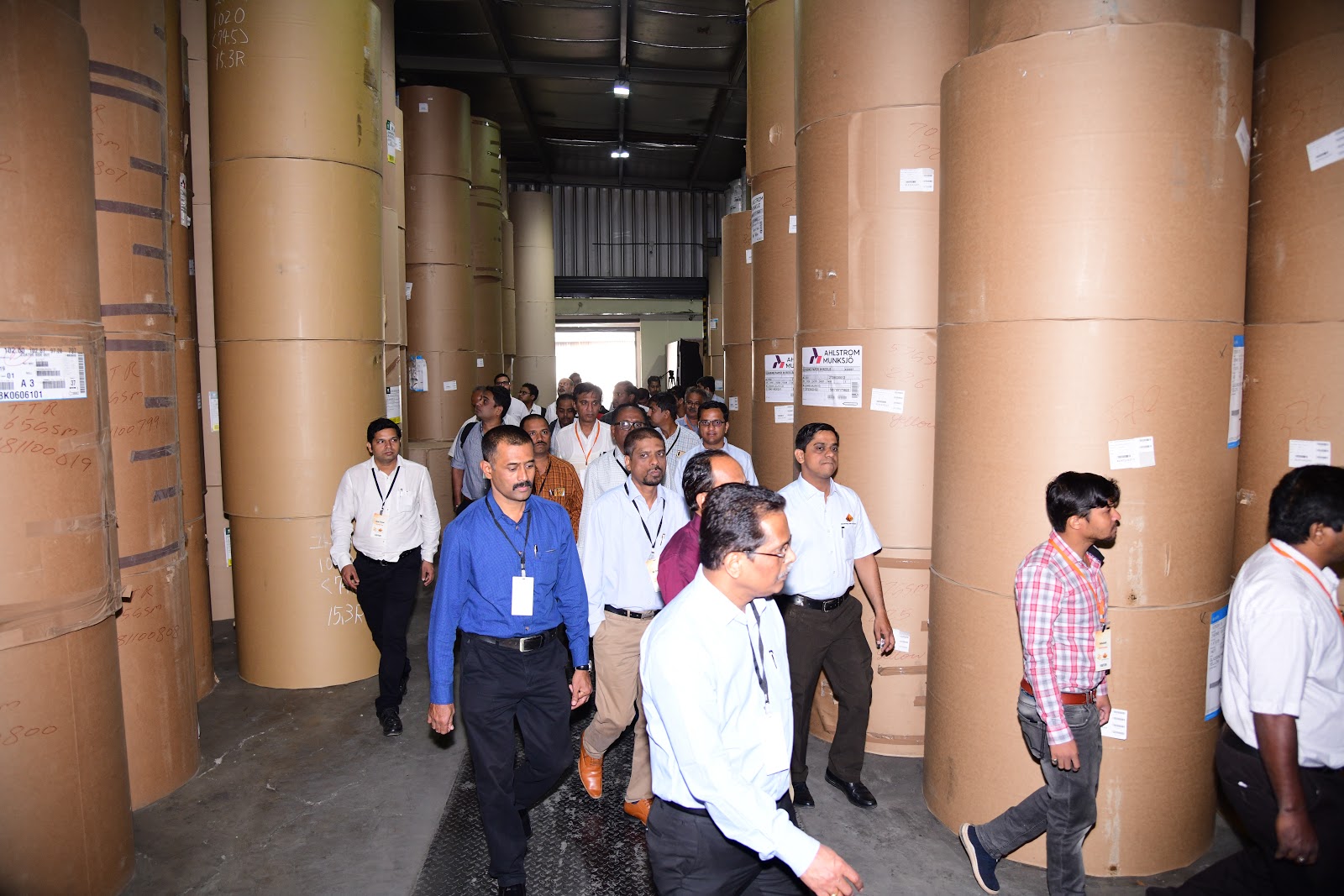
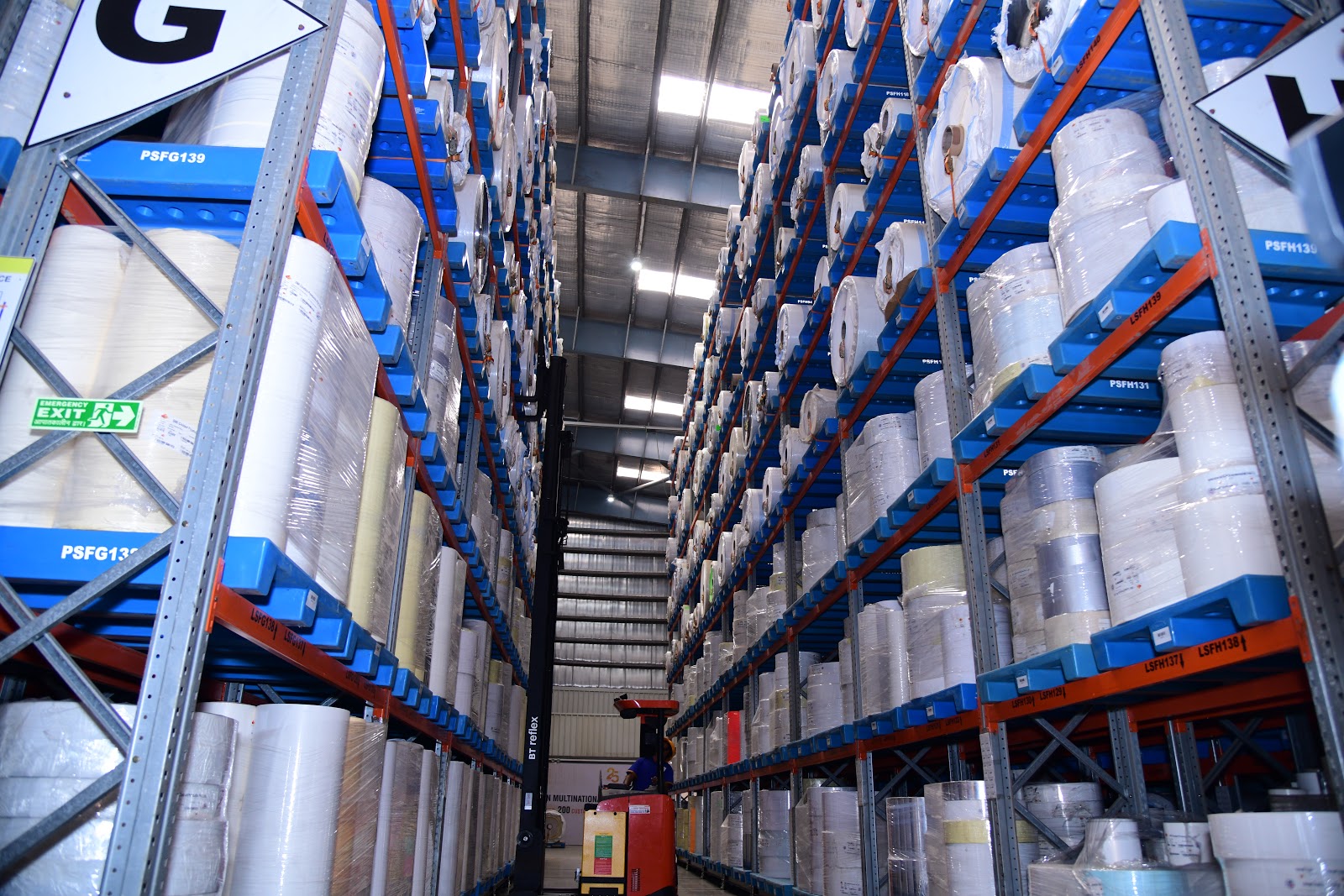
Eight story motorised movable stacking system helps the store material with optimum utilisation of space. An ERP aided workflow ensures smooth storage and movement of materials from receipt to despatch.
Well-equipped laboratories for testing and quality control of both inward materials and finished goods guarantees delivery of perfect quality material in each reel supplied to their 200 customers spread in 22 countries. 50% of SMI’s turnover comes from exports that constitutes over 300 SKUs offered by them.
Besides the Ambernath factory they also have a stock point and slitting facility in Dubai, UAE. The father son duo of Ajay Mehta and Rohit Mehta, with their dedicated team of 225 team members work tirelessly to achieve a steady growth rate of 15-20% per year. Commenting on the future Rohit wants to consolidate strength and expand into new areas of self-adhesive materials. While they see potential in exports of their products, yet they intend to cater largely to the Indian market which with a large population, is growing at a fast pace. More so in the face of a fast-growing organised retail spreading into remote parts of the country.
On the evening of 2nd February 2019 SMI arranged a gala dinner for all the visitors who came to share the celebrations of SMIs 25 years of growth. Speaking about the future prospect of the Indian Label industry Ajay Mehta says, “Label stock materials is a highly technical field with high turnover and low margins.
Global players need to work together to improve the financial health of the industry.” He further adds, “The Indian Label industry is poised for quantum growth. This needs to be fuelled well with better margins. Intense competition should be handled by creating innovative solutions, instead of just indulging in a price war.”
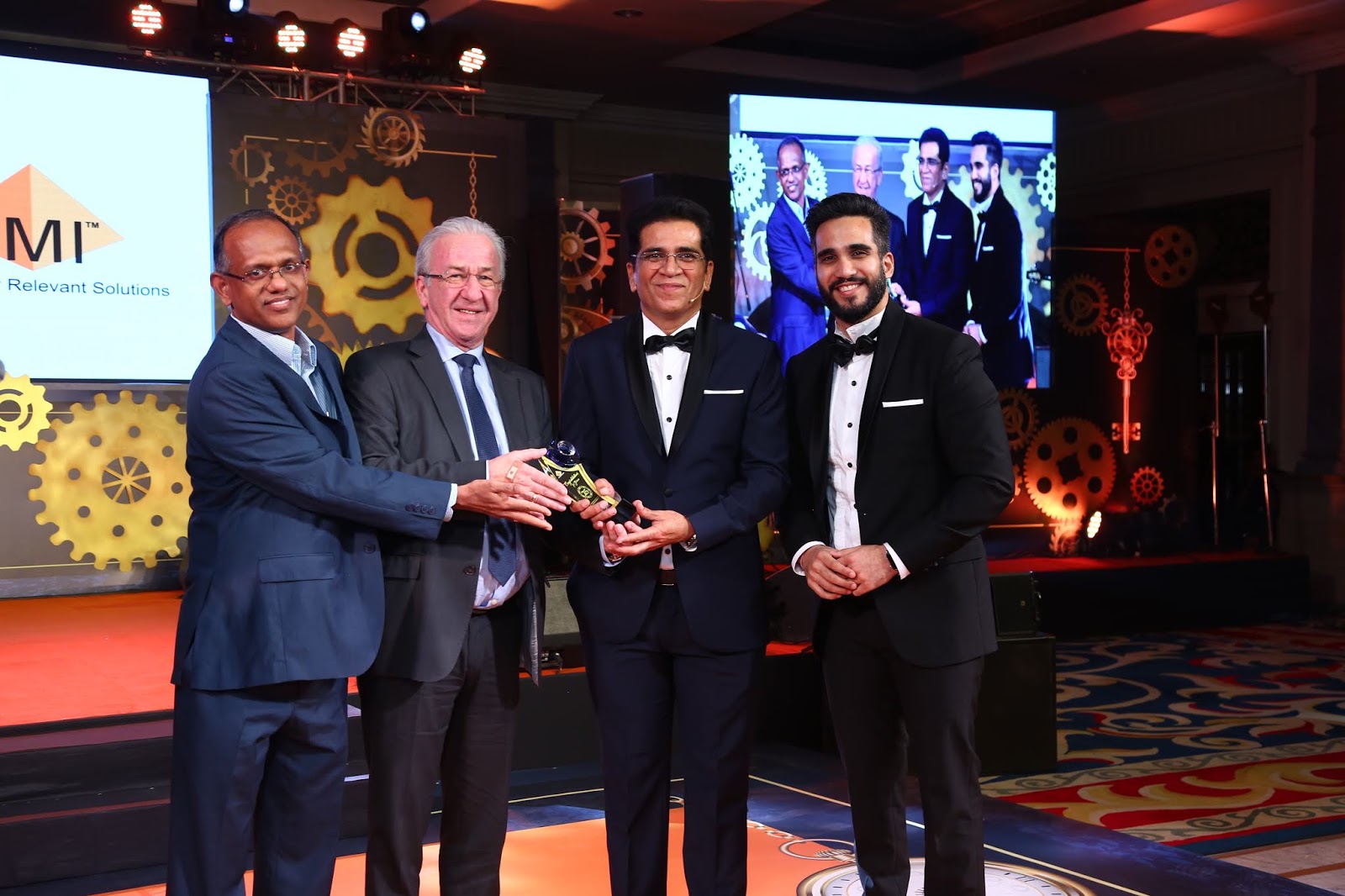
Ajay took time to honour and felicitate his team at SMI.
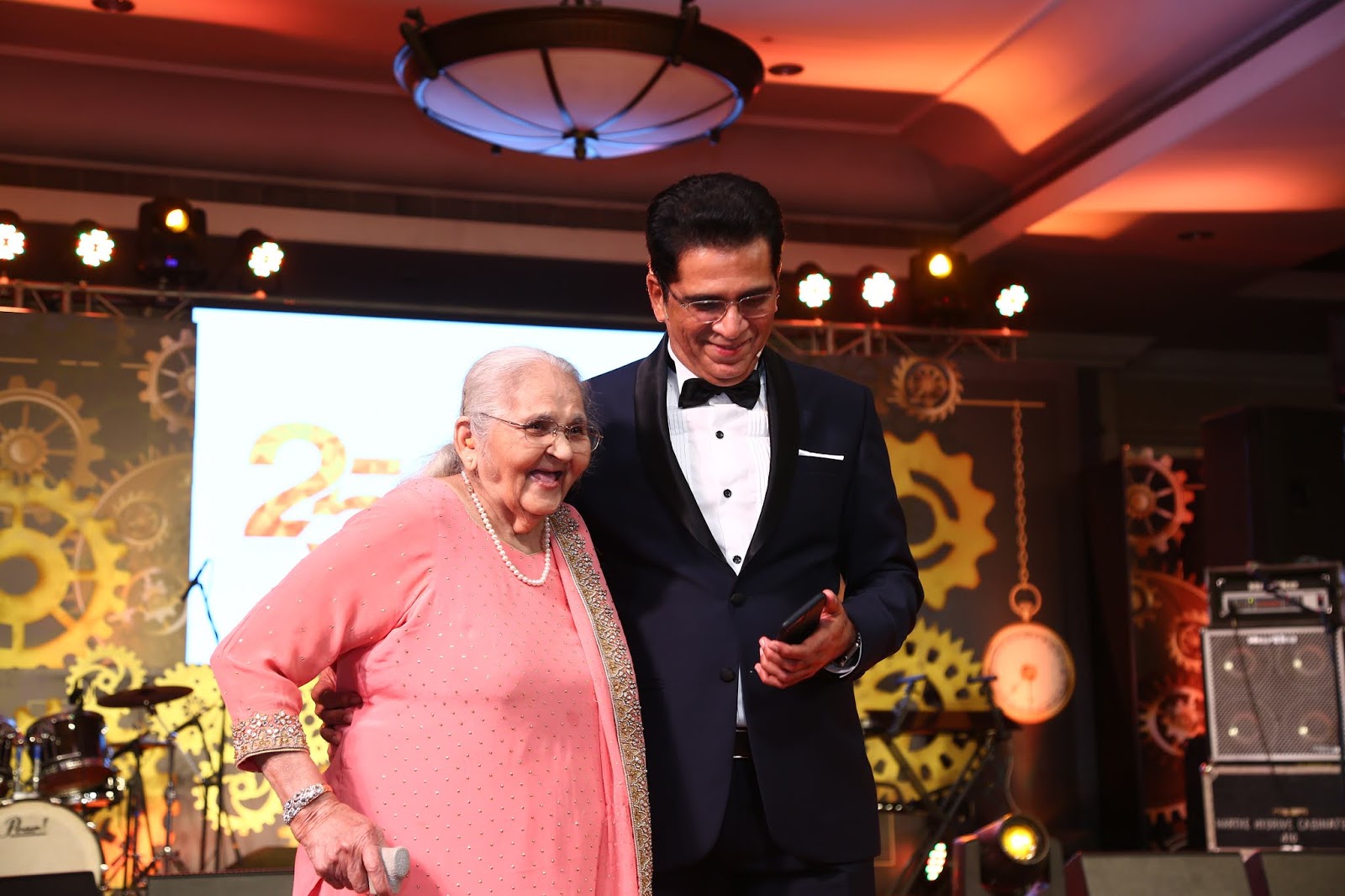
It was a memorable moment when Ajay called his mother to the stage and recalled her contribution towards the growth of their business over the years.
Suppliers and customers too spoke on their appreciation of SMI’s journey in the past 25 years.
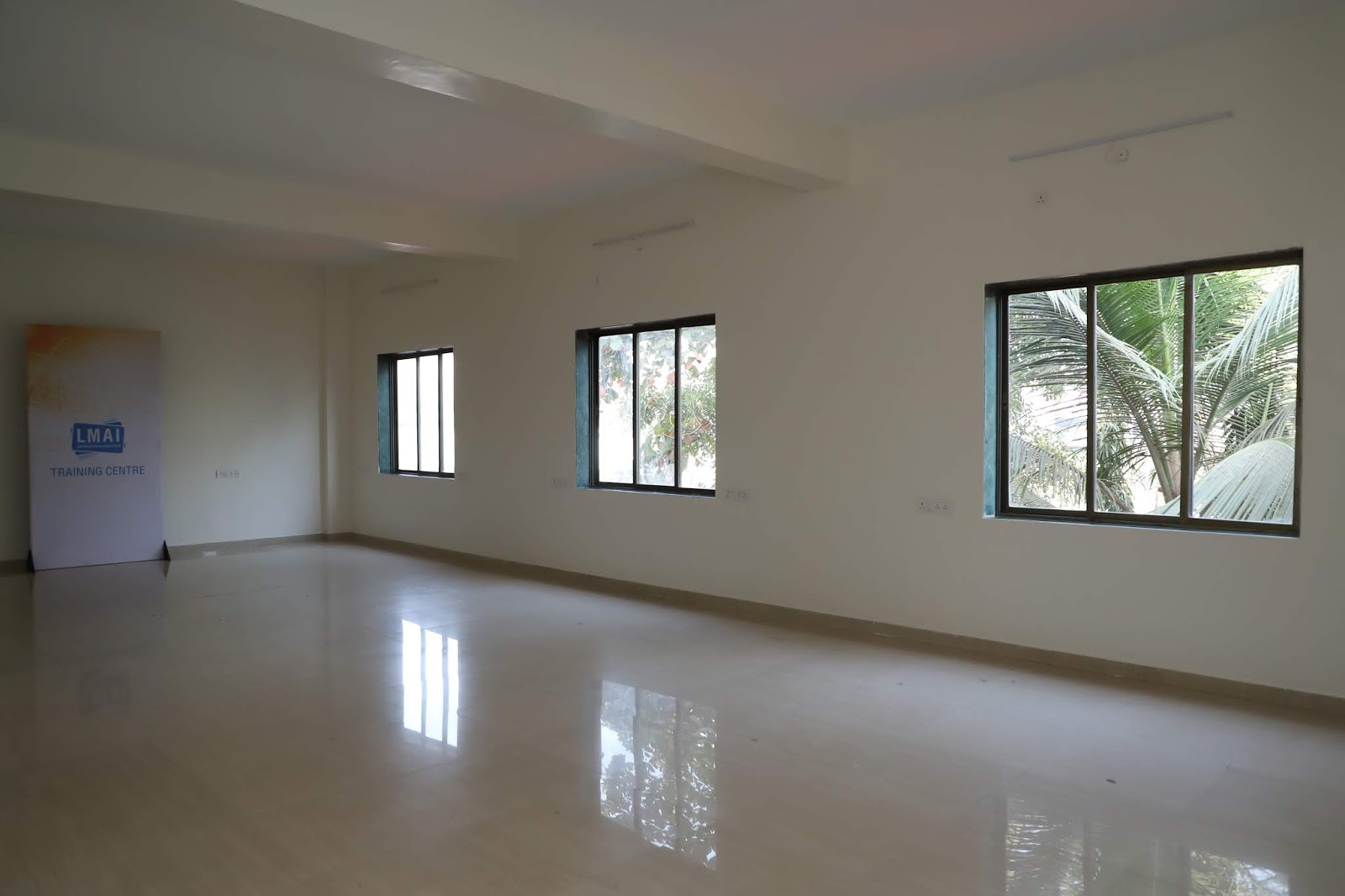
Besides investing and contributing to social causes, SMI has also been an ardent supporter of the India’s Label association LMAI, Label Manufacturers Association of India. They have been regularly sponsoring LMAI events promoting fellowship and networking in the industry and supporting technical seminars for the benefit of members. In a magnanimous gesture Ajay Mehta has agreed to provide space in his Ambernath facility for setting up of a LMAI training centre for operators and a lab for providing testing facilities to LMAI members.
Written by Harveer Sahni Chairman Weldon Celloplast Limited, New Delhi February 2019
On the 22nd of November 2018 at the LMAI Avery Dennison Awards night, held on the side lines of Labelexpo India, the winner announced in digital printing category-Wine and Spirits was Trigon Digital Solutions, Mumbai. Just over a week later, on the 29th of November 2018, Trigon was declared the Printweek India “Digital Printer of the year”. This was Trigon’s fourth award; the first two were Printweek “Pre-press Company of the year” awards won in 2015 and 2017. It is an incredible performance by a company promoted by first generation entrepreneurs just 10 years ago, with no previous experience in running a manufacturing company. They moved into roll form digital printing of labels merely 3 years ago. They have invested in a digital printing press at a time when we are witnessing the evolutionary shift of label production in India from conventional processes to digital. Digital printing is a segment of label industry that leading label manufacturing companies have been extremely hesitant to invest in, due to high cost of equipment and consumables. AnilNamugade the co-founder, along with partner Milind Deshpande, have promoted Trigon Digital and successfully led it on its digital label journey.
After graduating in Economics from Mumbai University Anil Namugade, also a Printing Technologist from the Government Institute of Printing Technology, took up jobs as a scanner operator from 1994 to 1997 in few of the leading pre-press houses in Mumbai. Here he acquired immense knowledge in repro-colour separation and prepress. In 1998 he joined Heidelberg as a software specialist and continued to work there until 2003. Anil joined Kodak as packaging and proofing specialist in 2003. It was a purely technical job where he developed his passion for proofing, learnt the nuances of colour management and the imperative need of good prepress for excellence in final print. During his stint with Kodak he was also handling technical and sales support which helped him gain experience in selling as well. Unfortunately, by 2007 Kodak was seeing a decline in business and as restructuring process was being put in place, he had to exit Kodak. Suddenly that one day he found himself jobless, away from a stable job in an MNC(Multi National Company). He firmly believed in and followed a simple mantra of success and excellence; “Look at problem as an opportunity and learn to grow and excel”. Drawing inspiration from this mantra, he along with partner Milind Deshpande who is also a printing technologist, set up their maiden start-up venture Trigon Digital Solutions.
From past experience and knowledge he had acquired from working in the previous jobs, Anil knew that customers needing packaging, wanted to see how their product would look, before they opted for actual printing and production. He saw the opportunity in this need, so Trigon was set up as a proofing and mock-up producing company. His knowledge of prepress and colour management helped him to achieve his goal. Earlier it used to be the creative agencies that visualised and created a format for packaging, Trigon creating an actual marketable mock up for the companies was a new and welcome development for brand owner companies. The first equipment they invested in was Kodak Approval NX that printed in sheet format and started to take up proofing and mock-up creation for customers. Finding success in their endeavors he soon realised that being closer to the customer is an imperative. In 2010 Trigon opened a facility in Bangalore and followed it up by setting up a unit in Delhi in 2012. In 2015 they went international by setting shop in Dubai and later an office in Singapore. All the units except the office in Singapore are equipped with Kodak Approval NX.
In 2015 they saw the opportunity in customers demanding label mock-ups in roll form, so in their Mumbai facility they invested in an Epson Surepress to produce samples including Flexibles, Laminates and Labels by digital printing in roll form. Moreover, the production on Kodak was turning out to be expensive and limited to sheet format. Soon their customers upgraded from demanding just mock-ups to ordering short runs for their specialised marketing needs. They also started to see business emanating from the shrink sleeve segment as also a growing demand for other roll form variants. The slow speed of Surepress could not cater to the demand they were getting and also there was a limitation that it could not produce shrink sleeves. At this time in 2017 Trigon decided to take a major step of investing in an HP Indigo 6000 digital press and enhance their capability to produce a larger range of products. A year down the line in 2018 Trigon yet again upgraded their HP Indigo 6000 to HP Indigo 6900 which had enhanced features. On this HP 6900 they could do inline primer coating saving them the time and valuable space, print metallic inks and florescent inks. With a widened customer base and enhanced capabilities they now cater to applications in FMCG, Liquor, Personalised labels, Variable Data labels, QR codes and a lot more. They now produce and sell a range besides labels, offering flexible packaging, complex laminates, lamitubes and shrink sleeves. Anil Namugade firmly believes that digital is the future of printing and innovative packaging. Dwelling on the general apprehension of label printers regarding ROI (Return on Investment), he feels that it becomes better from an expanded vision of providing specialised services to the customer. These services that Trigon offers include brand management, database management including validation, preparing the mock-ups for test marketing before indulging extensively, offering creativity to customers for their evaluation and aiding decision making, personalisation or customisation and incorporating variable information on each label or package at short notice. Their experience in pre-press has helped them greatly and he believes that by adding full post press setup Trigon has become a one stop shop for the needs of brand owners. The additional cost of digitally converted products needs to spell value for customers to justify the cost. Anil asserts that the vision for success of flexo graphic printing and Digital printing should be looked at separately and not as a comparison.
Trigon Digital Solutions plans to remain focused in digital Printing. With already a facility in Dubai and an office in Singapore they are a global entity and they will be expanding their global reach by establishing a setup in U.K. in 2019-2020 as they already have customers in 18 countries including UK and Europe. They have endeavored to remain logistically close to customers to be able to provide service at their doorstep. Surprisingly due to their business model of being linked to packaging development, marketing and brand management, their revenues do not come from purchase budgets of customers but come from their marketing budgets. Trigon making optimum use of space operates out of around 1800 square feet shop floor area of all facilities put together. Headquartered in Andheri East, Mumbai they have a workforce of 102 persons. At Trigon every new creation is a challenge but developing it is not. Anil proudly says innovation, technology, extensive knowledge of prepress, and having “People with Passion” in their team has always been a winning force for Trigon. They are committed to improve upon what the customer wants or brings to them for creation of a label or package that will spell success for their products and brand.
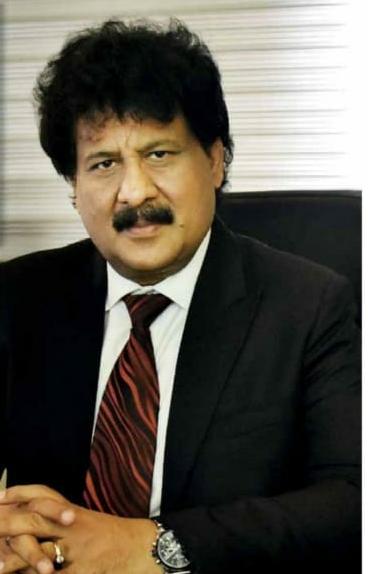
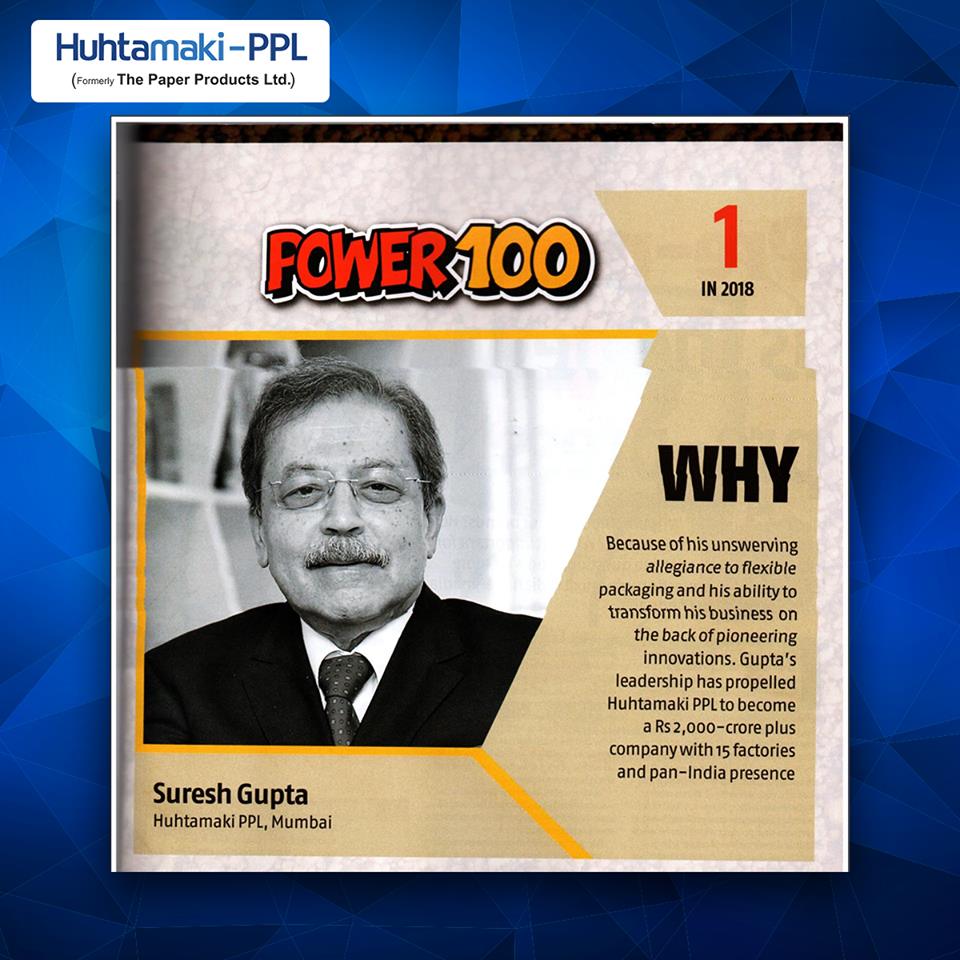
Thirty-one years after joining Huhtamaki-PPL (formerly Paper Products Limited or PPL), Suresh Gupta retired as its Executive Chairman. He joined the company in 1987 at a difficult time for the company, as business had slowed down since 1980 and they had to sell off their paper mill. When Suresh became a part of PPL the turnover of the company was just Rs.24 Crore and with a large workforce of 700 employees. He led the company until his retirement with sales reaching almost 100 times to Rupees 2300 Crores and the number of people working rose to 3500! Huhtamaki-PPL is now the largest producer of printed and finished flexible packaging materials in India. Under his leadership, the company, led not only PPL’s but also India’s foray into diverse label technologies as well. They were the very first entrant into shrink sleeve labels in association with Fuji Seal of Japan. Today Huhtamaki-PPL is the largest player in label manufacturing segment in India with their label sales touching 400 Crores which includes Pressure sensitive labels, Shrink Sleeves, Wrap arounds, In-moulds and other label forms. They are vendors to the virtual “who is who” in the Indian branded consumer goods and pharmaceutical industries. In pressure sensitive adhesive labels alone also, they are the largest at 200 Crores after taking over Webtech Labels, Ajanta Packaging and Positive Packaging.
Suresh Gupta
Being an army man’s son Suresh’s childhood was spent at various locations within India. His father who is now 92 years of age, was a paratrooper with artillery from the well-known 17 parafeild regiment of Indian army and retired as Director of Military intelligence. After retirement he was assigned as Director SSB (Special Security Bureau) by the cabinet secretariat. Retiring from SSB he was taken by the Himachal Government to be the chairman of Himachal State Electricity Board. Suresh has a brother who is 9 years younger than him and followed his father’s footsteps to join the army, has primarily headed combat formations, served in the UN Peace Corps and is currently a Major General. Typical of army families, Suresh’s schooling took place at various schools across the country, the last two being St. Georges School, Agra, and St Xavier’s School Delhi where he was in the boarding and finished in 1967 with excellent marks. Being underage, he could not apply for admission into the IIT or Delhi University colleges, so at the age of 15 years he did a year of pre-engineering at Government college for Men Chandigarh, where the youth in him got the better of him in not attending any classes other than chemistry. He did poorly, much to the disappointment of his father who was posted in Ambala at that time. His mother gave him 200 Rupees and sent him to Delhi to his grandmother. Admissions had closed for most good courses but a good school marksheet helped him get admission for BA economics honours in the prestigious Hindu College Delhi University. He studied hard and in the very first year he got a first division and ranked in the University to win back his father’s confidence. After graduating from Delhi University Suresh went to the Jamnalal Bajaj Institute of Management studies Bombay, which then was considered amongst the best two in the country.
Finishing his MBA, he was motivated and impressed upon by the head of HR department of Jamnalal Bajaj Institute who was also the vice president of Corning Borosil to join Corning Borosil, which he eventually did as a management trainee in 1974.
Suresh and wife Kumi
The following year in 1975 he got promoted and got married to Kum Kum Talwar fondly called Kumi. Kumi graduated from the prestigious Lady Shriram College in Psychology honours and did her Masters in Social Work when she topped her class in Delhi University, and has been Suresh’s close confidante. At a young age of 23 he was posted in Madras as Regional Manager South for Corning Borosil who manufactured custom designed glass reactors for specialised industrial chemical processes, laboratory glassware and consumer ware under brand names Corning, Borosil and Pyrex. Surprisingly his immediate colleague working under him, the Head of Sales and Service was 52 years old.
With daughters Ratna(L) and Shivani(R)
He enjoyed his stint in Madras as it was great learning time there and in 1979 his elder daughter Ratna was born. Post Emergency when the Janta government came to power the then minister George Fernandes came down heavily on US companies. While Coca Cola left the country, Corning was asked to dilute their equity to less than 40%. Suresh Gupta was at this time transferred to Delhi as Regional Manager North with additional responsibility of interacting with government and convincing them to excuse Corning from this equity reduction as a special case. Being a high technology company also supplying critical materials to defence, they were not allowed by USA government to setup ventures where they did not have full control. It was tremendous experience for Suresh, one side interacting with government and other side selling to large industries, government laboratories and finally setting up channel sales for their consumer products. Once it was clear that government of India would not relent regarding equity dilution, the company stopped further capital investment into the country. Now that it was evident that there would be no growth in the company, Suresh decided it was time to move on in life.
He shared his thoughts with a friend at Usha International, who instantly arranged for Suresh to meet Lala Charat Ram of Shriram group. He was taken on board and became Divisional Manager of the Lucknow Division of Usha International, stationed at Lucknow when he was 28 years old with almost 200 people working under him. Usha was selling sewing machines, electric fans and agricultural pumps. This was a challenging job as the market was extremely competitive and majority of the employees i.e. the mechanics, belonged to a militant union and were unionised. The area of operation for him was interesting as criminals and bad elements roamed free there. There are interesting and scary stories of his time spent in those areas. Due to his frequent tours his family at home had to be provided armed security guards due to threats.
Sardari Lal Talwar Founder Paper Products
During this period there was pressure from his wife Kumi’s family to join Paper Products Ltd. the company founded by her father Sardari Lal Talwar.
In the meantime, a close friend of Suresh Gupta from Middle East came visiting him in Lucknow out
of the blue with a first-class open ticket and a proposal to join the Doha headquartered Almana Group whose Chairman wanted an executive director who he could trust to join his Board as there seemed many issues with his existing team. Suresh took the trip to evaluate what was being offered, finding it very exciting he accepted the offer and joined them in late 1982. In due course, various businesses were put under him some of which he started, and seven companies including an IBM agency reported to him. He then was designated as Executive Director-International, he started businesses or had oversight of investments in Saudi, Dubai, Turkey, UK and US. After joining he recruited 16 Indian Managers in his team and parted company with four other Managers already in the company. He spent the next five years in Doha and reminisces of them as fascinating years, as a time of immense learning, travelling all over the world for 15-20 days each month. His younger daughter Shivani was born there. In the beginning of 1987 Suresh and Kumi were reviewing their career and lifestyle. Their eight-year-old elder daughter who was going to British school could not speak a word of Hindi, their mother tongue. They wondered if they should continue to live in the Middle East. The Almana Chairman understanding their dilemma offered to station Suresh in another country of his choice. At this time Suresh was also toying with the idea of taking up an assignment with United Nations but Kumi’s family was persistent and he decided to return to India and join Paper Products.
Rare picture of Suresh Gupta and father in law Sardari Talwar
In October 1987 Suresh Gupta and family returned to India to join Paper Products as a promoter and he acquired a minority shareholding. As mentioned earlier even though being a legendary company it had problems, the paper mill they had in Roha was sold. Kumi was the youngest child of Sardari Lal Talwar her two brothers were ageing and not keeping well and have since passed away.
Paper Products Limited was founded by Sardari Lal Talwar in 1935 in Lahore, that time in undivided India. Sardari Lal was running one of the four largest departmental stores of India of that time called Moolchand of Lahore with a customer base of Indian royal families and Britishers. The store stocked goods like a modern-day multi product retail and was founded by his Grandfather Moolchand and Uncle Khairati Ram who were also very charitable persons. They were running Hospitals, Schools, Temples and Dharamshalas (subsidised dwelling for travellers). Moolchand Dharamshala in Lahore was just opposite the Lahore Railway Station. The founders passed away at an early age and leaving the business to a young 15-year-old Sardari Lal. Moolchand store was importing milk bottle caps made of paperboard and paper crimped cups for the army till one day a British army officer in charge of the Dairy came to him and suggested that he import the paper and make the caps and pastry crimp cups in India. It would save the army some amounts enabling them to extend their budget. Sardari on advice of his international friends got the hand presses developed in India, imported some dies and punches and started to make the caps and cups in Lahore in 1935.
To start this maiden manufacturing venture, he emptied one of the Moolchand store warehouses and commenced production with the signboard outside reading, “PAPER PRODUCTS”. He later imported machinery from Windmoller and Holscher Germany in 1939 to start manufacturing paper bags. This was the inception of what is today Huhtamaki-PPL.
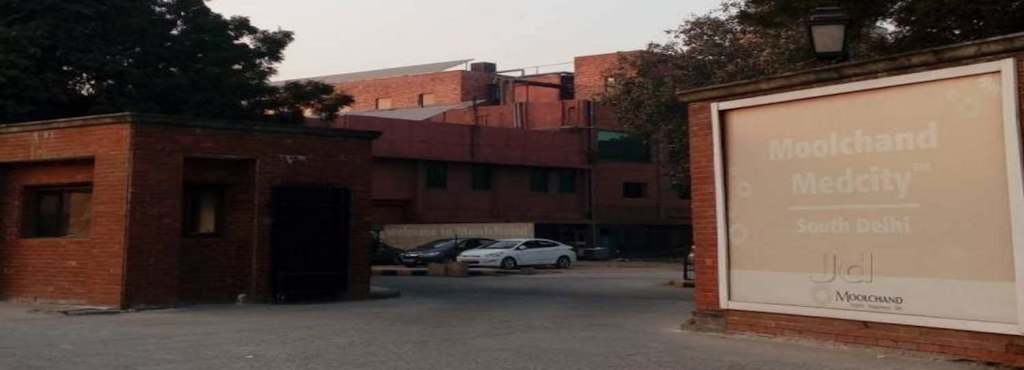
Moolchand Hospital Lajpat Nagar, New Delhi
Then came the partition of India, all was lost and left behind in Lahore when the family migrated to Delhi. For all the charitable work that the family did in what was left behind in Pakistan, Sardari Lal was given land in Lajpat Nagar as compensation. He had an emotional need to carry the philanthropic ideals of his parents, so before doing anything else he established the “Moolchand Kharaitiram Hospital” in Lajpat Nagar, South Delhi. He also started making packaging products that he was already doing before. Immediately after world war II in 1948 the Germans were holding the first Drupa, Sardari Lal, travelled by ship to attend where he met and struck friendship with some of the leading packaging people in Europe. Owing to his good reputation, Windmoller and Holscher gave him five Bag making machines with printing, on open credit. He returned to start a factory in Faridabad in 1949 followed by one in Ghatkopar Mumbai. Paper Products started to grow steadily and Sardari Talwar took his company public in 1951 retaining 51% with himself. Paper Products started to grow steadily and Sardari Talwar took his company public in 1951 retaining 51% with himself.
Thana Factory
Billy Heller owner of Milprint (now a part of Bemis Company, Inc.), then the world’s leading flexible packaging company based in Milwaukee, USA became a dear friend of Sardari Lal. Billy was also a philanthropist wanting to share his knowledge with the world, had set up an organisation called Milprint International Club with global leaders including Paper Products as members. With Milprint’s technical help he built the Thana factory in 1960 to the then world class standards. At this time his elder son Dr. K K Talwar who had done his doctorate in USA at the institute of Paper Chemistry returned to India. A little later his younger son Suresh Talwar completing his master’s in economics from USA, also returned to India. Dr KK Talwar was amongst India’s foremost scientists in chemical technology and paper making, he drove the company’s technology leadership. Suresh Talwar was the dynamic operational business head of the company. Business grew after Thana factory was commissioned, and many small factories were constructed across the country at Madras, Calcutta, Nagpur, Hyderabad and a paper mill in Roha.
Around 1980 things slowed down due to various reasons, the paper mill in Roha got sold, it was a difficult period. In 1987 the family had convinced their son-in-law Suresh Gupta to return to India and join the company. Suresh joined in October 1987 and spent a whole year working hard, travelled extensively in India and around the world to learn the technology and business as also meeting all the major customers and suppliers of PPL to understand the intricacies of their business. By 1989 Suresh was ready with his business plan that included induction of new latest technologies, while very slowly shutting down all factories except Thane. Due to the humane angle they did not abruptly sack people but informed transparently that in 10 years’ time this would happen. This with intention to let ageing employees retire and not add any new ones. However, expansion in Thane factory was kept going on, old machines were phased out and replaced by new ones and the staff from shop floor workers to upwards were given in-house training in latest technologies. Meantime a new cadre of craftsmen trainees, diploma trainees, graduate engineer trainees and management trainees was started with inductions of freshers from ITIs, diploma schools, engineering colleges and management institutes. An elaborate program of in-house training was put in place. The program was designed by Suresh and his colleagues to suit their specific needs may they be technology, customer or people handling. They were transforming the company to project their acumen in offering the latest in packaging. They went digital way ahead of time in 1989 when they started digital scanning and digital engraving of cylinders. They also started to computerise the company ahead of time. A start up consultancy company was recruited to put-in a modern computer hardware and software system (one of the first ERP’s) to replace the old card punch system. While modernising operations in Thana factory he shut down the old printing and wax coating converting lines and installed modern gravure printing and lamination lines making Thana a state of art unit once again. The first metalliser capable of producing certified barrier coatings was commissioned in 1994. There were many things done for the first time in India.
With Amar Chhajed
Suresh continued to add new products and expand his footprints into the world of packaging and in one of his frequent travels in 1990 he saw shrink labels in Japan. He established contact with the Fuji Seal Chairman Masaki Fujio, the global inventor of shrink sleeve and became the only licensee of Fuji Seal for shrink sleeve manufacturing in 1991. At around the same time he was discussing Therimage label technology with Dennison, later merged with Avery to become Avery Dennison. This technology enabled labels to be printed on a coated film and transfer the images on to the bottles eliminating the need for release liners. PPL installed the Therimage label production facility in Thana. Therimage was a challenge for Avery’s core business of pressure Sensitive adhesive products, so they bought Dennison and killed the Therimage business. Suresh saw the future of Therimage with Avery was not bright, so he shifted focus to pressure sensitive labels where the growth looked inevitable. PPL invested in an Aquaflex Label press and they were into manufacturing PSA labels at the Thana factory in 1994. In later years wanting to grow in labels business, since he was not finding enough of the right people and expertise to expand, he decided to buy expertise. For this reason, he bought Amar Chhajed led Webtech Labels, the leader in pharma labels in India. Then, Suresh extended his reach in fmcg by buying Chandan Khanna led Ajanta Packaging as well. In between he had acquired Positive Packaging which though large in flexibles had also taken over the labels business of SGRE in Bangalore. Therefore, now they have pressure sensitive label production in Mahape, Baddi, Rudrapur, Thana, Daman, Hyderabad and Bangalore.
Silvasa Factory
Being a first-time entrant into some of the evolving technologies he had to develop global suppliers and was instrumental in their eventually coming India. By 1994 Suresh was wanting to build another world class factory, despite resistance coming from the family which still held 51%, he went ahead with his plans for building it in Silvasa. PPL made a rights issue to raise the money to build the factory and enhance the working capital for growth. Construction began in the 12 acres property in 1995 and in one year the unit was in production for mainly flexible packaging including shrink sleeves. They made profit in the first year itself. Paper Products Ltd was growing at breakneck speed ranging between 20-30% per annum.
In 1998 Suresh bought the Hyderabad unit of Gautam Thapar, Ballarpur Industries which had been
Hyderabad Factory
setup as a joint venture with A and R, a leading European flexibles company. The unit was completely refurbished and new capacity was added. Hyderabad became the centre for wrap around labels. Meanwhile the company had made another rights issue to fund growth and the family’s holdings reduced to 32% as some members did not exercise their options. To fund the continued growth and expansion Suresh wanted to do yet another rights issue and wanted the family to increase their holding. But the younger generation were pursuing other professions, so it was decided to bring in an outside investor in synergy with PPL’s business. Van Leer and Huhtamaki combination which eventually merged to be one entity became the major investor chosen from amongst many options. Rather than the family selling its shares, PPL’s share base was doubled and the foreign partner directly invested into the company through preferential allotment of shares equivalent to 51% of the enhanced equity on 16 July 1999.
The company now with Huhtamaki as the new majority shareholder continued to aggressively pursue growth. Huhtamaki worldwide as a Euro 3 billion consumer packaging major had almost 100 companies across the globe. In 2001 and again in 2005, the Huhtamaki Board awarded PPL with the most exclusive and prestigious award of “Best Company of the Year”. PPL also received the “Most Innovative Company of the Year” award. Meanwhile Suresh was awarded the globally best “Manager of the Year” award, a unique honour.
Consequent to new fiscal incentives being announced by Government for Uttarakhand, a huge factory was built yet again on a 12-acre plot and commissioned at Rudrapur which again made a profit in the first year of production, and PPL continued with growth.
Huhtamaki wanted Suresh Gupta to head Huhtamaki’s global flexible business which he was hesitant to accept as he had no interest in moving out of Mumbai. However, he accepted to take the responsibility for Asia Oceania, operating from his base in Mumbai for three years. Finally, Huhtamaki removed his objection to running the group’s global flexible packaging business by telling him he could run it from his Bombay office. He had to accept the responsibility and ran the global business as an EVP and member of the Executive Board for Huhtamaki for six years. Thereafter he reverted to be the Executive Chairman for PPL but stepped down from his role as a promoter and simultaneously as per Huhtamaki’s desire he sold his shareholding to Huhtamaki.
Meantime industry peers honoured him with a Lifetime Achievement Award and Print Week, based on a readership vote. ranked him number 1 in the top 100 ranking of individuals in the industry. In Feb 2018, Suresh handed over day to day running of HPPL to the new Managing Director while he focused on tying up Board issues.
On 31st December 2018, Suresh Gupta retired and left the company that he so fondly nurtured.
In recent years, as a hobby, Suresh has been a supporter of socially beneficial enterprises from start-up stage and of businesses with purpose. He is also deeply interested in Art. He plans to intensify his work here and run a packaging industry advisory from his new office in Bandra. He would be happy to be of help to industry colleagues. He also plans to continue his active role in the “Indian Flexibles and Folding Cartons Association of India (IFCA)”. He leaves behind for his successors in HPPL his philosophy for success: “Sound fundamentals are enshrined in Good values; being Good compassionate people, knowing knowledge is power to be used with integrity, ever improving quality and service and continuous innovation makes for happy customers. Be the flag bearer of standard in your industry”.
Print Publications are free to reproduce this article by compulsorily giving credit to author and mentioning blog address http://harveersahni.blogspot.com
Written by Harveer Sahni Chairman Weldon Celloplast Ltd. January 2019
The Indian self-adhesive label industry has not only transformed in terms of printing and converting processes but has also evolved tangentially incorporating various technologies to label the products. The evolution is ongoing and keeps presenting immense challenges to label printers, suppliers and equipment producers. An industry focussed primarily on its self-stick capabilities now has moved into diversified label production, decoration, application and dispensing methods. Label is not merely a sticker but a branding tool that can be created and applied in various ways as perceived by the imagination of the Brand managers and marketing professionals.
From the mid-1960s when stickers in India started being produced manually by screen printing, the production processes used have undergone a sea change. The printing process evolved from flatbed letterpress to rotary flexo and then to combination and hybrid printing. These were just the changes that happened either in terms of label substrates varying from paper to filmic or changes in printing methods, may they be letterpress, flexo, screen, gravure, offset, digital or combination. In the new millennium the tangential evolution commenced. Shrink Sleeves providing 360 degrees label space on product came in however still due the sheer inertia of growth, the self-adhesive labels continue to grow. Environmental concerns are bringing in need for thinner liners in self adhesive to reduce the quantum of waste going to landfills, this is also leading to development of linerless labels. Digital labels are catching up fast but the bigger challenge it appears, will come from digital printing and decoration direct on products eliminating need for label substrates, liners and adhesives.
At the last labelexpo India 2018 the author had a one to one discussion with Pankaj Bhardwaj Senior Director and General Manager at Avery Dennison India Pvt Ltd for his views on the way forward for the label industry. He feels that there is nothing to worry as while the consumer story is intact, and decoration of labels is in intact, at Avery Dennison, we are still able to convert users from wet glue to pressure sensitive adhesive labels, achieving a stable double-digit growth on an ongoing basis.
According to him changes need to come from two directions and have started coming in, the first is decoration technology which comes with increasing the means of producing such happy and complex labels. Technically advanced labels that are the real products like RFID labels and labels with special features are needed to be developed. The second change according to Pankaj is the need to be prudent in prices and focus on the product mix. These two changes are the way forward, he feels. Stagnant price of labels with reducing margins does impact the bottom line of printers negatively. It is thus that, currently; offering the right product at the right price is very important.
When questioned about the challenges emanating out of labels evolving as mentioned in the first paragraph herein, he does agree that linerless labels have come but their extensive growth will happen only when they are technically and commercially viable. RFID surfaced during World war II, it is only now, in the last 3-4 years that it is becoming viable.
Avery Dennison is aware of the changes and continues to offer technically advanced products even for linerless labels. They have also invested in a venture producing liquid displays, Printed electronics and will diversify into technically complex products. They are a Pressure Sensitive Adhesive (PSA) label and graphic material producers. While PSA remains their basic offerings, yet they also sell non-PSA products. When asked about the impact of direct-on-product digital printing, he does agree it may affect the usage of self-adhesive labels but there is time for evolution to happen and by then the existing market will also have grown and alternatives developed so the technologies will evidently coexist.
Witnessing the success of labelexpo India and the number of label presses being invested in, he was asked if he felt India was booming in labels. In response he says the present growth of course is positive and is well reflected if we consider Unilever as a barometer, they have reported double digit growth for three quarters in a row. This does indicate a growing demand for labels and packaging. However, he feels this buoyancy is the residual effect of the negative impact on demand due to demonetisation and imposition of GST last year.
It created a void that is being compensated by an increased demand this year. Commenting on Labelexpo he said. “It is an important show, here we get to see a lot of technology and in which direction India is moving.” He added that labels as they are being produced now calls for increased capital investments on a regular basis. There is now an evident awareness of environmental issues which indicates that we are moving in the right direction. It is also an imperative that while expanding we make the business model more sustainable. “Surprisingly there is a lot happening at the bottom of the triangle” he said referring to the smaller printers indulging in moving up the value chain. The smaller producers were until recently dependent on pre-gummed sheets printed by offset, old flat bed letterpress machine or even screen printing. These printers are now installing flexo presses procured either from Indian manufacturers of presses or Chinese presses or used flexo presses, providing the growth impetus to the label industry.
When questioned that the industry has seen the top local Avery Dennison management in India move in a typical fashion. Raj Srinivasan, Anil Sharma and now Pankaj, all started with domestic responsibilities and were then moved out on to global responsibilities. He responded, “Avery Dennison is a great place to work with. It is a dynamic company that has recognised the talent from India. They are expanding their business in APAC region and globally utilising this talent effectively.”
Written by Harveer Sahni Chairman Weldon Celloplast Limited New Delhi. December 2018. Publications are free to reproduce the above article giving credit to author.
Indian Label industry has for the last many years been registering steady double-digit growth. The industry largely consists of family-owned small or medium-sized enterprises employing 1-5 label presses. A handful of larger enterprises have surfaced in recent times due to acquisitions or mergers by multinational companies.
The size still needs to become bigger to reach the size of large international label producers. Ironically some of the upcoming existing companies in this segment who were growing and appeared to become large players, opted to be acquired rather than go it alone. We do see some Indian owned label companies now rising from the crowds to become evident in growth beyond the average size. It is hoped that they will also not opt to be acquired, we do need indigenous companies that will grow and prove their mettle. There is an imperative need for these companies to break away from being single owner or family driven businesses to become professionally-managed entities. They need to optimise production processes, manage wastages, invest in workflow automation, etc. leading to continuous growth and better profitability. Stronger bottom lines in the industry is sure to enable printers investing in expansion and employment of new technologies leading to evolution of the industry, presenting state of art products. A large population and expanding retail trade are driving the demand for labels. The industry that originated in just the metro cities is now spreading to the interiors of India, there is need for further growth as printers realise the need to be multilocational to be able to service customers in a large country more efficiently. At this time the exhibition Labelexpo is looked at with interest as it provides knowledge not only to existing printers but also to new entrants. It showcases the best of indigenous and international label production equipment, materials and consumables at one place. India’s label association LMAI not only supports this important exhibition but also adds value to it by organising events on the side lines, making it worthwhile for their printer and supplier members.
LMAI, L9 meet: L9 is the informal platform of leading global trade associations for the labels and narrow-web industry which was founded in 2009 for the purposes of communicating regional issues and developments to the global industry, identifying and jointly examining issues of transnational concern to industry members, sharing information, developing and recommending best Industry practices regarding efficiency,
training, technology, safety and environmental matters, recognizing Industry achievements and pursuing such other programmes and activities as may promote and better the industry worldwide. The alliance consists of LMAI (India), JFLP (Japan), FINAT (Europe), TLMI (North America), LATMA (Australia), PEIAC (China), AMETIQ (Mexico), ABIEA (Brazil) and SALMA (New Zealand). Every year L9 meets in one of the member association countries. At the last 7th L9 meet in Beijing China it was decided that LMAI India will host the next meet. LMAI has made elaborate plans. It is now scheduled to be a 4-day prestigious global meet that will include multiple events and agendas including Label Exchange Program, L9 Board Meeting, Industry visits, Labelexpo visit, networking and leisure activities. The event will also cover a wide range of subjects within the label industry including sourcing and consumption of raw material, future demands, quality parameters, new machinery, innovative technologies and global trends.
Spearheading the program LMAI past President Sandeep Zaveri says, “We are very excited to welcome the L9 participants to India” acknowledging support of his LMAI colleagues Vivek Kapur, Amit Sheth, Ajay Mehta, Harveer Sahni, President-Kuldip Goel, Rajesh Nema, Ramesh Deshpande and Dinesh Mahajan in organising this important event, he further adds, “It is an opportunity for all our label printer friends to meet international label printing leaders and hear them on various ascents like recycling sustainability.” The L9 meet and related events are sponsored by SMI Coated Products as main sponsor and Intergraphic Pulisi.
LMAI Avery Dennison Label Awards Night: This prestigious Label industry biennial event has
traditionally been organised by Tarsus, the organiser of Labelexpo India along with the show Labelexpo. This is the first time that the event is being organised by LMAI under the leadership of their President Kuldip Goel. LMAI Avery Dennison Awards night will take place on the first day of Labelexpo India on 22nd of November 2018 at Expo Mart Greater Noida, UP India. It is expected to be a memorable event full of information, presentations, entertainment and global networking opportunities as the international visitors who will come for L9 meet will also be present. The award categories are as follows; · Flexo Category · Letterpress Category · Offset Category · Combination Printing Category · Digital Printing Category · Screen Printing Category · Rotogravure Category (under Gold Category) · Booklets & Coupon Labels Category (under Gold Category) · Innovation Category (under Gold Category) · Green Sustainable Category The entry to the awards night function is restricted to either invitees or paid ticket holders. PRICES AND BOOKING; · Individual places – per seat price – Rs. 3999 · For LMAI members the cost is subsidised to Rs. 2999 Sponsors for this gala night are as follows;
Avery Dennison Gold Sponsor
Vinsak Silver Sponsor
Nilpeter Silver Sponsor
SMI Coated Products Silver Sponsor
OMET and Dupont Silver sharing Sponsor
Intergraphic Pulisi Silver Sponsor
Gallus/Heidelberg Silver Sponsor
J N Arora and Co. Silver Sponso
Labelexpo India: Labelexpo India is scheduled to be held at Expo Martsharing , Greater Noida, UP India from 22nd to 25th November 2018. It is the largest event for the label and package printing industry in South Asia – with more products, more launches and more live demonstrations! The exhibition will display Digital and conventional printing presses, High tech label and packaging materials, Prepress and platemaking technology, Finishing and converting systems, Inspection, overprinting and label application equipment, Dies, cutters, rollers, Inks and coatings, RFID and security solutions, Software and interactive technology. Spread over 4 days in 4 halls the show has 250 exhibitors which include Avery Dennison, Bobst, Esko, HP, Hyden Packaging, Martin Automatic, Monotech Systems, Nilpeter, OMET, RK Label, Xeikon, and Zhejiang Weigang Machinery. The last labelexpo India in 2016 saw over 8000 visitors.
Brand Innovation Day: Labelexpo India 2018 hosted “Brand Innovation Day” will take place on the afternoon of Thursday 22 November (Day 1 of the show). It will include a series of presentations followed by a short tour of key suppliers, highlighting the latest technologies and showing how brands can achieve stand-out product presence. About 50 brand owners and packaging designers in India are expected to attend. The purpose of the program is to equip delegates with expert insight into making the most out of their brand, how they can overcome key challenges on the path to future growth and staying ahead of competition in a fast-paced industry.
Labelexpo Global Series managing director Lisa Milburn, who will open the Brand Innovation Day, said: “Our most commonly asked question at Labelexpo India is how brands can learn how to use their labels and packaging to stand out from the competition. Given the success and popularity of our educational program for our other Labelexpo events including our Americas show in held in last September, we wanted to provide similar opportunities for Labelexpo India attendees. The appetite for labels and package printing continues undiminished in India and it is now one of the biggest growth markets, so it felt the right moment to offer this educational opportunity to brand owners and packaging designers at the show itself. “The Brand Innovation Day” is a rare chance for them to gain industry insights into how a brand can be inspired to innovate, experience the highlights of Labelexpo India 2018, and learn the tricks of the trade from the experts.”
The Labelexpo India Brand Innovation Day is sponsored by HP, Avery Dennison and SMI. The above article is written and compiled by Harveer Sahni, Chairman Weldon Celloplast Limited New Delhi India, October 2018