Self Adhesive Labels Industry In India and The World
The pressure sensitive adhesive labels and packaging industry is growing at a steady and rapid pace in India. It is now time that the contribution of those who have achieved success is chronicled so that those who wish to move ahead have a platform to look for information, news and interaction. This Website intends to provide all that along with inspiration and reference.
Yesterday on the 2nd of February 2017, the world’s largest label printing company CCL announced their entry into India. CCL lead by Geoffery T Martin and headquartered in Toronto Canada has 2015 revenues reported at 3 Billion USD and a total workforce in excess of 19000 employees, operating out of 150 state of art manufacturing facilities spread over North America, Latin America, Europe, Asia, Australia and Africa. CCL, through their Dubai based joint venture with Albwardy Group; Pacman-CCL, signed a binding agreement to acquire a majority stake in Mumbai based Super Labels. The press release received by me from Pacman-CCL and also available on the company website is as below;
CCL Industries Announces India Entry for CCL Label
TORONTO, ON–(Marketwired – February 02, 2017) – CCL Industries Inc. a world leader in specialty label and packaging solutions for global corporations, government institutions, small businesses and consumers, announced today that the Pacman-CCL joint venture, headquartered in Dubai, has signed a binding agreement to acquire a 70% stake in privately owned Super Label Mfg. Co. ("Super Label"), based in Mumbai, India. Super Label focuses on pressure sensitive labels for large consumer products and healthcare customers with operations in India. Pacman-CCL will invest $3.75 million in the venture to acquire its stake, reduce debt and provide funding for future expansion. Closing is subject to customary procedures and is expected to conclude later this month. The company will continue to be headed by its founder, Bharat Mehta, and becomes part of Pacman-CCL trading under the
CCL corporate identity system with immediate effect.
John Dawson
Pacman-CCL now has plants in Dubai, Oman, Saudi Arabia, Pakistan and Egypt as well as India. The Company is jointly owned by CCL and Albwardy Investment based in Dubai and headed by John Dawson, Managing Director. 2016 sales were approximately $50 million.
Geoffery T Martin
Geoffrey T. Martin, President and CEO of CCL, commented, "Over the last decade we looked many times at entering India through acquiring a local business. Super Label is one of the best managed we have seen, I believe this is the best way forward given Pacman-CCL's proximity to the region. Our Indian Checkpoint subsidiaries remain separate to this venture, entirely under CCL control, focusing exclusively on Retail and Apparel markets."
CCL has been eyeing the Indian market for more than 6 years now. In my blog post that time titled, “Joint Ventures, Mergers, Acquisitions & International Partners, still Positive in labels.” I had mentioned; “On the 21st of March 2011, a press release from CCL Label Worldwide ruffled many feathers and set the ball rolling towards the current trend of JV’s and acquisitions. CCL label headquartered in Canada, employing 5800 employees at 61 locations around the world, acquired 50% stake in Dubai based Label Co. Pacman. In the same press release a line read; the partners have also agreed in principle to a prospective future Greenfield investment by Pacman- CCL in India. If the world’s largest label company was planning to invest in India, it was time for Indians to take stock. They had to consider partnering with other international partners to face the challenges coming from such large entities. Though CCL has yet to announce their entry into India in label production yet leading Indian label manufacturers have opened their doors by either selling out or partnering with larger players.”
During Labelexpo 2013 at Brussels I met Geoff Martin, Chairman of CCL Label and could
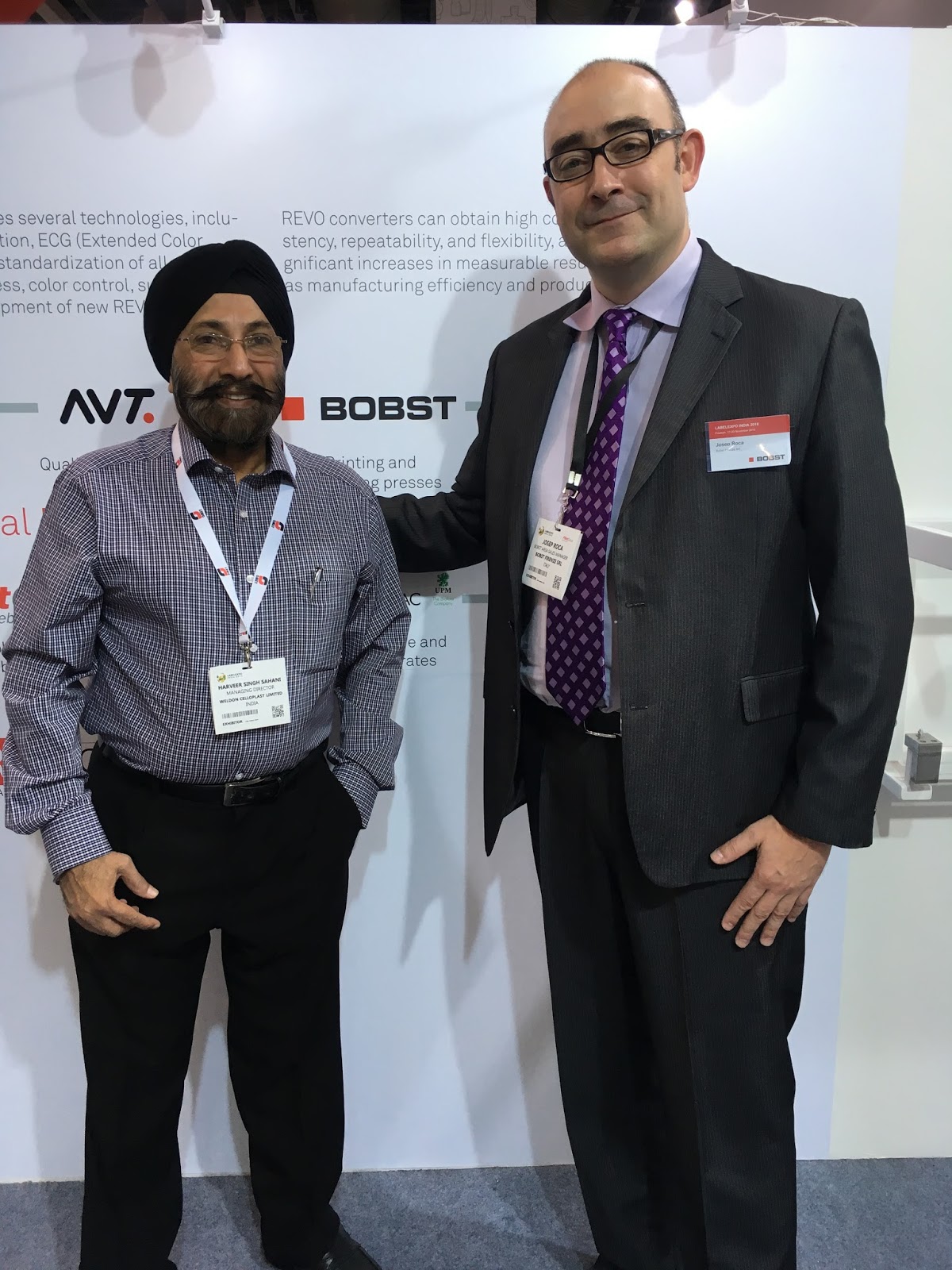
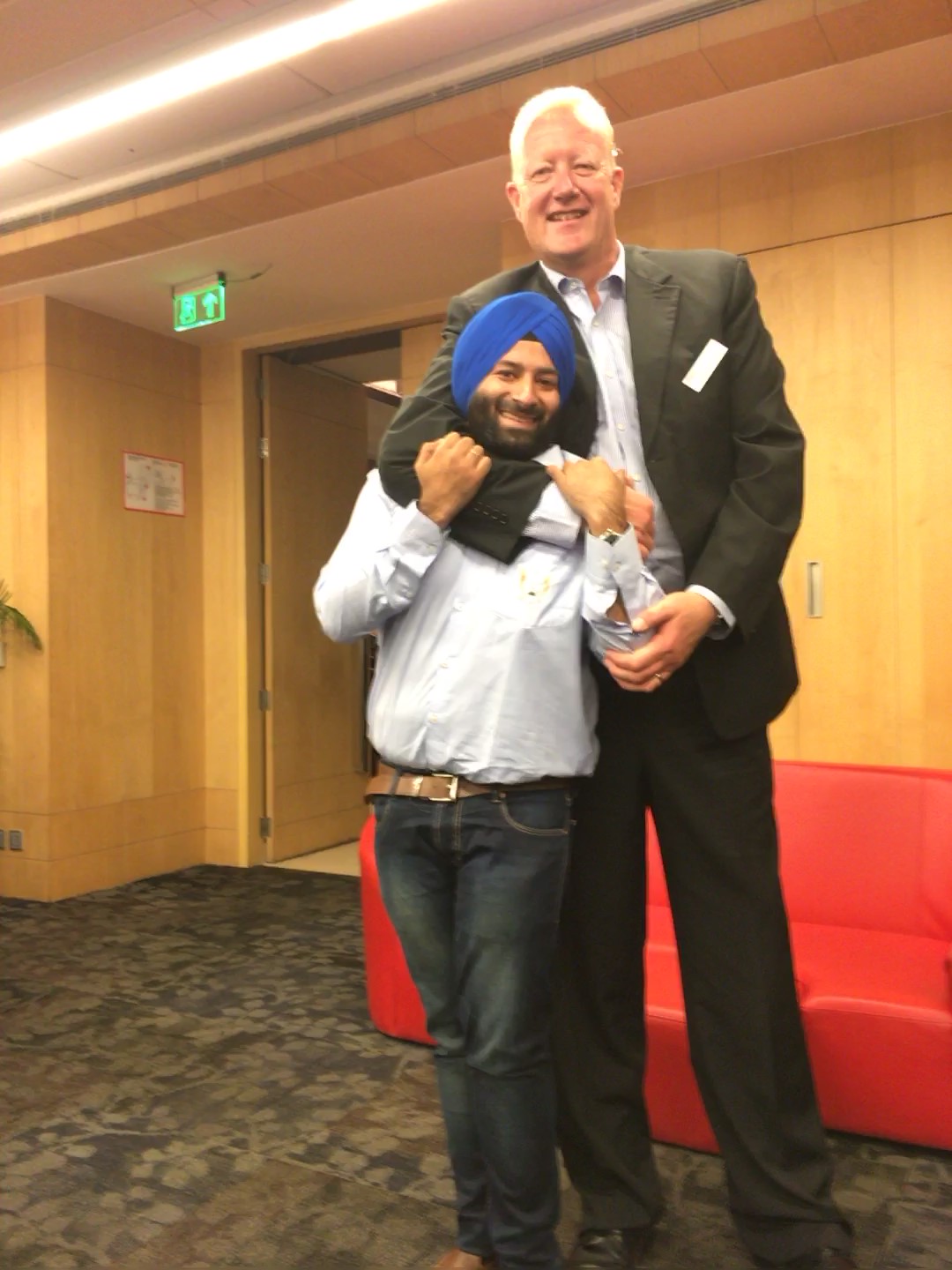
Harveer Sahni with Geoffery Martin at Labelexpo
get an in-depth “India specific” view from him. The industry in India has for long looked at him with bated breath as to when he will invest and have been guessing who will be his strategic partner. Geoff had at that time mentioned that they were looking at many companies but his vision was to look for companies whose promoters had emotional dedication towards their venture. He did not approve of promoters who after succeeding wish to sell, make big money and quit. Those who managed their company well with vision to see their units and their team prosper even after management changing hands, were what he was looking at. In December 2015 Guenther Birkner, now the President, Healthcare and Specialty business at CCL visited Mumbai and the news spread everywhere that CCL had signed up to acquire controlling interest in Bharat Mehta lead Super Labels in Mumbai. However in absence of any confirmation or press release from either of the companies, it remained a rumour or gossip. More so after CCL took over Checkpoint systems, it was evident that finally CCL has presence in India. Now with this press release CCL’s entry into label industry into India is a confirmed reality.
Chronicling the history of label in India I wrote, “By 1976, Bharat Mehta and his brother
Bharat Mehta
setup a label press. Bharat Mehta bought his first Siki Label press from Ahmedabad where it was being used to produce unsupported wet glue labels. Shifting over from a business in agricultural pumps at the age of 26, Bharat Mehta settled down perfectly in to his label printing business. He is one of the most respected label printers. From a single Siki he went on to add a fully loaded Gallus, an EM 280 8 colours, EM 280 6 colours, and an Acquaflex. He was the first in India to opt for a full UV label press. In the earlier part of the decade of 2000-2010 he lost heavily in a major fire but firm resolve brought him right back in what he liked best, “Producing self adhesive labels”
Soft spoken gentleman of the Indian label industry Bharat Mehta is both, the history and present of the Indian label industry. He is one of the first label printers in India. I could sit with him and chat for hours about our time spent in this industry which has evolved like a family for him and me. Bharat Mehta’s Super Labels is one of the leading and respected label printing companies in Mumbai. His two sons joined him in business after completing their management studies.
Indian label industry is growing for sure but most of our printers complain of intense competition and depleting margins. They are under pressure to service debt as they would ideally wish to do comfortably. They are in a dilemma on the extent of further expansion, more so in the scenario whereby large multinational companies are investing into India. They wonder if the existing customer base and market will grow rapidly to provide enough opportunities for all or shrink by the incoming of foreign investors into labeling. My personal view is that with a growing literate population, low per capita usage at present and expanding retail, there will be enough business for all.
Written and reported by Harveer Sahni, Managing Director Weldon Celloplast, New Delhi, India
Magazines are free to publish this report giving credit to author.
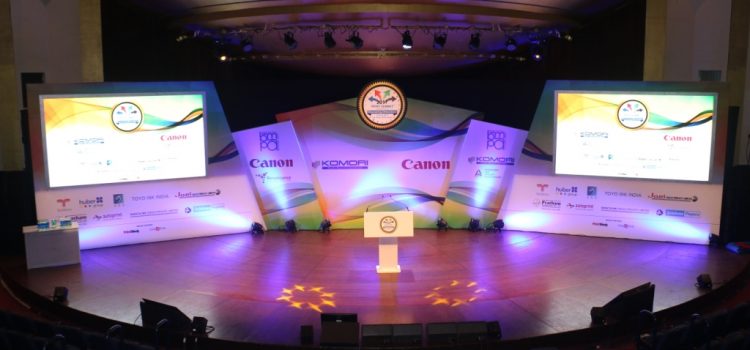
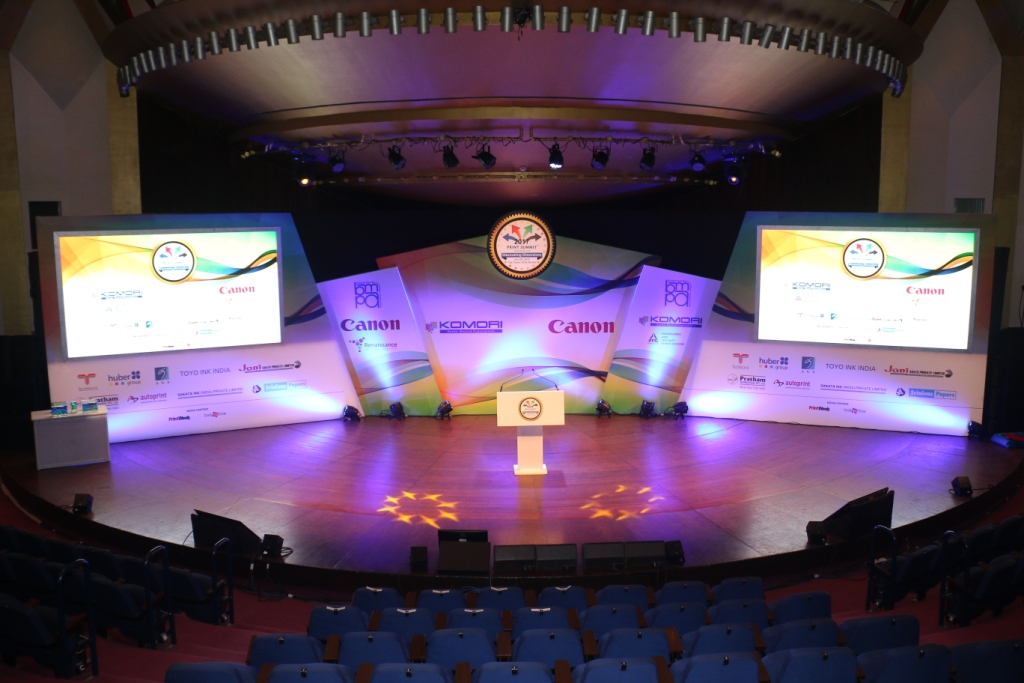
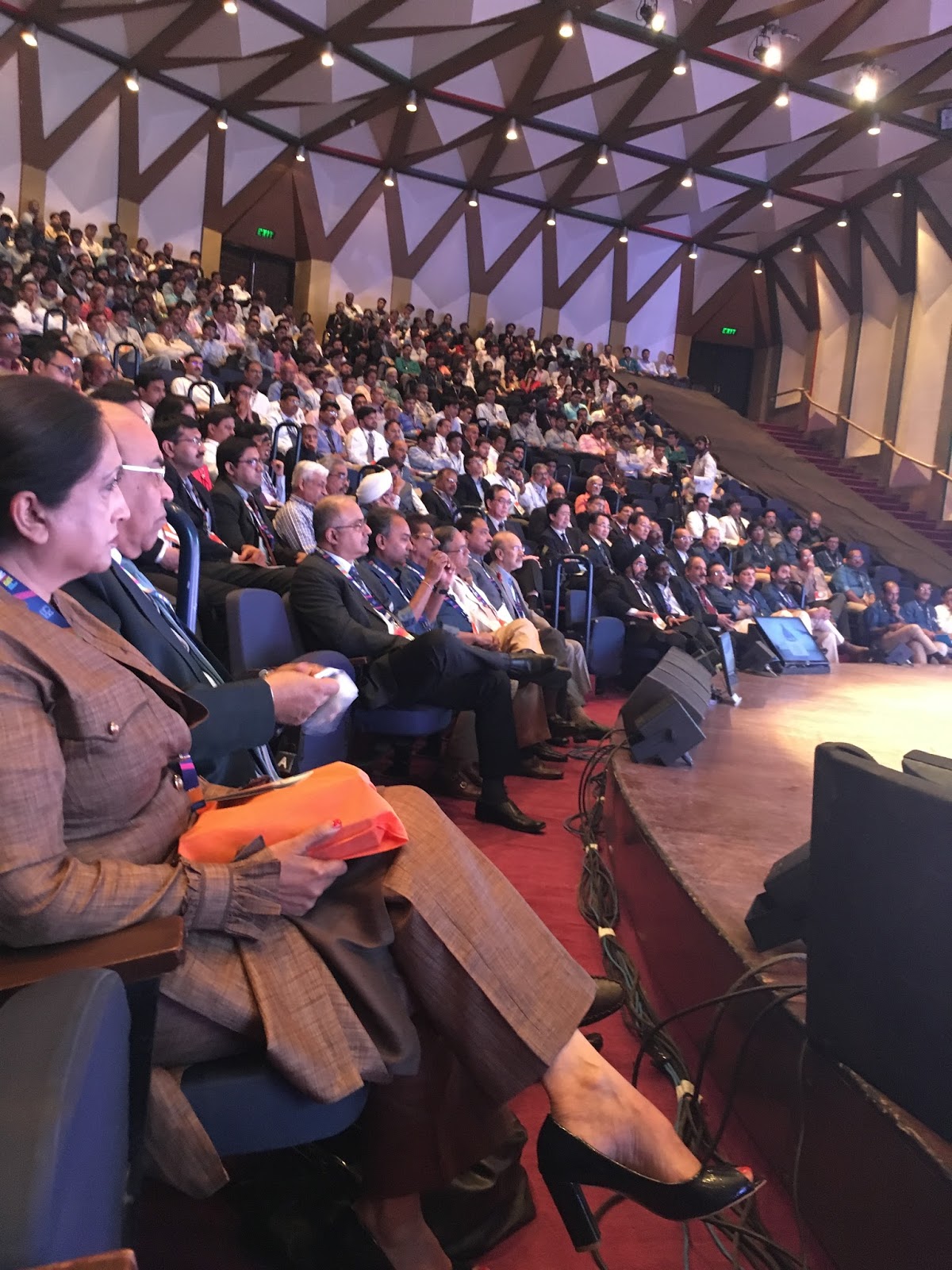
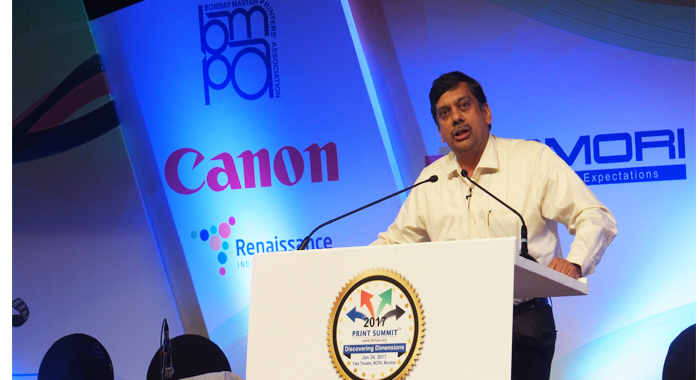
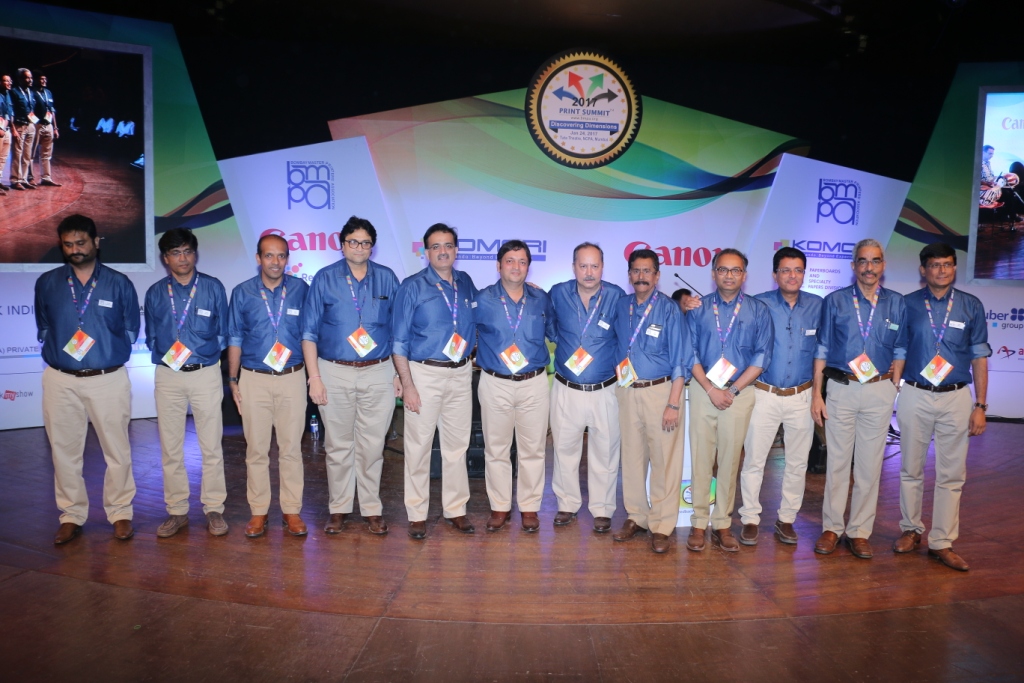
I have been used to seeing sponsors or industry suppliers make monotonous presentations in the garb of delivering knowledge to printers at various print industry conferences. The procedure is relevant at most conferences even now. When it gets a little over bearing, delegates in the audience are seen yawning. At the FINAT Congress in 2008 at Paris, I was surprised to see a speaker speaking of her mountaineering experience. As the US based LNW magazine reported, “Some people in the audience tend to leave conferences before the end, pleading important engagements (particularly on a Friday) so that the last speaker addresses rows of empty seats. Few of the delegates at that FINAT congress had previously heard of Cathy Dowd, but the sheer incongruity of inviting a female mountaineer must have intrigued many, and the house was full to hear of a South African team's ultimately successful bid to conquer the world's highest, mountain. Dowd has the actress' ability to match words, gestures and images. The images were of peaks and yawning chasms; the words were largely about teamwork under extreme conditions, and what happens when it goes sour. It was a little theatrical, but nonetheless a memorable performance.” I have been in awe of what she shared from her experiences with the crowd and how it translates to enduring situations in day to day work. BMPA’s “Print Summit” brought back not just memories of that day in 2008 but excelled in taking the concept to amazing heights. I am overwhelmed by what they created at this excellent event. With close to 1000 delegates attending and staying glued to their seats till the end shows, what an excellent event it was.
The summit started with presentation by one of the most highly decorated officer Lt GenSyed Ata
General Hasnain
Hasnain, PVSM, UYSM, AVSM, SM, VSM & BAR, the former CorpsCommander of the Indian Army’s Srinagar based 15th Corps who has experience of almost every turbulent spot where the Indian Army is deployed. He served in Sri Lanka, Punjab (during the militancy), North East India, Jammu & Kashmir and commanded his unit in the Siachen Glacier. He also served the United Nations in Rwanda and Mozambique. In 2010 he was assigned to Kashmir for the seventh time to lead the Army’s efforts to find peace. His leadership techniques famously titled — ‘Heart is My Weapon”, “PlayFriend, Not God” and “Passion in the Heart & Fire in the Belly”, are considered new age mantras for the Army and other organizations. His narration of experiences on the “Challenge of being a Siachen Warrior and leadership management” thereof, left delegates imagining the replication of these procedures in corporate management and the results it would deliver!
Faheem Agboatwala
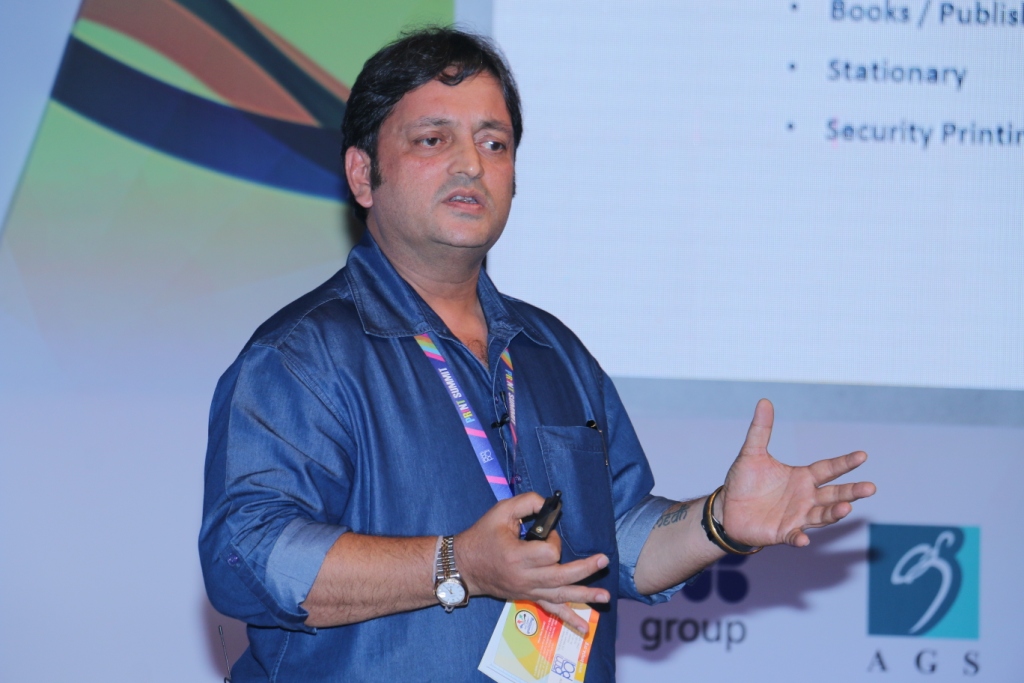
Faheem Agboatwala, director of Mumbai based Hi-Tech Printing Services spoke on the need for businesses to recognize the “S Curve”. He described it as a time in life of a business where the promoters need to recognize the approaching end of a profitable cycle while the business is still making profits. It is a time to make investments into new arenas or move on to the next S Curve in the life cycle of their enterprise to reach higher levels of success. Enterprising promoters have the sixth sense to foresee the situation and jump ahead to the next curve. Attributing the courage of entrepreneurs to accept exponential change from ending an ongoing successful business to initiate a new venture to drive growth, he showcased the story of three such companies who used the theory of S Curve and reached a pinnacle. Two of these have a strong presence in self adhesive labels. In fact all three have indulged in labels in their life cycle. These companies are Akar, Mudrika and Printmann. Ashok Jain lead Akar Ltd. is a provider of innovative solutions in Printing, Packaging, Publishing and Promotional products. I met Ashok Jain the first time in the mid 1990s when he was into regular commercial offset printing and was also printing stickers on sheet fed offset. He went on stage to narrate his story of jumping the S Curve multiple times to success. His Mantra has been to pick and choose clients, go out of the press room and think business like a leader. Tejas Tanna of Printmann spoke about the need for printers to draw respect from customers as partners and not just being vendors. Printmann moved from just commercial printing to cartons and self adhesive labels with high concentration in the pharma sector. I have known Manish Desai of Mudrika Labels, a 100 Crore company, for decades. I have also written his story on my blog https://harveersahni.blogspot.in/search?q=mudrika . I have seen Manish and his team jumping the S Curve as decribed by Faheem a number of times. From screen printing to outsourcing offset printing for making stickers to the achievements until now has been a very interesting and curvaceous journey. Manish attributed his success to the regular visits to customers, exhibitions and virtually moving out of his shell to connect and grow. He is the past president of LMAI (Label Manufacturers Association of India.
I am not really a movie buff, I now see maybe one or two films in a year. It maybe interesting to note
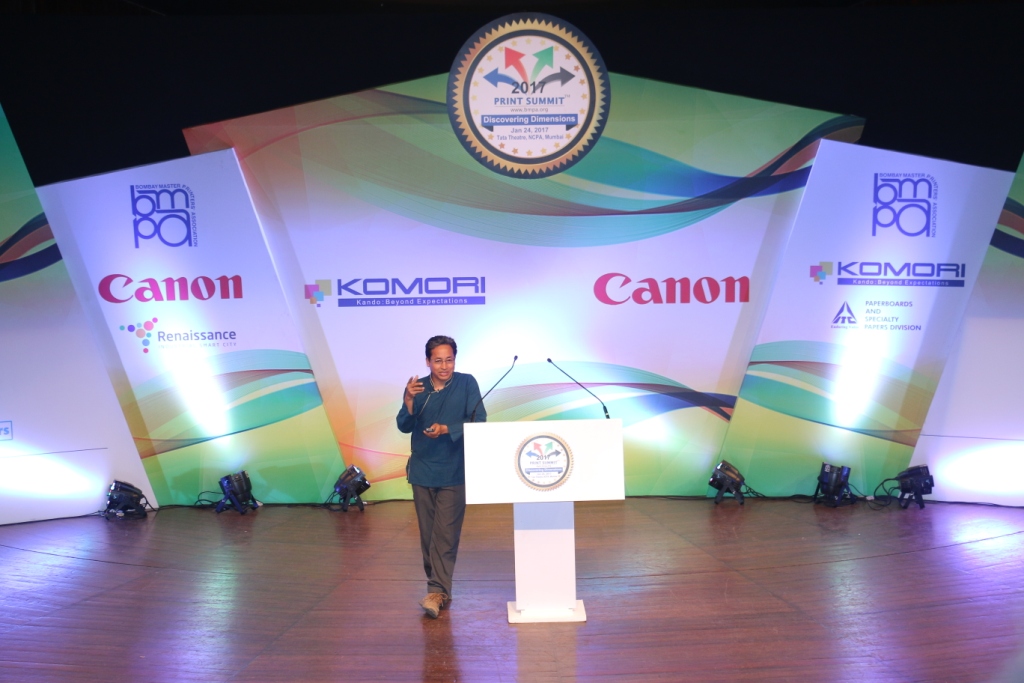
Sonam Wangchuk
that from 1984 to 2000, for almost 17 years I did not see a single film. In the new millennium my children do drag me to movie that they feel I will enjoy thoroughly. When I saw the list of speakers, I noticed the name Sonam Wangchuk from Ladakh as a speaker, it immediately reminded me of the movie “Three Idiots” a movie that I had seen and was thrilling! I did not think much of the resemblance in name thereafter. At the Print Summit in the after lunch session, Sonam Wangchuk a Rolex laureate came on stage. I was having difficulty in keeping my eyes open. The heavy lunch was playing mischief. When Sonam started to speak on innovation in adversity, my mind jumped to alertness and the rest of the session I was listening in overwhelming attention? I had goose pimples! It was as if I was watching a sequel to the film “Three Idiots”. He spoke on simple things created out of just the nature’s bounty. A school is constructed without electricity and heated with sunlight and use of convection principle. When the outside temperature is -15 degrees, it is +15 degrees inside. In winters upto April when you have ice in Ladakh there is water but when in may the ice has melted and flowed down there is acute scarcity and difficulty. Sonam saw in May one year that there was an unmelted block of ice in the shade of a bridge, drawing inspiration from that. Realising that the Ice did not melt under shade, a fountain spraying droplets of water in the air was created from the pressure of water flowing down the hills in subzero temperatures. These would freeze and fall down forming a stupa of tons of ice that with its reduced area of exposure to the sun, would remain as ice and be a source of water during summers. It sure was a wow presentation with many such stories. I wish I had heard some more. Sonam is now working on creating a university in a desert in Sikkim with natural resources.
Mehul Desai
Mehul Desai, founder and chairman, Mail Order Solutions and President of BMPA highlighted three companies Prodon Enterprises, Seshaasai Business Forms, and Vistaprint he stressed the need for dwelling and researching the historical data to evaluate the growth areas and identify contributing factors to your bottom line and moving ahead using this information so as to decide on future investments to remain profitable in growth. Padma Bhushaan, Shekhar Gupta said “I hear that print is dying. Let me assure you, it is not. We have a literate population that is growing.” He spoke on leadership qualities reminiscing his interaction with various prime ministers of the country. Padma Bhushan Dr B M Hegde spoke on wellness.
C N Ashok
Autoprint Managing Director, CN Ashok speaking on, "Will the next generation inherit?" said it was time for investing in a strong positive balance in the emotional bank account for the next generation. Delegation and then allowing the next generation to indulge in decision making is need of the hour. Not letting go of the authority is a hindrance to smooth transition to Gen Next. Speaking at the event Satoshi Mochida President and COO of Komori Corporation Japan said, “That print market is on the rise in the near future.” Puneet Datta, Canon’s director, marketing and sales in his presentation stated that technological innovations are transforming businesses within print. “The time to embrace digital is now” he concluded.
The “print summit” has established itself as a landmark event for the print industry! Getting huge number of printers to attend from beyond the geographical reach of the organising association and then having them sitting in full strength with rapt attention throughout the presentations upto the end is something rarely witnessed not only in India but across the globe. Clapping in unison to acknowledge the delivery of wonderful speeches, standing ovation to outstanding presentations and appreciation of organization by the BMPA’s young team was seen abundance. Industry leaders who were seen at this event include Ramesh Kejriwal of Parksons Packaging, Technova boss Pranav Parikh, Narendra Paruchuri of Pragati Hyderabad, Kamal Chopra President AIFMP, Anand Limaye Hon. General Secretary AIFMP and many more. I congratulate the BMPA team and thank Mehul Desai for having invited me to attend this wonderful show.
Written by Harveer Sahni Managing Director, Weldon Celloplast Limited, New Delhi-10008 January 2017
Leading printers and supplier members of Label Manufacturers Association of India (LMAI) met at Holiday Inn Hotel, Aero City, New Delhi on the 17th of January to dwell on the plans and initiate preparations for a mega Labels conference. The conference titled “Innovation Simplified” is slated to be held at Jaypee Palace Hotel and Convention Centre, Agra on from 20th July 2017 to 23rd July 2017. LMAI has appointed Kuldip Goel, Managing Director of Noida based Anygraphics as the conference Chairman. This will be the 4th biennial LMAI conference.
Previous LMAI conference at Jaipur
The first two earlier successful conferences were held at Goa and the 3rd was held at Jaipur. Leading printers and global suppliers are likely to attend this event. Participation in this event will be restricted to members in good standing and registration will be made on first come first served basis. New printers and suppliers can register by filling the form downloaded from http://lmai.in/PDF/New_Membership_Form.pdf .For the 3 nights 4 days program, delegates will be required to check in on 20th July 2017 and check out on 23rd July 2017
Members attending the meet gave their suggestions for making this a mega event that will deliver
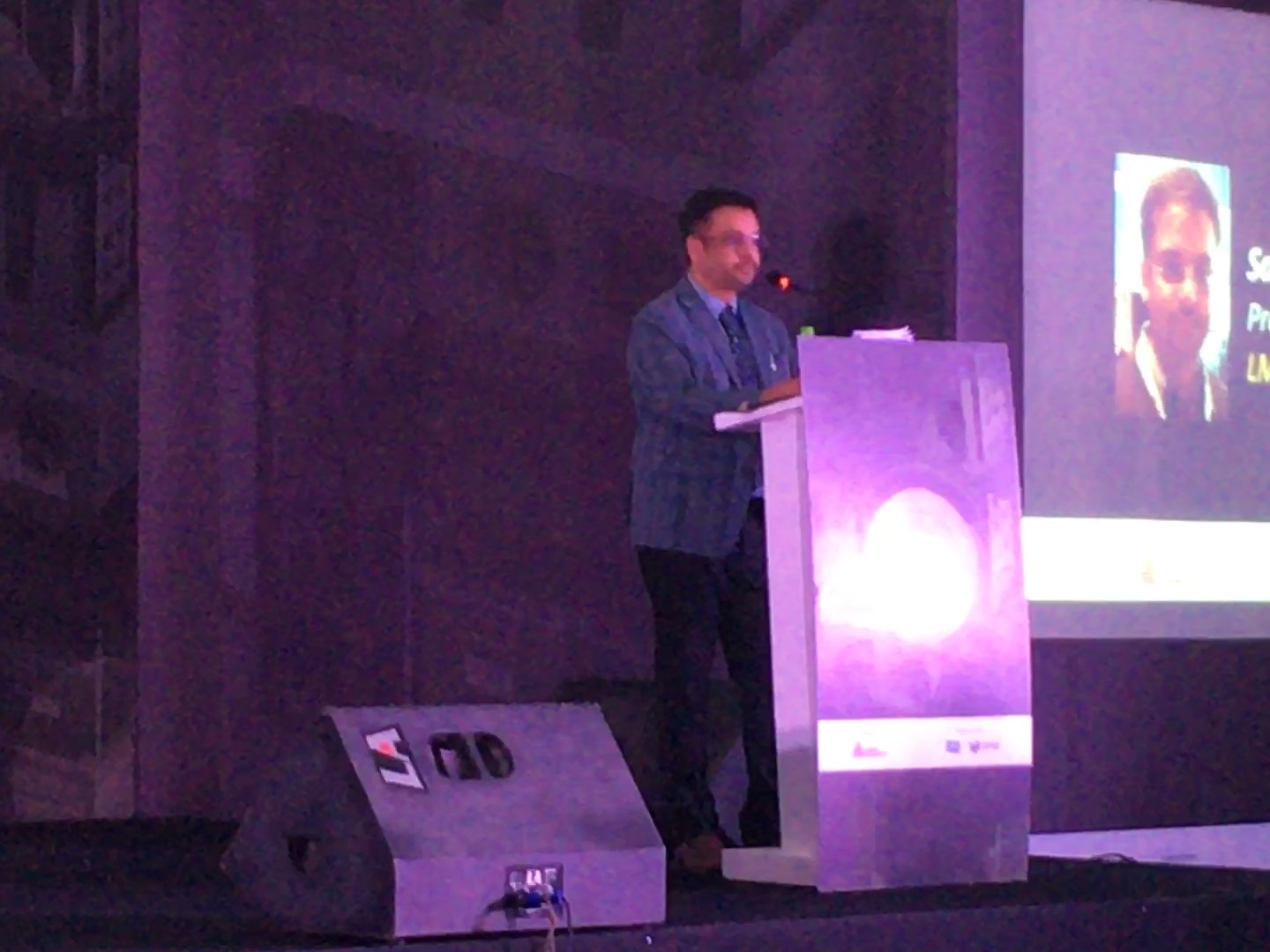
Sandeep Zaveri President LMAI
knowledge and networking opportunities to the label fraternity, a big success. It was decided to form sub committees comprising of members from across India to get maximum participation in organizing and reaching out to the industry in every nook and corner of the country. Printers who attended the meet include Sandeep Zaveri-President LMAI and MD of Total Prints Mumbai, Kuldip Goel-Anygraphics NOIDA, Rajesh Chaddha-Update Prints Gurgaon, Rajesh Nema-Pragati Graphics Indore, Vivek Kapoor-Creative Labels Mumbai and Ramesh Deshpande-Renu Prints Aurangabad . Leading Suppliers who attended include Pankaj Bhardwaj-Commercial Director Avery Dennison, Praveen Gupta-Country Head UPM Raflatac, Prasenjit Das-DuPont, Amit Sheth- Label Planet, Ajay Mehta-MD SMI Coated Products, and Pawandeep Sahni Director Weldon Celloplast.
Kuldip Goel Conference Chairman
Speaking at the meet Sandeep Zaveri asserted the resolve of LMAI management to continuously deliver value to members by organizing technical workshops, seminars, conference and networking events. LMAI also provides information on important government notifications and other issues of interest to members. Speaking about the conference Kuldip Goel assured that he and his team will endeavour to make this event pleasurable. It will deliver knowledge in terms of presentations by leading industry suppliers and technocrats. An entertainment program that motivates the audience to participate and enjoy the moment is being mooted and finally in the course of those 3 days, enough opportunities for networking with peers in the industry will be provided. Being organized in the historical city of Agra, family members will have the chance to visit Tajmahal and other monuments in the city, if they so desire.
On February 25, 2012, I posted a story on Kimoha Entrepreneurs Ltd. lead by Indian entrepreneurs Vinesh Bhimani and Kiran Asher. The amazing path traversed by them and their commitment to grow the company with support of an inspired team has made me update their story to current level and post it yet again.
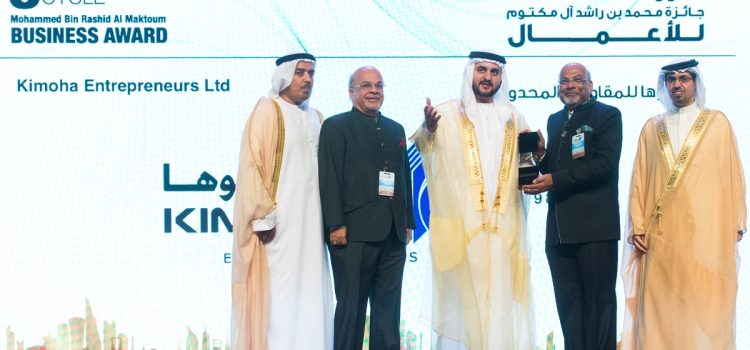
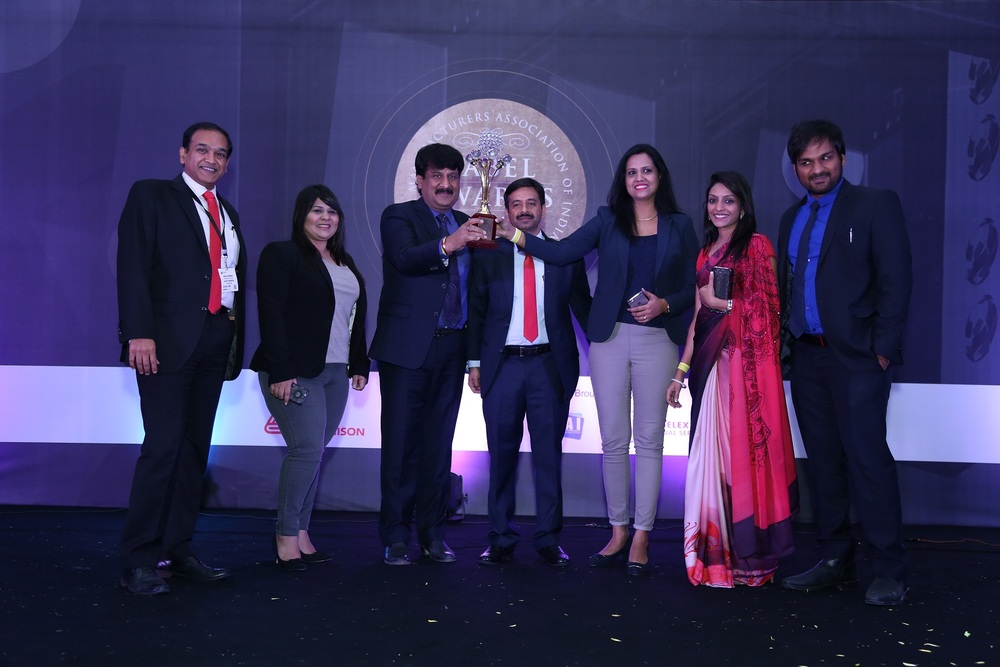
Under the patronage and in the presence of His Highness Sheikh Mohammed bin Rashid Al Maktoum, Vice-President and Prime Minister of UAE and the Ruler of Dubai, the DubaiChamber of Commerce and Industry successfully concluded the eighth cycle of the Mohammed bin Rashid Al Maktoum Business Award, by honouring 20 companies during an award ceremony held at the Madinat Jumeirah Arena in Dubai on 27th of July 2015. One of the two awards in the Manufacturing category was presented to the leading label printing company in Middle East Asia; Kimoha Entrepreneurs Ltd. lead by Vinesh Bhimani and Kiran Asher of Indian origin.
printing companies run by Indians in Middle East Asia or for that matter by anyone outside their homeland. His persistence and commitment to succeed has enabled him to bounce back to success from extremely adverse circumstances. With over two decades of relentless effort and dedication, he created his label brand “Xel-lent”. He achieved perfection by creating labels and print packaging products that would stand out in the market place. During my visit to his facility, I was overwhelmed by the way he accorded a welcome (which I gathered is a customary practice whenever any of the company’s stakeholders or important guests visited); All the TV monitors in the company (there were quite a few), had a welcome message for me apart from announcing various awards received by them. Chairman Kiran Asher has been honoured by the President of India at the Pravasi Bharatiya Divas (A day for Indians living abroad) at Jaipur in January 2012. Carrying the hospitality further, my picture (commemorating my visit) was taken and gifted to me in an elegant folder along with customized gifts. He has experienced success and rejoices the fruits of bringing excellence to “Xel-lent” and also to all the businesses and operations at Kimoha.
Whilst Vinesh Bhimani’s grandfather lived in Africa working for a private bank in Zanzibar,
The very first telex roll machine
his father preferred to return to India and set up shop in a free and independent India in 1947-48. Nizamabad in (AP) India became the family’s base and in partnership with his uncle bought a rice mill. They did not meet with success and lost all that they invested, in a year’s time. However they were persistent and restarted a small floor mill (Atta Chakki, as they call it in India). This venture, by virtue of their hard work prospered to become a successful rice mill! In 1962 Sanjiva Reddy, the then Chief Minister of Andhra Pradesh and later the President of India, conferred upon this mill an award for safety. 1970-71 saw Vinesh’s father parting ways with his uncle and in conjunction with his own brothers (whose responsibility became his after the demise of Vinesh’s grandfather) taking over the management of the rice mill. Vinesh then still young and attending school during the day would spend his evening and nights in the rice mill.
Vinesh graduated in Commerce from Nizamabad, and his father crafted different plans for him. He did not want him to join the rice mill, instead wished that he would take up the offer of RRL Jorhat, (Regional Research Laboratory) to use their technology to manufacture carbonless paper. The seed for his involvement with Paper was sown and necessary equipments ordered from Kolkotta by the family. Meanwhile Vinesh was sent to Mumbai for a one month management course. He was to stay with his uncle (mother’s brother). The uncle was the fifth generation from a family that was heading the 146 year old large and respected trading firm Khimji Ramdas, based in Oman. Vinesh’s uncle made him an offer to come to Oman but his family was ready to start the carbonless paper unit in Nizamabad. Unfortunately the equipment failed to perform and they lost all the money they invested into this project.
At this point of time Vinesh was sent to Oman to get a “feel” of things before returning to Nizamabad
and start something else there. That was 40 years ago and he never returned to settle down in India. Vinesh had joined Khimji Ramdas as a trainee and left at the post of a General Manager in 1988. From Oman he came to Dubai and with the experience gained in Oman he, with his brother in law Kiran Asher, started a trading company. They made their first deal of importing Turmeric from Hyderabad, India and exporting to an Iranian customer against a post dated cheque. The cheque bounced and they lost most of the money invested! Whatever stock of turmeric was left with them was brought by them and stored in a Jebel Ali warehouse. As luck would have it, that night, a water pipe in the shed burst and they lost all that remained. Vinesh Bhimani was a devastated and embarrassed man. He blamed himself for his brother in law and partner Kiran having lost money. He offered to sell his house in Mumbai to repay Kiran. Perhaps God had other plans for Vinesh. Kiran asked him to stay on and wait to let things settle down, they decided to stay together. It was now time to start “Kimoha”. Briefly they started packing food items but soon shifted to manufacturing telex and fax rolls. It was a humble beginning with a machine made by his uncle in Nizamabad. Nostalgically Vinesh reminiscences that they participated in an exhibition and Sheikh Mohamed, the current ruler of Dubai, visited their stand and asked them if they manufactured these rolls in Dubai. He then advised a big stationer accompanying him to buy from them. For many years this stationer remained one of Kimoha’s biggest customers. Business began to grow with exports to many countries and Vinesh started to travel extensively. During his travels he would be fascinated by the baggage tags, each time he would check in at the airlines counter. He would study the tag at length and vowed to produce it one day. He went to Japan to visit suppliers of thermal paper as also to learn about the product. It was a matter of time now, his mind was made, “he would manufacture the baggage tags and self adhesive labels”.
Mike Fairley and Vinesh Bhimani
Vinesh Bhimani went to the first Labelexpo that was held in Brussels and also attended the presentation made by the international label guru Mike Fairley. All this effort was made to learn about the products that he intended to produce one day. He had a voracious appetite to acquire knowledge about the products that he intended to indulge in. At Labelexpo, machine suppliers were wondering who this man from UAE was and what all he was talking about. He was a new entrant and wanted a label press to have features that were not for beginners. He wanted a 24 inch repeat and three die stations, etc. Little did they realize how focused this man was. Before the show ended he was decided on the configuration of the press, it had almost everything on it, the repeat he wanted, print stations, turnbar, sprocket hole punching, fanfold, etc. It looked expensive but when he called his partner Kiran Asher, the answer was in the affirmative. Kimoha was on way to success.
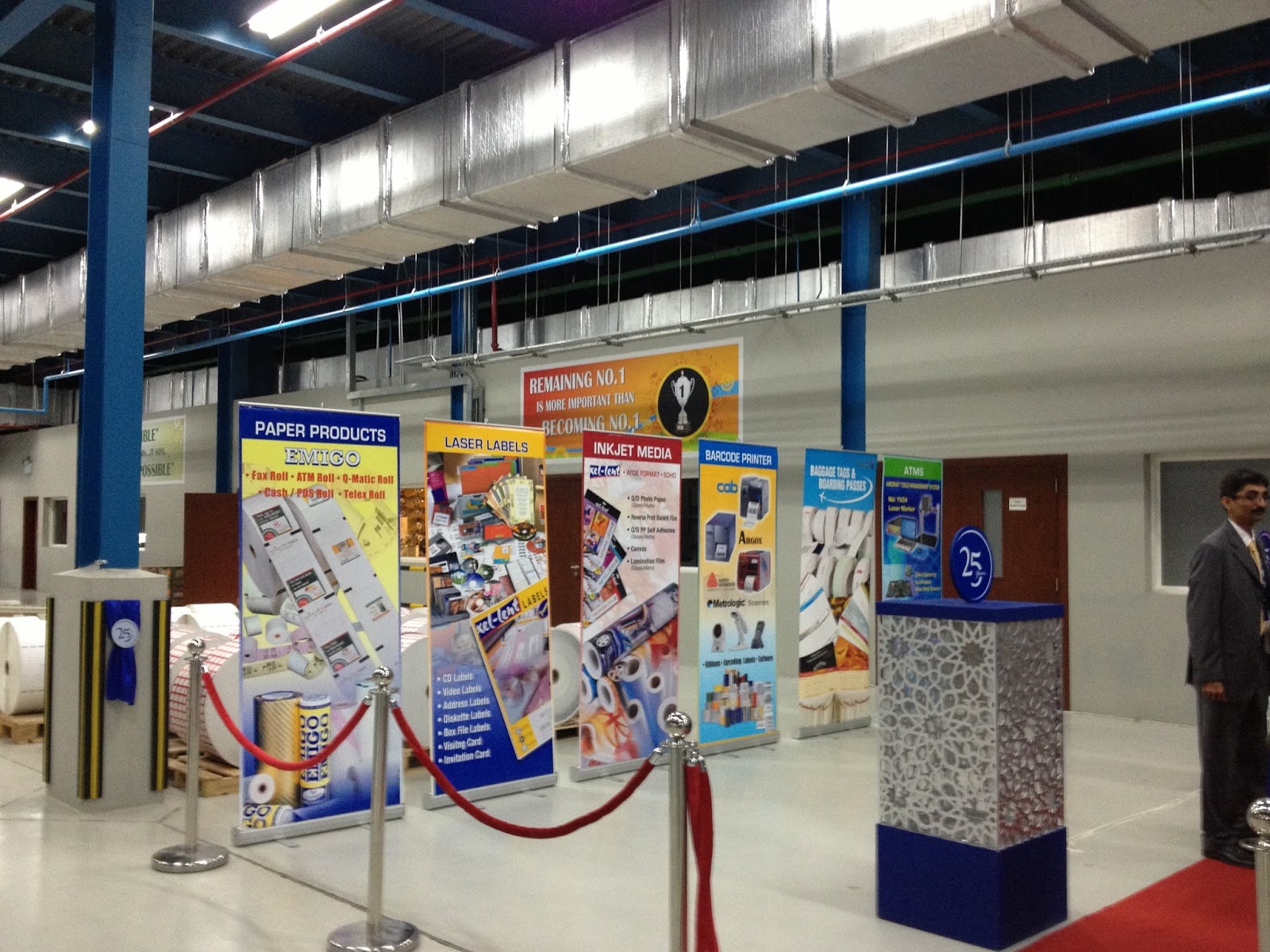
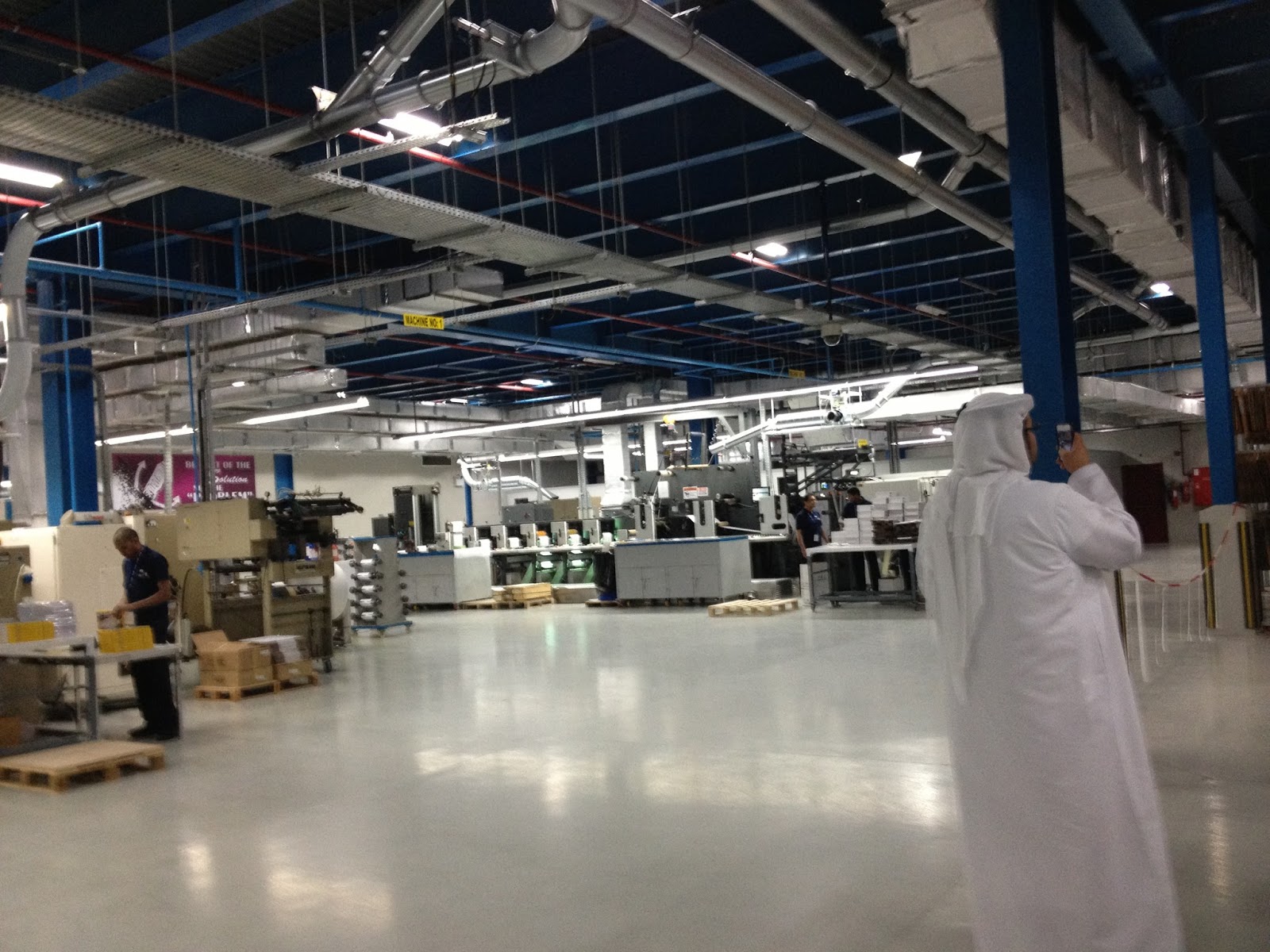
Initial hiccups were normal. There were no operators so Vinesh had to go to India for recruitment. In 1995 Kimoha got their first contract for baggage tags from Emirates Airlines but with a rider attached. They were warned that if they do not deliver they would have to quit UAE! All appeared to be going smoothly when a nightmare struck, the die got damaged on line and all hell broke loose. They rushed a person to UK by the next flight and return immediately after collecting the die. They delivered and kept their commitment. Kimoha has not looked back thereafter. At three Labelexpos thereafter, they kept buying new presses one after the other. With just two employees in 1988 in an 18 square mtr office, Kimoha has come a long way. They now operate out of a 20,000 square mtr brand new facility at Jebel Ali, Dubai. The factory is immaculately clean and systemized. They operate with 13 flexo label presses and one digital press alongwith a host of other finishing and converting equipments having capabilities for hot-foiling, Embossing, online numbering and applying registered holograms. The total workforce at Kimoha is in excess of 300 employees. Kimoha offers a range of baggage tags, label products, flexible packaging and stationery. With a sales turnover of multi million Dirhams, their products have presence in more than 35 countries. Their presence in the baggage tags segment is very strong with supplies going to over 100 international airlines, airports and ground handling providers over the world.
Purnima Bhimani married Vinesh in 1978, she was by his side in business that day and she is still there in office daily supporting him actively. She takes care of finance and planning of the interiors at Kimoha. She has given her best to the growth of this enterprise. Their only son Jay is 21 years old and studying. Jay may join the family business one day but the parents feel it is too soon to say as young people are quite unpredictable. He may want to do something else. After all the family has a history of drifting in diverse fields. The great grandfather was a banker and the following generations drifted to Rice mill, Floor mill, International trading, Food packaging and on to Labels, Printing and Packagings. Kiran Asher, Vinesh’s brother in law and partner who has been his staunch support, is the Chairman of Kimoha. Vinesh’s brother Rajesh has also been with Kimoha for almost two decades. He is responsible for besides other things the house keeping at Kimoha. His work shows! The facility is amazingly clean. Vinesh Bhimani works hard and his team is like his family. He tirelessly communicates with them to instill family values. His staff sometime receives emails from him that were written at 3am in the morning. He took 267 people one day to visit Burj Khalifa, in an effort to deliver his message of aiming high and having higher virtues in life and to understand how one feels when one “At The Top”. Each day starts with the entire Kimoha family (the workforce) joining in morning prayers. At lunch they are served a high-end restaurant catered meal and are allowed some extra time to play indoor games before returning to production. Education of employee’s children, medical expenses, insurance, etc., is areas where the company supports its employees.
Kimoha has been honoured as one of the top 100 SMEs in Dubai in the first ever ranking initiative in 2011 and then again in 2013.
In 2011;
They were in 38th rank in the overall top 100 SME companies in Dubai
3rd in the top 10 SME in the INNOVATION category
10th in the top 10 SME in the GLOBAL ORIENTATION (EXPORT)
6th in human capital development
In 2013,
They were in 27th overall rank
5th in innovation
4th in human capital development
15th in growth performance
26th in international orientation
34th in corporate governance
Kimoha has also been fortunate enough to be conferred with:
CSR Label from Dubai Chamber of Commerce & Industry (3 consecutive years)
Leed Gold Certification from United States Green Building Council for Kimoha’s new state of the art office-cum-factory-cum-warehouse building.
In-house Flexo and Digital Pre-press Facility – CTP
Laser labels produced from recycled label stock and packed in recyclable boxes when demanded so by buyers.
Converting photopolymer plates from 1.7mm to 1.14mm, thus reducing Carbon footprint by 17%
Ensuring that the new Premises meets the rigid green standards set by USGBA and EHS, viz. among other things, Over 900 tons Air Conditioning with aid of 410 A Refrigerant. Minimal CFC emissions
Occupation and Movement sensors
Recycling 95% of plate-making solvent
Installation of LED light in office and factory
Ongoing project to install solar to run factory and office using 100% solar energy
When asked about his vision on what his venture will be in future, Vinesh Bhimani is pensive in his thoughts. He firmly believes that whatsoever is done and will be done in future, will only be according to the “Will of God”. He says, “We are like robots operated by this Master sitting above all of us with controls”.
Vinesh Bhimani is non-committal on what Kimoha will be. He firmly believes that he has to be doing something different and specialized. Kimoha will continue to expand and diversify. He wishes that his entire Kimoha family remains bonded together and involved in creating something special. Size is not what matters. The goal is, to be unique and achieve a status where the entire team has contributed, to bring excellence to Xel-lent and beyond and be the part of a global network! “This is what we pray in a morning-prayer that we make with all our employees at our premises on all working days”, Bhimani concluded.
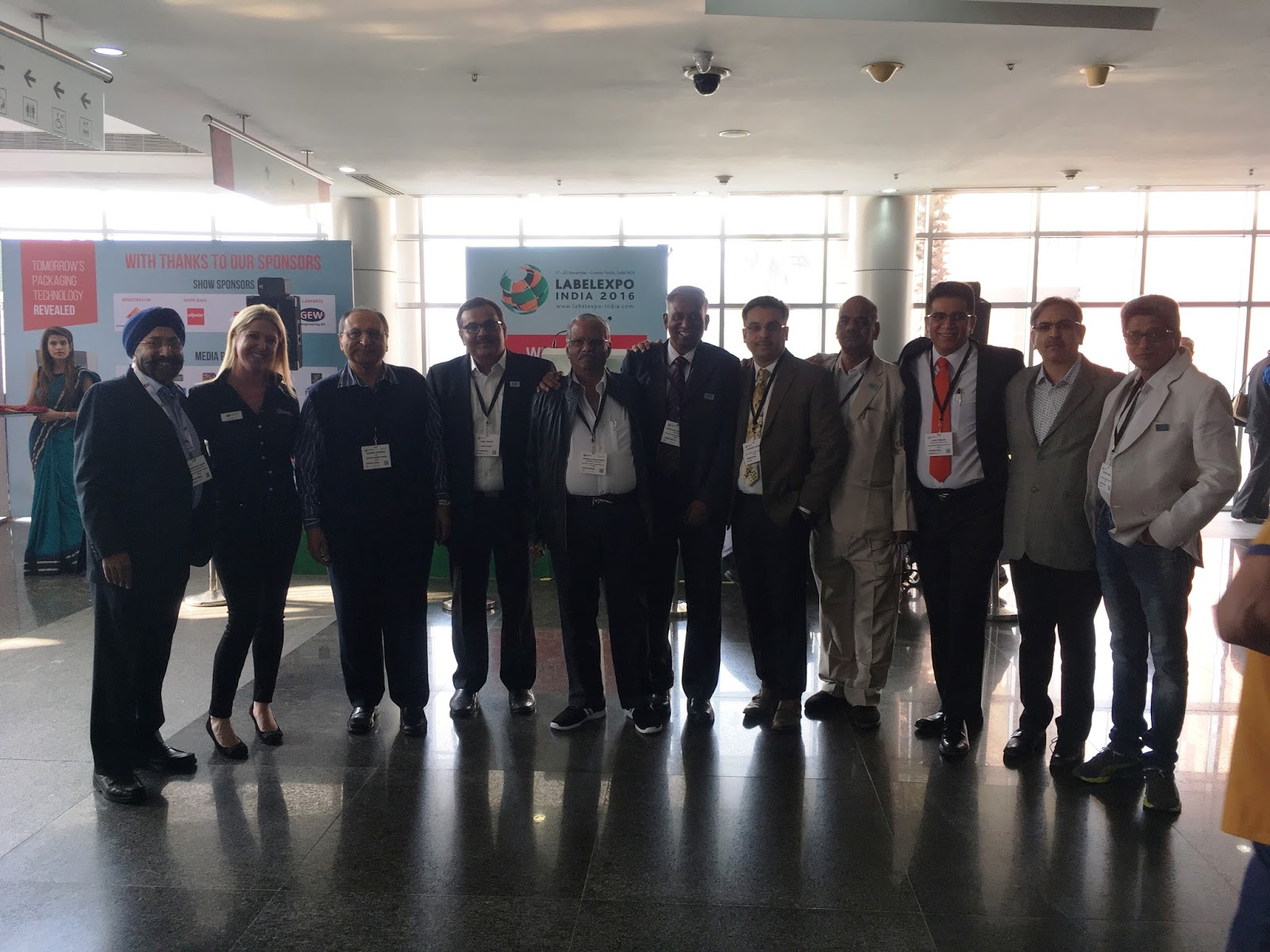
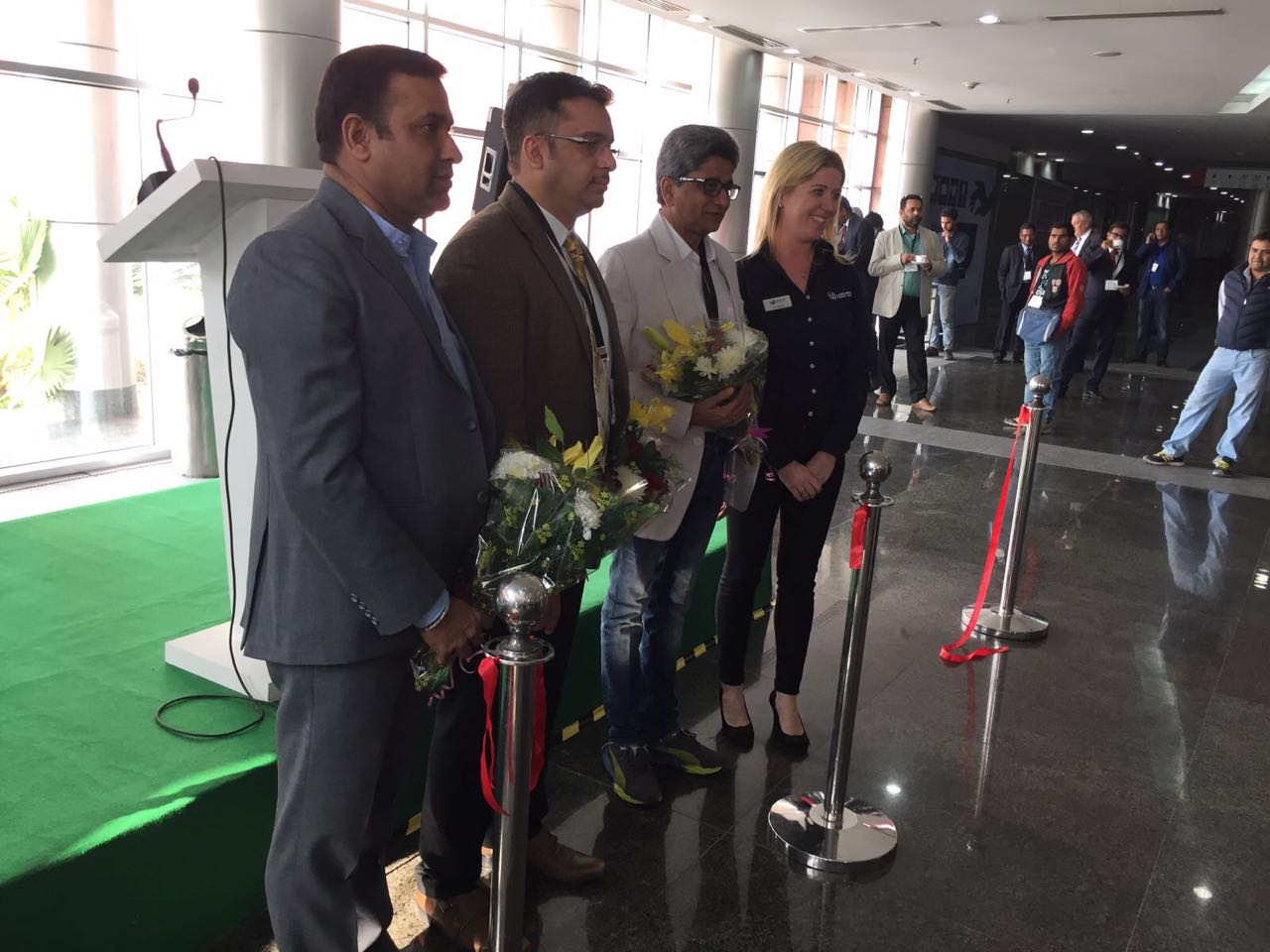
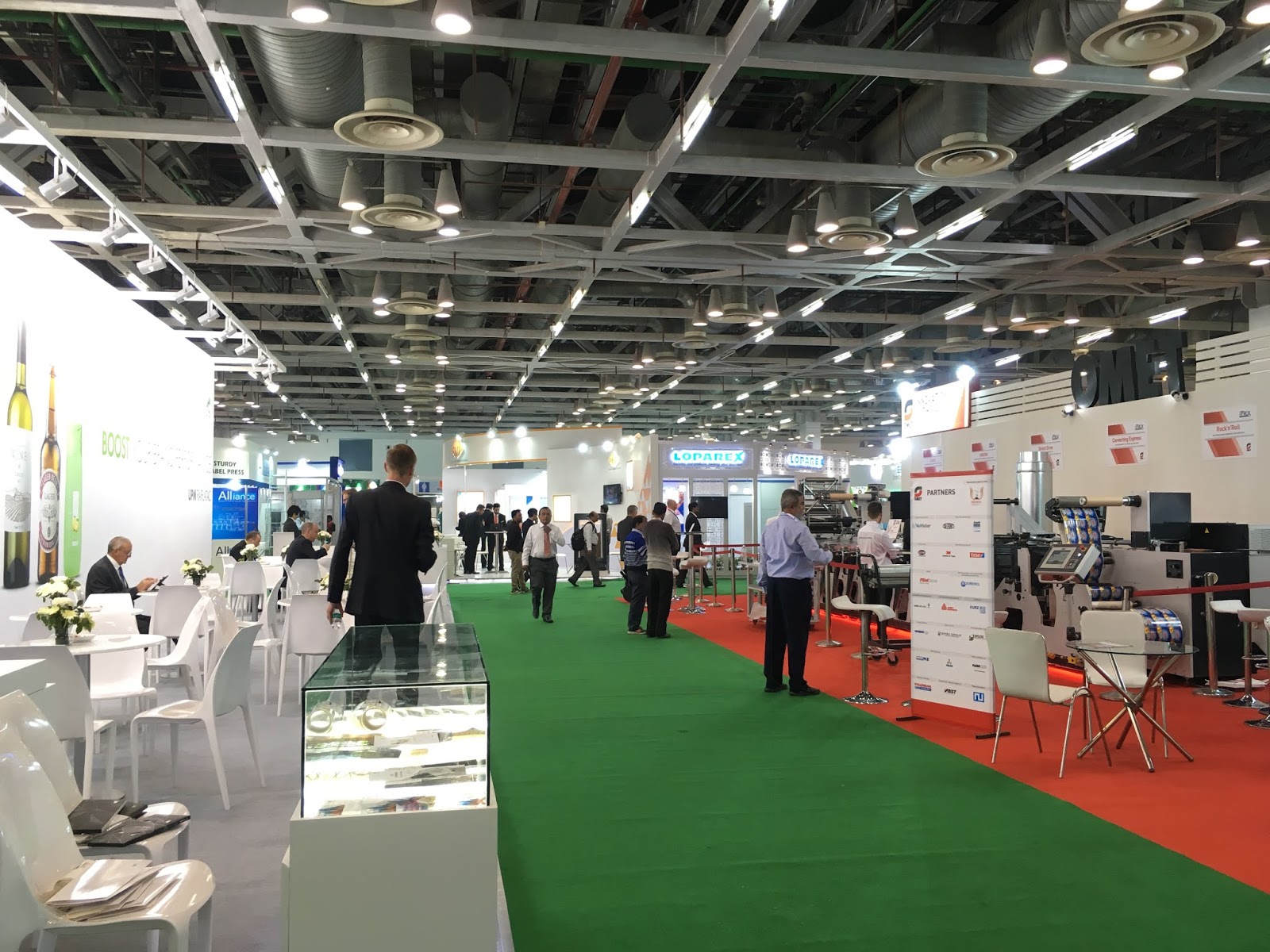
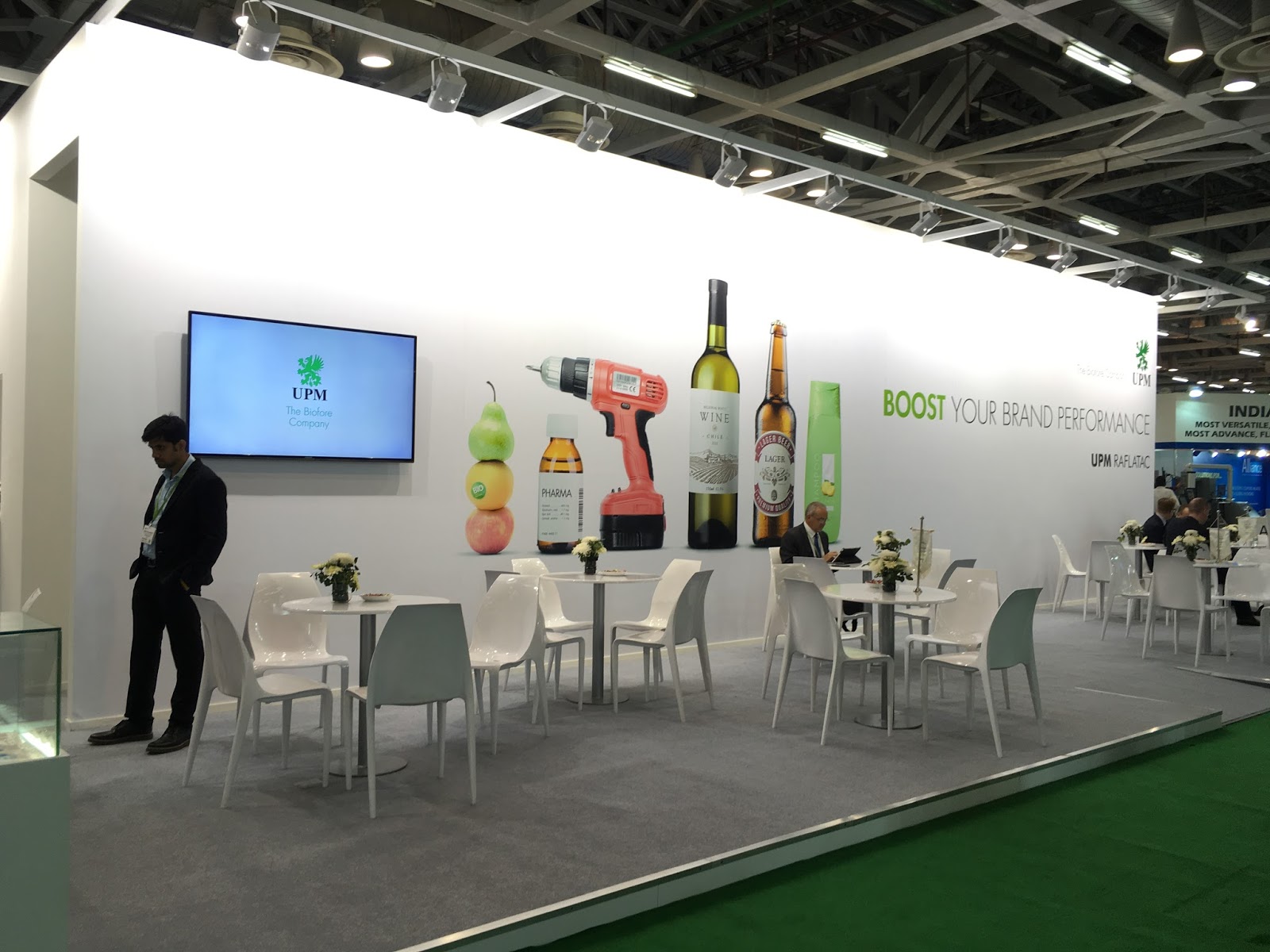
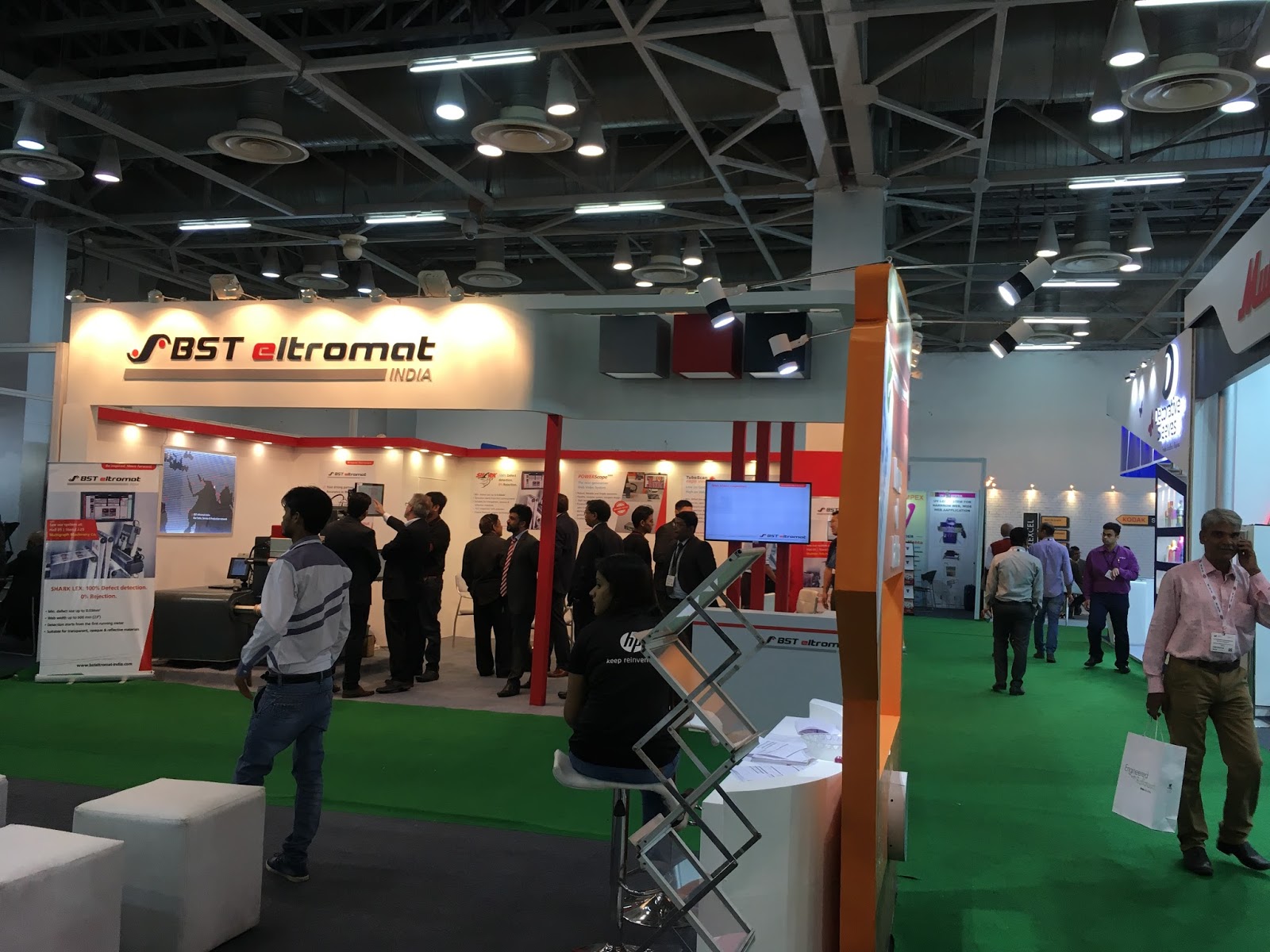
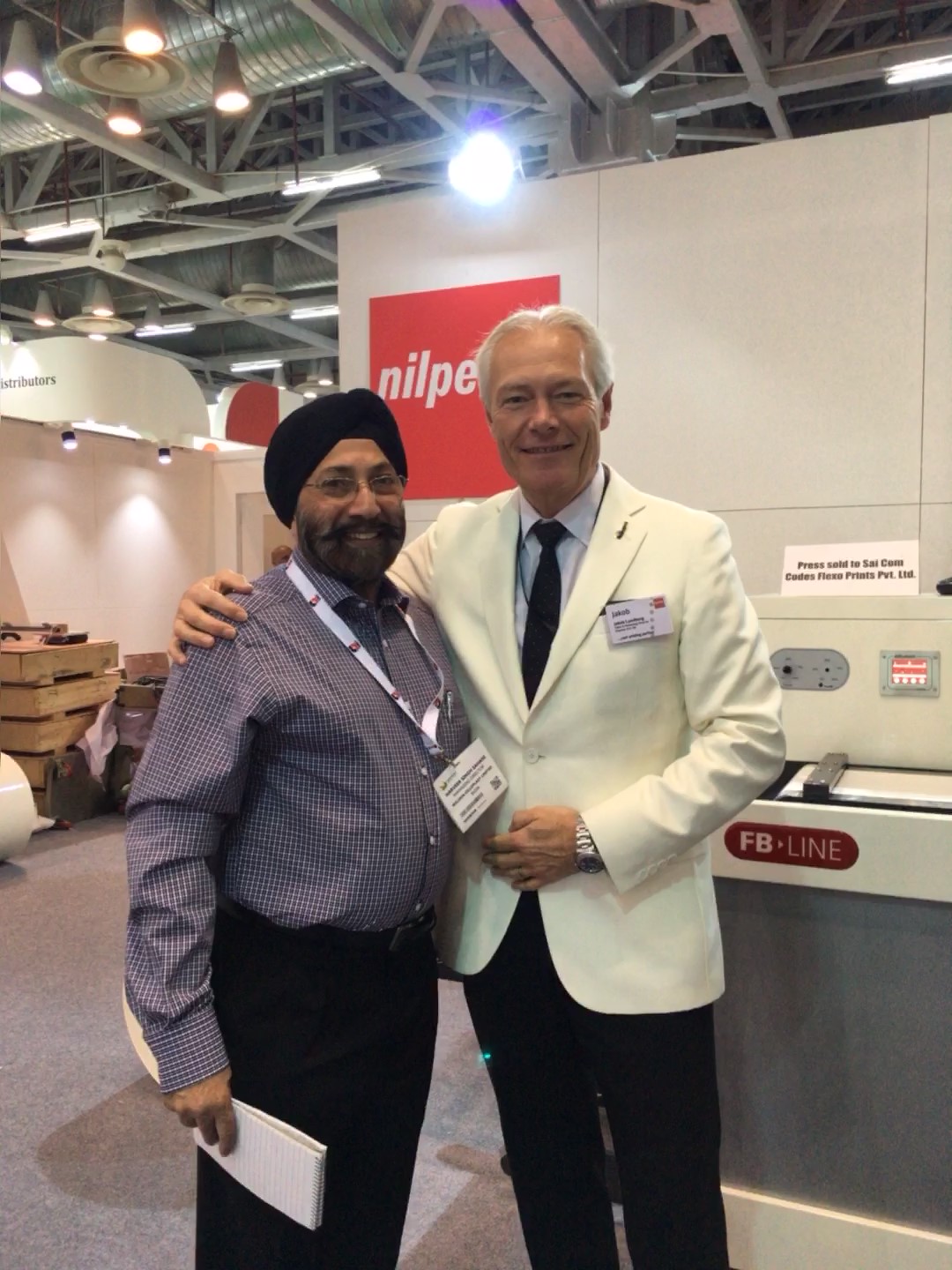
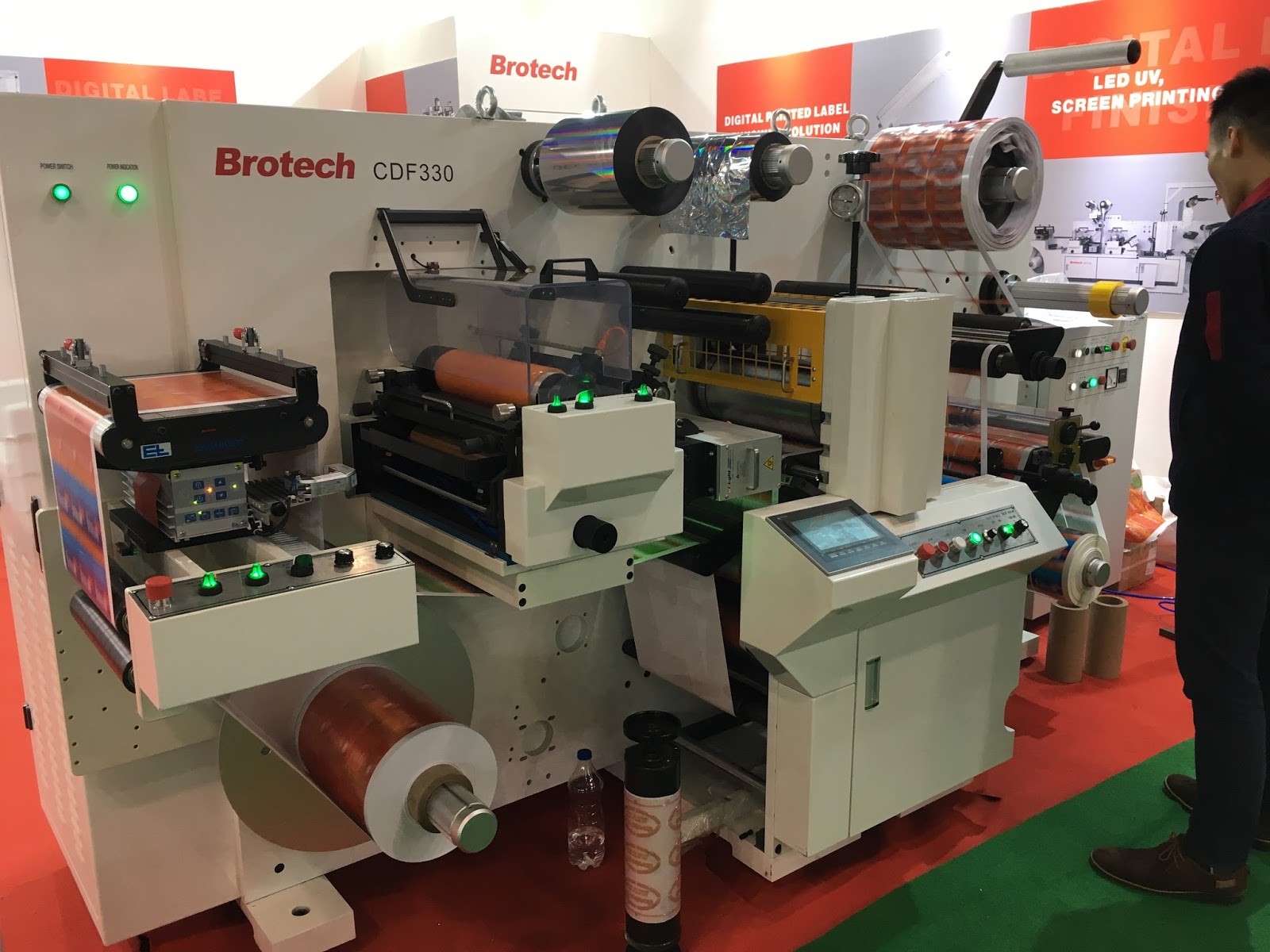
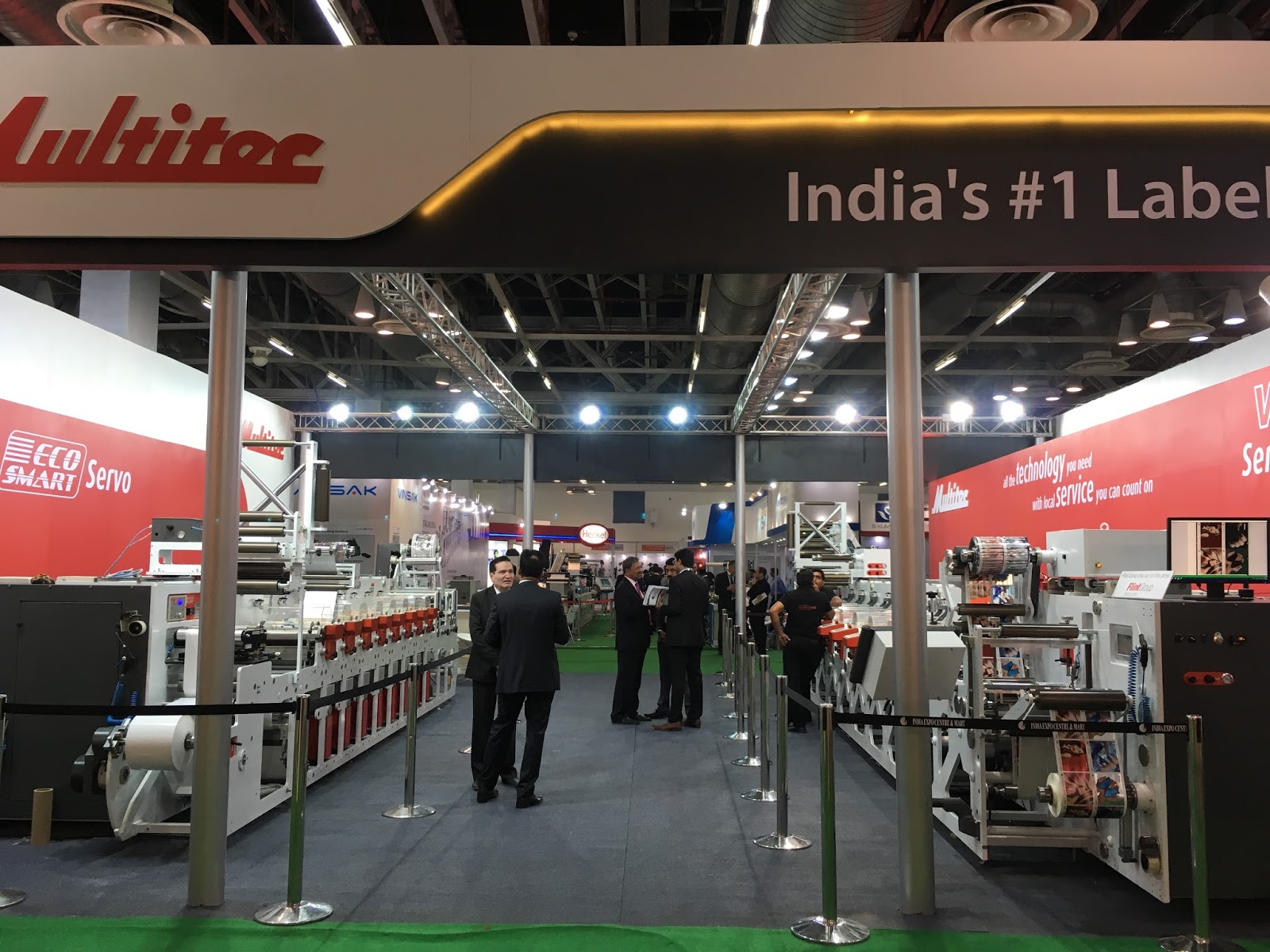
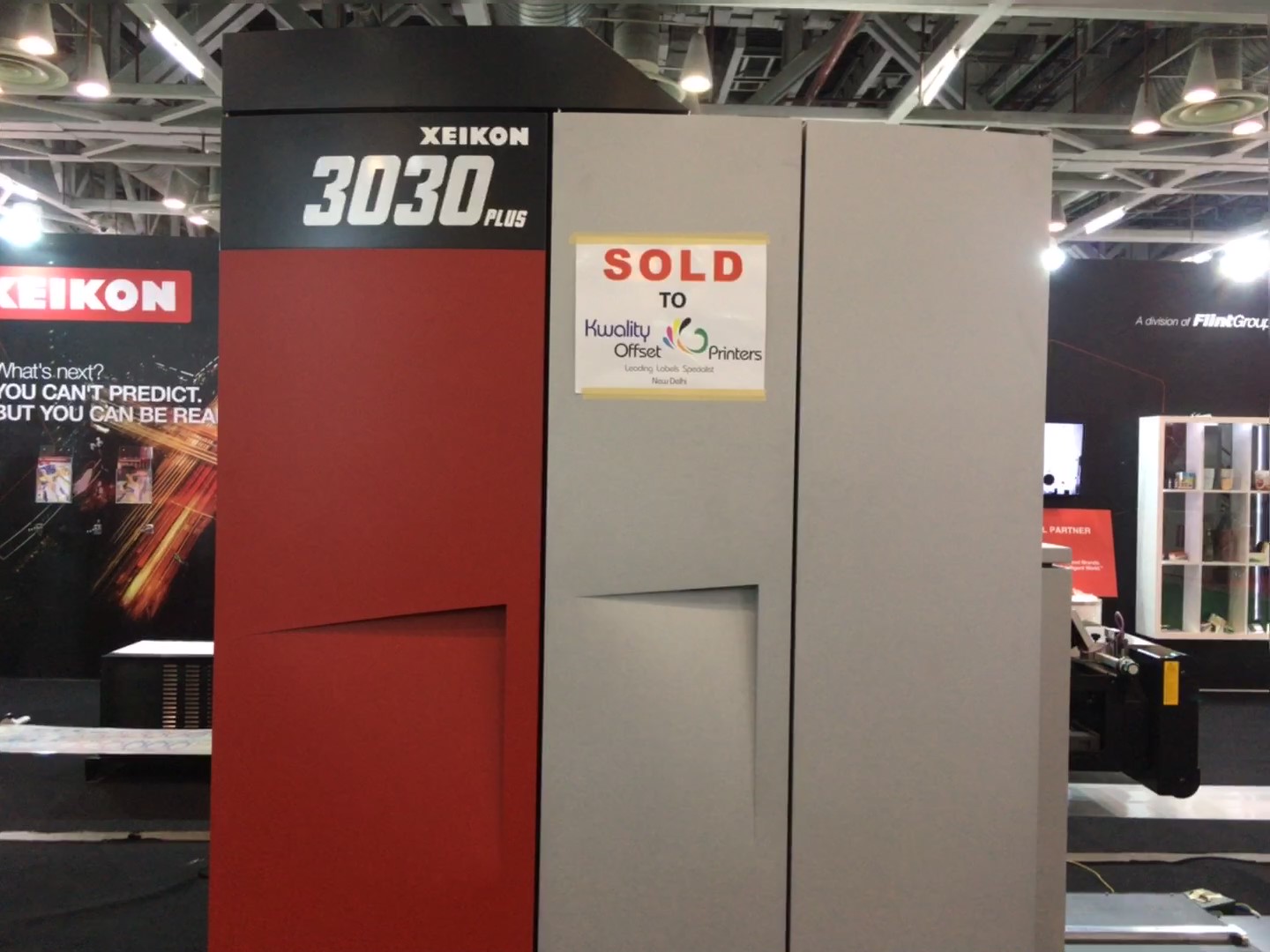
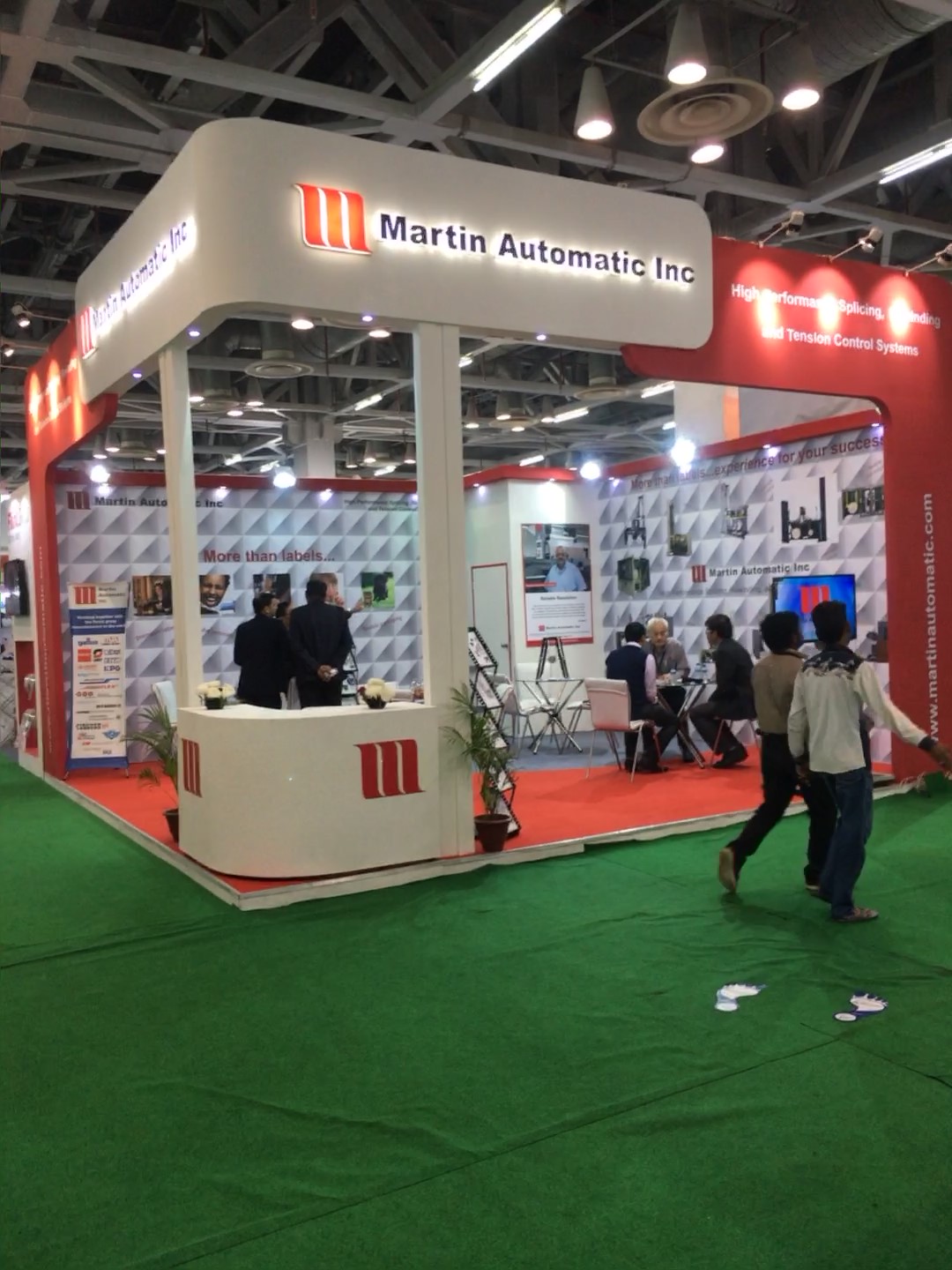
My story on Labelexpo India held recently at the Expo Mart, Greater Noida, India some 37 Kms. away from the traditional venue, Pragati Maidan in New Delhi, will be published in the forthcoming issue of Narrow Web Tech, Germany. Meanwhile I produce images of the show as I saw it.
The LMAI stalwarts!
Delhi Priters Association President, LMAI President-Sandeep Zaveri, Hon.Secretary LMAI Rajesh Nema & Managing Director Labelexpo Lisa Milburn
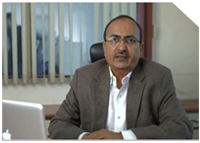
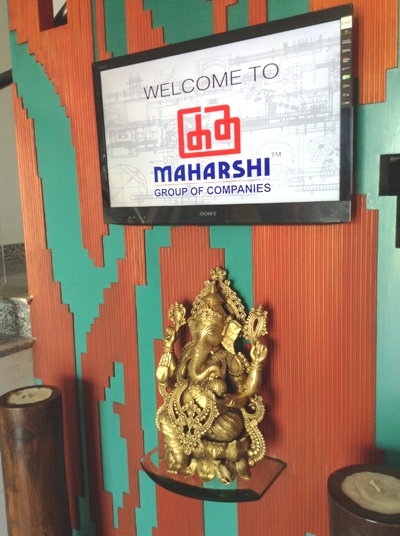
Rajesh Shah heading the Ahmedabad based Maharshi Group with a conspicuous presence in the label industry, manufacturing label applicators and labels, is a deeply religious man with strong family values. Son of an eminent lawyer, Rajesh finished his mechanical engineering in 1976 and left for Germany to work for a contractor company having office in Germany and sites in North Africa. In 1978 while still in Germany, he was summoned by his family to return to India due to his mother’s serious illness. Being the eldest of the four siblings, they are three brothers and one sister; he felt that it was his responsibility to be home by his mother’s side in this hour of need. In 1979, Rajesh returned to India and soon thereafter got married and decided to settle down in Ahmedabad. His wife came from a business family, who was involved into textile machinery. While Rajesh was contemplating the way forward, he was suggested by his in-laws to try and get into engineering industry. He accepted the suggestion and started a business of manufacturing Stainless Steel Vessels, Process equipment and other needs of the pharmaceuticals, Cosmetic and chemical industry fabricated in a small set up and supplying. The small size of the operation and slow progress soon made him restless and he started to look around for something that was bigger and more innovative with quicker turn around. Some friends suggested him to make conveyors, the idea appealed to him. At this point of time he set up his maiden industrial startup venture Gopinath Engineering Company for fabrication of stainless steel vessels and conveyor systems. This brought him in touch with more pharmaceutical companies and he being a sharp observer was looking around for synergies that would support his venture. In the early 1980s he saw the opportunity come his way that would shape the way for his future growth. Ahmedabad based Core Pharmaceuticals wanted to install automatic Self adhesive Label applicators on their packaging lines but found the imported equipment way too expensive. Rajesh knew from the word go that this was his chance and he grabbed the opportunity. He offered to develop the label dispensers and applicators for them. To understand the product intricately, Rajesh left for Germany and visited Guhl and Scheibler AG, a company manufacturing automatic labelers. He also visited other similar European manufacturers to understand their technology.
On visiting different manufacturers, he understood the technology in detail and concentrated on the best available. On return to India Rajesh developed his first label applicator and once it was successfully installed, there was no looking back!
The Labeling systems manufacturing facility is now a part of the Maharshi group and known as Maharshi Udyog. It is perhaps the largest labeling systems and applicators manufacturing company in India. This part of the group is operating in a factory with 100 employees on a plot area of 100,000 square feet and built up shop floor of 60,000 square feet. Another 90,000 square feet of land has been acquired adjacent to the factory for further expansion. Rajesh’s other brothers, Bhagwat Shah and Hiren Shah also joined in to manage the growing group. While Rajesh looks after overall activities as a Group Chairman. Bhagwat, a commercial person, looks after finance, administration and personnel and Hiren, a Mechanical engineer, looks after design and manufacturing at Maharshi. Hiren’s brother in law, Jigesh Dani takes care of sales and marketing under the guidance of Rajesh. The next generation is already in business. Rajesh’s son, Harshit, a mechatronics engineer, is already actively involved in the group activities taking care of automation systems, sales and marketing. Bhagwat’s son, Dhrumil has completed his MBA from Nirma and is under training in sales and marketing.
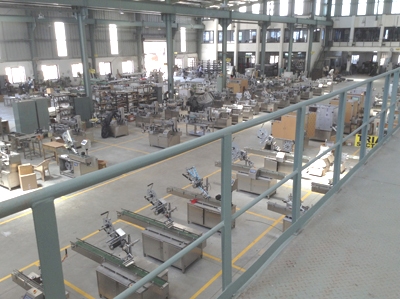
Maharshi Udyog’s sprawling shop floor is a sight to witness. It has a huge number of machines in various stages of completion. The variety of equipment is so diverse that one remains in awe at the possibilities they have created for themselves. The range of products they offer is from simple label applicators to print and apply systems for variable data labels, incorporating barcode inspection, missing label detection, bottle neck inspection and automatic segregation. It is an amazing array of equipment that they produce. They are also entering into production of packaging machines that include machines for automatic filling, capping, labeling, carton erection, product insertion and whole gambit of automatic packaging. The unit is complete with design, electronics and quality control departments. The spare part storage is all meticulously systemized with computer support and it is easy to trace the spares instantly when a customer is in need. The whole process of customer service support is planned at the manufacturing stage itself. Since they cater to the food and chemical industry, most of the fabrication is done with recommended grades of stainless steel. The shopfloor is clean and systemized with workers widely spread out and working on the equipments allotted to them. All equipment on completion undergoes strenuous tests before the customer is called in for the FAT (Factory Acceptance Test).
It is obvious that on entering a new industry one has to ensure that proper raw materials are available.
Jigesh Dani and Rajubhai
In the 1980s Indian labelstock manufacturing was still in its infancy. Availability of labelstock in roll form was still scarce and not of the quality as desired. For this reasons the label rolls produced from them were also not as desired. The web when running on these label applicators would break due to improper punching or the matrix would keep breaking due to uneven release values. Most of the conversion of stock to labels was done on slow flat bed Japanese label presses. The release base paper availability those days was difficult and what was available had caliper variations causing erroneous die punching. Where the release paper was thin the die would not punch and the label would lift with the matrix and where the release paper was thick there would be a through cut causing web break increasing downtime and wastages. If the release was too tight, it was another nightmare with matrix breaking and its removal was a cumbersome exercise. Silicone chemistry that time was still the old, which is now outdated, the tin catalyst curing system with post curing process. This always resulted in uneven release values causing problems in label dispensing on applicators. When Maharshi faced these problems in the late 1980s, they developed vendors who could understand their need for labels that would work on their applicators. It initially appeared to work but then due to reasons mentioned, while this problem was being attended yet another cropped up. The market for labelers grew and with it grew the demand for labels in roll form. Their preferred vendors could not deliver the desired quality in time. So that the applicator business does not suffer, a decision to integrate forward was taken at Maharshi to produce labels themselves. It was time to set up Maharshi Labels.
In 1995 the Shah family invested along with investments from Bhagwat Shah’s friend Rajendra Gandhi (fondly called Rajubhai) and Jigesh Dani to initiate the enterprise Maharshi Labels. Rajubhai was to look after production and Jigesh would take responsibility of marketing of not just the labels division but the entire Maharshi Group. From setting up shop in 1995 to 1997 they invested in 3-4 presses. These were the flat bed Onda and Changi presses. In those three years, as the population of their labelers grew, the Maharshi team realized that these slow flat bed machines will not support the growth in demand for labels. In 1997 they added a ten inch rotary flexo Acquaflex label press to augment their label production capacity. The decade of nineties and later, saw a sea change and growth in the label industry in India. Flexo printing, plate making, inks and pre-press was evolving. Usage of self adhesive labels in India was on the rise. Automation in the packaging industry became not just a process but an imperative need to meet deadlines. Growth bug hit Maharshi. Between 1997 and 2012 they bought a label press every alternate year. They were a Mark Andy customer and when the MA-LP-3000 was launched, they bought it within months. Then the change of heart! They sold all the Mark Andy presses and one by one replaced them with Gidue’s. Today they operate with 5 Gidue (Now Bobst) 370mm label presses. They still use the old flatbed machines for the real short runs and as the duo of Jigesh and Raju says, we enjoy using them.
Lord Ganesha
It is traditional and almost all label printers, when they commission a new press, the first label they print is a religious label. Mostly it is picture of the God that they worship. This is to seek HIS blessings for the new equipment. At Maharshi they follow this even today, each time they buy a new press, they print the picture of a deity. When I asked Jigesh if they had any nightmares, the answer was quite simple, “we are deeply into machine building and know how to troubleshoot. So we had no real nightmares!” One of the earliest labels they printed was that of Vasmol, a popular brand. The most challenging and satisfying job till date remains the Signature whiskey label that needed to have micro embossing, foiling with three different foils and printing with special pantone shades. The job became extremely challenging because the customer, who was using their labelers, did not give any artwork. They just handed over a few labels to copy and produce identical. Accepting the challenge the Maharshi team developed a special multi-foiling machine in-house and imported the blocks from UK. The challenge was successfully met and brought immense satisfaction. Rajubhai and Jigesh continue to efficiently run the label enterprise with active support of the Shah family. Rajubhai’s son is a qualified chartered accountant and planning for some expansion in related products.
Jigesh’s only son, Yash has no interest in the father’s activity, he is deeply into music. He is a fine Tabla player (Indian drums), who has entered the Guiness book of records for the longest Tabla playing performance.
At the moment Maharshi’s expansion plans are under wraps. They have the space and resources to expand. Maharshi Labels has the scope to expand and they have access to the market but the intense competition and shrinking margins makes them cautious. However still, the growing market size does confuse them, tempting them to consider producing to economies of scale and cutting down on wastages and increasing volumes. Their label unit operates from a land are of 50,000 square feet and a shop floor of 30,000 square feet with 70 employees. The total group turnover of the Maharshi is around 15 Million US Dollars. They have their hands full at this moment and it is a matter of time before they will divulge their plans for next expansion. As for their intention to foray into packaging, Jigesh says, “The day we can convert it on a web press in-line cost effectively, we will also be into packaging.”
The article maybe published with the permission of Narrow WebTech Germany giving credit to them and to the author For advertising enquiries please email to;
Presentation at St. Moritz, Switzerland in September 2003 as a part of the Cham Paper mills Pressure Sensitive Symposium. Now reproduced!
India is an exciting country full of diversity. The culture, language, religion, food, colour, weather/environment, etc. changes as you travel through the different states from Kashmir in the North to Tamilnadu in South or for that from Maharashtra in the west to Kolkata in the East. A country with 1 billion and 27 million people is now becoming the hunting ground of the marketing people worldwide.
The shear size of the market is attractive, though the urban population is almost 28% of the total population, but the growth rate of 31.2% in the no. of people in urban areas compared to the 17.9%in rural India, points towards a growing middle class and a huge potential market. Self-adhesive labels is a market that is now looking up and registering growth from the impact of this urbanization and consumer awareness due to the efforts of the marketing men, whether they are from Indian companies or from the multinationals. Selling consumer products by individual shopkeepers over the counter used to be the most widely employed method of selling till a couple of years ago. While it is still the predominant method yet the more global style of relating through self-service departmental stores is making retailing a fashion statement with marketers and consumers. This new trend has brought in a whole new demand on to the labels industry. Gone are the days when only esthetics was the criteria for finding a place on the shelves. Today a label has to perform in imparting good looks, last till the life of the product, give information and to top it all has to have variable information’s in terms of barcodes to facilitate selling, accounting, inventory controls, etc. This and many such trends have brought a surge of demand to the Indian label industry while it is difficult to dwell on all aspects which are bringing bigger volumes yet it will not be out of place to mention that a major demand is also arising from organised manufacturers practices where labels with a limited life span lasting only on shop floors are used. They help in assembly, inventory control, security, identification etc. People are coming forward with demands for new types of label applications that were unheard of in this country. The growth in this market has now prompted the label printers to get together and from the label printers association to look into matters relating to them. The Government of India trade policy reforms, provide an export friendly environment, with simplified procedures. Focus is on liberalisation, openness, transparency, globalization, moving away from restrictions and improving competitiveness to meet the global market requirements. All this has resulted in bringing in a whole lot of foreign direct investment in industry and infrastructure. Needless to say we now find international self-adhesive labelstock manufacturers like Avery Dennison setting up shop here. Raflatac did make a foray by selling through a distributor but the arrangement was terminated due to total reliance on imports. However still according to Mr. Kerri Palli of Raflatac whom I was talking to at Labelexpo-Brussels, “India is very much on our mind and will be our next stop to set up a manufacturing base”. Jacstaadt also had plans, Torsten JungLenz, their sales director, has a lot of friends in the Indian label industry. Now with Avery having acquired Jac, the market equation stands changed.
Indian market for self-adhesive labels initially was concentrated in Mumbai and it is thus that we find highest number of label printers and labelstock manufacturers there. Majority of self adhesive labels in the earlier days were the product of the screen printing Industry. Screen printers would print plain paper apply glue on the back, dry it, place the release liner and then die-cut. Then the offset printers moved in and with that came the demand for labelstock in sheets. Many of these printers installed narrow web label presses and soon the way self adhesive labels were made started to change.
Though the narrow web label industry has spread out to Ahmedabad, Pune, Vapi, Daman and other nearby areas but the biggest concentration still remains in Mumbai. This is attributed to the growth of large industrial base there due to proximity to the port. Growth spread to other areas, north India, due to its proximity to central government, has become a high growth centre. Setting up of facilities like Internal container depot, handling international cargo and custom clearance, made many multinationals and industrial groups set up industrial enterprises in this region. In my runup to writing this article this article I had sent a questionnaire to many label printers, label stock manufacturers, silicone coaters, adhesive manufacturers etc. Although, all did not reply, yet whatever replies I could get made interesting reading and I would like to share with you in these articles.
Market sizes and growth In my effort to arrive at a relatively accurate figure on the size of the market, I asked this question but none of the respondents could give any conclusive data. Infact a couple of people who attempted, were way off the mark so I decided to make my own study. According to Mr.Praveen Shankar of Jubilant Organosys (formerly Vam Organics) the total market of water based PSA for label application in India is 5000 tons per annum. “Silicone consumption for paper release application in India is to the time of 300-350 tons per annum,” says Dipankar Dutta of Wacker Metroark. Based on my knowledge as a labelstock and release liner manufacturer I arrived at a figure, which correlates, to both the above figures. The production of labelstock by indigenous manufacturers is between 125-140 million square meters. This does not include the products offered or sold by Avery, Jac or Raflatac or those imported into the country. To my estimate additional 50% of the above quantity comes in imports in shapes of raw material, finished goods or stock lots so I estimate the present demand in India to the time of 200 million square meters most of which is paper stock and does not include tapes or other self adhesive materials. With this I arrive at a usage of less than a quarter square meter of per capita usage. Compare this with 12 square meters in USA, 8 in Europe, 7 in Japan, less than 1 square meters in rest of Asia. Most of the respondents suggested growth rate projections between 10-20% however personally I would rate it much higher. I refer to the “Asia Label Market briefing“ by Mike Fairley and published by Labels and Labelling, wherein it is given that self-adhesive market in India in 1999 was 65 million square meters. I take this as indigenous production and compare it to the figure I arrived at 125 million square meters, which means a growth rate of 40%. When looking at area wise usage the general views are that Western India leads followed by North, South and East in that order. However highest growth rate in terms of percentage seems to coming from North but due to the larger size of the market, bigger volumes still come from the west. The North Indian market is registering a fast growth owing to the fact that, National capital region Delhi and surrounding towns is the most urbanised area with 93% urbanisation followed by Chandigarh at 89.8%.
Facestocks India has been a predominantly paper labels market. Recent trends and demands by innovative label designers has brought with it, demand for better and different face materials, whether paper or filmic. Higher converting speeds, newer printing methods, need for variable information printing and sensing of the printed data and other such requirements have forced labelstock producers to offer better face materials especially suited for required applications. Filmic stocks are picking up in demand. Today filmic stocks are less than 10% of the total labelstock usage but in terms of percentage higher growth rate are coming from this segment however due to the sheer size of the paper label segment the growth volume will remain much bigger in paper.
Adhesives Water based emulsion adhesives are the most widely used adhesives in the Indian self-adhesive labels industry. Almost all the new capacities that are being created employ water based emulsion PSA. Solvent borne acrylics and rubber resin adhesive are only a miniscule portion of the industry. However the underdog is hotmelt adhesive. Indian label printers are taking a fancy for this. Prasad Accumeter and Stay on Papers in Hyderabad, and Interlabels in Mumbai must be given credit for contributing to the growth of labelstocks with hotmelt adhesives. Newer capacities in hotmelt segment are being added. Two new Nordson hotmelt coaters have arrived one for Millenium papers, Chennai and one for Weldon Celloplast Ltd. in New Delhi. Most of the Indian Labelstock manufacturers employ locally made coaters to coat water based adhesives however a few exceptions like Kedia Lamicoats at Silvasa have installed a used Windmoeller and Holsher coater.
Silicone Solvent based tin catalyst silicone systems have been the most widely used and accepted silicone coatings. With installation of faster converting rotary label presses and to remain competitive printers wishing to drive volumes, the need for better release coatings became imperative. Metroark Ltd. which is now known as Wacker Metroark was the sole supplier in earlier days so the scope for development was limited. Then with the advent of liberalisation came the other players like GE and Rhodia. Soon a pleasant change has started to descend the silicon liner market. GE and Rhodia had their technical men visiting the leading coaters and advising them to improvise and use their existing machines to coat newer technology. Today thermal curing solvented and solventless platinum catalyst silicone system are being used by a a few coaters in India. However UV curing and electron beam curing systems have not even been considered so far. Faster label dispensing and applications is putting pressure on more and more label printers to opt for the advanced silicon chemistries on the release liners. In terms of substrates used for siliconising, glassine remains the most preferred one. However cheap stock lots of SCK tempt may converters to use it. It is interesting to note that some top of the line converters of computer labels in A4 format are specifically demanding SCK and CCK liners for this application because of their lay flat properties and non slip feeding into the printers. Notably amongst these printers are R.K Papers at Mumbai and Rational Business Corporation at Delhi. Filmic liners are now also being experimented and used in certain products.
Printing Technique :-Flatbed, letter press printing remains the most widely employed printing technology. This is mostly due to the lower cost and local availability of dies as compared to expensive and imported rotary dies. Progressive and dynamic printing companies are now opting for newer, faster rotary flexo label presses as also semi rotary letter press machines with a variety of option like UV curing, laminating and hot foil stamping stations Machines like Nilpeter, Gallus, Aquaflex, MarkAndy, Iwasaki, Kopack, Comco, Orthotec, Focus, Arsoma etc have found their way into many label printing units. Though highest capital investment is in the West, with concentration in Mumbai, the highest growth in terms of percentage is coming from the North, South comes third with Eastern sector trailing. To my knowledge in recent years Amit Sheth of Sheth Graphics has successfully sold atleast three Orthotec machines in Calcutta. Other than this the Eastern market relies on screen or offset printers for self-adhesive labels. I am not aware of any additional capacities in label printing created the last couple of years in this area.
Summary Almost all the respondents to my questionnaire feel there is no slow down in the label industry. They all foresee a bright future for the Industry. Entry of Multinationals like Avery, who are now omni-present in the industry is welcomed by printers as they feel that they will make the market grow and develop in quality. What is surprising is that other labelstock manufacturers share this view. Infact most of the respondents in the industry feel the presence of multinationals is good news however they are all optimistic that the multinational labelstock manufacturers will not enter into label printing. It shows an underlying fear, given the fact that Avery markets labels and other finished labels worldwide. Apart from the normal growth it appears there will be a marked shift from wet-glue labels to the self-adhesive labels. Mr. Ravindran of Seljegat in Sivakasi is optimistic and happy that the liquor industry has started its shift towards self-adhesive labels this will be a major chunk adding to the usage of self-adhesive labels in India. Without mentioning the development being made by manufacturers of label presses in India this study would be incomplete. Pioneering work is being done by many, I would like to mention the achievement of Baldev Singh Jandu of Jandu Engineering who has now over eighteen fully rotary label presses in operation and has orders worth another six in hand. This is incredible! All machine are flexo rotary. A word of caution comes from all against the free inflow of B grade materials and stock lots into the country. In words of Pranay Goda of Kaygee Papers, it is the biggest threat facing the industry, label printers and suppliers should form an association, educate end users and set standards. Time has come when more and more constituents of this industry are coming forward for the growth of the industry. Formation of label printers association at Mumbai, launching a B2B portal www.pressuresensitivematerials.com by Weldon, a label show has to be held in 2002, etc are some of the steps that will promote the industry. With a market as large as India there is only one way the demand can go…..Up!
Note for print publications: Magazines may reproduce the above article by giving credit to the author.The above article is written by Harveer Singh Sahni, Managing Director of Weldon Celloplast Limited, New Delhi-110008 in August 2003
“The annual turnover of Indian packaging industry will touch $ 32 billion by 2025 from the present $ 24.6 billion” the Union Minister for State for Commerce and Industry E M Sudarsana Natchiappan said as per report in the Economic times of Jan 06, 2014. We are now into the end of 2016, which is almost three years hence. The growth rate is estimated by the Indian Institute of Packaging and the ministry of Commerce & Industry at 15%. If I take this CAGR (Compounded annual growth rate) of 15% and calculate, the total packaging market size in India at present should be 35 Billion USD per annum.
According to PIRA (Pira is the worldwide authority on the packaging, paper and print industry supply chains), labels constitute less than 3% of the total packaging market. This includes all of Self adhesive labels, Shrink sleeves, Wet glue labels, In-mould labels, etc. So the market size of labels in India if I calculate at a modest rate of just 2.5% of the total packaging market, it works out to be in excess of 0.9 Billion USD or at present rate of Forex conversion rate, it is estimated to be Rupees 6000 Crores. Assuming 40% of this to be the market of self adhesive labels, the market size of self adhesive labels then works out to over Rupees 2400 Crores or approximately 900 million square meters. This would include all of printed paper & film labels, Sheeted and roll form labels, stock lots, Barcode labels, etc. The organized sector may look much smaller but together with the unorganized sector in the label industry which has mushroomed all across different geographical zones in the country adding volumes to the overall consumption, the consolidated figure becomes substantial. Consumption continues to grow steadily in even the smaller towns of the country. Some of my industry colleagues exercising caution, differ in opinion and emphatically state that the market size is lower. With current Indian population in October 2016 being 1.33 Billion, the per capita usage of label materials in India is estimated by me to be 0.67 Square meters while my other friends in the industry feel it is a little less than half a square meter per capita, meaning the market size is almost 670 million square meters. So the market should be within the range of 670-900 million Square Meters.
Self Adhesive Labels Industry In India and The World: Indian labels market; inching towards a billion square meters
Let me go about this, another way. There are more than 500 label printers for printed labels and an equal if not more, number of label manufacturers who produce plain labels, price labels, A4 inkjet/laser labels and barcode labels. This adds up to a 1000 converters having anything from one to maybe twenty presses. There are large converters who use over 40,000-50000 square meters per day and then there are those who consume much less.
If I take just an average of a modest 2500 square meters per month and with almost 1000 converters, this translates into a consumption of 750 million square meters per annum! If I increase the average consumption to 3000 square meters per day the consumption figure jumps to 900 million square meters calculated at 300 days production. If I add to this the sheet fed label market the market sizes increases further. I have tried assessing the market size in three different ways and each time it reaches within the same limits. Surely we have with finality crossed the half a square meter per capita consumption mark and are inching towards the one square meter per capita and presently hovering around close to the magical I billion square meter mark!
Note for print publications: Magazines may reproduce the above article by giving credit to the author.
Written by Harveer Sahni, Managing Director, Weldon Celloplast Limited New Delhi India. October 2016.
“The annual turnover of Indian packaging industry will touch $ 32 billion by 2025 from the present $ 24.6 billion” the Union Minister for State for Commerce and Industry E M Sudarsana Natchiappan said as per report in the Economic times of Jan 06, 2014. We are now into the end of 2016, which is almost three years hence. The growth rate is estimated by the Indian Institute of Packaging and the ministry of Commerce & Industry at 15%. If I take this CAGR (Compounded annual growth rate) of 15% and calculate, the total packaging market size in India at present should be 35 Billion USD per annum. According to PIRA (Pira is the worldwide authority on the packaging, paper and print industry supply chains), labels constitute less than 3% of the total packaging market. This includes all of Self adhesive labels, Shrink sleeves, Wet glue labels, In-mould labels, etc. So the market size of labels in India if I calculate at a modest rate of just 2.5% of the total packaging market, it works out to be in excess of 0.9 Billion USD or at present rate of Forex conversion rate, it is estimated to be Rupees 6000 Crores. Assuming 40% of this to be the market of self adhesive labels, the market size of self adhesive labels then works out to over Rupees 2400 Crores or approximately 900 million square meters. This would include all of printed paper & film labels, Sheeted and roll form labels, stock lots, Barcode labels, etc. The organized sector may look much smaller but together with the unorganized sector in the label industry which has mushroomed all across different geographical zones in the country adding volumes to the overall consumption, the consolidated figure becomes substantial. Consumption continues to grow steadily in even the smaller towns of the country. Some of my industry colleagues exercising caution, differ in opinion and emphatically state that the market size is lower. With current Indian population in October 2016 being 1.33 Billion, the per capita usage of label materials in India is estimated by me to be 0.67 Square meters while my other friends in the industry feel it is a little less than half a square meter per capita, meaning the market size is almost 670 million square meters. So the market should be within the range of 670-900 million Square Meters.
In 2003 I made a presentation for Cham Tenero Paper Mills Pressure Sensitive Symposium in St. Moritz Switzerland whereby I had made an assessment of market size of self adhesive labels in India based on consumption of adhesive and silicone sold in India to produce silicone release liners and self adhesive labelstocks. The presentation has been reproduced by me as a post on this blog, please check out . With my experience of being a siliconiser and labelstock manufacturer I calculated the amount release paper and labelstock that could have been produced. The figures coincided and gave a realistic picture of indigenous production of labelstocks by local players to be between 125-140 million square meters plus the imports and sales of Avery Dennison which had just started to get a firm foot hold into the market and was operating out of their Gurgaon facility only. Taking 125-140 million square meters as the reasonable figure in 2003 and calculating at the Ministry of commerce and Indian Institute of Packaging declared CAGR of 15% per annum we arrive at a present market size of self adhesive label materials of 769-861 million square meters which is within the estimated market size arrived at in the paragraph above. In the earlier part of the new millennium we saw rapid growth of self adhesive labels, much above the CAGR 15%, this was for various reasons; the economy was opening up, organized retail was also coming up creating new demand for labels and the old slow flat bed label printing machines were making way for faster rotary flexo label presses.
In 2013 I wrote an article on Baldev Singh Jandu of Jandu Engineers, who besides making label printing machines also makes coating and lamination machines. Most of his equipment is supplied to MSME units that fall into unorganized sector. He has been making coaters for many years now. In 2013 alone he sold 16 coaters, though he says his coater are being now designed to run almost 100 meter per minute, yet I calculated at an average speed of just 50 meters per minute, two 8 hour shifts and a 25% down time. That would translate into an annual production capacity of 170 million square meters. This increase is coming from just one equipment supplier in just one financial year. He has been building coaters and selling for many years. He continues to sell his coaters and there are others also like him building coating lamination machines adding to the bulging capacity of self adhesive materials in India. Then we have hot melt adhesive coaters coming in from China. This all is besides the capacity augmentation by the likes of Avery, SMI or the imports by Raflatac. I am sure neither of these coaters are idle nor are they up for sale. The market is huge and continues its upward trend. In the second half of 1990s there were just three labelstock manufacturers in NCR Delhi and maybe 10 to 15 across the country. Today the number in NCR is close to 30 and overall in India is in hundreds. This all leads to figures of market size much larger than what we are assessing it to be.
Let me go about this, another way. There are more than 500 label printers for printed labels and an equal if not more, number of label manufacturers who produce plain labels, price labels, A4 inkjet/laser labels and barcode labels. This adds up to a 1000 converters having anything from one to maybe twenty presses. There are large converters who use over 40,000-50000 square meters per day and then there are those who consume much less. If I take just an average of a modest 2500 square meters per month and with almost 1000 converters, this translates into a consumption of 750 million square meters per annum! If I increase the average consumption to 3000 square meters per day the consumption figure jumps to 900 million square meters calculated at 300 days production. If I add to this the sheet fed label market the market sizes increases further. I have tried assessing the market size in three different ways and each time it reaches within the same limits. Surely we have with finality crossed the half a square meter per capita consumption mark and are inching towards the one square meter per capita and presently hovering around close to the magical I billion square meter mark!
Note for print publications: Magazines may reproduce the above article by giving credit to the author.
Written by Harveer Sahni, Managing Director, Weldon Celloplast Limited New Delhi India. October 2016.
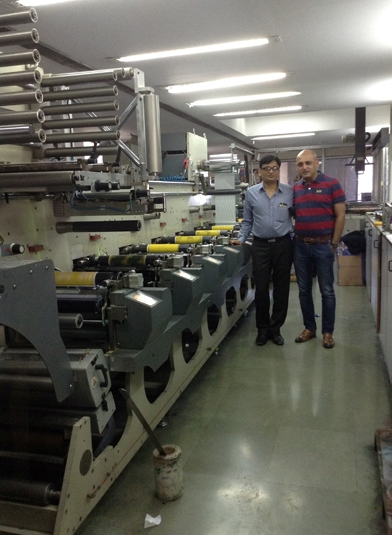
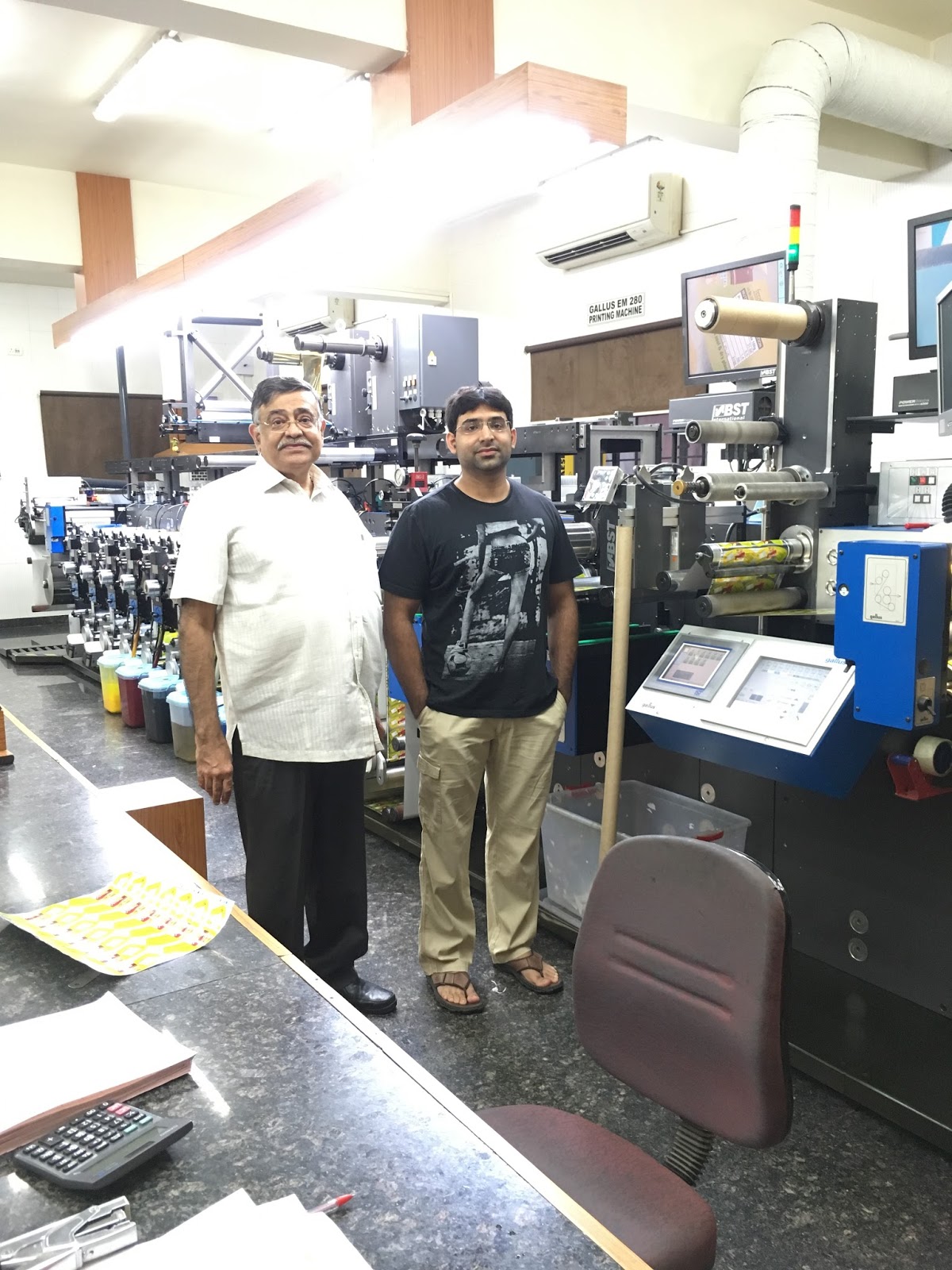
Brothers Surendra Kapur and Jatindra Kapur directors of Jai Kaushal Industries and R K Papers Mumbai mentored their sons Himanshu Kapur and Karan Kapur into label printing business with their start-up enterprise J K Fine Prints Pvt.Ltd. While their fathers and mentors continue to run their own continuous stationery, business forms and label printing unit R K Papers Pvt. Ltd., their young boys continue to grow their label business efficiently with financial discipline, quality assurance and modern business management systems in place. Surendra Kapur has been an early entrant into label industry and the founder president of LMAI (Label Manufacturers association of India). He draws immense respect from the label fraternity in India. On April 22, 2011 I wrote on Surendra Kapur in this blog https://harveersahni.blogspot.in/2011/04/trading-in-paper-to-producing-labels.html . On one of my recent visits to Taloja, Mumbai where J K Fine Print is located, I had the opportunity to visit and interview Himanshu Kapur and see for myself the path traversed in these last few years.
Karan Kapur
Since Karan looks after marketing and sales, operating out of their Nariman point office in SouthMumbai, I could not meet him. Himanshu an MA in Psychology and Karan an MBA from Mumbai’s SP Jain Institute were just 23 years and 24 years old respectively when J K Fine Prints was setup. It was a pleasure to see Himanshu now as a much learned label printer, confident and in control of what he was doing. I asked him whether he thought of opting for other careers before starting this enterprise and whether he faced any initial starting troubles, he said, “There was no problem in starting the company as Dad Surendra Kapur had trained him well for two years before starting this venture”. He further added that since the family was in labels he never thought of anything else, “I knew that for me, it has been labels, always!”
Surendra Kapur & Himanshu Kapur
Due to a talented and experience mentor behind, they never faced any real nightmares. Kapurs have traditionally been fans of letterpress printing. They even started this company with letterpress printing technology. For Himanshu the most satisfying moment till date has been the shift from 4 colour flatbed letterpress printing to Flexographic rotary printing by installing a 7 color Gallus press. Months before the press arrived he spent endless hours on internet surfing to learn the nuances of flexographic printing process. When the press came, he was ready for it and adapted it without any problem. He has been so satisfied that he has shifted most of his jobs from letterpress to flexo. I asked him which was the most complex job that he has done till date? Though he said there are many yet he mentioned the Kid Baion (Merck) label that he did. It was an 11 colour job that he compressed to 6+1 colour and achieved excellence. He proudly mentions that the elders do not interfere with their work and rather compliment them for having achieved success.
The unit has grown from 10000 square feet that was originally built to 18000 square feet by adding another floor. Presently they are working with two Gallus flexo label presses, two Letterpress label machines, three Omega’s, One Hot Stamping machine, fully automatic core cutting and a host of finishing equipment. As availability and management of manpower continues to become challenging, Himanshu has extensively indulged in automation. The automatic core cutter is one such equipment that cuts down time and reduces 3-4 persons permanently cutting cores. Plate cleaning was another area where they employed one person on each machine but with installation of an automatic plate cleaning machine they have just one person doing the job. They started with strength of 35 employees in 2006 and gradually went up to 70. With Himanshu‘s efforts they now produce more with just 35 people. He asserts that once he as an ERP system which he is working on in place, he will be able to reduce the workforce by another 4-5 persons.
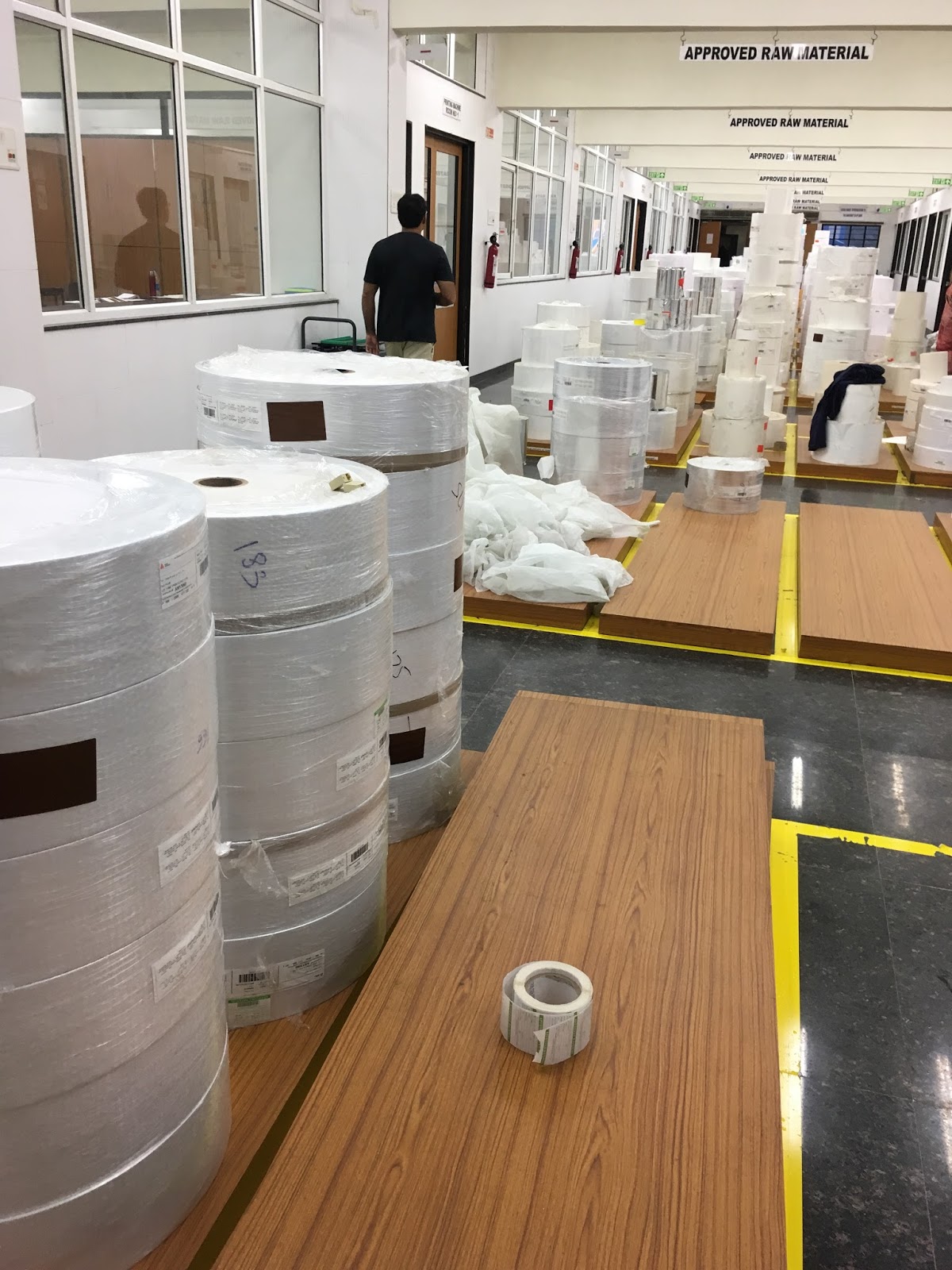
The youthful urge to grow is evident in these young men. When they started they were consuming just 15000-20000 square meters of label stock per month. This has now grown to 300,000 square meters. It was amazing to see that when they implemented their expansion plans, three different additional press rooms have been constructed providing space for three more label presses planned for future. All the rooms have storage areas for toolings and plates. Only the presses need to move in! Once Himanshu is able to get these additional equipment in, he is says the capacity will increase by 200% and is confident that the company will double up in sales in the next five years. He has spent a lot of time and money on time optimization as also on track and trace implementation. Each core has a core identification barcode label generated through a dedicated software so that in case of need the material can be traced to all steps of process that it has gone through. All raw materials coming in is tested and recorded in a fully equipped laboratory. Finished products are inspected both online and offline for 100% customer satisfaction.
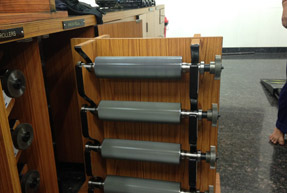
Himanshu has invested a lot of time in designing storage and handling systems for toolings and plates for easy access and their safety. The storage drawers and racks have specified materials that will not contaminate or scratch the toolings and consumables that contribute to quality production of labels. He is committed to continuously upgrade the setup to achieve higher levels of quality and efficiency. They have so far not invested in plate making capabilities because Himanshu believes that this job has to be left to professionals so that the product is delivered to them perfect and defect free. Maybe a day later in life, when the workflow and workload demands so, he may invest but as of now he does not wish to add a department in his company that will not produce additional revenue. Also given the fact he is comfortable with the quality delivered when plates are outsourced.
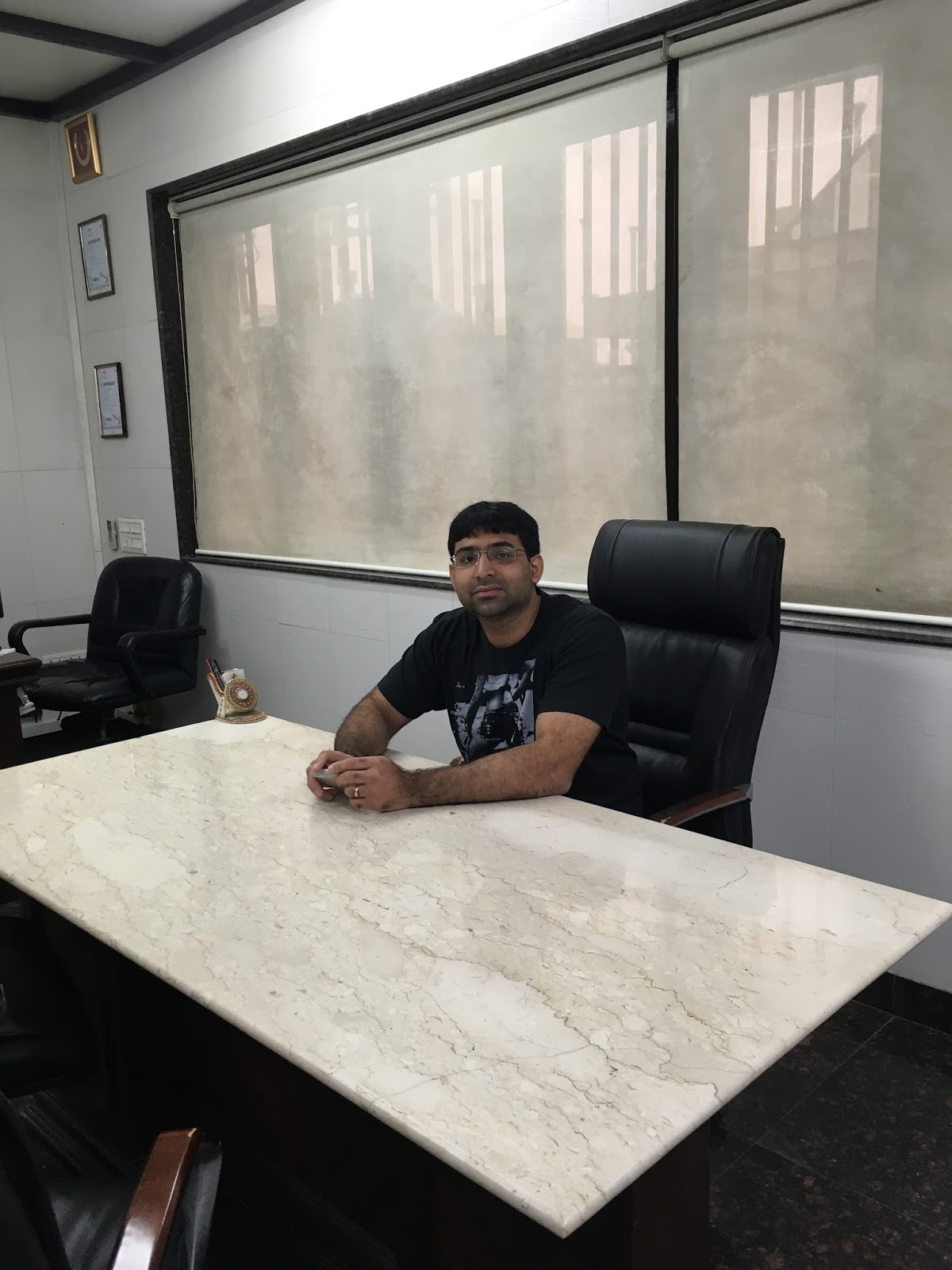
He has a voracious appetite to learn more about printing processes and his office is full of electronics and gadgets unlike his father’s office whose desk is devoid of any electronics or computers, only his mobile remains in his pocket. However even now if one visits Surendra Kapur, one cannot fail to notice that his desk is devoid of any papers and is immaculately clean. If a paper comes in to his desk, within moments he will dispose it off; either gives instructions on the matter or get up himself and put it neatly in a file. Himanshu for that matter also follows his father’s style but as far as electronics go, I need to go once again to see what all he keeps doing on that front. His main desk is in use when he is not on his computers and interacting with staff or visitors. His electronic workstation is on his right hand corner to be in use when he is on his computers and alone, to acquire further knowledge.
Though not actively involved in sales yet when asked about competition, Himanshu emphatically states that price is surely an area of concern and that we would prefer to lose a customer rather than reduce prices. Lastly when asked a question that I ask everyone, “what about digital printing?” Even more emphatically he says, “Not for another 7 years!”
Himanshu Kapur is not really the gen next in the Kapur family. Actually he is the fourth generation of the family patriarch Lala Jai Dayal Kapur who due to his friendship will Lala Karam Chand Thapar founder of BILT (now Avaantha Group) became the distributors for Ballarpur Industries Limited. Lala Jai Dayal Kapur’s son Ram Kumar Kapur, Himanshu’s grandfather setup, R K Papers in Mumbai to manufacture paper stationery. Ram Kumar’s son Surendra Kapur took over the reins of the manufacturing unit and expanded into labels, his brother Jatindra looked after marketing and sales. Now their sons Himanshu and Karan run J K Fine Print Pvt. Ltd. With a strong heritage and deep roots in business this, young duo is expected to rise exponentially in the label industry.
Note for print publications: Magazines may reproduce the above article by giving credit to the author.
Written by Harveer Sahni, Managing Director, Weldon Celloplast Limited, New Delhi. September, 2016.