

Written by Harveer Sahni Chairman WeldonCelloplast Limited New Delhi December 2018

The pressure sensitive adhesive labels and packaging industry is growing at a steady and rapid pace in India. It is now time that the contribution of those who have achieved success is chronicled so that those who wish to move ahead have a platform to look for information, news and interaction. This Website intends to provide all that along with inspiration and reference.


Indian Label industry has for the last many years been registering steady double-digit growth. The industry largely consists of family-owned small or medium-sized enterprises employing 1-5 label presses. A handful of larger enterprises have surfaced in recent times due to acquisitions or mergers by multinational companies.
The size still needs to become bigger to reach the size of large international label producers. Ironically some of the upcoming existing companies in this segment who were growing and appeared to become large players, opted to be acquired rather than go it alone. We do see some Indian owned label companies now rising from the crowds to become evident in growth beyond the average size. It is hoped that they will also not opt to be acquired, we do need indigenous companies that will grow and prove their mettle. There is an imperative need for these companies to break away from being single owner or family driven businesses to become professionally-managed entities. They need to optimise production processes, manage wastages, invest in workflow automation, etc. leading to continuous growth and better profitability. Stronger bottom lines in the industry is sure to enable printers investing in expansion and employment of new technologies leading to evolution of the industry, presenting state of art products. A large population and expanding retail trade are driving the demand for labels. The industry that originated in just the metro cities is now spreading to the interiors of India, there is need for further growth as printers realise the need to be multilocational to be able to service customers in a large country more efficiently. At this time the exhibition Labelexpo is looked at with interest as it provides knowledge not only to existing printers but also to new entrants. It showcases the best of indigenous and international label production equipment, materials and consumables at one place. India’s label association LMAI not only supports this important exhibition but also adds value to it by organising events on the side lines, making it worthwhile for their printer and supplier members.

LMAI, L9 meet: L9 is the informal platform of leading global trade associations for the labels and narrow-web industry which was founded in 2009 for the purposes of communicating regional issues and developments to the global industry, identifying and jointly examining issues of transnational concern to industry members, sharing information, developing and recommending best Industry practices regarding efficiency,
training, technology, safety and environmental matters, recognizing Industry achievements and pursuing such other programmes and activities as may promote and better the industry worldwide. The alliance consists of LMAI (India), JFLP (Japan), FINAT (Europe), TLMI (North America), LATMA (Australia), PEIAC (China), AMETIQ (Mexico), ABIEA (Brazil) and SALMA (New Zealand). Every year L9 meets in one of the member association countries. At the last 7th L9 meet in Beijing China it was decided that LMAI India will host the next meet. LMAI has made elaborate plans. It is now scheduled to be a 4-day prestigious global meet that will include multiple events and agendas including Label Exchange Program, L9 Board Meeting, Industry visits, Labelexpo visit, networking and leisure activities. The event will also cover a wide range of subjects within the label industry including sourcing and consumption of raw material, future demands, quality parameters, new machinery, innovative technologies and global trends.

Spearheading the program LMAI past President Sandeep Zaveri says, “We are very excited to welcome the L9 participants to India” acknowledging support of his LMAI colleagues Vivek Kapur, Amit Sheth, Ajay Mehta, Harveer Sahni, President-Kuldip Goel, Rajesh Nema, Ramesh Deshpande and Dinesh Mahajan in organising this important event, he further adds, “It is an opportunity for all our label printer friends to meet international label printing leaders and hear them on various ascents like recycling sustainability.” The L9 meet and related events are sponsored by SMI Coated Products as main sponsor and Intergraphic Pulisi.
LMAI Avery Dennison Label Awards Night: This prestigious Label industry biennial event has
traditionally been organised by Tarsus, the organiser of Labelexpo India along with the show Labelexpo. This is the first time that the event is being organised by LMAI under the leadership of their President Kuldip Goel. LMAI Avery Dennison Awards night will take place on the first day of Labelexpo India on 22nd of November 2018 at Expo Mart Greater Noida, UP India. It is expected to be a memorable event full of information, presentations, entertainment and global networking opportunities as the international visitors who will come for L9 meet will also be present. The award categories are as follows;
· Flexo Category
· Letterpress Category
· Offset Category
· Combination Printing Category
· Digital Printing Category
· Screen Printing Category
· Rotogravure Category (under Gold Category)
· Booklets & Coupon Labels Category (under Gold Category)
· Innovation Category (under Gold Category)
· Green Sustainable Category
The entry to the awards night function is restricted to either invitees or paid ticket holders.
PRICES AND BOOKING;
· Individual places – per seat price – Rs. 3999
· For LMAI members the cost is subsidised to Rs. 2999 Sponsors for this gala night are as follows;

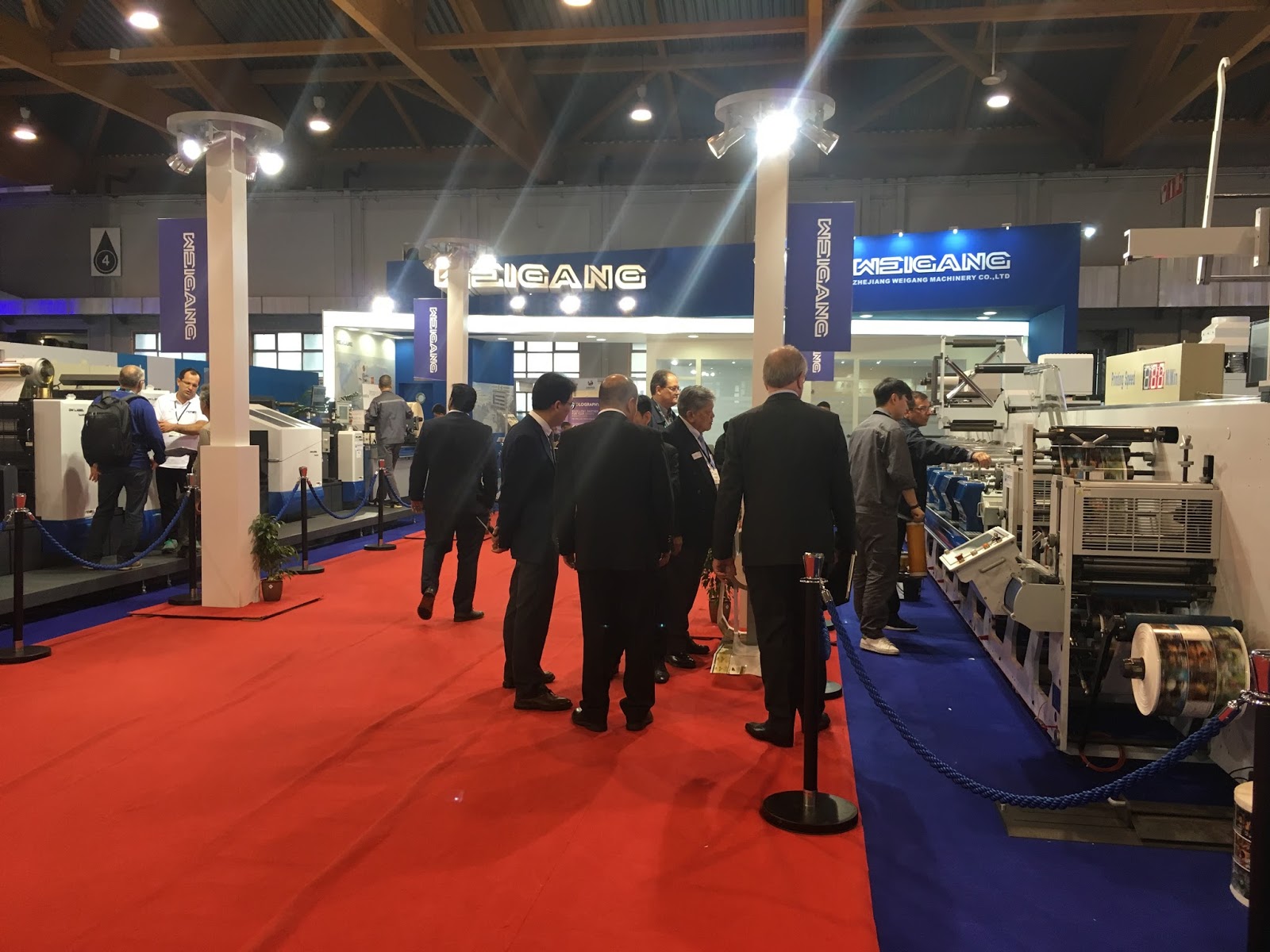
Labelexpo India: Labelexpo India is scheduled to be held at Expo Martsharing , Greater Noida, UP India from 22nd to 25th November 2018. It is the largest event for the label and package printing industry in South Asia – with more products, more launches and more live demonstrations! The exhibition will display Digital and conventional printing presses, High tech label and packaging materials, Prepress and platemaking technology, Finishing and converting systems, Inspection, overprinting and label application equipment, Dies, cutters, rollers, Inks and coatings, RFID and security solutions, Software and interactive technology. Spread over 4 days in 4 halls the show has 250 exhibitors which include Avery Dennison, Bobst, Esko, HP, Hyden Packaging, Martin Automatic, Monotech Systems, Nilpeter, OMET, RK Label, Xeikon, and Zhejiang Weigang Machinery. The last labelexpo India in 2016 saw over 8000 visitors.

Brand Innovation Day: Labelexpo India 2018 hosted “Brand Innovation Day” will take place on the afternoon of Thursday 22 November (Day 1 of the show). It will include a series of presentations followed by a short tour of key suppliers, highlighting the latest technologies and showing how brands can achieve stand-out product presence. About 50 brand owners and packaging designers in India are expected to attend. The purpose of the program is to equip delegates with expert insight into making the most out of their brand, how they can overcome key challenges on the path to future growth and staying ahead of competition in a fast-paced industry.
Labelexpo Global Series managing director Lisa Milburn, who will open the Brand Innovation Day, said: “Our most commonly asked question at Labelexpo India is how brands can learn how to use their labels and packaging to stand out from the competition. Given the success and popularity of our educational program for our other Labelexpo events including our Americas show in held in last September, we wanted to provide similar opportunities for Labelexpo India attendees. The appetite for labels and package printing continues undiminished in India and it is now one of the biggest growth markets, so it felt the right moment to offer this educational opportunity to brand owners and packaging designers at the show itself. “The Brand Innovation Day” is a rare chance for them to gain industry insights into how a brand can be inspired to innovate, experience the highlights of Labelexpo India 2018, and learn the tricks of the trade from the experts.”
The Labelexpo India Brand Innovation Day is sponsored by HP, Avery Dennison and SMI.
The above article is written and compiled by Harveer Sahni, Chairman Weldon Celloplast Limited New Delhi India, October 2018



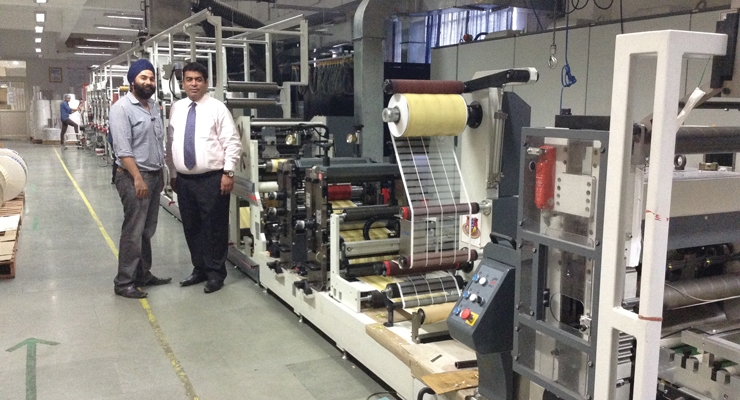
 Change is the only permanent in a growing scenario, also stagnation leads to deterioration so one has to keep improving, innovating and expanding to remain in reckoning in a vibrant colourful industry. The label industry, much to the discomfort of the existing peers of the industry is seeing a lot of investment from the sheetfed offset printers. The sheet offset industry is used to big time investments in equipment and voluminous sales justifying their lower margins with massive turnovers. They were content with ever growing toplines, yet when the bottom lines needed strengthening labels appears to be a solution. While this would not add much to the top line but would surely contribute positively to their bottom lines. In a conspicuous effort to make their balance sheets look more presentable, it seems the offset printing industry is becoming indulgent in labels. It is for this reason we see label exhibition stalwarts Tarsus targeting the offset printers for their upcoming Labelexpo India. This is much to the discomfort of existing label industry constituents as it would add to the intense competition bringing pressure on already depleting margins in terms of percentage.

 Calculating quantities of label stock manufactured from the number of coaters installed with Labelstock manufacturers we have, according to the author’s personal estimation, Avery Dennison is leading the pack and SMI following, together they account for over 40% of the production in India with almost 48 Crore or 480 million square meters per year. According to Jandu Engineers, who have been the main coater laminator supplier to the unorganised sector, they have till date installed 150 adhesive coating lines in the country. While Jandu asserts that his coaters run at 100 meters per minute but for a realistic estimation their speed with down time has been considered at 50 meters per minute. Added to this is the production coming from numerous Hotmelt coaters installed and together with the stock lots used, the total again justifies the 1 square meter per capita usage. Another evaluation done with base consumption that most in the industry had agreed at 0.25 square meter in the year 2003. Applying a year on year growth rate of just 10%, this year we cross the 1 square meter per capita usage. The estimation is the author’s personal estimation only, many of the industry peers may not agree with the author’s estimation yet it appears that we have come a long way in the last 20 years. The self-adhesive label production and consumption in India all including roll, sheet, stock lots etc. this year seems to have reached a whopping 1.30 billion square meters!!!


 |
| Gautham Pai |


 |
| Kuldip Goel |
 |
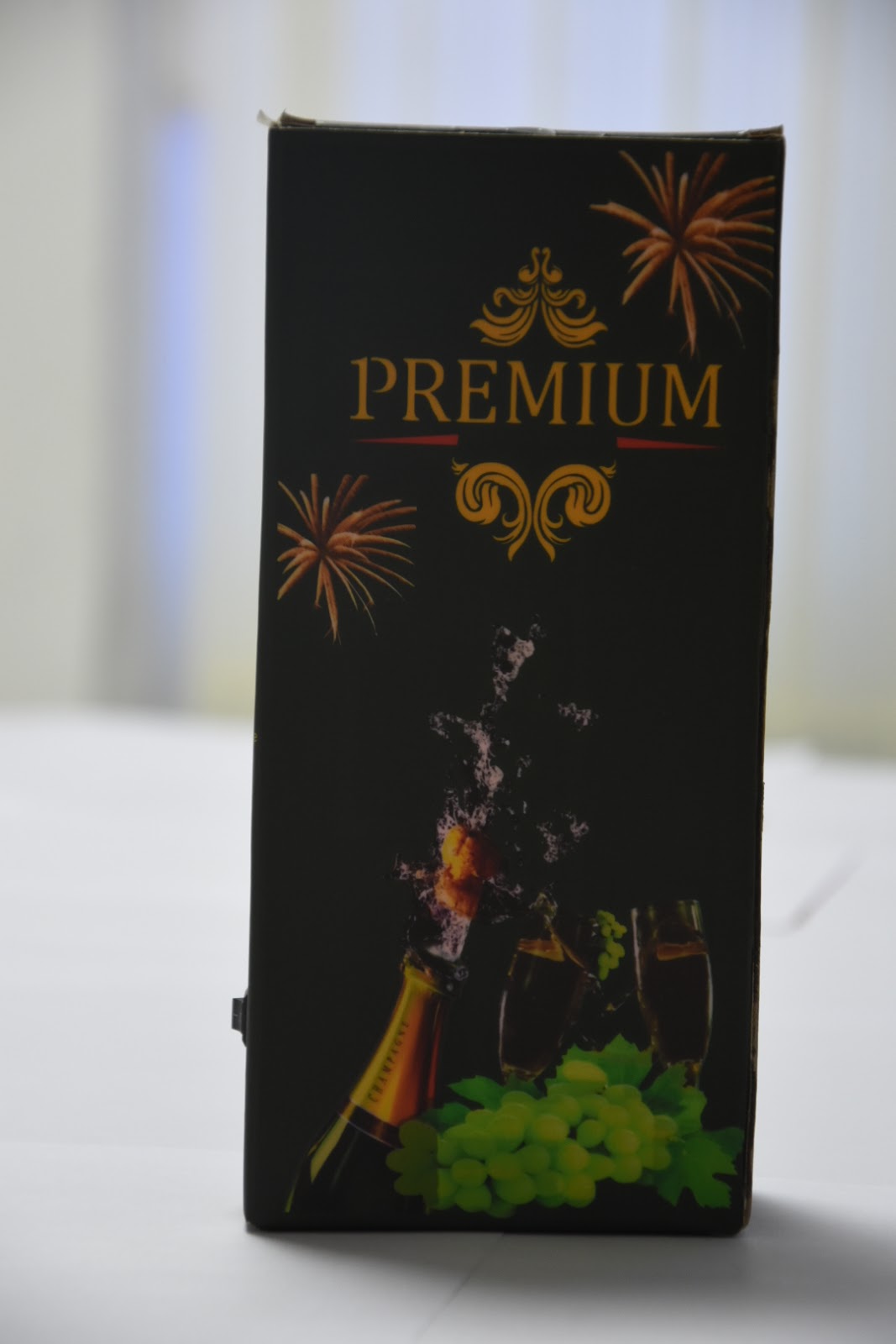
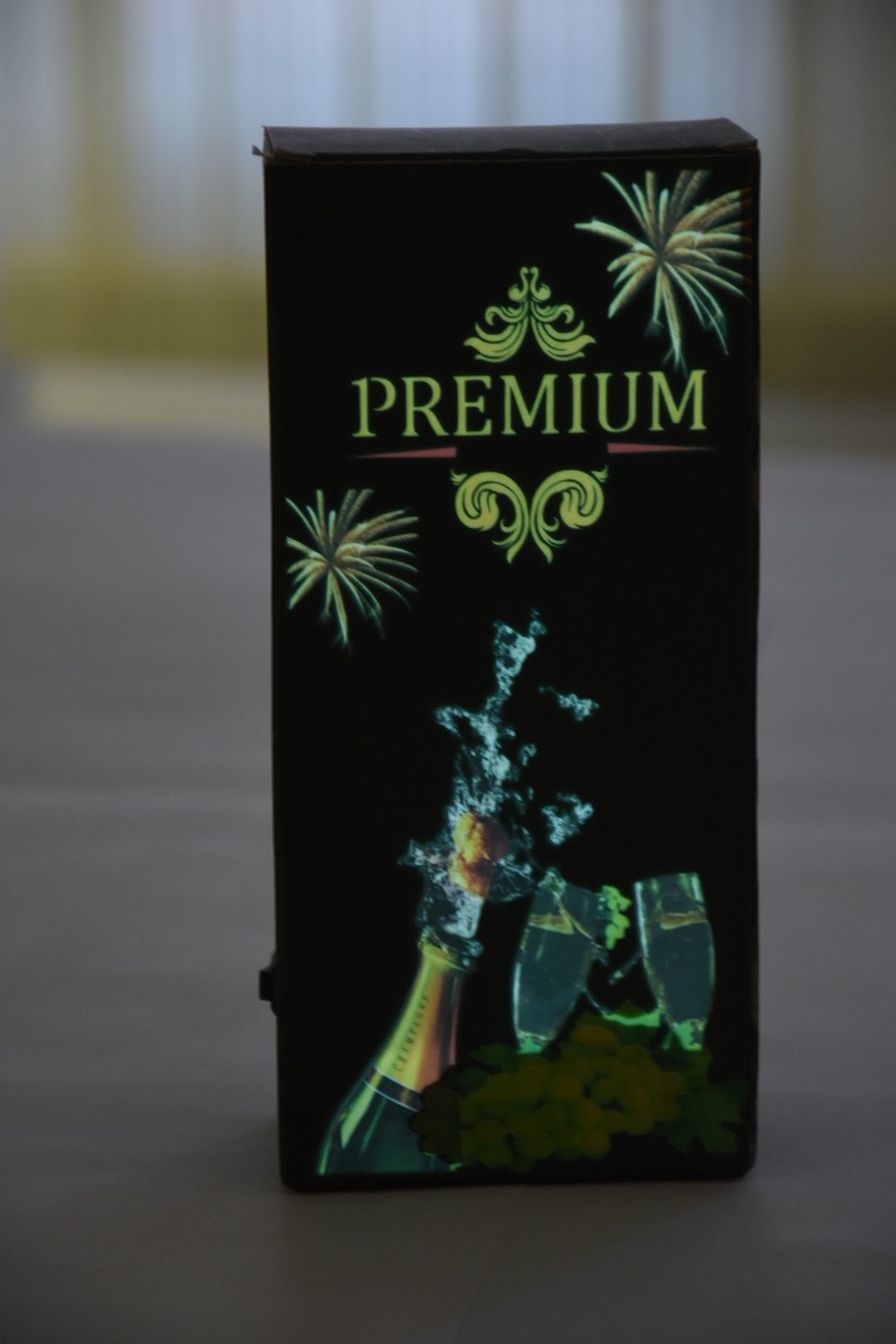
| Label created by Any Graphics |
 |
| Booklet Label by Unick-Fix-A -Form |


 |
| Add caption |

 |
|
| Mark Andy/Rotoflex Stand |
 |
|
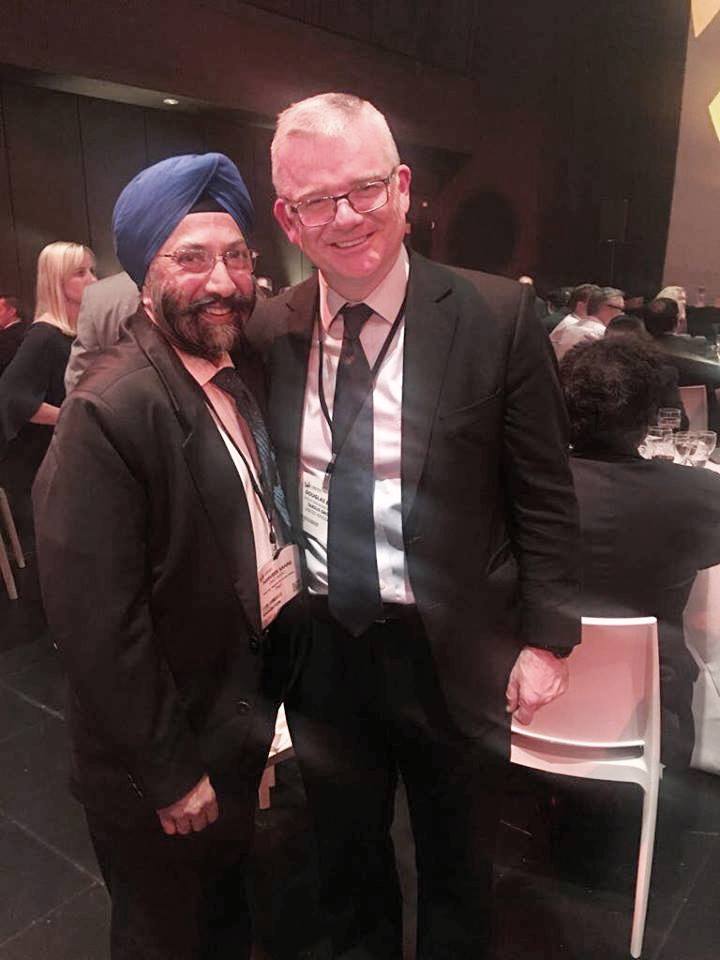
| With Douglas Emslie, Tarsus Group Managing Director |



 |
||||
| With Lisa and Mike Fairley at the dinner |
 |
| SMI Team at their Stand |
 |
||||||
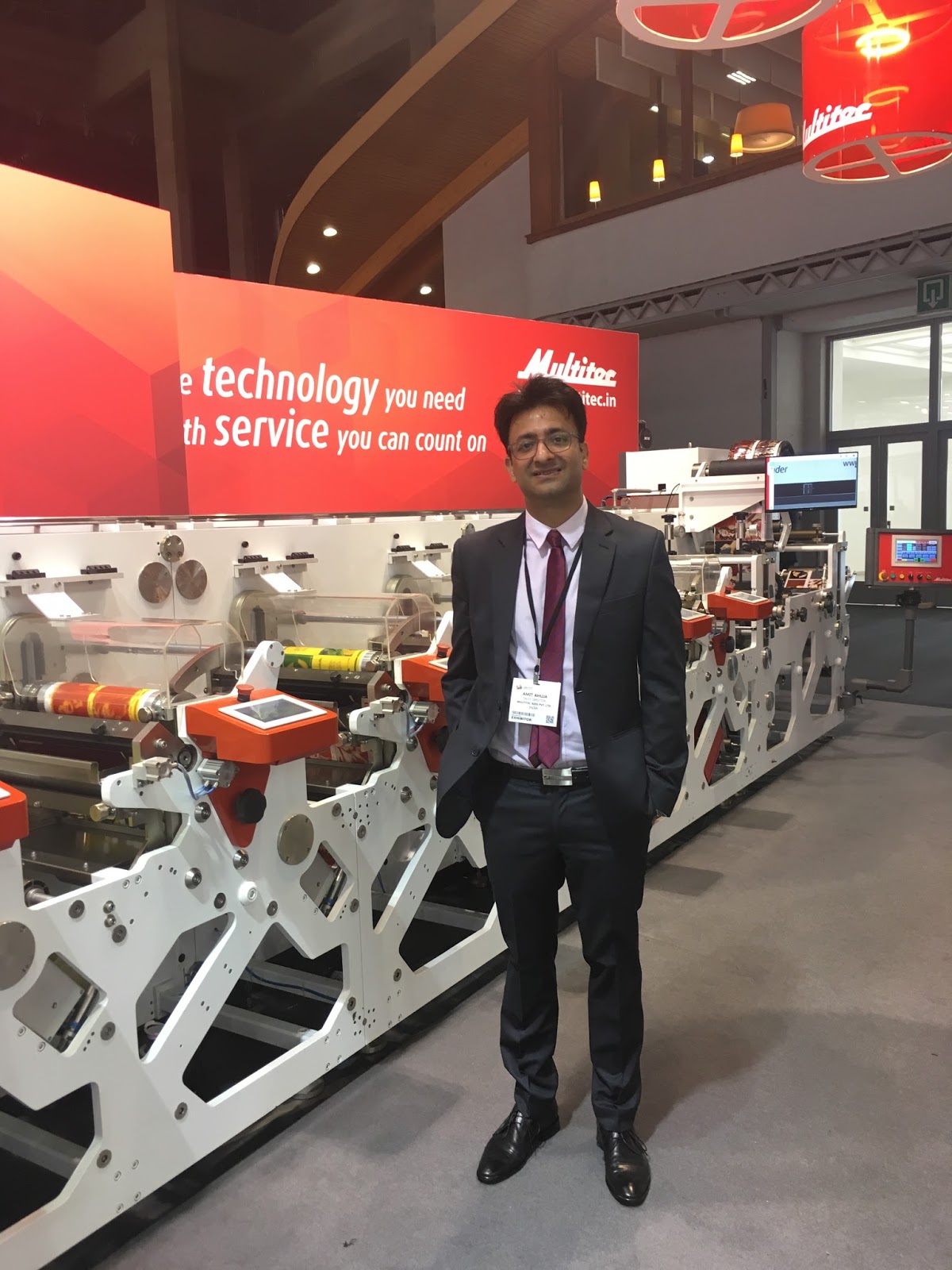
| Amit Ahuja Multitec |
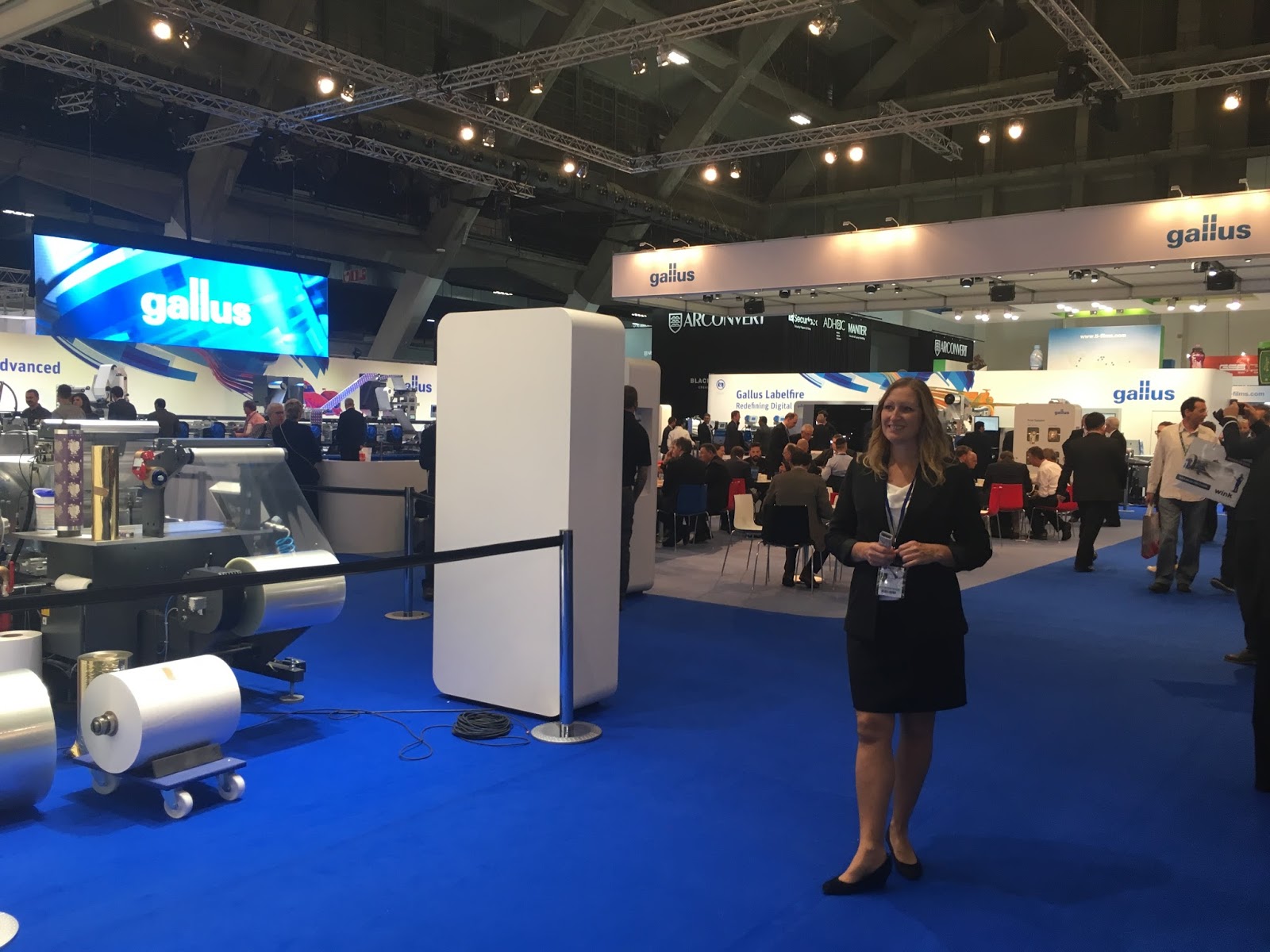 |
| The Gallus Stand |
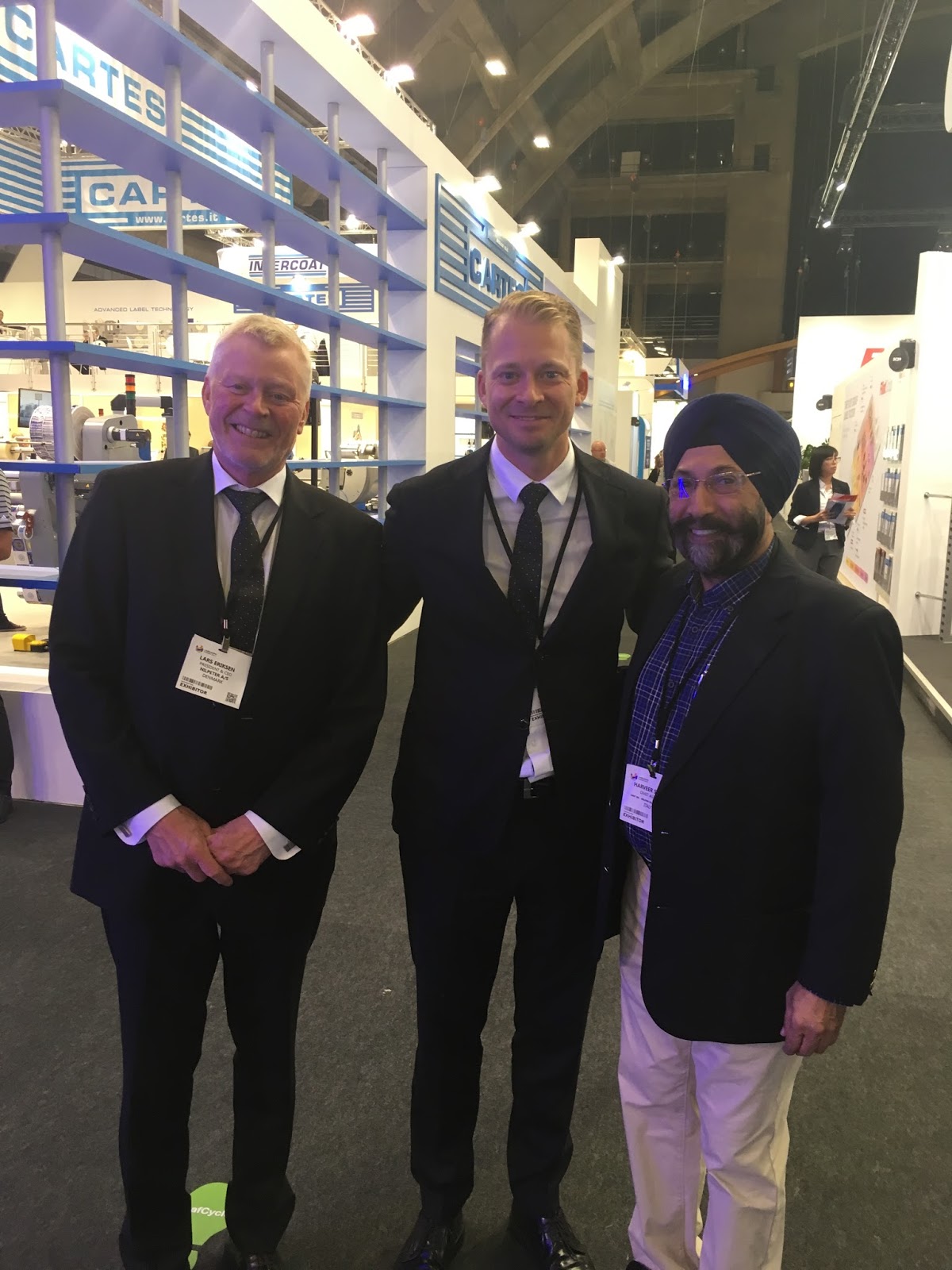 |
| With Lars and Peter Eriksen of Nilpeter |
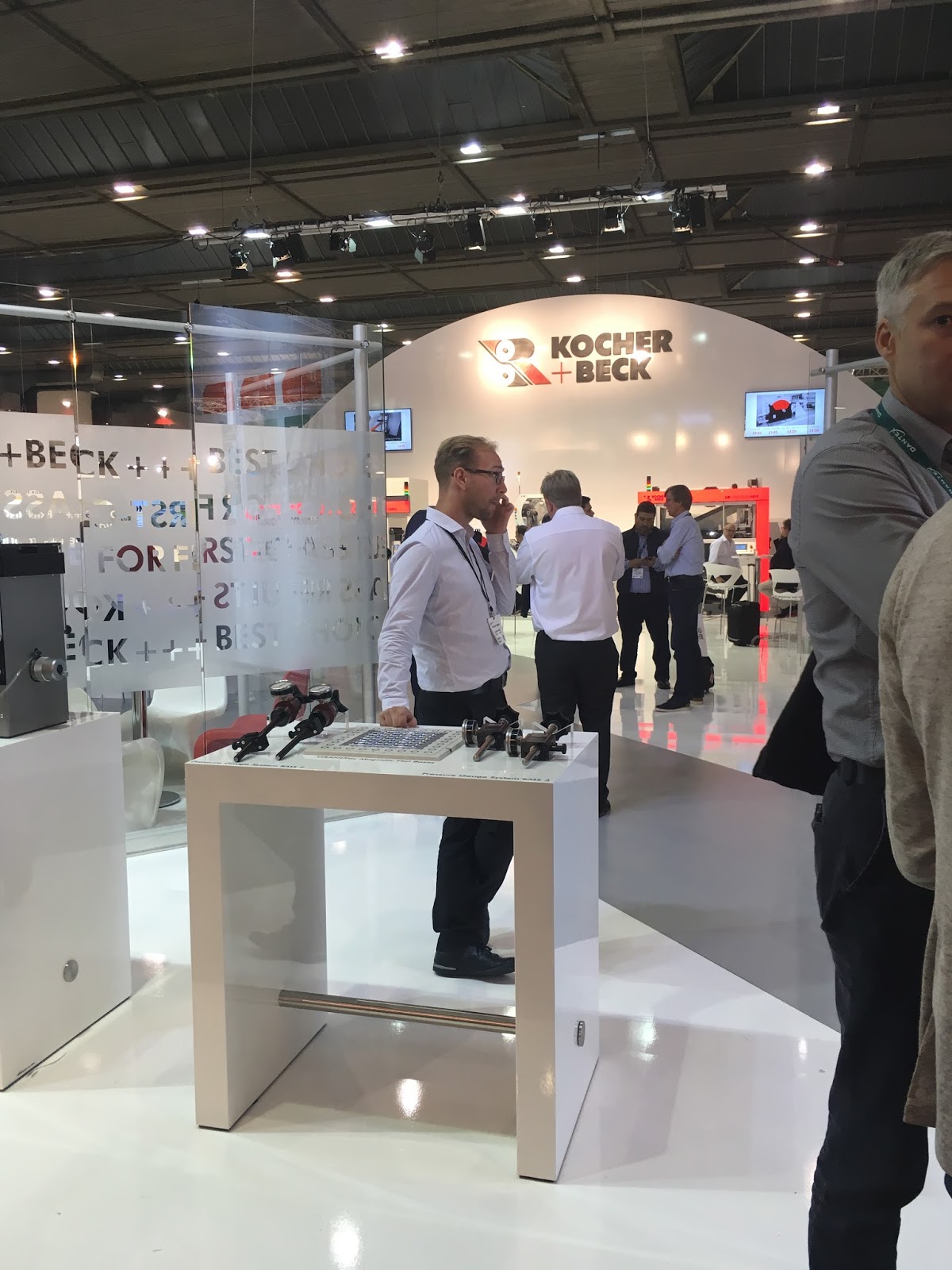 |
| Kocher + Beck Stand |
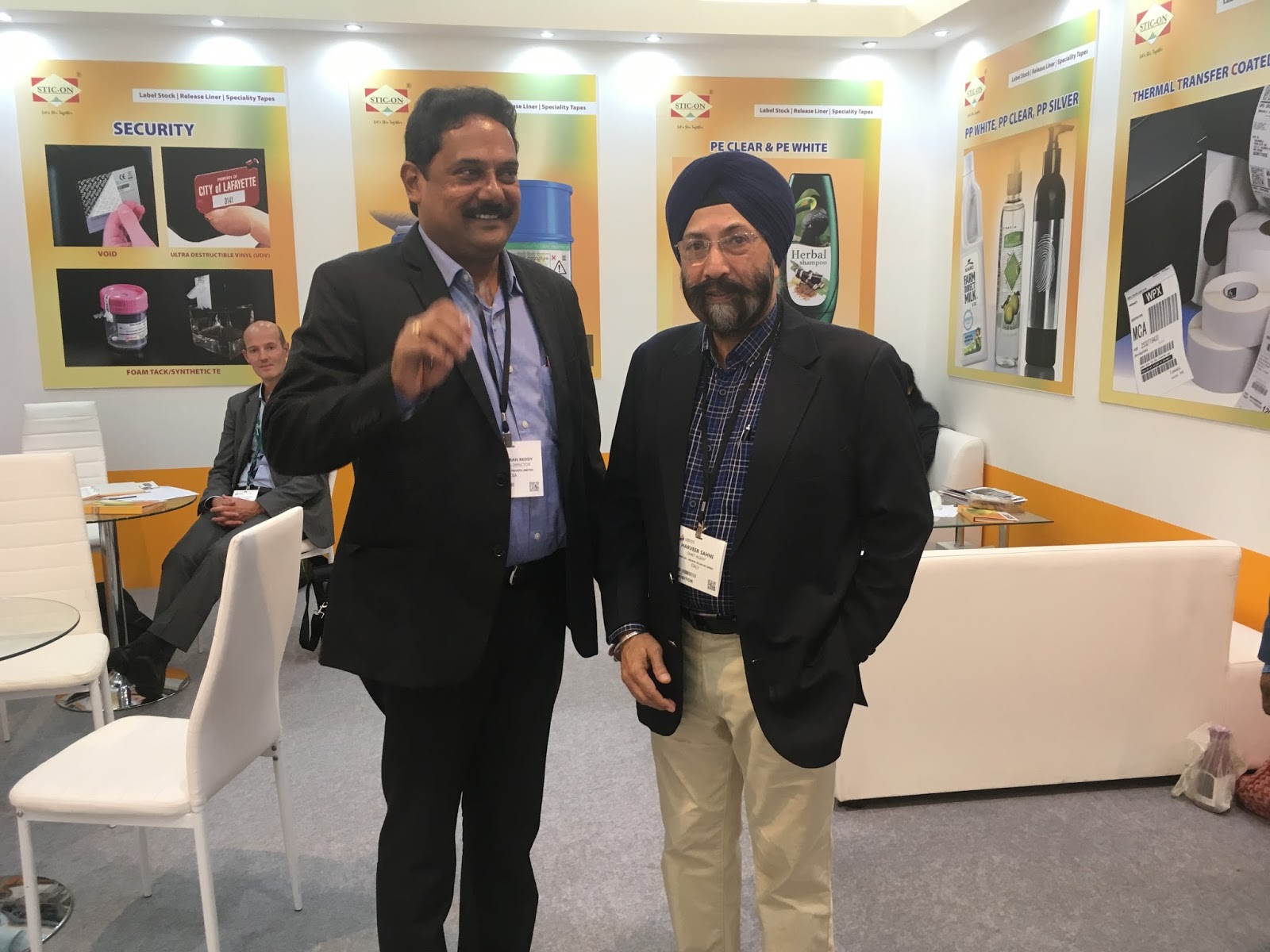 |
| Karan Reddy of SticOn papers Hyderabad |
 |
| Tapan Patel of BST Eltromat |
 |
|
| John of Orthotec |
 |
|
| Bobst Stand |
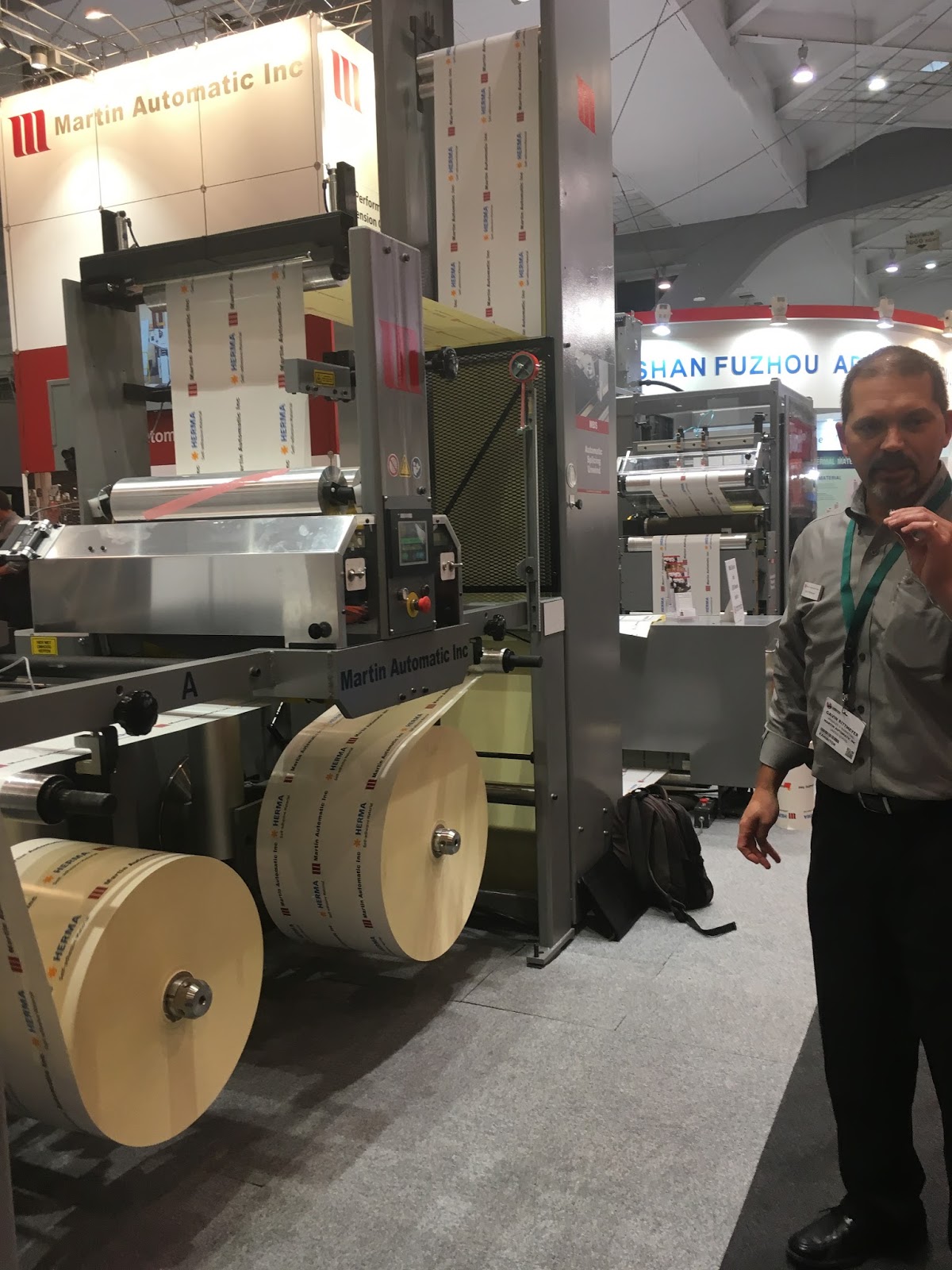 |
| Gavin Rittmeyer of Martin Automatic |
 |
| MPS Stand |
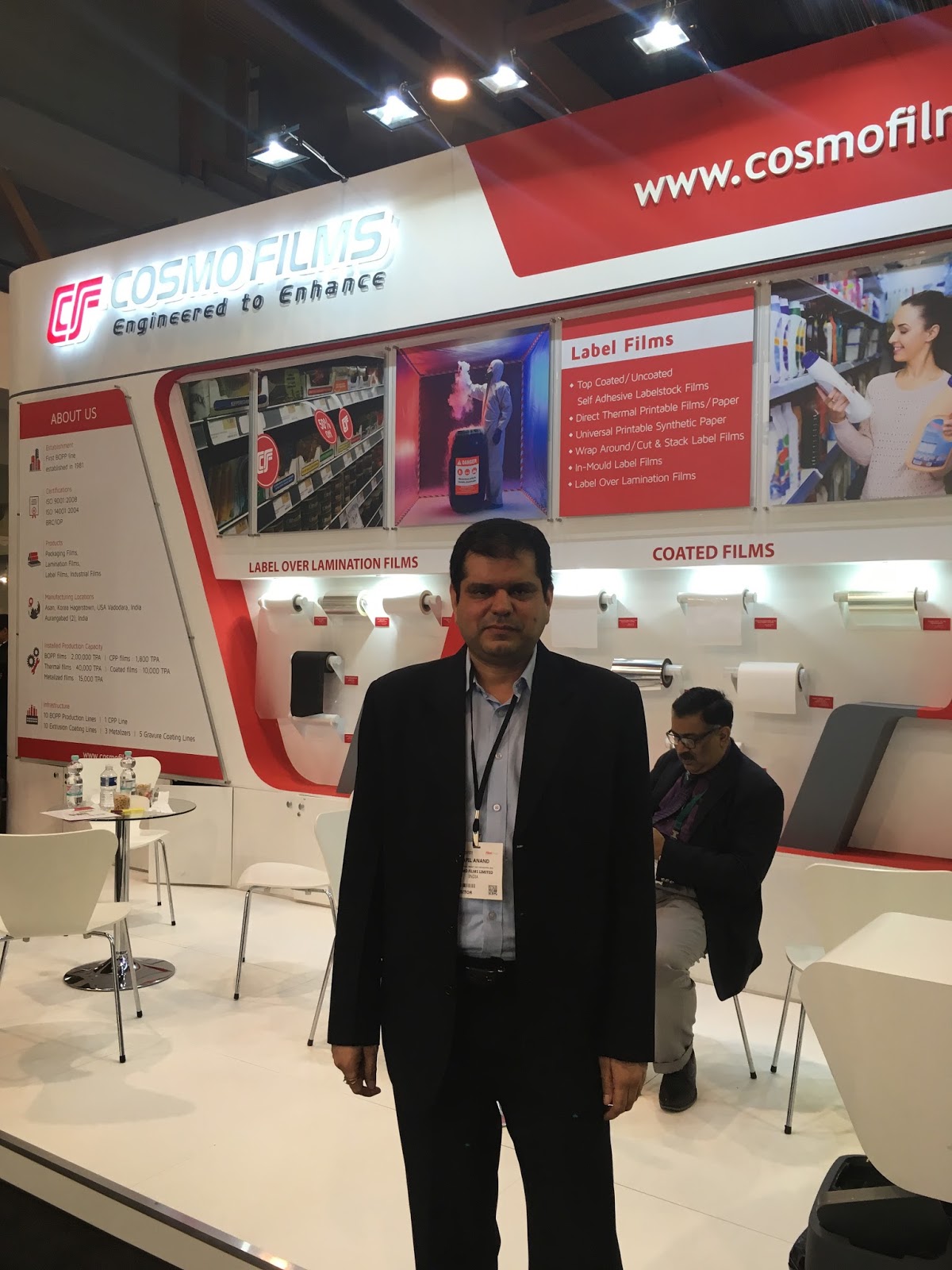 |
| Kapil Anand of Cosmo Films |
 |
| Marco Calcagni of OMET |
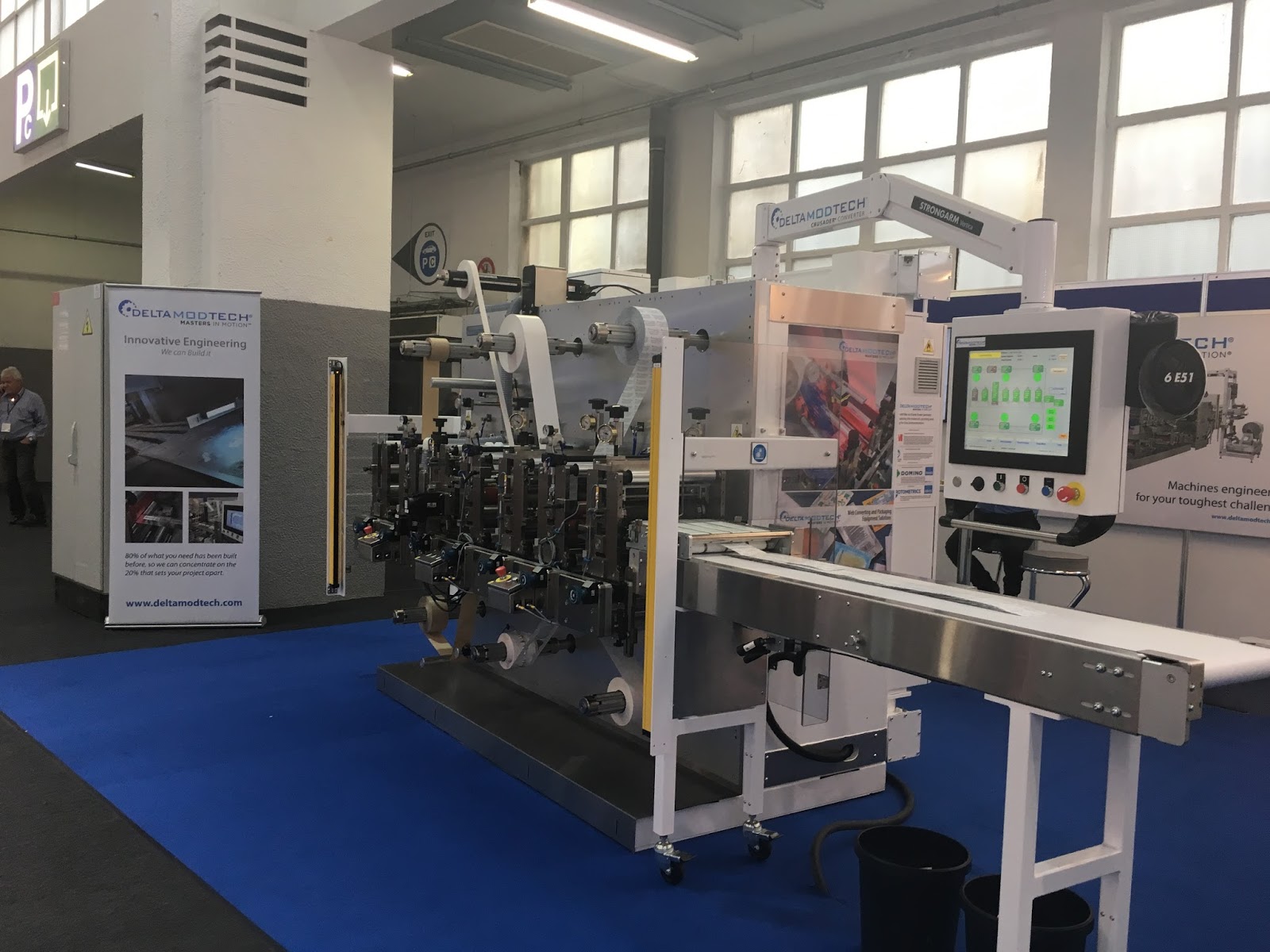
 |
| Spilker Team |
 |
| The Sahnis with Paolo Grasso, Omet |


 |
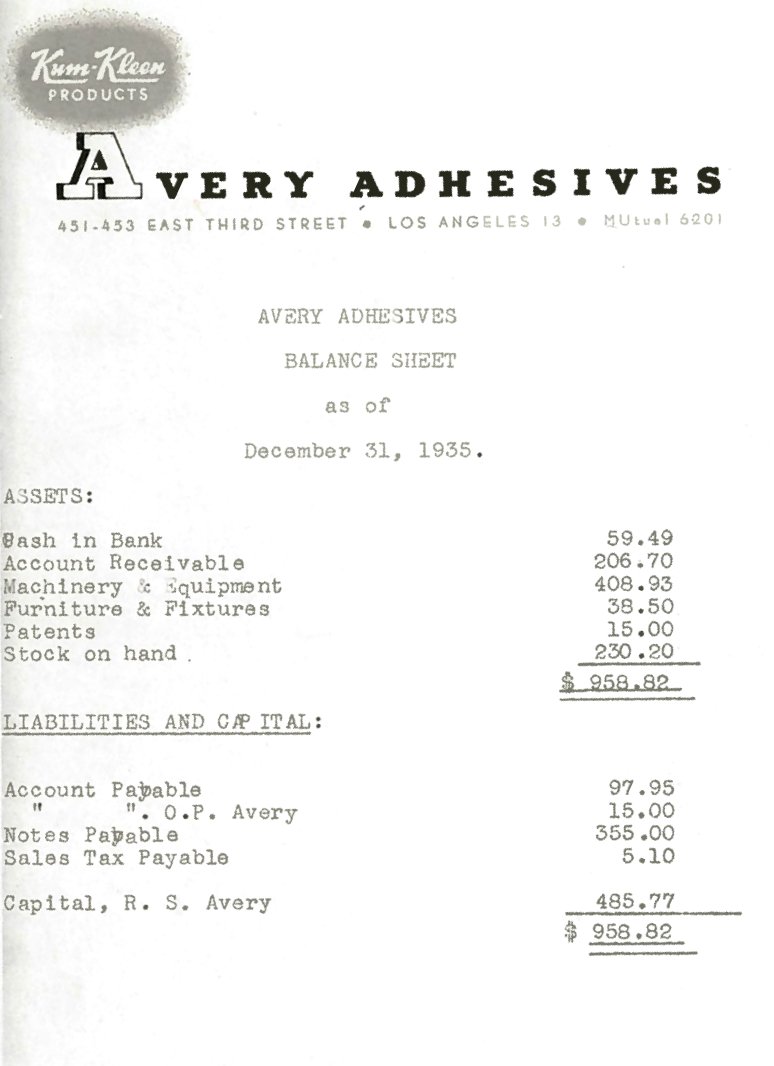
| R Stanton Avery |
 |
| Raj Gopal Srinivasan |
 |
| Mahesh Pathak |
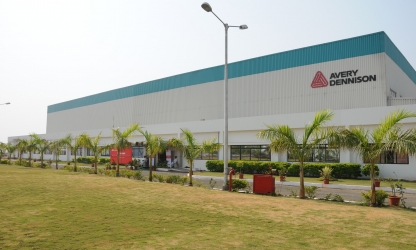 |
| Avery Dennison Plant in Pune |
 |
| Anil Sharma |
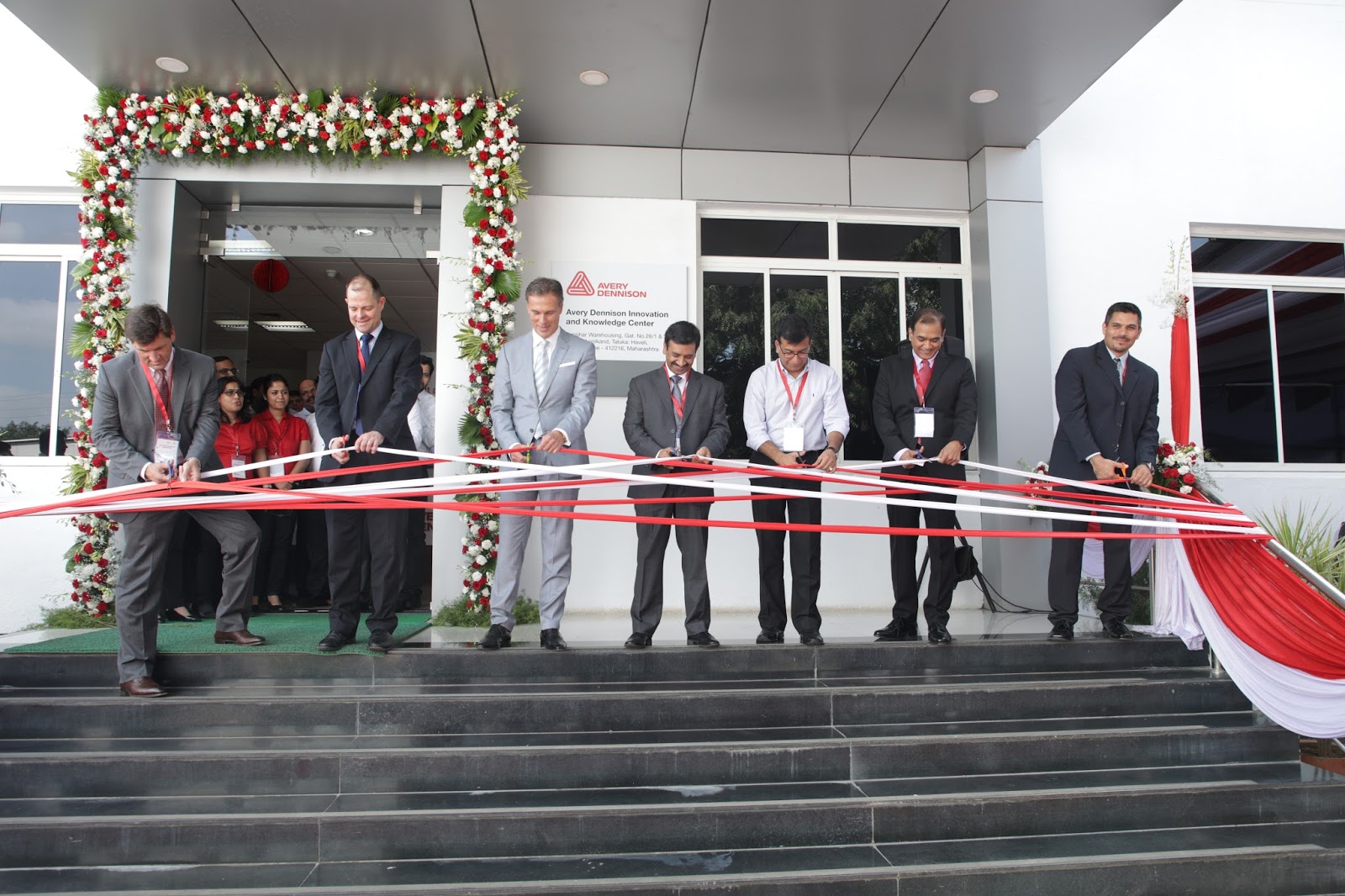 |
| Inauguration of Innovation and Knowledge center PUNE |
 In 2014 to expand further and augment its range of products offered, Avery Dennison India installed another coater at Pune. This time, it was an emulsion adhesive coater of 1.50 meter width. With increased manufacturing capacity and capabilities a bigger range of products is now being offered to their customer base. According to Vivek, who heads the supply chain management in South Asia, Avery Dennison’s bulk of the production i.e., about 350-400 SKUs comes out of the Pune facility. Gurgaon plant now complements the total production most of which is rolled out from the Pune plant. Solvent based adhesive products are still imported and sold wherever required. 95% of all products sold by Avery Dennison in India are made in India complying with the Prime Minister’s call to “Make in India”. 20 years ago they were largely reliant on imports and now only 8-10% material is imported, rest is all manufactured in India.
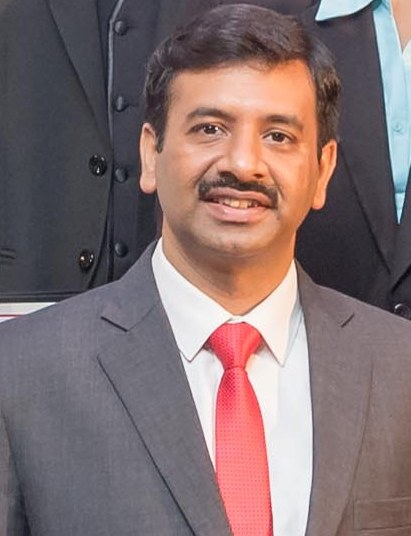 |
| Pankaj Bhardwaj |

 Corporate social responsibility is getting increasing focus for Avery DennisonIndia. Company has multiple programs in the areas of women empowerment, children health and education. Among other programs, Avery Dennison Foundation runs a program by the name of 'Avery Dennison Spirit Of Inventions' in collaboration with six universities by recognizing and rewarding innovative ideas from students in the field of science, engineering and technology.
This is the final part of History of Indian Label Industry” up to third quarter of 2019 written by the author. The history would look incomplete if mention was not made of those who started their label journey from scratch or very humble beginning and then rose to a pinnacle achieving success not only in the home market but also internationally and continue with their journey to greater heights.

From the start of new Millennium in 2000 until the time of writing this part of the history, enormous changes have come about in the Indian label industry. Label printing companies who started from virtually nothing, grew and spread to multiple locations. Some of the bigger ones on the way, decided to sell out to or partnered with foreign companies who were entering the Indian market for label manufacturing. Label, being a miniscule portion of the total packaging cost of a product, does not deliver very large turnover as compared to that of package printing or flexible packaging companies.
However, it does generate relatively higher profit margins than that of high turnover package printing industry. For this reason, we did not see any label companies in the earlier part of the new Millennium who could reach a coveted target of Rupees 100 Crore or a Billion Rupees as annual sales turnover. However, some packaging companies or multinationals who invested in labels as well, were above this figure. It was incredible that at least three Indian startup companies who started their business purely with stickers that later evolved as labels, grew to cross Rupees 100 Crores turnover or more in 2018-2019.

First among them is Manish Desai led Mudrika Labels. Sandeep Desai working at a greeting cards company started trading in stickers that he outsourced in 1975 and a year later he started screen printing them at home. His 10-year-old cousin, Manish was always excited to see stickers being made. In 1977 Sandeep moved his sticker manufacturing to a 500 square feet factory in Malad.
In 1985 they started outsourcing pregummed sheets and get them printed on offset to finally finish them to be stickers at their factory. They grew and expanded into packaging, making cartons and corrugated boxes. Sandeep eventually moved into packaging and the young Manish who had labels in his heart, in 1996 expanded into labels with Kopack label presses and later many Gallus presses. He further expanded integrating backwards to produce self-adhesive labelstocks and collaborated with a Korean company to produce heat transfer labels. By 2019 Mudrika labels were working out of 100,000 square foot shop floor, 550 workforce to achieve a Rupees 160 Crore (1.60 Billion Rupees) annual sales turnover.

The second person to achieve this Kuldip Goel of Any Graphics started from very humble beginnings. At a tender age of 14 years he started making stickers by screen printing manually himself to earn some money while still in school. He did this in his one room home. Despite extreme hardships in life he remained honest and focussed on providing the best in quality and indulging in innovation. In 1989 he started his maiden venture Stickline in Noida. By start of the millennium Kuldip’s company Any Graphics was recognised as one of the best label manufacturers in quality and one that never cut prices to get orders but prove their innovative capabilities to convince customers. From mere screen printing he went on to add dome labels and letterpress printed labels in his portfolio. In 2009 he moved to a 100,000 square feet clean sanitized dust free factory adding, Heidelberg Offset Presses, Orthotecs and a fully loaded Omet flexo and screen combination label press. He also became one of the largest makers of rigid boxes.
By 2019 he had crossed the Rupees 100Crore sale without compromising profit margins and becoming one of the most awarded companies in India. In 2019 he commenced construction of a certified green factory spread over 15000 square meter plot size and 250,000 square feet shop floor.

The third printer who grew in similar pattern, a stout follower of Lord Shiva who greets people with, “Jai Bhole Ki” (Victory to Lord Shiva, lovingly referred to as Bhole) Sanjeev Sondhi, started his career as a medical Representative and carried on in the profession switching jobs until 2005 when he decided to trade in Barcode labels, printers and accessories.
He was looking for bigger things in life! Two years later in 2006 he launched his maiden start-up venture Zircon Technologies India Limited with a Mark Andy 2200 Label press in Dehradun. Being a salesperson himself he drove the company in fast mode expansion and in a few years added multiple Mark Andy and Omet label presses which include the high-end combination Omet Vary flex 430mm. In just 15 years of inception Zircon crossed the Rupees 100 Crore reaching 120 Crores annual turnover mark coming purely from label manufacturing, “a record in itself”! While other successful label companies at this stage would look for foreign suitors, Zircon in 2019 was the first totally indigenous label manufacturing company planning to go public to raise capital for future expansion. They got the approval from SEBI in November 2018 with plans to open a 90-100 Crores public issue. Waiting for an appropriate time to launch their public issue Zircon continued to grow and invest in expansion. Sanjeev hoped to invest 80 percent of the receipts in expanding labels business while the rest in other allied products. Sanjeev was even looking at inorganic growth by indulging in Mergers and Acquisitions. With 3 factories in Dehradun and one in Chennai Sanjeev Sondhi aims to grow multi-fold with blessing of Bhole (Lord Shiva).

Having achieved such success through sheer commitment and hard work it is natural for companies like the three mentioned above to look at other avenues in synergy with their business to achieve a faster growth. All the above, while they continued to be proud of their beginnings and aware of the evolution, started to study or invest in new technologies.
We had reached a time when multiple labelling technologies surfaced, and future had many surprises in store. From the primitive times when a label had to be either tied to a product or riveted on to it or affixed with a wheat flour paste, we believed to have reached a pinnacle when self-adhesive or pressure sensitive adhesive labels that were developed and grew to establish as a predominant labelling technology. Initially it was the manually applied wet glue adhesive paper labels that were in use. With development of starch and dextrin-based glues and availability of automatic wet glue labelling equipment, wet glue labels became the most widely used method of labelling. Most of the organised industry employed packaging lines incorporating wet glue labelling. It was used in all segments like pharmaceuticals, Liquor, cosmetics, oils and in fact most of the products that were packed in glass bottles or metal cans. When plastics, mostly HDPE (High Density Polyethylene), started to evolve as a preferred packaging material for glass bottles and cans due to ease of manufacturing, reduction of freight due to lighter weight per can, possibility to produce in different shapes and colours, labelling with starch or dextrin based adhesive became a challenge. This change was taking place during the 1970s and 1980s. Since HDPE is a low energy material, paper labels with water-based adhesives made from various gums, starches and dextrins would not anchor on to the containers or would fall off in transit. Labels with pressure sensitive adhesives or stickers had already started being made initially by screen printing methods and later by offset printing, these labels would stick well just by application of pressure. They did not have to wait for drying and could be packed instantly after labelling while the wet glue labels would have adhesives oozing out on the sides and attracting dust and shifting in packing process, adversely affecting the aesthetics. More and more companies were opting for these stickers.

Towards the end of last century self-adhesive labels evolved in roll form and the automatic labelling equipment for pressure sensitive adhesive labels became available. Many companies did resist shifting from wet glue to self-adhesive due to the high cost of label applicator replacements.
This is a big challenge that the likes of printers mentioned above faced and yet with their firm resolve they became a part of the change that brought them success. As the retail became dependent on customer choices and there was need for better decorated labels, self-adhesive labels became the preferred labelling technology and grew at fast pace. In between screen printing on containers also started but a slow process that did not have much decoration as compared to printed labels, it did not grow as a preferred process. Self-adhesive grew so much that it became almost 50% of all the labels produced in India. As we entered the new millennium and started looking also into future the thought process for future of labels is becoming extremely diverse and evolving in different tangents. Shrink sleeves came in to take away a big market share given the possibility of 360 degrees visibility. Wrap around labels also became extensively used in the beverage segment. Heat transfer label technology that had originated as Therimage Label technology developed by Dennison Manufacturing company in USA in the 1990s did not flourish then because Avery, who acquired Dennison, did not promote it as it was not in sync with their core business of self-adhesive labels. Once the patents expired, the Heat Transfer Labels or HTL reappeared in the second decade of new millennium and started growing. In mould labels is another labelling technology that had found usage in many segments and started registering growth in large volume usage. At this time, I try and link the changes to the three above who understood the need to expand the scope of labels in their business portfolio. While Mudrika as I mentioned invested in heat transfer labels, Any Graphics into innovative labels and rigid boxes and Zircon also started moving into brand security and innovative packaging including spiral wound containers.

Around this time environmental concerns also impacted the self-adhesive label industry as almost 50% of the converted product is waste going to landfills. Much work was being done on this to reduce the liner tonnage by opting for thinner filmic liners that can be recycled and by developing linerless labels.
Digital printing on to the products is another technology that may replace some of the usage of self-adhesive labels. All said and done, the sheer market size in India and the inertia, brings business to all label technologies and for this reason the self-adhesive labels market continued to grow at double digit rates. The industry will keep evolving both in terms of quality and innovation as also taking environmental concerns in its stride.
In over a year, as another decade ends, the author will update the history on the outcome of such endeavours. The total History as chronicled by the author until now is now available on this blog on links as below:
Part 1: https://harveersahni.blogspot.com/2010/08/history-of-indian-label-industry.htmlPart 2A: https://harveersahni.blogspot.com/2019/07/history-of-indian-label-industry-part-2a.htmlPart 2B: https://harveersahni.blogspot.com/search?q=History+part+2bPart 2C: https://harveersahni.blogspot.com/2019/08/history-of-indian-label-industry-part-2c.htmlPart 2 D: Above
Written by Harveer Sahni Chairman Weldon Celloplast Limited New Delhi July/September 2019
Note: No one is authorised to reproduce, copy or reprint this article until permitted by the author in writing.

Converting process:

Designing a label is a designer’s job, passion and creative indulgence, but converting it into a label that will deliver the envisaged results of communicating with the consumer, is the job of a label converter. If, as I mentioned in the earlier two parts of this series, the designer has taken care of the converters capabilities and challenges, the result is close to being as desired. However, if at the designing stage the eventual converting process is not revisited, converting may become a nightmare and may call for more time and involvement to make changes in design. Let us consider a label that is not one of the regular shapes like a square, a rectangle or a circle. If it is a like a star or an odd shape with sharp corners, it will be a challenge to die cut the labels slowing down label conversion, bringing up the cost of label. In such a situation label dispensing may also become erratic. Such label presses are now available with many label printers that die-cut and remove waste matrix of complex shaped labels while converting but then these options are not available with all venders. The designers need to consider ease of conversion and dispensing. Sometimes designers tend to create labels in the shape of objects like a flower, a dumbbell, a butterfly, a bird or even like a falling drop. These shapes will either be difficult to die cut and will substantially slow down the label press during conversion. I am not suggesting that such shapes should not be indulged in, but on the contrary if the product and its marketing warrant’s it so and can support a higher conversion cost, it may even become a necessity to create such complex labels. At times when it is an innovation being created to reach out to a specific customer segment, the challenges in conversion and speed must take a back seat. Die-cutting in label conversion in-itself is a very exhaustive topic and an intricate technology which is beyond the purview of this article as we are dealing with the life of a label from concept, design, and conversion to its final resting on the product and its performance there from.
Brand Promotion:

Any brand from inception onwards, in its journey to success keeps gaining value as it reaches out to the product’s targeted audience. Label is one part of the package that contributes towards the brand promotion from the word go! The aesthetics and the decoration part have been dwelled upon earlier in this series, yet a very important part of the label is brand promotion. While the aesthetics and decoration of the label tempts the consumer, to impulsively lift the product off the shop shelf but it is the brand promotion in-built into the label that will bring the customers back to make a repeat purchase. A product may have been created with lot of skill and effort to be the best buy for the discerning consumer. Its commercial success will depend not only on repeated purchase by the impulsively indulgent buyer but by his spreading the message by word-of-mouth to others about the product. The information on the label should communicate the strength and reliability of the manufacturer. The label should deliver a message that the brand is “value for money” bringing appreciation from the judicious buyer who inadvertently becomes the brand’s ambassador. It is easy to mimic successful brands, but one must realize that the learned and well-informed consumer is quick to recognize a copy. I refer to this issue of duplication later in this article. The label needs to communicate the research and effort being put into creating the product to meet the emotional and aspirational requirements of the users. The label and eventually the product itself must communicate that it will add to the stature of the user. The message on label in the shortest form, given the limited space, is required to be conveyed emphatically and should be very strong and bold in branding! The content on the label is necessarily required to create an aura promoting brand recall. One must be mindful of the preferences and sensitivities of the target audience that could be children, young people, males, females or the elderly. The brand promotion capabilities of the label will create a communication link between the product and its consumer thereby establishing a channel for successful sale of the product on an ongoing basis. Often sales promotion is also incorporated in the label like free extra quantity or freebies with each purchase but here a word of caution is to be remembered, one should not confuse brand promotion with sales promotion. Brand promotion is a priority for building stature and value of a brand in the customers mind while sales promotion is a temporary step to give intermittent boost to sales. While brand promotion brings long term gains, sales promotion gives shorter gain.
Brand Protection:

As brands attain popularity and grow driving-in more revenue, another set of people wanting to make quick money by cashing in on the value of these brands, start to create look-alikes, duplicates and counterfeits. The innocent user falls prey to such unscrupulous elements by buying these non-standard products. They are exposed to dangers of being harmed by usage of such spurious products. Consumer is unable to judge whether the product is duplicate or the original product sold by the brand owner is of inferior quality. The brand is likely to suffer in value and reliability for no fault of theirs. The menace of counterfeits has attained gigantic proportions. According to a report by “The Organisation for Economic Co-operation and Development (OECD)”, Trade in counterfeit and pirated goods has risen steadily in the last few years – even as overall trade volumes stagnated – and now stands at 3.3% of global trade, according to a new report by the OECD and the EU’s Intellectual Property Office. Trends in Trade in Counterfeit and Pirated Goods puts the value of imported fake goods worldwide based on 2016 customs seizure data at USD 509 billion, up from USD 461 billion in 2013 (2.5% of world trade).

Innovation:
Consumer is the king! It is a famous quote, I would modify it a little and say, Consumer is the king maker!” If consumers approve of a product, it could deliver fortunes to the brand owners. So, to reach out to these king makers, the brand owner must innovate both in the package and label design. One sometimes wonders what innovation one can create in a label. A small patch of label that carries the brand and its information, can be decorated as mentioned earlier in this series with foiling, embossing, varnishing, lamination and die-cutting in various shape. However, in an effort to catch the consumers fancy, labels must have innovations as per the label segment they cater to. A food product label is created with a natural effect where you can see and feel the texture of the label. Portraying freshness, a leaf or a flower may be created to exhibit water droplets that one can touch and feel. These are accomplished by using diverse printing and processing technologies on their combination presses. Development of such labels is the outcome of creative capabilities of innovative label printing companies. I quote some of the innovations that I have seen in recent times;

Consider a wine label; Wine enthusiasts like to know about the wine before indulging in it. They wish to know the quality of grapes used for making that wine, the region and the terrain where the grapes came from. The label is made like a book to be read! One cannot put all this information on a single label, so labels are produced like a small booklet affixed to the wine bottle.

The hazards of using infected syringes, has been highlighted for long to curtail the spread of infection. There is an imperative need to dispose-off the used needles safely. I visited the Schreiner facility in Munich Germany, some time ago and was shown labels where after use the needle is broken on to a plastic trap which forms a part of the label on disposable syringe. These traps are then sent for safe treatment and disposal.

Another interesting example is a label created for the Heinz tomato ketchup pack. On one side if you open the pack, ketchup can be squeezed out like it is done from a regular bottle. However, if there is need to use the ketchup as dip, one can peel off the entire label by pulling the tab on another end to expose the ketchup and get a feel as if it was in a bowl.

Other innovations are like a safety temperature indicating label on cooking gas cylinders that would change colours to indicate safe temperatures or Braille labels on wine bottles for the physically challenged blind who also like normal people enjoy their wine and will like to read the information as wine lovers.
Summary
Label printing and converting technologies continue to evolve and I have written about the different processes on my blog where a lot of information is available. The printing that initially surfaced as letter press, moved over to flexographic printing followed by stand alone or hybrid presses incorporating combination of flexo, digital, screen, offset Rotogravure printing and diverse embellishing process like hot-foil, cold-foil, UV varnish, embossing, debossing, front and back printing all done in a single pass. The packaging development specialists now need to be well versed with all the technologies and processes. In this three-part series, one can see the journey of the label from concept to its life on the product after application. It goes through a technical life cycle interacting with diverse technologies from design, to printing, conversion, dispensing and life thereafter. Each of the technologies that the label encounters in its life cycle including the chemical, mechanical and physical properties is a science it itself. Before concluding we must keep in mind the end-of-life waste management while creating a label or package. The whole chain of persons who contribute to the life of a label are a team who eventually rejoice in the success of a product that adorns a label they created.
The complete 3 part series are accessible at the following links;
https://harveersahni.blogspot.com/2014/09/the-life-of-label-i.html
http://harveersahni.blogspot.com/2014/12/the-life-of-label-ii.html
https://harveersahni.blogspot.com/2022/02/life-of-label-iii.html
Written by Harveer Sahni, Chairman, Weldon Celloplast Limited, New Delhi-110008 India, January 2015 and updated in February 2022

 |
| Dhiresh Gosalia |
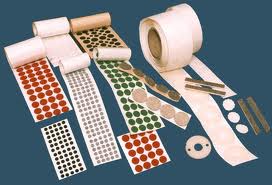 |
| Self Adhesive Stickers/Labels |
 |
| PSA Tapes |
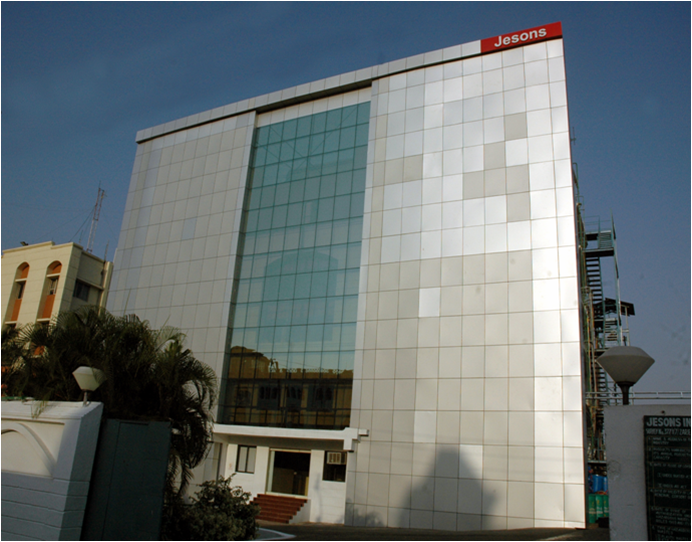 |
| Jesons Daman Factory |
 |
| Jesons Parel Office |


 |
| Honey Vazirani |

 |
| Divya Keshav |
 |
| Priyata Raghavan |
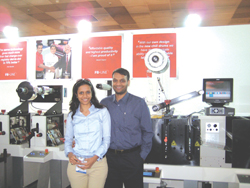 |
| Sandhya Shetty and Santosh Shetty |