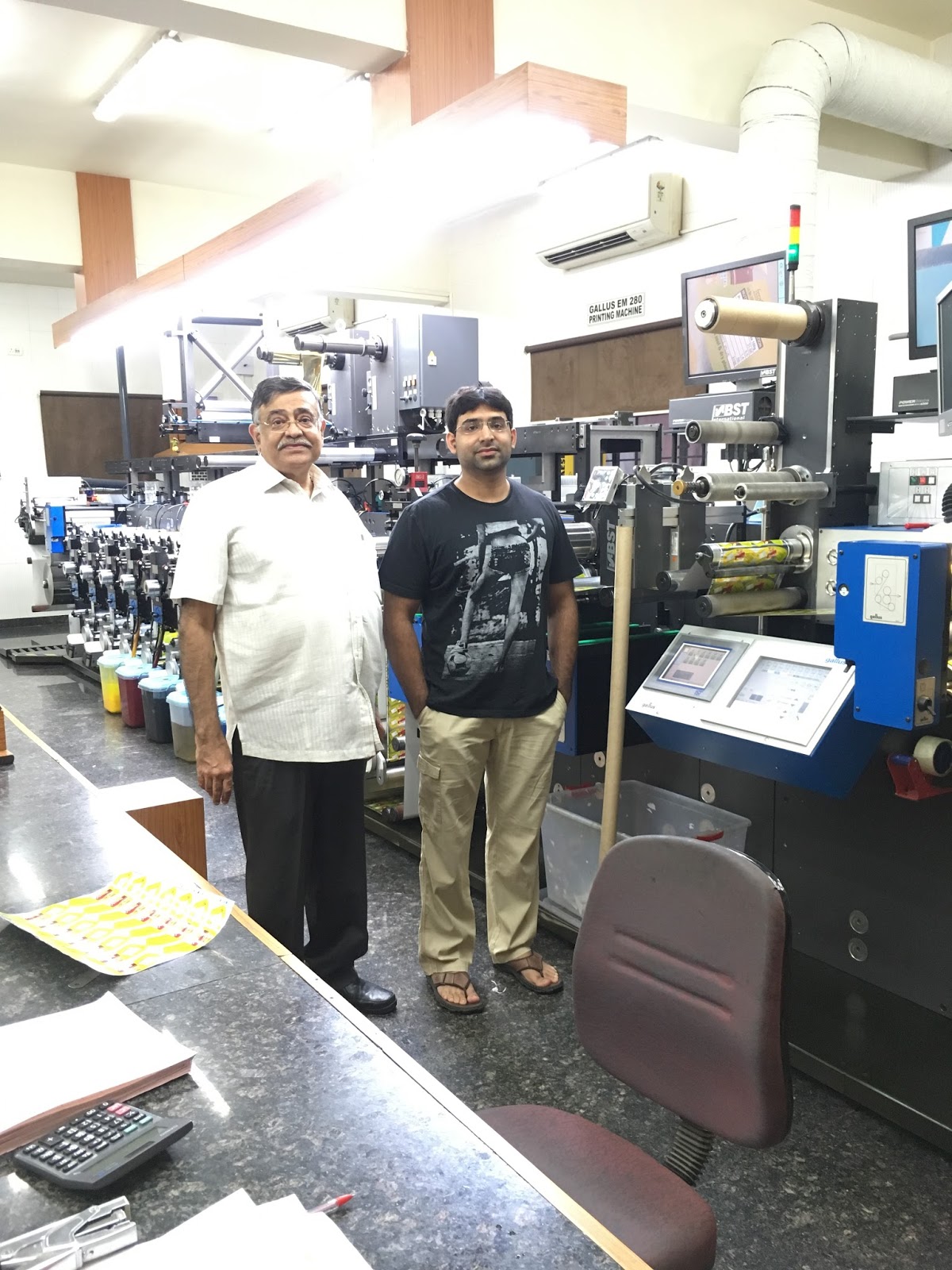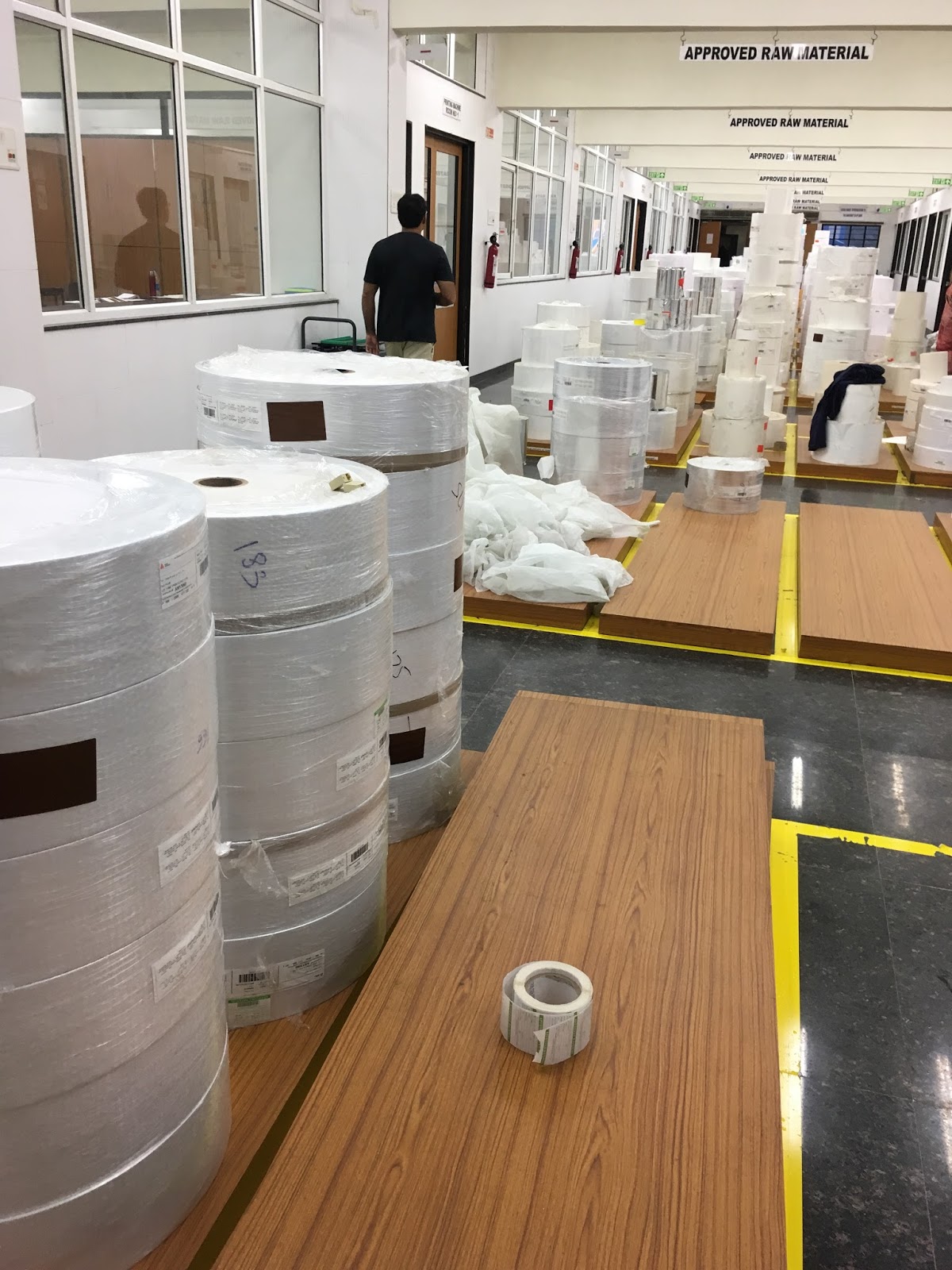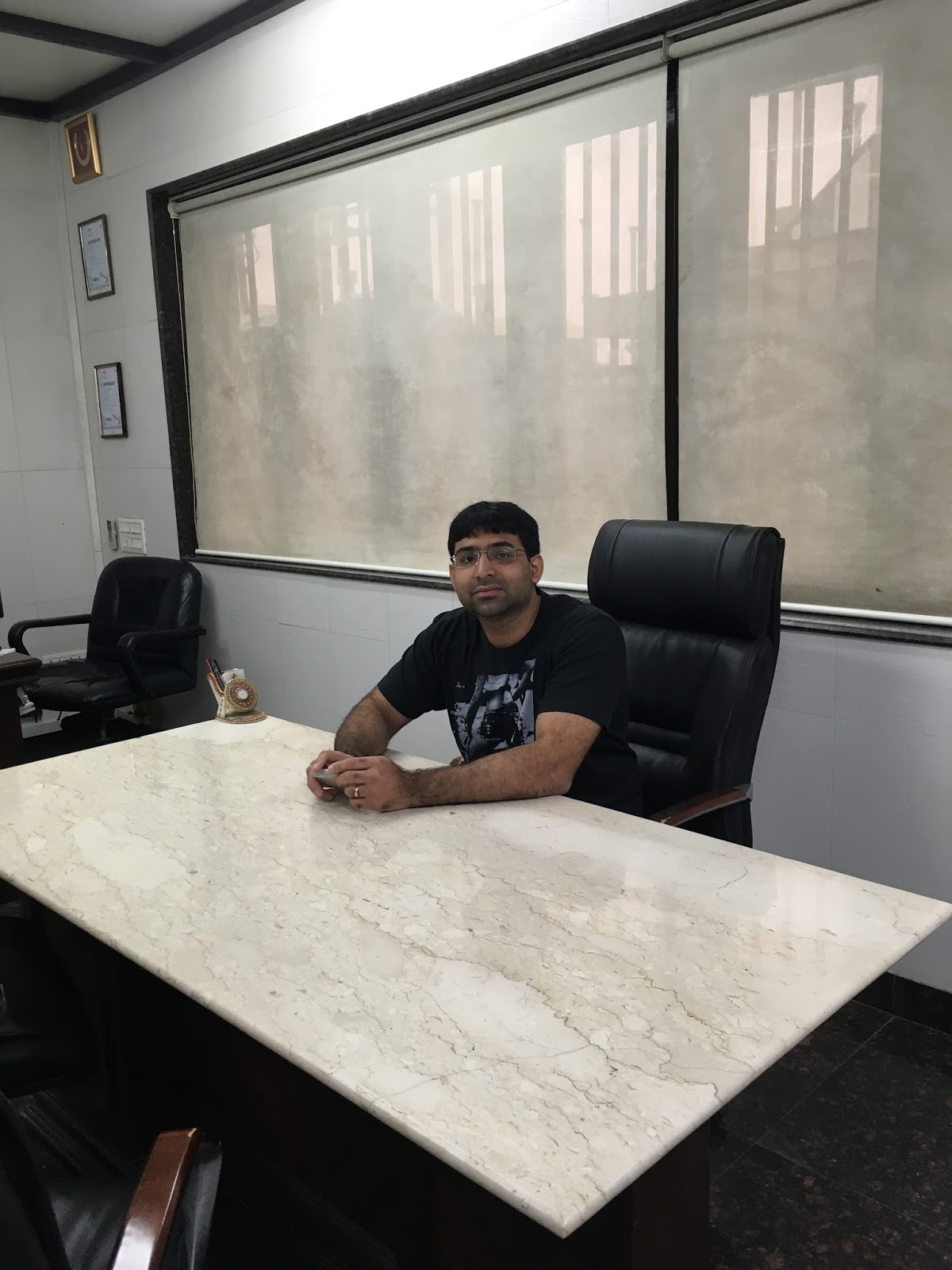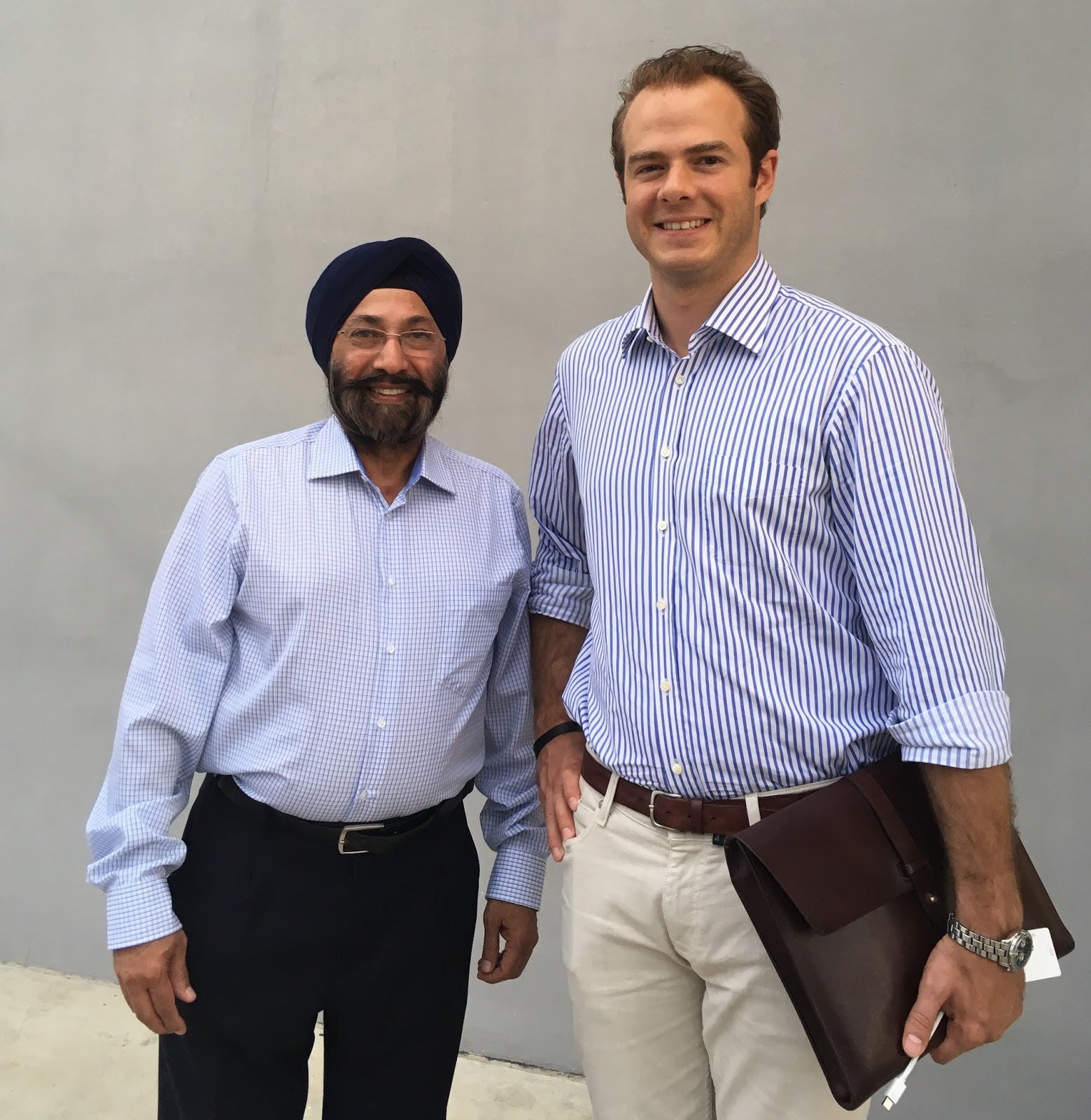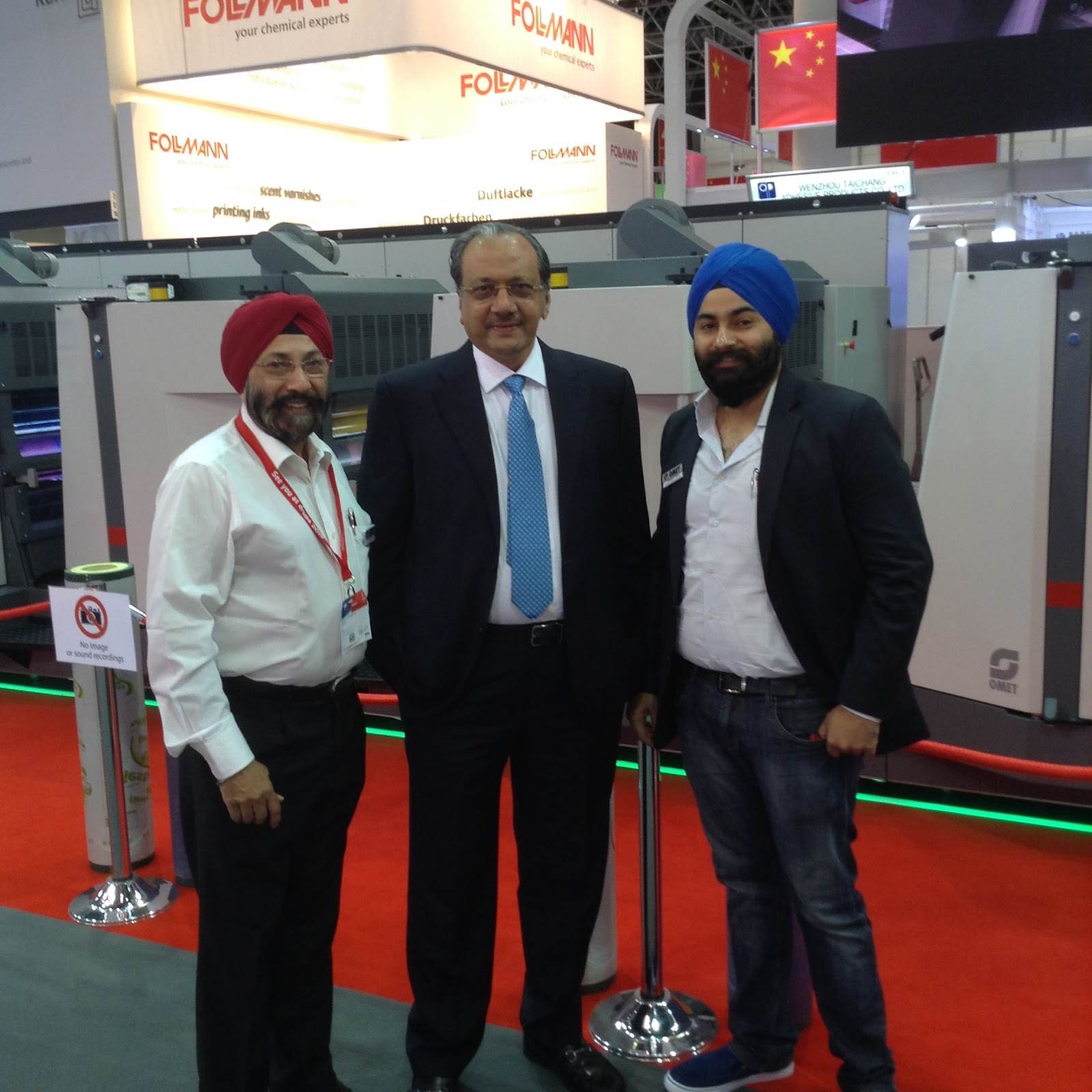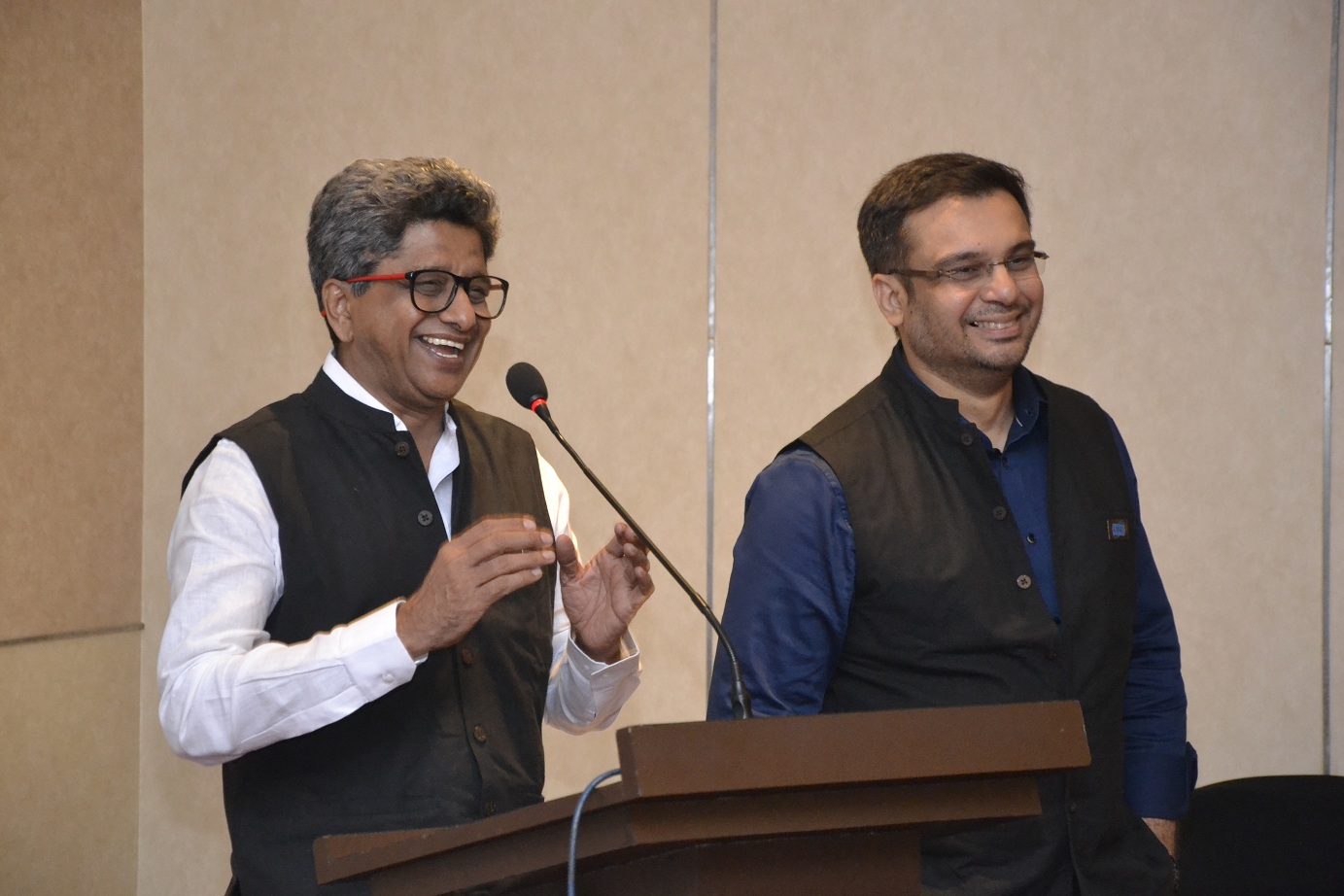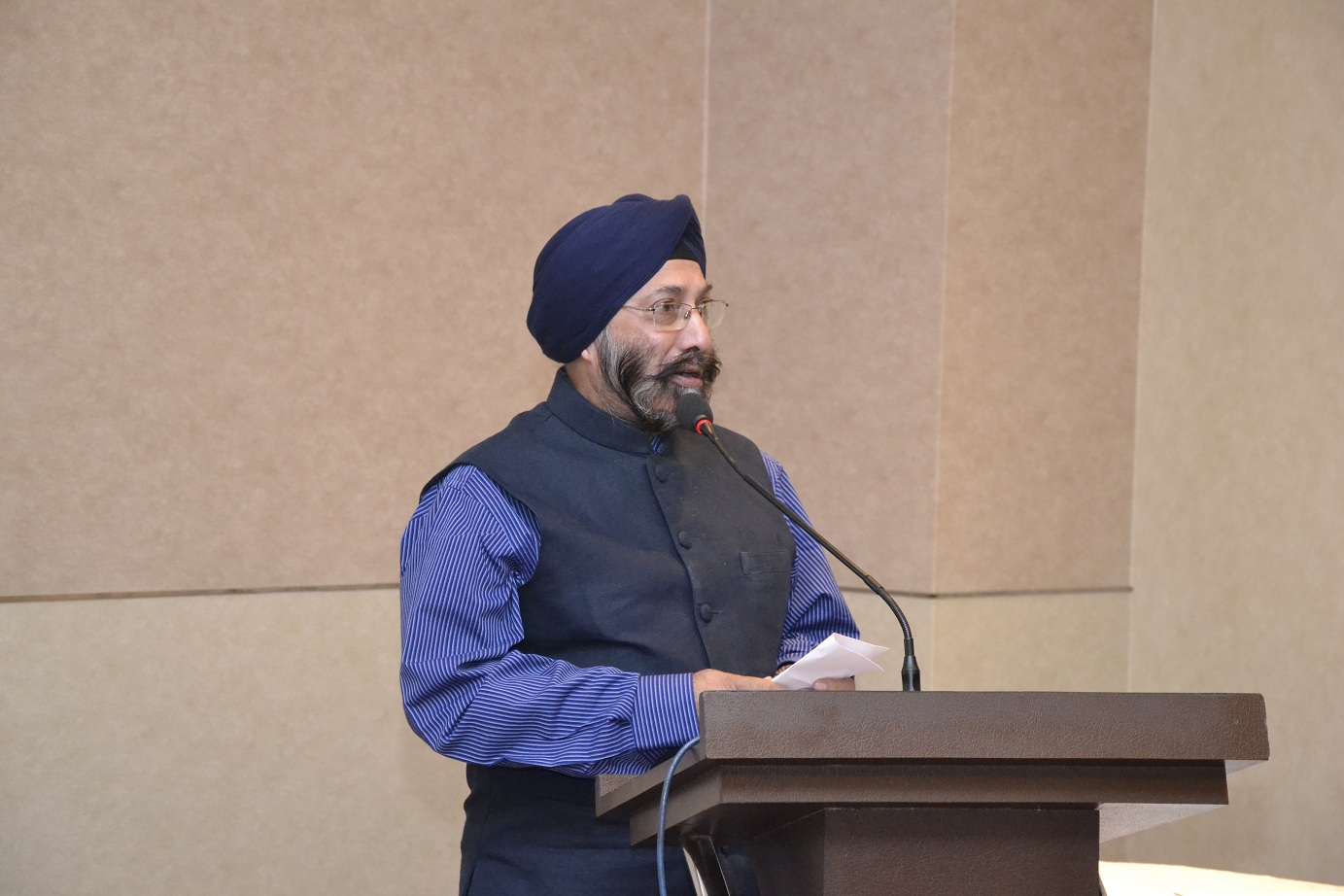
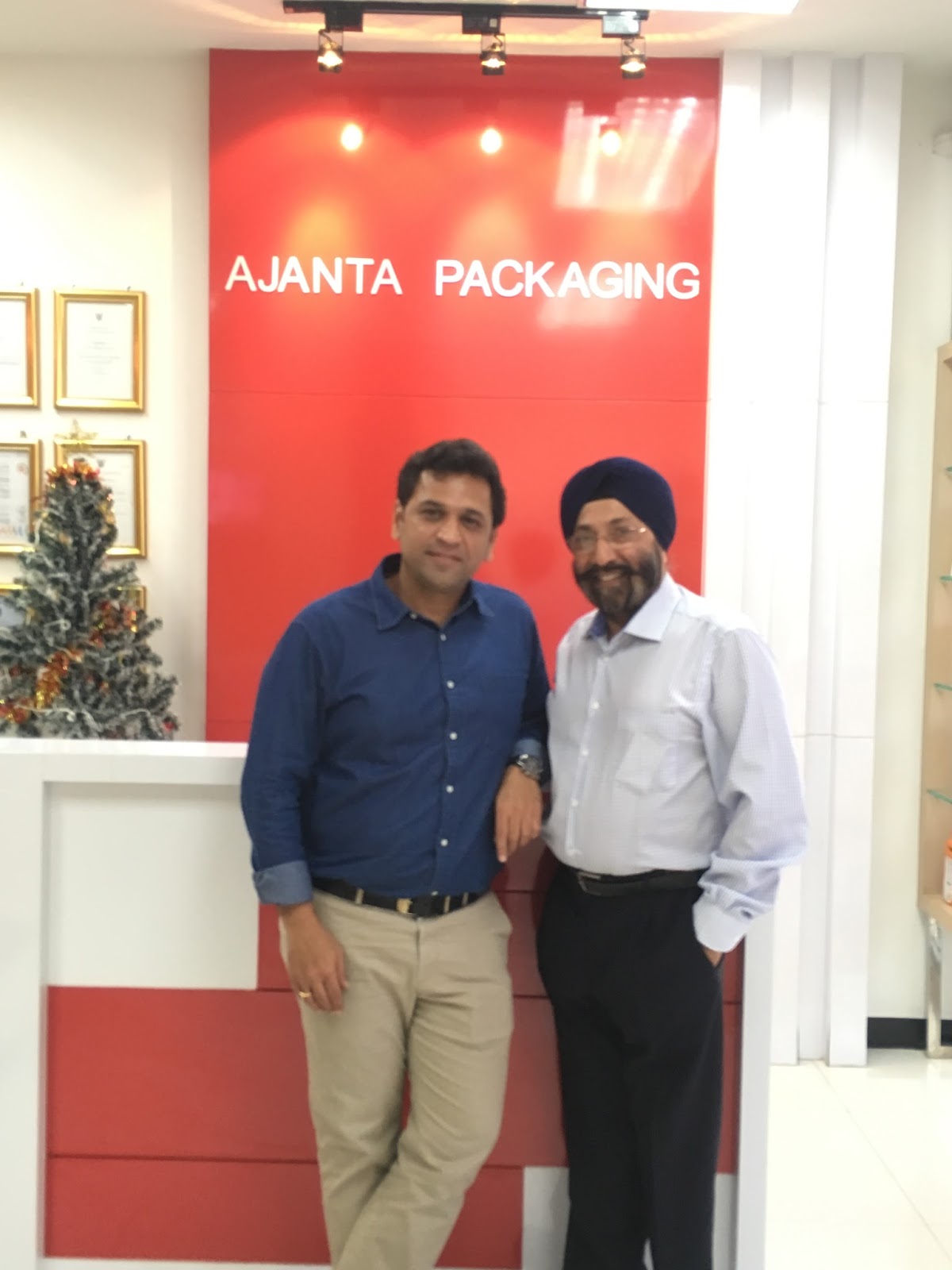
Exactly 6 years ago on the 7th of August 2010 I wrote an article titled “Chandan Khanna; I wanted to be different!” He has more or less proved that statement and has worked hard to excel in his journey to grow in labels. The last line of that article was, “He is committed to excel in labels and reach the topmost slot in five years from now and would still be doing something different!” Rarely one sees people committed to their aspirations and achieving what they wished. Today Chandan Khanna lead  Ajanta Packaging is now one of the top three label companies in India with wholly Indian ownership and qualifies to be the only Indian owned multinational label printing company having manufacturing presence in three countries i.e. India, UAE and, Thailand. In the last couple of months I have had the opportunity of visiting his two overseas units in Sharjah (UAE) and in June 2016, I visited his unit in Thailand. I was very impressed! I was tempted to question him, “Chandan how do you manage?” The answer he gave appeared to be in continuation to where we left in the last article in 2010. He replied, “I am different and will continue to be so.”!
 
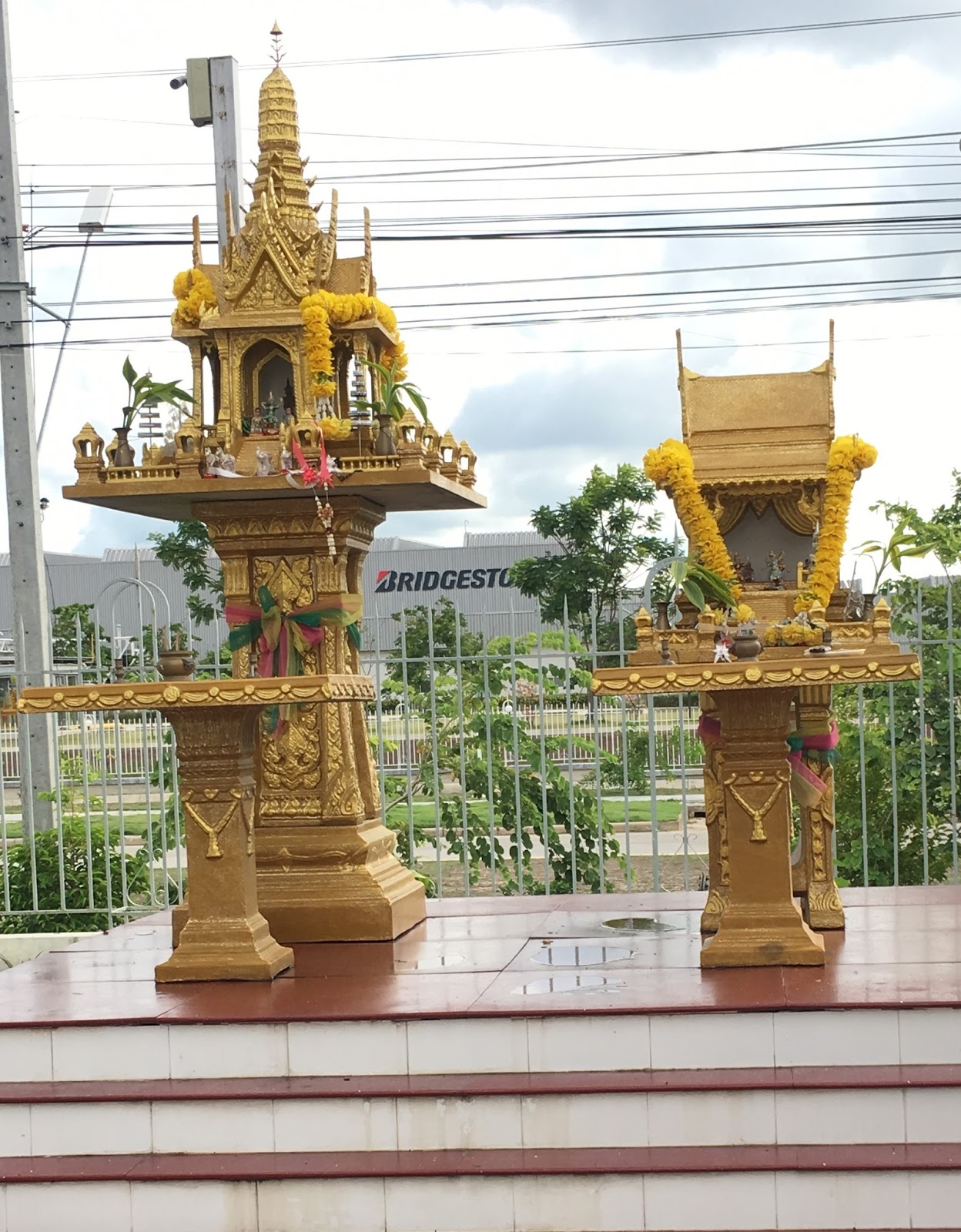
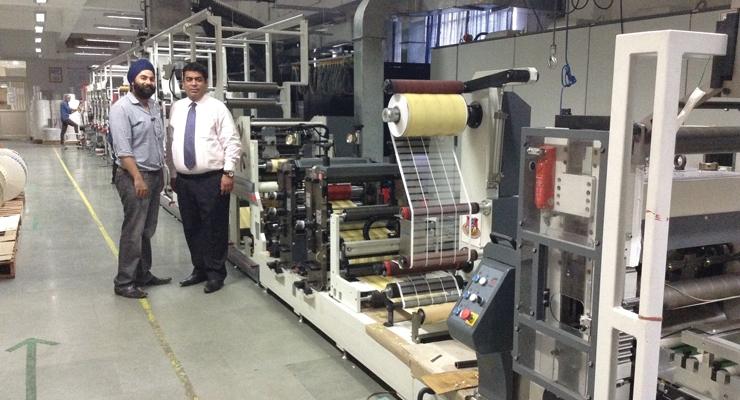
Ajanta Packaging’s Thailand unit is on the highway from Bangkok to the tourist destination of Pattaya. Infact it is almost on the outskirts of Pattaya. After spending the night at an amazing airport hotel Novotel Bangkok, we i.e. I and my wife, were picked up early morning by Ajanta’s car to drive to Pattaya. After checking into another outstanding property The Dusit Thani and freshening up we left for the Ajanta factory. As we arrived at the unit we witnessed a Thai Spirit temple adorning the entrance, further inside was also an Indian temple with Lord Ganesha and Laxmiji, displaying the owner’s deep faith and religious values. We were welcomed by an extremely hospitable staff with TV monitors displaying a welcome message for us and traditional “SwasdeeKha!” by the ladies who welcomed us.


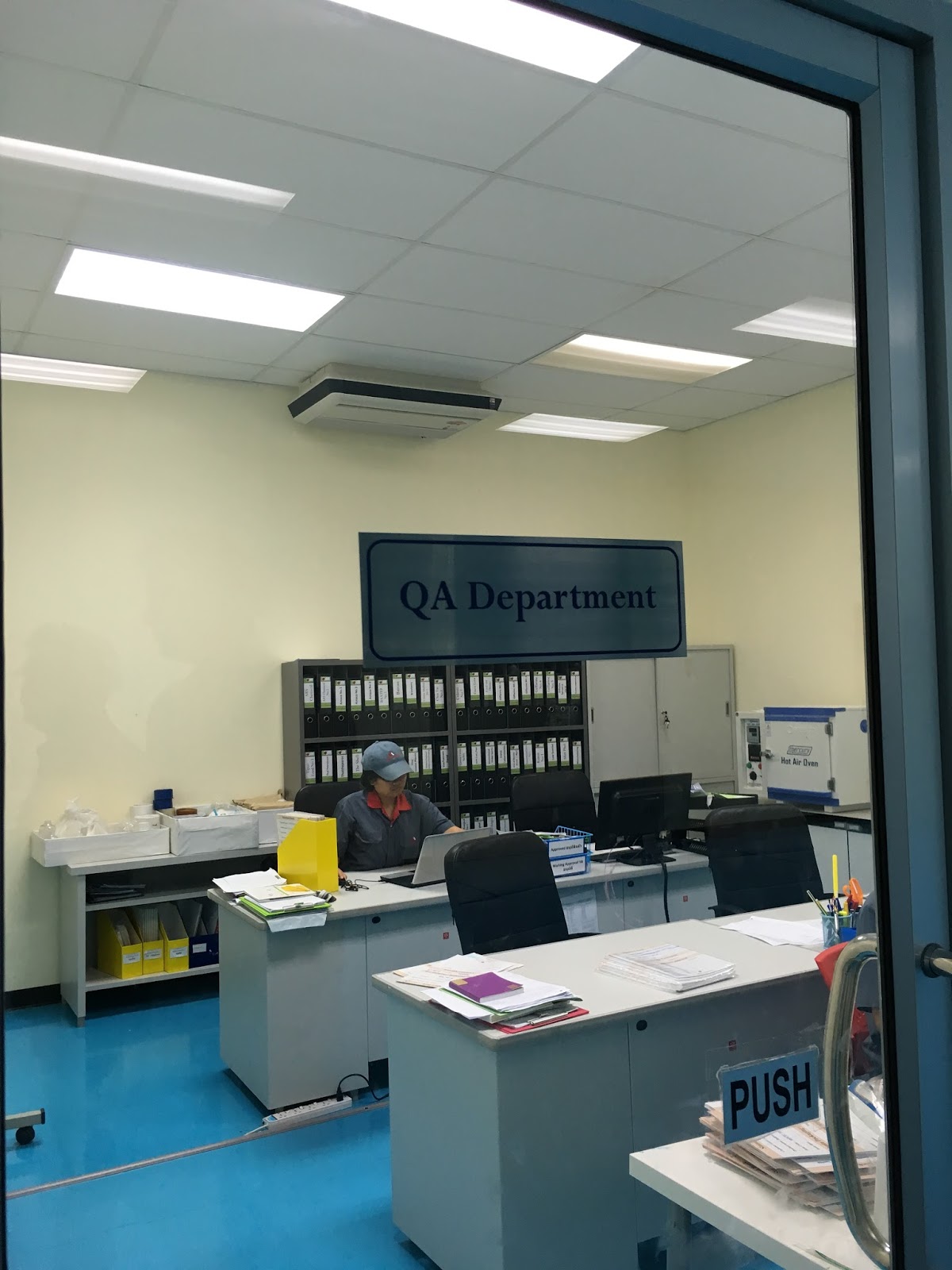
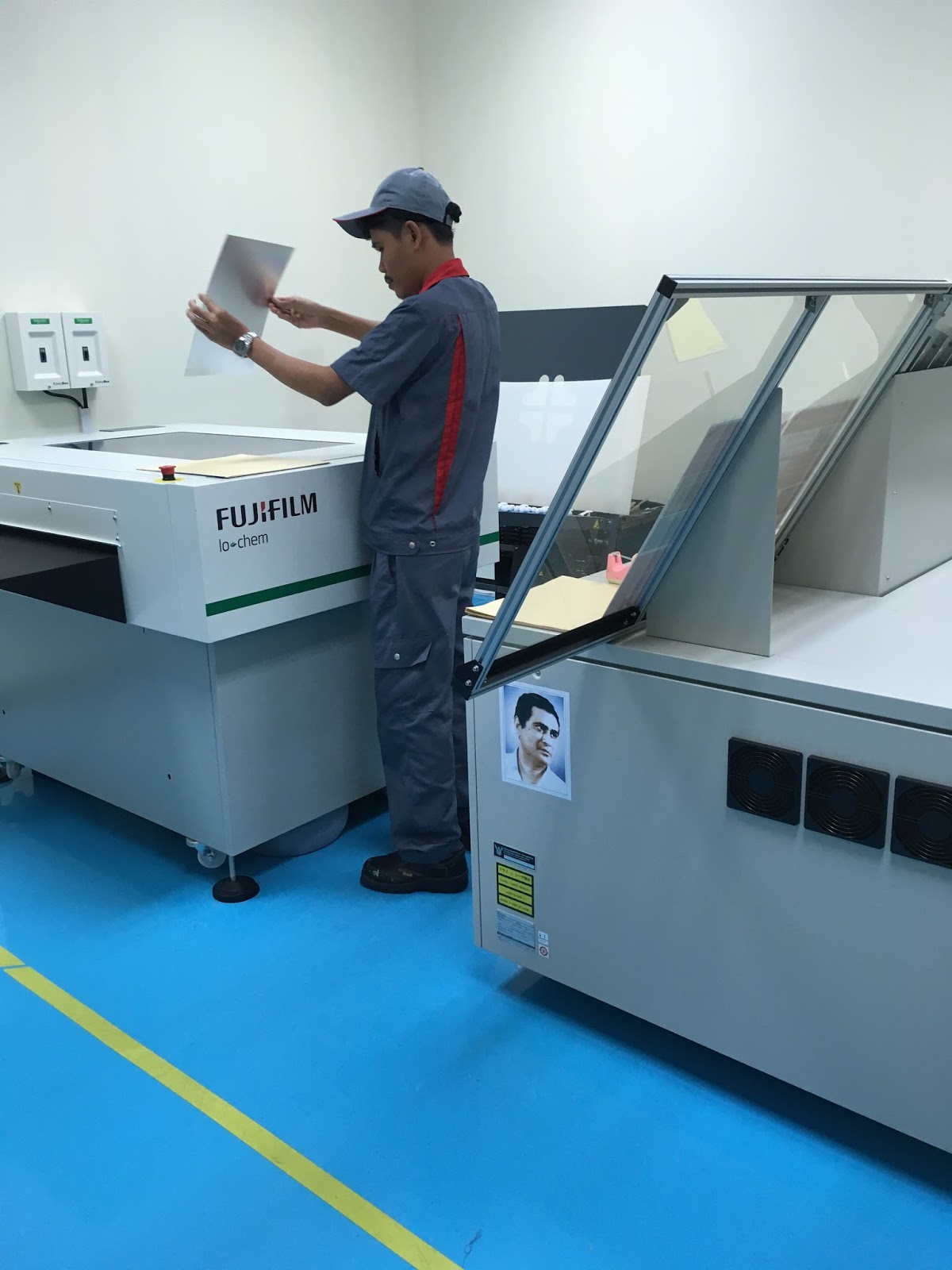
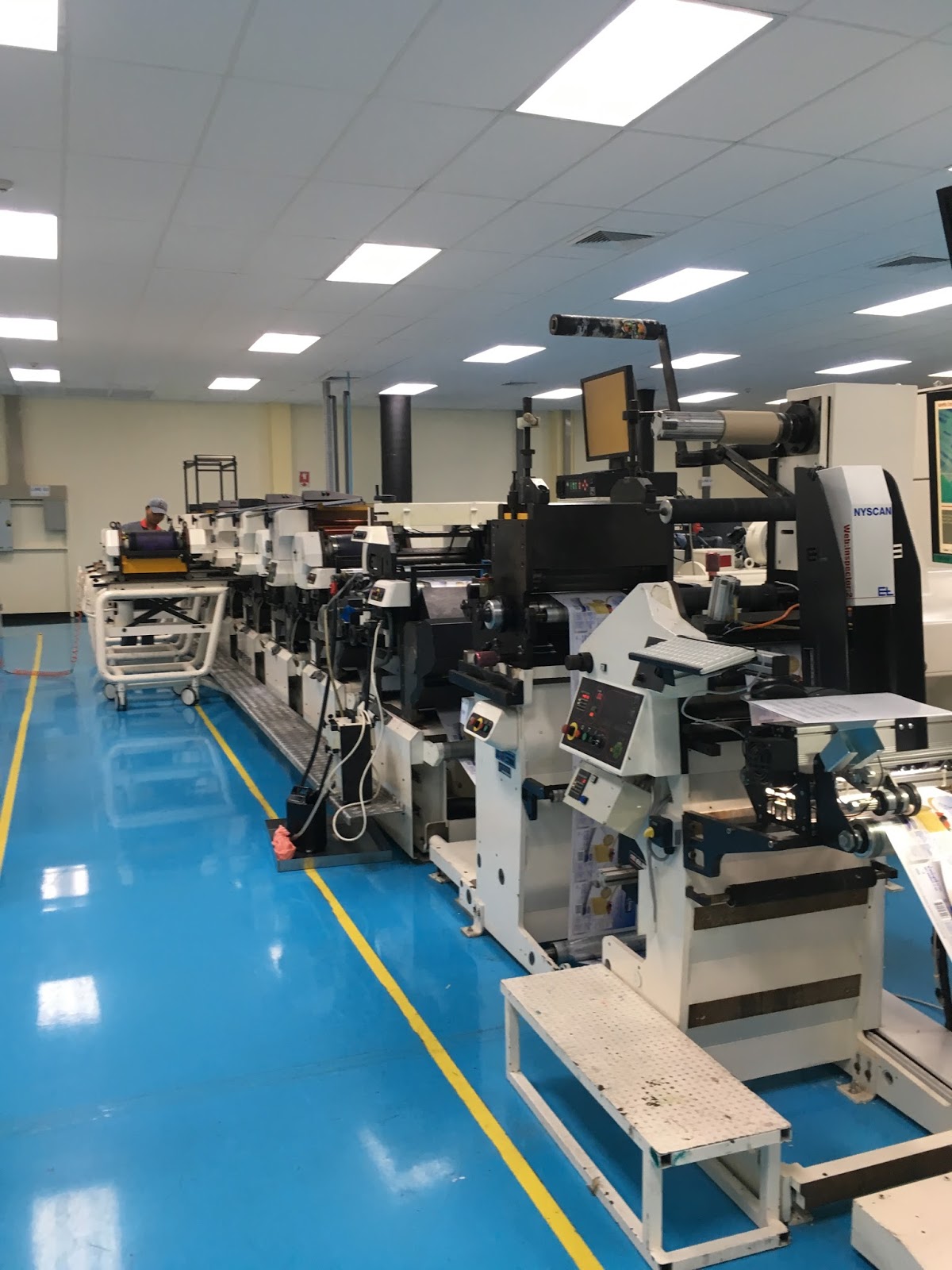
After a briefing in the fully equipped conference room we took a round of the unit. The unit is immaculately clean and self sufficient. They have their own design department, plate making department and quality control laboratory. 


The pressroom has one Nilpeter MO Combination Flexo/Offest presses and two Iwasaki intermittent offset presses besides flatbed registered die-cutting machines and a host of slitting, inspection and finishing equipment. A 12 colour Nilpeter Flexo/Gravure combination press will be installed later this month in August 2016. 


It was interesting to see that the space provided for further expansion and installation of new equipment was also kept spotlessly clean and gleaming. The dynamism of Chandan Khanna and his endless efforts to grow was evident by his personal indulgence in every aspect of this unit.


After lunch arranged by them in the unit’s dining room we left to meet yet again to experience Chandan ‘s excellent hospitality that evening at an open air restaurant on the seashore serving amazing seafood and local beer. I am still in awe of Chandan having made this trip memorable for us.


Ajanta Packaging owes its inheritance to a very renowned printing family of Mumbai that owns Ajanta Printarts. Ajanta packaging is headquartered in Mumbai and has manufacturing facilities in Daman (Near Mumbai), Baddi (North of Delhi, in Himachal Pradesh), two units in Sharjah (UAE) and this unit in Thailand. A very dedicated and ambitious technocrat, Chandan wants to extend his foot prints globally. He travels extensively to achieve his goals. He is now looking at moving his business to the western world as well. He is already evaluating investments in Europe by either taking over an existing unit or by entering into global alliances. 


Through ups and downs coming his way, Chandan moves on tirelessly to achieve his ambitions because he wants to reach the pinnacle in the next five years before he starts to slow down to enjoy the fruits of his labour and let the company grow and prosper by the inertia set in by him and led by his team of seasoned professionals in each and every plant. Will he slow down? It is a question I am not sure I have the answer to…


Note: Magazines may reproduce the above article by giving credit to the author.
 
Written by Harveer Sahni, Managing Director, Weldon Celloplast Limited, New Delhi. August2016
 
On July 21 2016 when I received information that PackPlus 2016 had been sold out I tweeted; “Sold out! PackPlus 2016 July 27-July 30 Pragati Maidan, N Delhi Show heading for unprecedented success http://www.packplus.in  @PackPlus2016
 
The show PackPlus, a complete packaging show, has grown more than 30 percent over the last edition with many more exhibitors, product launches and running machines. While there, one can learn about Package 4.0 at the AIA knowledge pavilion (stall no. 12A.40). There are free seminars on Next Generation Automation, Flexible Packaging, Open & Smart HMI, and Integrated & Vision Guided Robotics & Vision System for Quality. Register at: www.aiacampus.in/index.php/industry/automation-pavilion/click-to-register HP is planning free seminars for brand owners at their stand in Hall 12. The timings are at 4pm on 27 and 28 July and at 11 am on 29 and 30 July. In the gross area of 14,000 sq.mtrs., PackPlus will be happening alongwith SupplyPlus and CartonTech. The Show has positioned itself as one of the most sought for exhibitions for the display of latest innovations & developments from the industry. Some of the leading companies including Uflex Limited – Engineering Division, Pelican Rotoflex (P) Ltd., Ishida India (P) Ltd., Global Link Impex, Zhongke India (P) Ltd., Clearpack India (P) Ltd., Autoprint Machinery Manufacturers Pvt  Ltd., Hewlett – Packard India Sales Private Ltd., Intralox India (P) Ltd., AnyGraphics (P) Ltd., Domino Printech India (P) Ltd., Uflex Limited – Holography Division and many more have booked prominent stalls to showcase their wide range of equipment and to disseminate information. Visitors will get an opportunity to experience the running machines and have one-on-one interaction with the representatives from international companies
 
PackPlus is founded and organized by the husband wife duo Neetu and Anil Arora. They also happen to be the founders of India Label show which was subsequently acquired by UK based Tarsus and renamed as “Labelexpo India”. A decade ago I wrote about Anil Arora’s journey upto Labelexpo 2006. In 2007 it was acquired by Tarsus and for the 2010 edition they renamed it as Labelexpo India. I reproduce that article after moderate editing;
 
The path traversed by Neetu and Anil Arora:
It was during one of my visit to Mumbai in the year 2001, while planning a trip to Labelexpo Brussels with friends from Industry, I expressed my wish that we should have a label show in India. Immediately one of the label printer friends informed that one Mr. Anil Arora was already working on the project and had approached many in the industry in Mumbai. Since the subject was of interest to me I investigated and got Mr. Arora’s contact details. Before leaving for Delhi I called Anil Arora to enquire about his plan for the show. From the small chat with him I found him very convincing. I felt this man was committed to the show and would make success of it. I told him I would support him and if any help was needed I would be available. Three days later Anil was in my office in Delhi and we were discussing plans to make the show a big success.
 
By end of the year the whole industry was excited about the show and the first India label show was completely sold out. So much so that the organizer had to vacate their own stand to make room for demanding prospective exhibitors. The show was a big success.  It brought the industry closer and it was first time in the history of self adhesive labels in India that such fellowship was witnessed. It was also during the run-up to the show that the LMAI (Label Manufacturers Association of India) was formed.
 
The show then moved on to a much bigger Pragati Maidan. Anil Arora and his better half Neetu Arora worked hard to make the show bigger and better. The promotions were so well planned that road shows which gave insight on what to expect, were held in cities and towns all over India. There were road shows held in Srilanka and Bangladesh also. The second show in Delhi was bigger and better with the Tarsus group organizer of Labelexpo taking a big portion of the show. The India label show brand was fully established not only in India but also internationally. There are nostalgic memories of the awards nights and the parallel dinner meetings during the last show.
 
The third show in this series was held on (6-9 December 2006); the excitement in the label industry had built up. The show was bigger and attracted a much larger foreign attendance. The importance of the show was reflected by the fact that the Finat sponsored “Indo-European label Exchange” was held alongside the show. FINAT, the self-adhesive label trade association acted as ‘matchmaker’ between European and Indian labeling industries to create a forum to give small and medium sized member companies in both regions better chances of doing business with each other. The forum was supported by the EU’s Asia Invest programme and was organised in cooperation with the national trade associations VskE (Germany) and LMAI (India). More international presence, more working presses and a series of product launches from an industry that was waking up to global challenges confirmed the show’s resounding success. A conference was also held alongside the show, and was organized under the aegis of the world renowned Alexander Watson Associates (AWA).
 
Alongside the Show, International Packaging Conclave will happen on 29 July at Pragati Maidan Conference Centre. It will focus on Print Optimisation & Colour Management for Flexible Packaging. 25+ experts from the industry will unite for a daylong session where more than 200 delegates including Brand Owners, Package Converters, Packaging Technologists, Procurement Professionals, Print Specialists, QA, Managers, PrePress & Media Professionals, Designers, Material &Equipment Suppliers and Consultants will attend the programme. We are all set for a record-breaking edition,” said Neetu Arora, President, Print-Packaging.com (P) Ltd., the organisers of the Show.


Neetu and Anil have two children, a son Nauroze pursuing his management studies and a daughter Garima Arora who is a celebrated Chef. After training in Switzerland and France she has worked in the famous Gordon Ramsey’s restaurant in Dubai, then in the world’s number one restaurant Noma in Copenhagen and is now working at the best Indian restaurant recognized globally; Gaggans at Bangkok. She is soon expected to open her own restaurant in Bangkok with support from Gaggans.


Note: Magazines may reproduce the above article by giving credit to the author.
Written by Harveer Sahni, Managing Director, Weldon Celloplast Limited, New Delhi July2016
VICTOR HUGO, a French Poet in the mid nineteenth century, once remarked: “You can resist an invading army; you cannot resist an idea whose time has come. When mobile telephony came in, one could not imagine the reach it will provide to a common man who would not have means or will to reach out to the world at large. Telephones with internet connectivity have transformed life magically. No one could imagine that the only communication link that people had, “the landline” would one day become just a show piece. Such ideas, whose time comes by, evolve with such speed that the generations are left in awe of the change. Label industry is now faced with many such ideas like the move from conventional to digital printing, linerless labels and now evolution of in-line converting. Given the large investment in space and manpower, sheet offset, over a period of time is surely going to evolve to inline printing, decorating and converting using multiple technologies with lesser space and just a few people. At the recently concluded Drupa 2016, many such types of equipment were displayed attracting interest of printers. If it was just printing, the offset presses are doing a great job. It is the decoration and finishing that needs space, manpower and a host of different machines spread over a large shop floor. In modern retail highly decorated labels and packages are an imperative for consumers to reach out for the products. Hot foiling is one of the many processes that catches the eye of a consumer and becomes the preference of many a brand owner. So far most of the hot foiling is being either done offline on flat bed hot stamping machines or in-line with slow intermittent presses. It has been the wish of label printers who are so used to doing the conversion from start to finish in a single pass on their high speed rotary presses, to do the hot foil also in the same pass without compromising on the speed and quality.   
On the 3rd of June, Peter Frei, CEO Switzerland headquartered Pantec GS Systems AG pulled me out of a busy Drupa to take me to the premises of Gewa Etiketten located on the outskirts of Frankfurt some three hours drive, for an “open house” to showcase their in-line hot foiling application equipment “Rhino”, that can be integrated into flexo label presses without really compromising too much on speed. Pantec GS Systems AG is an independent subsidiary of Pantec, a worldwide operating technology supplier for industrial applications and medical devices offering services, products and solutions in the field of machinery and medical engineering. They provide sophisticated in-line refining solutions. Their dedicated equipment for rotary and flat bed hot foil stamping & embossing, high performance vacuum foil savers, high speed & precision hologram placement is made to provide efficient high quality refining, directly in-line.
 
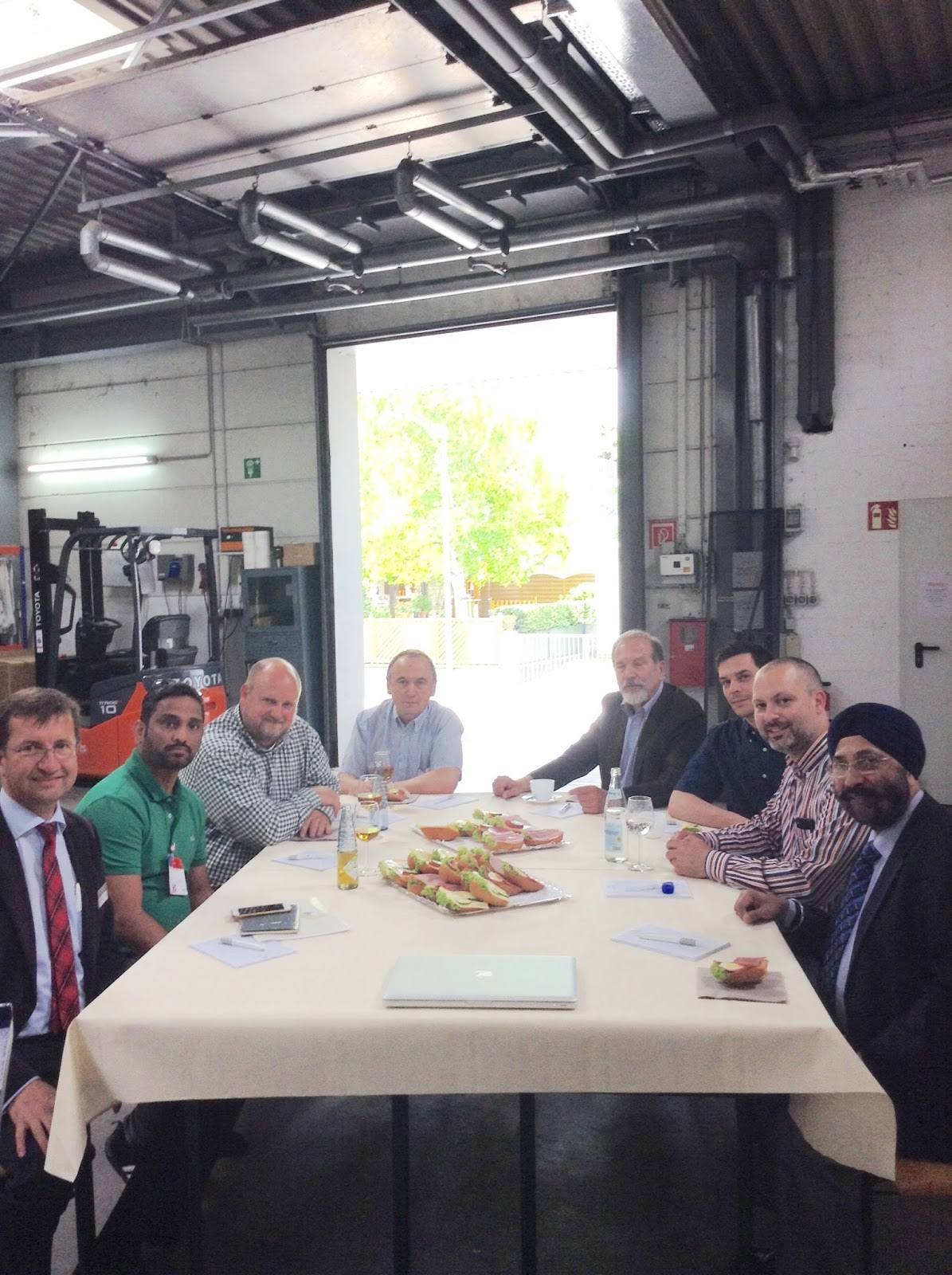
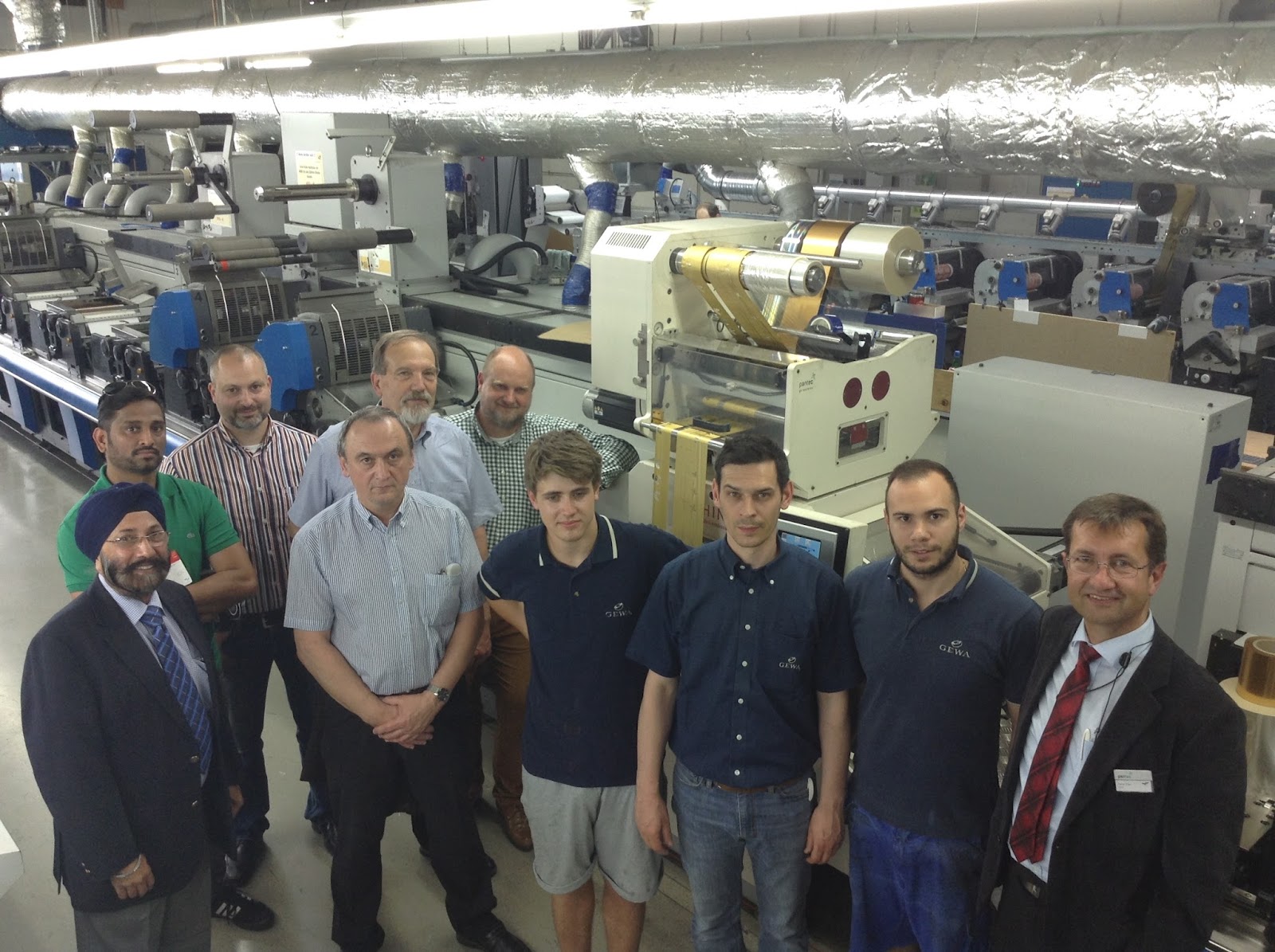
The company hosting the Open House, Gewa-Etiketten is leading producers of labels for Wine, Sparkling wine and spirits in Germany and Europe. The family owned enterprise was founded in 1931 and the third generation headed by Mathias Walter is still in control. The company operates from a total area of 7000 square meters and a production area in excess of 50,000 square feet. With 170employees at two locations, one that caters to sheet offset segment for wet glue labels and the other for self adhesive labeling, they achieve sales of 23 million Euros. The unit that we visited had 6 Gallus combination presses and one HP Indigo digital press besides a range of other complementary equipment. They cater to customers demands from 10,000 to half a million labels per day. As we reached the venue of Open House, Uwe Reflinghaus, CEO of Gewa-Etiketten welcomed us with lunch and introduced us to his team. Some more printers and suppliers were also present. 
 
 
Peter Frei


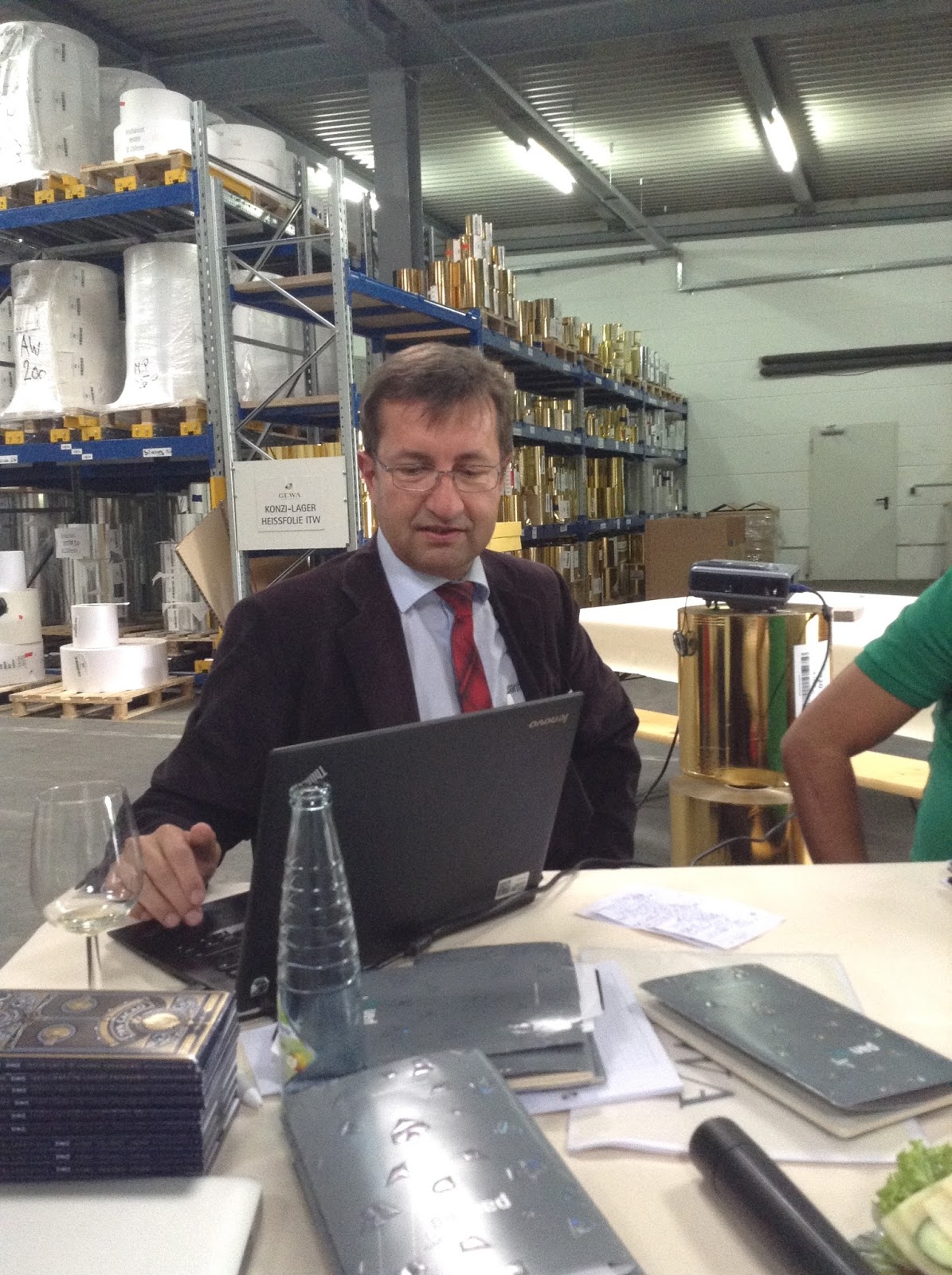
All visitors after introducing themselves heard Peter Frei, CEO Pantec GS Systems give his presentation. He said “I do believe  that single pass printing  and converting of packages is the real new opportunity for label printers having such web machinery already” He further added, “ I think there is a ‘huge opportunity’ that arises for label printers in packaging after integration of Pantec Rhino in an existing label press, as you will see being done here at Gewa”. After his presentation it was time to go to the shop floor for the demonstration of Rhino inline hot foiling system. 


Oliver Jung
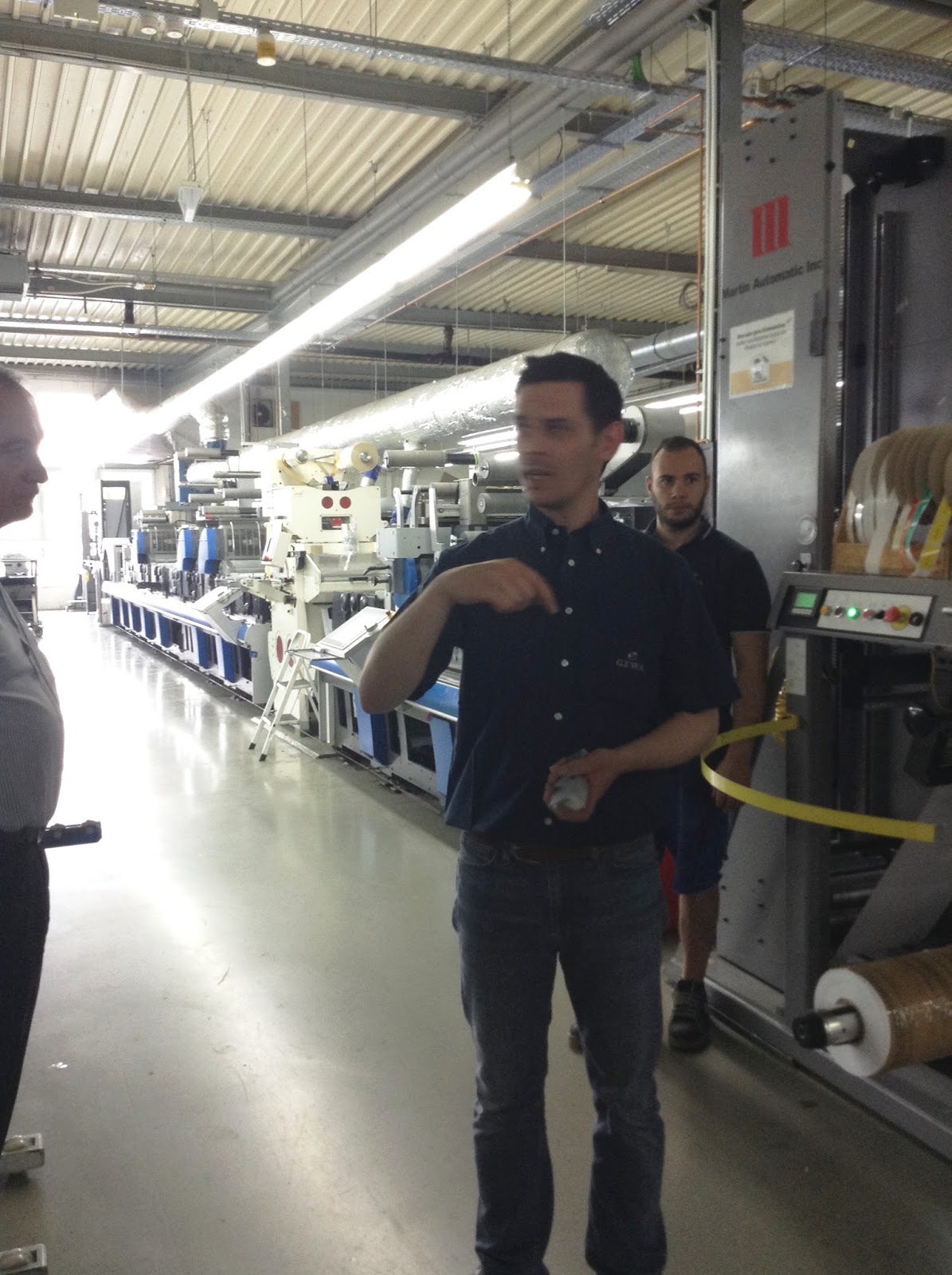
Oliver Jung, the printing expert handling the Pantec implementation project at Gewa took charge to explain and demonstrate the equipment and its technology.The Pantec Rhino was integrated in line on a Gallus RCS combination press to demonstrate In-line package printing and decoration as alternative to sheet fed package conversion. A label press was being used after integration of Pantec Rhino to produce highly decorated cartons. Contrary to the rotary web operation where the web continuously moves, this equipment has web Stopping-Stamping-Moving on, giving sharper images of stampings. The interesting part is that while the stop start operation is limited to the Rhino, the web otherwise keeps moving steadily and continuously at regular machine speed without stop and go motion. The equipment shown was capable of making 18,000 strokes per hour however they now have one that can do 25,000 strokes per hour. The movement and stamping is well portrayed in the video at https://www.youtube.com/watch?v=OA6SWgTqI-g&feature=youtu.be 


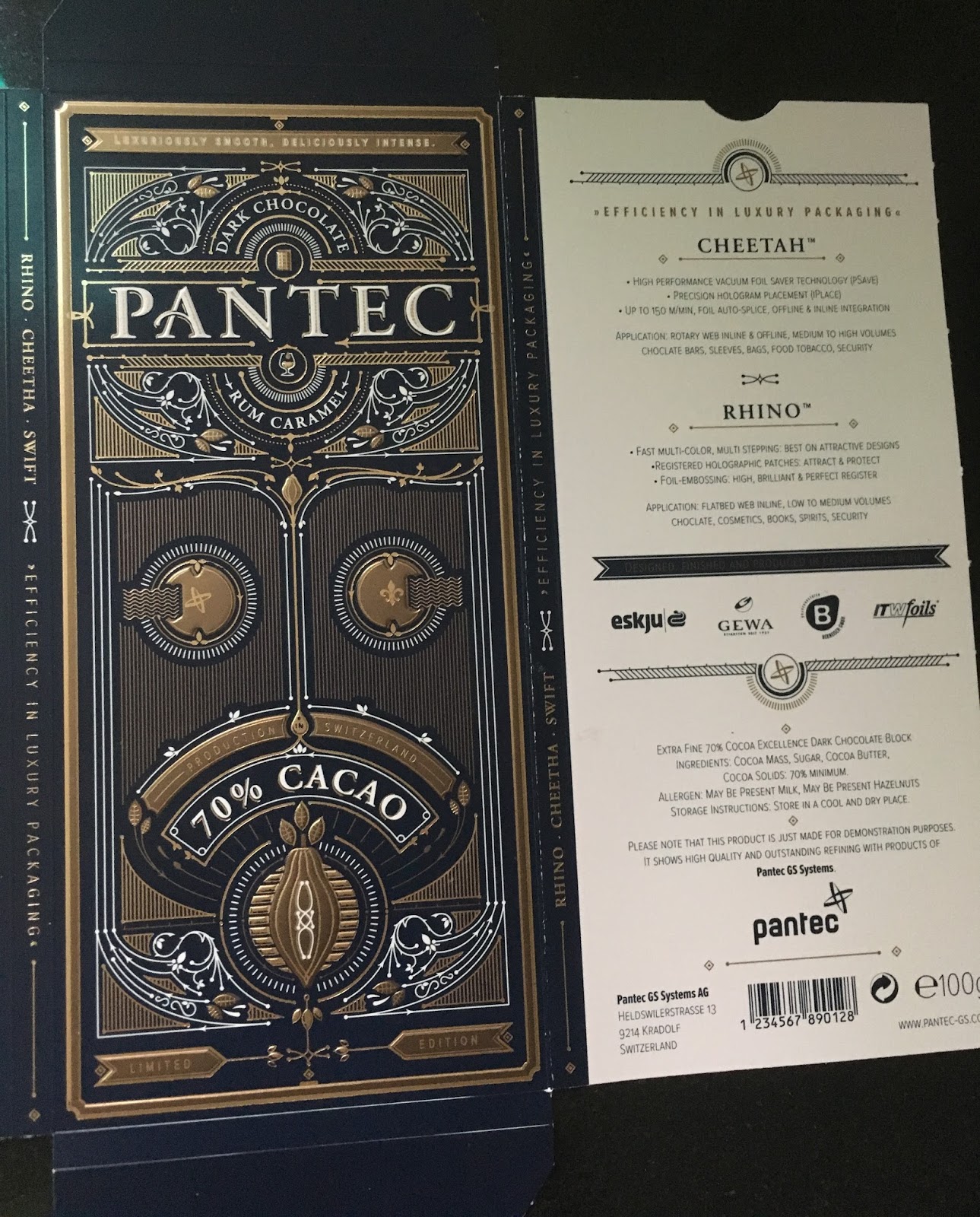
In one demo they ran a Pantec Rum Chocolate carton with printing, embossing, hot foiling and die cutting all running at 120 meters per minute in a single pass. 


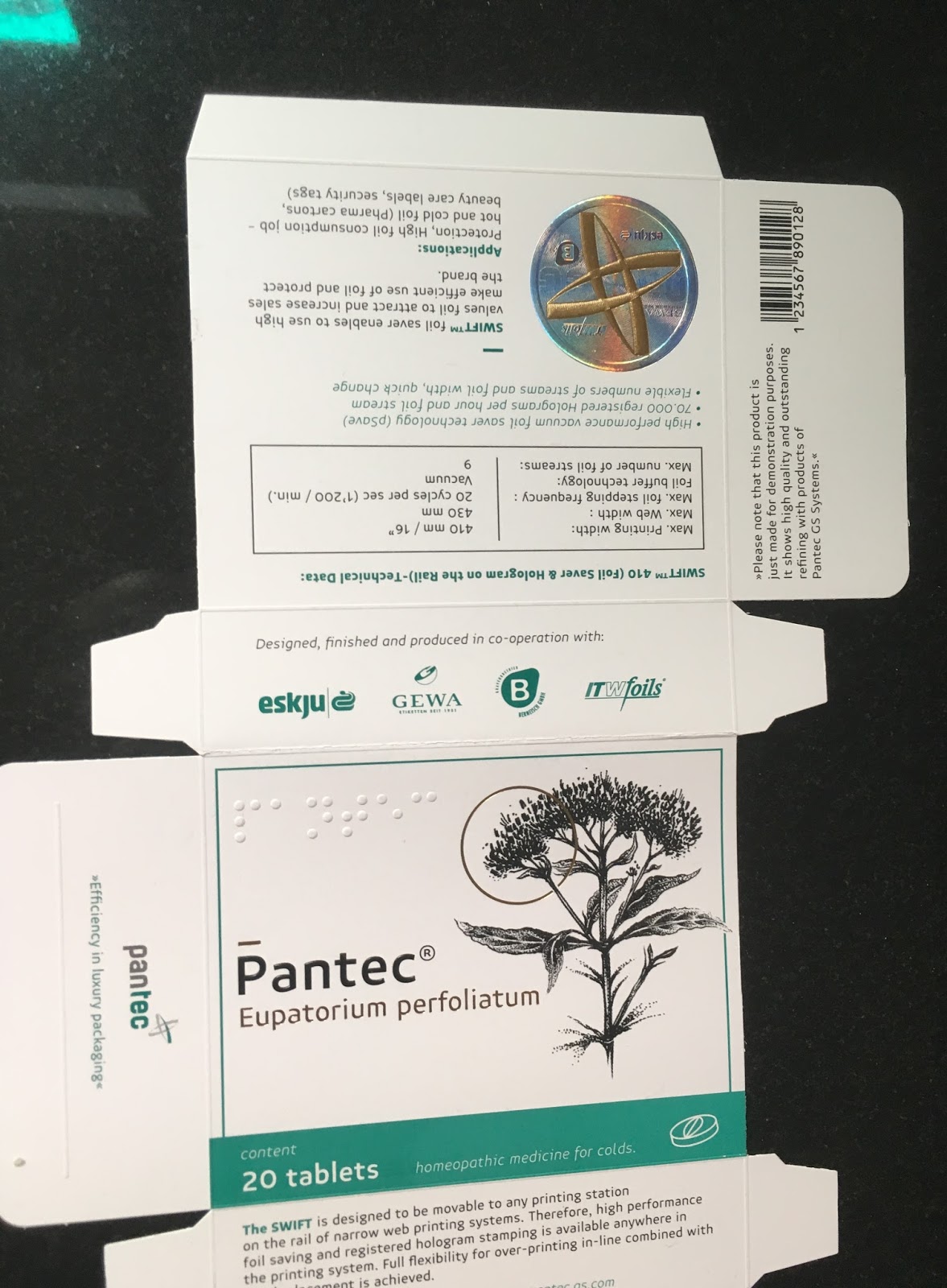
In another demo they ran a carton with also placing of registered hologram, printing on it and embossing around it. The equipment has advantage of speed in roll and as compared to sheet it has no wastages that occur at grippers and at gaps.


Rhino system brings the quality of sheet fed hot foil embossing, attractive patch placement for prestige markets and hologram stamping for security into web presses;
·      Consistently designed for in-line economy
 
·         High frequency stamping for high press speed (up to 25´000 strokes/h)
·         Quick job change (no format parts) for high press availability
·         Crosswise foiling and multistroking allow single pass production of multifoil designs
·         Reduced per-unit costs (no off-line preparation, less maculation)
·         Up to two foil saving servos
·         Significantly reduced cycle times for orders
 

Note: Printing magazines and publications may reproduce this article giving credit to author.


Written by Harveer Sahni, Managing Director, Weldon Celloplast Ltd. New Delhi India July 2016


Ø  Indian label industry expanding to smaller towns
Ø  Indian label growth at 15% Per Annum
Ø  Combination printing is the emerging trend
Ø  Digitalprinting of labels, still a taboo
 

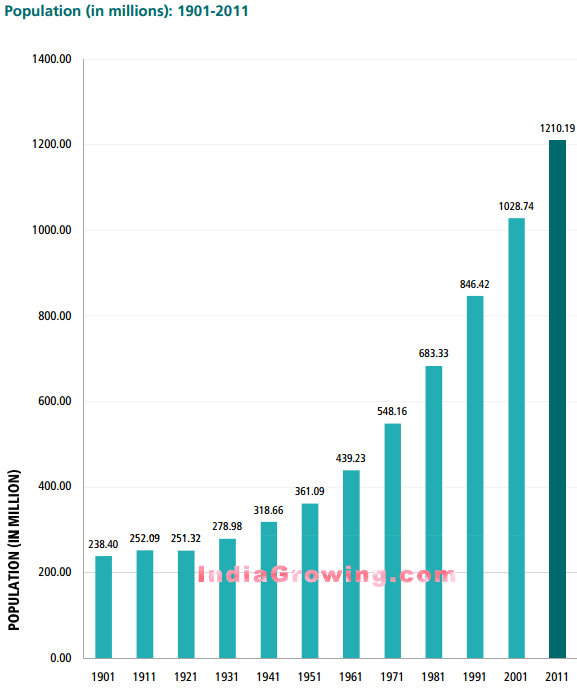
Population continues to grow at an enormous pace in the metropolitan cities of India and infrastructure, despite the rapid growth, remains under intense pressure. The migration of rural population to urban areas has made life in big metros extremely demanding and difficult. Government of India, for many years has been making efforts to stem this shift from rural to urban areas. The effects are now evident. Mobile telecommunications, television, internet, better road, employment guarantee scheme and rail connectivity have largely been successful in bridging the gap and stemming the pace of migration. As a result, the smaller towns have in recent years experienced a spurt in demand for consumer goods. 


Decades ago Mahatma Gandhi said, “India lives in its villages”. This is largely true even now but gradually the villages are modernizing owing to availability of all modern ameneties in nearby towns. They need not commute or shift to far away expensive metros to live a life that they watch on TV. This has resulted in a steady growth in demand of consumer durables in the smaller towns of India attracting investments from leading manufacturers to cash in on this change. The Neilsen Compnay, in a report titled, ‘Emerging Consumer Demand: Rise of the Small Town Indian’ states; “Eight thousand towns, 630,000 villages, over eight million stores and 1.2 billion people! In such a diverse consumer universe, how do you measure demand, where is it strongest? North vs. South, the metros vs. Rural – the choices are endless. Despite current inflationary environment, tier II and tier III towns are showing strong momentum with an improved demand appetite. The smaller Indian towns are leading the demand surge & shopping like metros.” The label printing industry has also been witness to this trend. In the past few years we have seen investments being made to produce labels in smaller towns of India. An industry that originated and was predominantly located in the west gradually spread to the other metro cities, is now registering its presence in these smaller towns. In my effort to assess the impact I asked printers in all zones of India, “Label industry is now expanding into smaller towns and cities. Do you agree?” The response was unanimous, YES! They all felt that it will impact the label growth positively. The LMAI President Sandeep Zaveri stressed, “It is required to grow in smaller towns”.
 
In trying to assess the trends and growth of labels in India, I interviewed 12 established and leading label printers spread across different geographical zones of India. 10 respondents out the 12 confirmed that there is definite growth in the country, one was not sure and felt it may have grown at places and gone down elsewhere while one was emphatic in saying that the growth rate had decelerated. Anuj Bhargav of Kumar Labels, while being convinced that the label consumption graph is positive yet he cautions, “Growth exists, but increase in capacity is more than the demand escalation. This is leading to unhealthy competition”. So over 90% of printers interviewed say there is growth. When asked the rate at which they individually grew, 10 out of 12 reported double digit growth, 3 of them grew 20% and the topper Sanjeev Sondhi of Zircon reported a growth rate of a whopping 35-40%!  Two reported 7-10% and one 5-7% growth.  Answering my question as to how they estimate the national growth rate of self adhesive labels in India to be, only 9 responded and out of these 7 confirmed it is a double digit growth between 10 and 20% and 3 out of these 7 said the growth was actually 20%. 2 of them said 7-10% and one said it was 5-7%. When I look at all these three questions and the responses from printers, it is quite evident from the way printers have grown and the way they estimate the national growth rate, labels in India can safely be estimated to be growing in excess of 15% per annum.
 
Most of the organized Indian label industry belongs to the MSME sector (Micro, Small & Medium Enterprises) and that they are predominantly family owned businesses. A handful of them have been acquired by international companies but largely they remain within the control of original promoters and their families. These units were largely initiated at very small scale with a single label press. Until a few years ago most of the good presses that contributed to the evolution of labels in India came from Europe, US and Japan. Gradually Taiwan made presses came in which then was followed by the Chinese made equipment coming to India in big numbers due to the low prices of the equipment. Indian press manufacturers have also made a mark for themselves in recent times. Today label printers with these Chinese and Indian presses have become a definite and identifiable segment of our label industry. I asked all the targeted label printers, “Chinese and Indigenous label presses manufacturers have in recent times made many installations in India. This trend is creating a lot of capacity at the lower and middle segment of the market. What is your opinion?” All respondents agreed with this and feel there is enough for all at various levels of investments. Sanjeev Sondhi in response says, “In my opinion quality will finally decide who will remain in game.” Industry leader and veteran Narendra Paruchuri heading Pragati Pack, Hyderabad stated, “This is quintessential question like the chicken and egg syndrome. The markets in the smaller towns cannot afford or break even on the high tech machines. So they will opt for the cheaper ones from China. Quality will not be very good but may be that is what is needed in that market. We are no judge for this and if they can sell and make it a success, good for them.” Pragatai Pack has invested in some of the most advanced equipments to enhance their printing, converting and decorating capabilities. On my question, “What is your mantra for growth, higher volumes or highly technical & innovative products?” he added, “We have to keep on at the technology and see what is it that we can do and can do that better than others. This is a quest for all businesses and only in the answer to this question lies your success. So if you come out with a unique/innovative product, your sales will rise. Also maybe the growth rate of the country itself will give you an opportunity to grow your business. Progress is relentless and technology a great leveler. So what we thought was exclusive a few years ago is common occurrence now. So the quest has to continue. Always…”
 

All the respondents agree that it is time to take stock of the situation, shift focus and innovate. They have similar answers to my querry on their “Mantra for growth”. Mahendra Shah of Manohar Packaging, “Higher volumes have not paid off to any one and I guess we label printers have gone beyond lower limit, so best would be to divert on to innovations and get into more technical products”. Himanshu Kapur of J K Fine Prints Mumbai states, “Higher volumes and lower margins is a wrong growth trend , so we prefer technically innovative products”. Dinesh Mahajan Prakash Labels, Noida; “It has to be a mix of high volume and innovations.”


The trend of combination printing that helps employ diverse printing and converting technologies in a single pass has become synonymous with innovation and secure printed products. To my question “Combination or hybrid printing is attracting lot of investment. Do you see this as an emerging trend?” 8 out of 12 printers feel that combination printing is necessary to create innovations and it is the emerging trend. 3 did not respond to this statement and only one said it is not the emerging trend. Many offset printers have started to invest in combination label printing equipment as a part of their expansion into packaging. Label printers on the contrary would not really invest in offset printing. A few years ago I remember Amar Chhajed of Webtech answer this question to me. He said we are so used to doing all printing, decoration and finishing of product in-line in a single pass, it is difficult for us to imagine moving stacks of sheets around the huge shop floor with a massive workforce. 

 
Ahmedabad based Mahrishi Labels, had forayed into offset printing and they did not find comfort with their decision. As per Jigesh Dani, “Having entered into sheet fed business we have realised that it's not just simply printing but a different ballgame. In my opinion it may be easier for sheet fed offset printers to enter inline converting but difficult other way”.  With the advent of combination presses going wider and able to handle a wide array of substrates and thickness, the possibility to produce folding cartons inline also has become a reality. Many label printers feel this is the time to move in the direction.


Raveendran of Seljegat feels it is time for combination printing and says, “Yes we need to invest on the production of functional packaging”. Gururaj Ballarwad of Wintek Bangalore which is a part of Signode India Group feels not many label printers will move into packaging yet he says, “Investment in combination printing is necessary to sustain, maintain & enhance the capabilities.”


Digital printing in India still remains a taboo with Indian label printers due to high cost of operation and consumables. However as a slight change in their thought process the higher end printers say it is time to consider digital printing as a complimentary part in a combination press. So while they invest in a press that has offset, flexo, gravure and screen printing capabilities, they will probably also opt for a digital printing station as well that will add to their capabilities. This will also help them in proofing, as also to cater to increasing number of short run customers.
 
India is a large and diverse country with multiplicity of cultures, food, language, dress habits, different festivals and lifestyles. As literacy enhances and the pockets of the middle class start to bulge it becomes an imperative for the marketers to focus on individual segments of the society. Innovation at this time becomes an imperative as also the capabilities to produce segment specific short runs. Just in time deliveries is another demand coming for end users due to the short run jobs. This results in making the larger label companies to consider multi locational production facilities. The response on this is quite divided within the industry. While many printers feel that one centralised facility is better for quality production and control. With better logistics it is possible deliver anywhere in the country in reasonable time. Yet there are others who feel locational advantage is necessary to service and retain large clients. Some large printers already have invested in multiple facilities not just within India but also outside India. Ajanta Packaging has units in Daman in the west and Baddi in North of India. They also have units in Ajman UAE and Bangkok Thailand. Indian label industry continues to grow at a steady pace and is also attracting international attention however still it has not yet grown to the level of large international label companies. There is still room for much more but it should grow steadily, as the demand grows.
 
 
Written exclusively for Label and Narrow Web USA http://www.labelandnarrowweb.com/issues/2016-05/view_features/india-rsquo-s-label-market/ by Harveer Sahni, Managing Director, Weldon Celloplast Limited New Delhi India. March 
2016 The article may be reproduced by giving credit to the author and http://www.labelandnarrowweb.com
L to R: Rajesh Nema, Jigesh Dani, Sandeep Zaveri,Amit Sheth
Harveer Sahni & Ajay Mehta
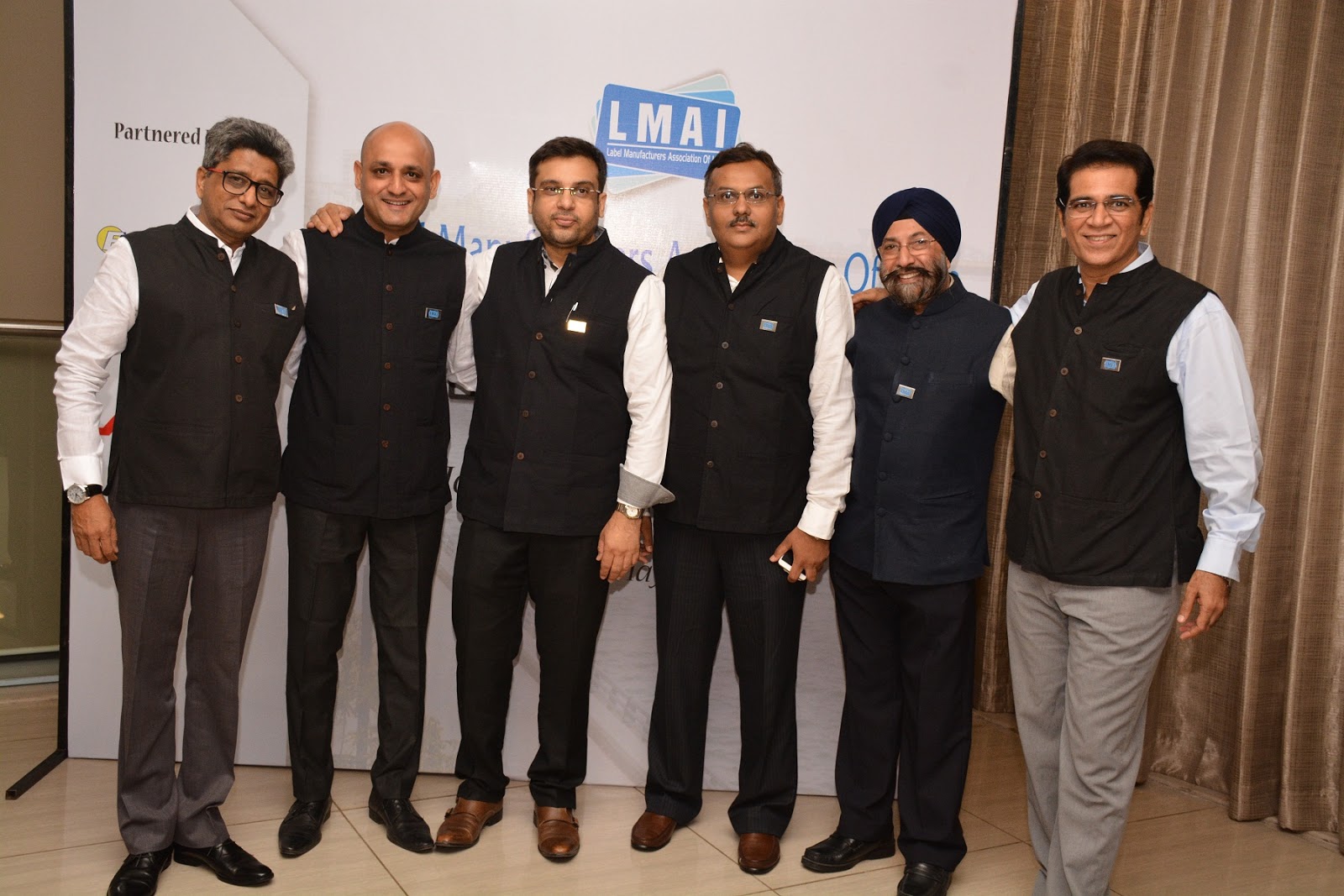
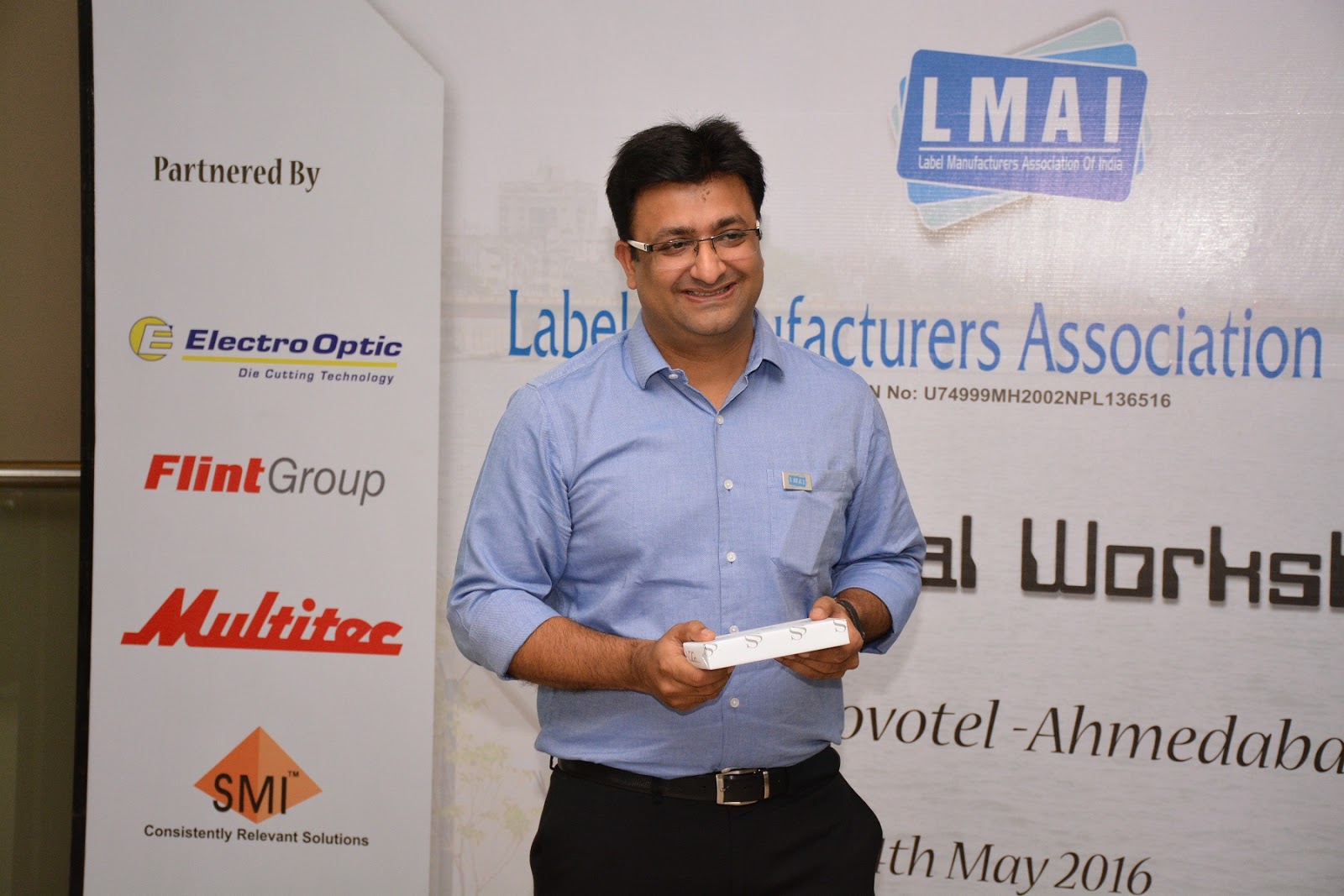
In scorching heat with Ahmedabad temperature soaring to 46 degrees Celsius Rajesh Nema, honorary Secretary LMAI was driving from Indore to Ahmedabad, a six hour drive to reach the venue of yet another technical workshop organized by LMAI (Label Manufacturers Association of India). That is commitment!  This is the fourth in series of  Technical workshops organized under the leadership of the young LMAI president Sandeep Zaveri. It was held at Hotel Novotel Ahmedabad on the 14th of May 2016. The LMAI leadership team reached the venue a day in advance or in the morning of the event to foresee that the Ahmedabad printer members have a perfect workshop and networking opportunity.
 
Sandeep Zaveri & Jigesh Dani
 
 
The host for the evening was Jigesh Dani from Maharshi Labels, a leading label printing company in Ahmedabad. Jigesh himself painstakingly made the arrangements at the hotel and also interacted with the local LMAI members to be present and ensure success of this event. 


Audience
 
 
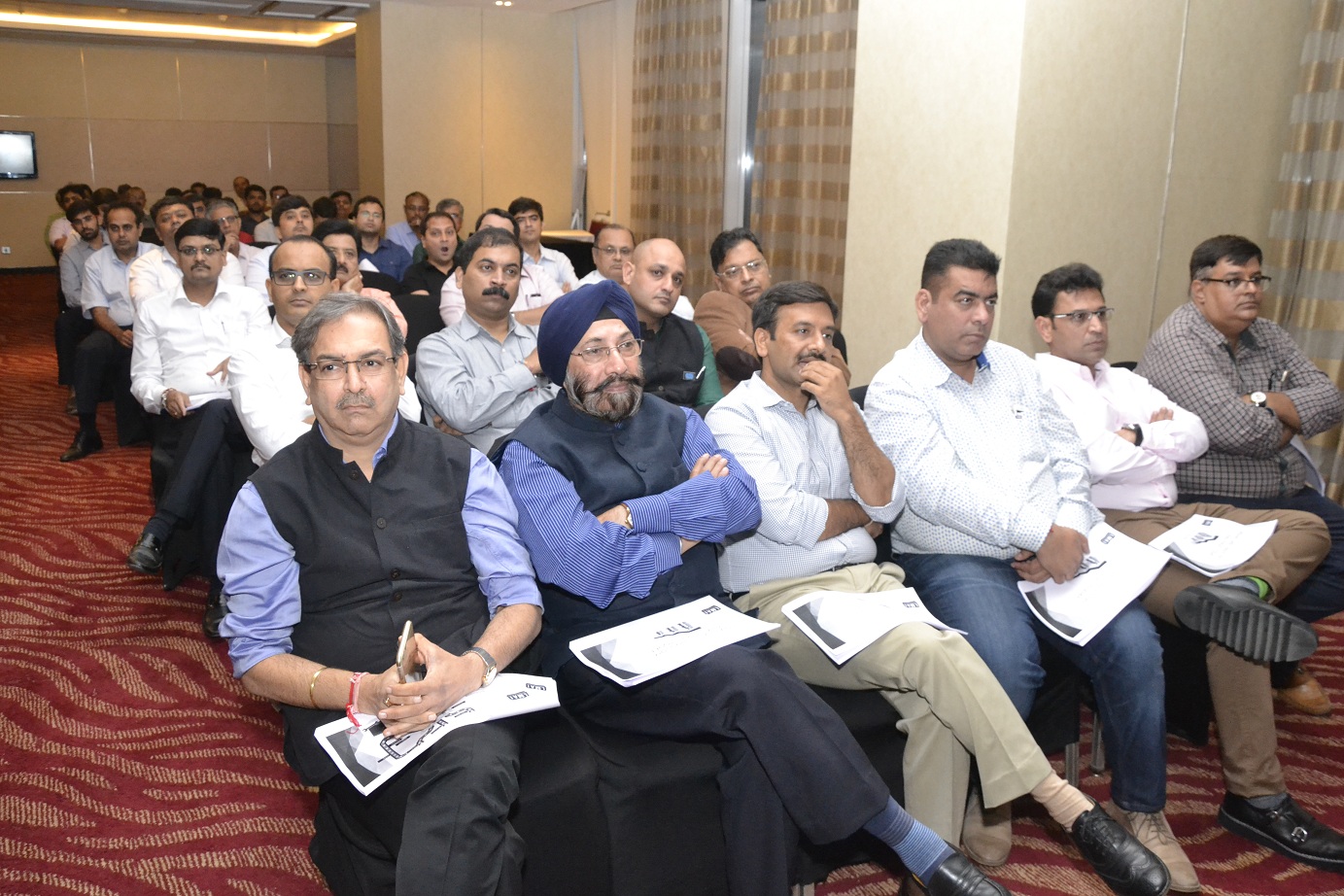
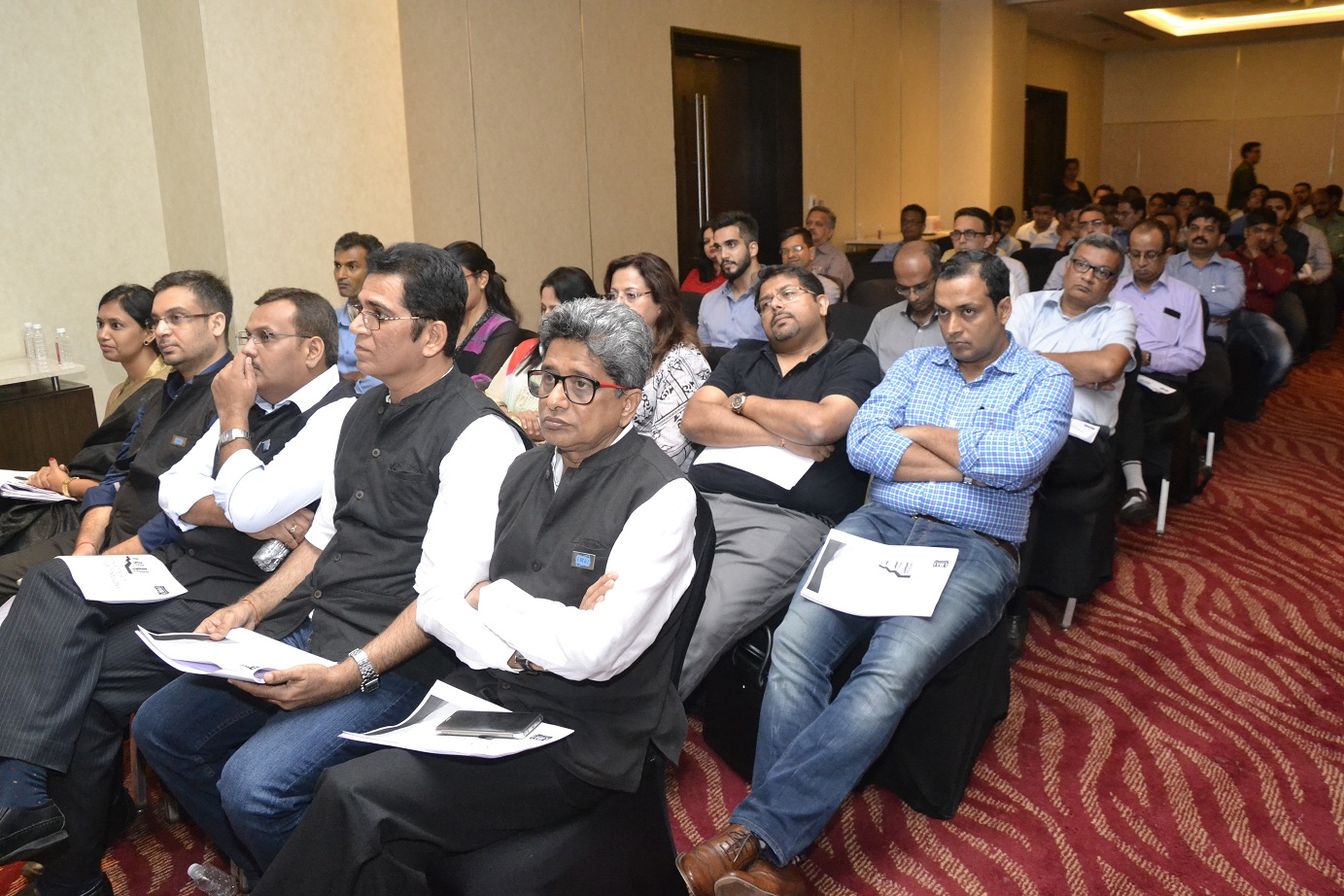
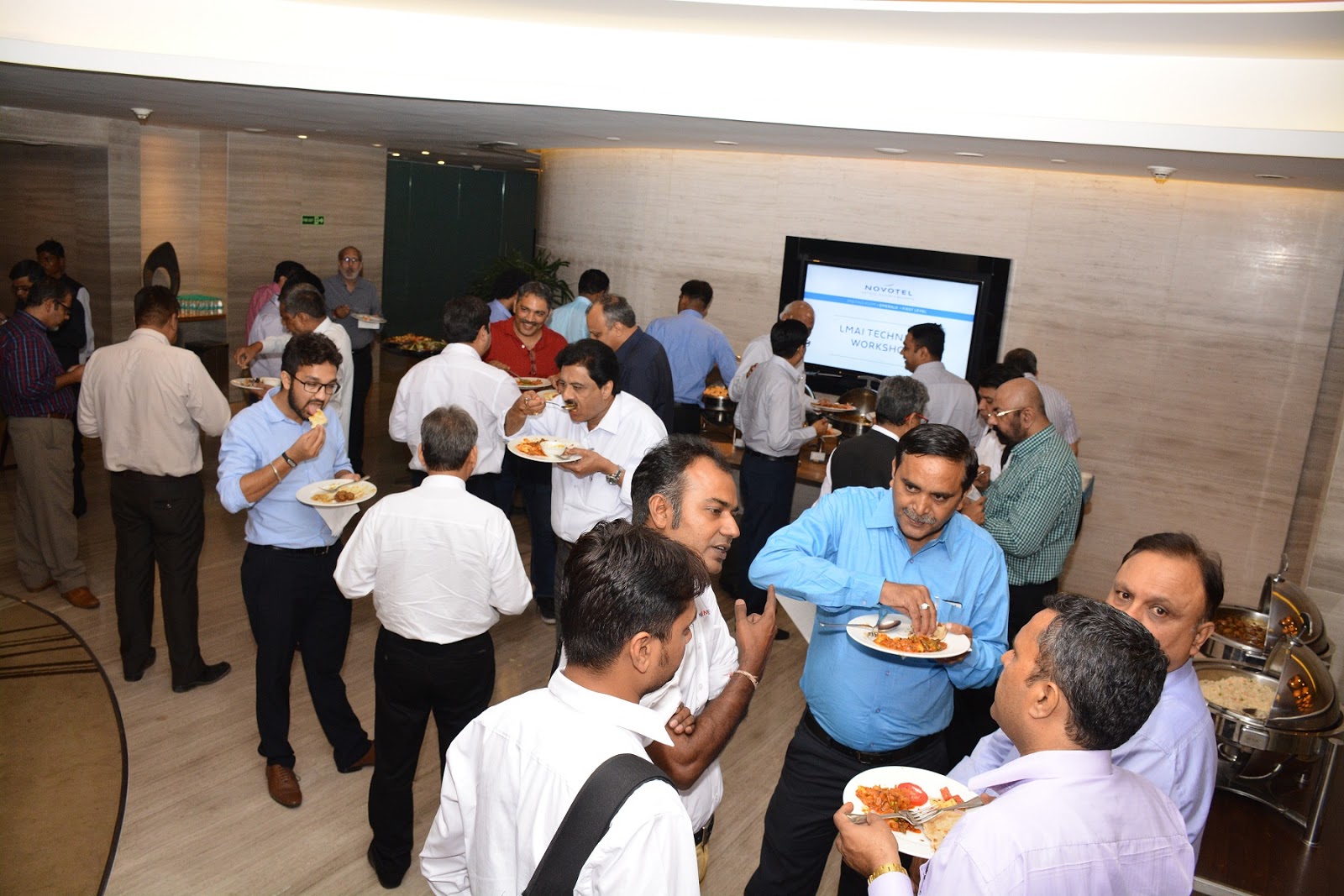
Almost 90 delegates attended the workshop, making it a very successful event. The printers and suppliers had enough time before and after the presentation to network and exchange views on the issues their industry was facing. 


Neeraj Muni
After welcoming the guests Jigesh invited the first speaker Neeraj Muni from Electro Optics to address the audience. Neeraj extensively explained the difference in blade angle for films and paper. The angle is broader, say 90 degrees when you have to cut a paper stock because after initial penetration into the paper the rest of the paper is crushed apart however in case of films a sharper angle is imperative for the blade to pierce into the film and effectively die-cut it. He also spoke about common problems faced like through punching, uneven cutting, die wear, etc. He also advised how to clean and store the dies for better die life.
 
Nirav Shah of Letra Graphics felicitating Neeraj Jagga
Neeraj Jagga from Xeikon, now a part of Flint group, spoke next. He briefly dwelled on the reasons why label printers have so far stayed away from digital printing and then went on to further explain why powder toner technology was better than liquid ink digital printing technology. According to him in case of powder toner the dry powder sits on top of the paper unlike the liquid that penetrates the paper thereby interfering with the chemistry of the paper. The advantage of using dry toner technology is that it is approved by FDA, printed matter is light fast and does not penetrate the packaging paper substrates. He agreed that for long runs it is expensive to use digital however it is ideal for short runs and that so far it is recommended as a complimentary printing technology and not a mainstream system for large printing houses.
 
LMAI awards distribution function is a standard side event for Labelexpo India held every
Rajesh Nema & Sandeep Zaveri

alternate year. It has been observed that a very small number of companies apply to participate in this competition. As a result we see the same company going to the stage for one after another award. It is now the endeavour of the LMAI leadership to try and have widespread participation from an increased number of LMAI printer members. The LMAI honorary Secretary Rajesh Nema and the President Sandeep Zaveri took the stage next to appeal for all converter members to come forward and send entries for LMAI awards in greater numbers. As an incentive to encourage wider participation the duo announced that the first entry from each member would be free. Fees will be charged for subsequent entries. It was also felt that fancy presentations made by large label printers influenced the judges more than the actual label entry. To offer a level playing field, LMAI have distributed a standard kit in which label entries can be made. It was also informed that Premier Marketing was the firm that had been appointed to coordinate the collection, compilation and conducting of the label competition. LMAI is also organizing the next technical workshop at Kolkata on 15th July 2016 thereafter they plan yet another series that will commence from Mumbai.


Ajay Mehta
 
Ajay Mehta, of SMI Coated papers, a leading manufacturer of self adhesive labelstocks spoke on the various types of components in Labelstocks. He discussed different facestocks, adhesives and release liners. He also spoke on what effect storage and application temperature has on the final label.


Amit Ahuja


Amit Ahuja of Multitec, has been the front runner in taking Indian label press manufacturing being acceptable at global platforms. He spoke on nuances of label printing and converting on flexo rotary presses. He also informed about further developments being made in label presses that are made in India. 


Chirag Gokani of Wealthwiz, gave an informative presentation on wealth and estate management. He also discussed the process of creation of will, setting up of various trusts, their management and how to store the documents so that they are traceable and manageable by the inheritors.
 
Harveer Sahni
Finally Harveer Sahni of Weldon Celloplast conducted an interactive question and answer session. Starting with a discussion on blade height for different types of adhesives other topics discussed were reduction of waste in label production, impact on price of labelstock by supplying EXACT width not matching the deckle width,  impact of different climatic zones in the country on performance of pressure sensitive adhesives and avoiding wastages on a label press. Finally when the audience was asked to raise questions on wealth and estate management surprisingly there was absolute silence. Summing it up Sahni said, “It is a typical of Indian businessmen not to discuss their financial queries in public.”


Leading Printers who attended the program included delegates from Astron Packaging, Maharshi Labels, Letra Graphics, Pinmark, Art O Print, Unick Fix-a-Form, Nitai Labels and Ankit Graphics besides others. Media presence was from Print week, Packaging South Asia and Printing Samachar. Vote of thanks was given by Rajesh Nema followed by a networking dinner.


The above article maybe reproduced or published by magazines giving credit to author.
 

Written by Harveer Singh Sahni, Managing Director, Weldon Celloplast Limited, New Delhi, India May 2016

India is the second most populous country in the world after China yet it is home to world’s largest youth population. As literacy levels grow, more and more young English speaking people are coming out of schools, colleges and universities seeking gainful employment. These youth on employment, have disposable incomes in their pockets and have made the burgeoning middle class, a powerful buyer segment driving huge demand of consumer products. As demand escalates for food, clothing, medicine and other consumer durables, it spells out a huge need for labels & packaging. There is further impetus to this industry segment as organized retail becomes more widespread across the country. Shop shelves need to look smart so as to tempt the consumers to reach out and lift the product that appeals due to the packaging it adorns.
 
 
According to the Ministry of Commerce and Industry and the Indian Institute of packaging, the total market size of packaging industry in India is 24.6 Billion USD growing at the rate of 15% per annum. According to WPO and PIRA(Pira is the worldwide authority on the packaging, paper and print industry supply chains) Printed Cartons is 17 % of the total packaging market amounting to approximately 4.7 Billion US Dollars and labels is a small part of packaging, less than 3 % approximately 850 Million US Dollars which includes all of wet glue labels, self adhesive labels, plain labels, in-mould labels, shrink sleeves, wrap around labels, etc. Personally I estimate the market size of labels in India to be somewhat larger than this.
 
With growing usage of internet amongst industry and general public, commercial printing has received a setback. In the late seventies or early eighties when Indians visited exhibitions abroad, they carried back large number of catalogues and grudgingly paid huge amounts for excess baggage to airlines. On return they would hardly find time to go through those loads of paper brochures that would lie around on their desks till it was time to go for another exhibition. The new millennium has changed all that. Since all information is available on internet, there is no need to carry the extra baggage any more. To remind one of what all to check later when back home, the mobiles and IPads are handy and one just has speak and record in these devices to retrieve the reminders at a later date. The convenience as it came, saw a very important growing segment of the printing industry i.e. catalogue printing, starting to diminish or vanish. At this time packaging and not commercial printing is seen as the dependable area of growth and in synergy with the work offset printers are used to doing. As long as there is growth in a literate population needing food, clothing and consumer products, obviously the need for packaging and folding cartons will continue to grow steadily.


Jeetubhai of Finearts, who installed
india's the first flatbed Iwasaki label press
In the 1970s and onwards, the self adhesive label printing industry in India was evolving. From its initiation as a product of screen printed process, with time self adhesive label transformed to a product of the offset printing industry and finally registering a change from the sheetfed printing process, it went on to be produced on in-line narrow web presses. Initially in India, labels started to be printed and converted in an in-line operation in roll form on Japanese flatbed letterpress machines with flat-bed die-cutting in reels of widths 100mm or 150mm. Sometime during the 1980s there started a shift from flat bed letterpress printing to Rotary flexo printing and rotary die-cutting in-line in similar widths. Evolving further, towards the end of the last millennium in the 1990s the flexo presses started to get wider in width, from the 150mm size to 250 mm. The wider width and higher speeds due to rotary converting appealed immensely to label printers and thus started the decline in preference for cheaper flat bed presses that were extremely slow and would produce by impressions per minute rather than meters per minute. In an effort to increase productivity, the width of rotary label presses somewhere at the end of 1990s or the beginning of the decade of 2000, got wider to be at 340-370 mm. Even the speed of these presses increased from 300 feet per minute to over 200 meters per minute. Flexographic printing was preferred for line jobs but when high-quality images in halftone were needed, sheet fed offset printing was opted for. In the last few years the quality of flexographic printing, due to development in prepress process improved making it comparable to offset printing. Flexo rotary label printing flourished not only in India but generally across the world. With increased investments in these presses, intense competition was felt by the label printers. This situation called for innovation and creating more decorated and complex labels incorporating different technologies. As a new millennium dawned, a new concept came to the fore when flexo label printers started investing in equipments with multi-process printing and converting. This is also referred to as combination printing or hybrid printing whereby more than one printing, decorating or converting technologies are employed on the same machine to use the finer results from different print processes. Also the new millennium brought with it the change in narrow web label presses to go still wider to 430mm-530 mm.


A combination press at Renault, Palghar. Prints offset, Flexo,
Gravure, Screen, Hot foil, etc. with embossing and
die-cutting  in a single pass.
Once this happened, the range of products that could be converted on these machines also widened, as diverse materials of varying thickness could be handled with automatic registration controls producing a wide range of end products. Innovation and technically designed capabilities of these equipment, presented an alternative for conventional printing and converting of folding cartons to converting in-line in a single pass. This provided further impetus to the narrow web printing industry to go wider hereon. Today we have in-line presses that incorporate diverse printing processes like Offset, Flexo, Screen, Gravure and digital with finishing processes like varnishing, laminating, cold foil, hot foil, embossing, die-cutting, creasing and waste removal all in a single pass on the same machine.
 
The self adhesive label that is a minuscule part of the packaging industry primarily consists of three main components;
 
1.       Release Paper
2.       Adhesive
3.       Face Paper
 
Each of these components, have a whole lot of chemistry and variations as per need and requirement of the label and its application. The converting process consists of printing, decorating, die-cutting or sheeting, waste removal and rewinding for end product in roll form  or stacking in case of sheeted end products.  The evolution of narrow web label presses, to be able to produce a wider range of end products, have prompted the machine builders to innovate and make the machine not only to go wider but also to integrate diverse processes, paving way for conventional sheet fed printing to in-line printing and converting of folding cartons using multiple technologies as also handling different materials of varying thickness. While flexographic printing one can achieve exact pantone shades, offset printing delivers fine skin tones and vignettes, with gravure the impact of metallic inks is decorative, screen printing helps putting a higher deposition of ink so as to achieve the vibrancy of colours and digital can provide variable data as also help make short runs besides proofing . These web presses are now available in widths upto 850mm catering to printers producing folding cartons, flexible packaging and shrink sleeves. Not very long time ago 850 mm was considered as wide web but now it is an extension of the narrow web printing equipment merging with the mid web segment and offering dedicated equipment for the folding carton industry.
 
A typical Offset press shop floor
If one has to just print a large volume print job, then the conventional offset remains the best option. However given the modern day imperatives of catering to a demanding retail oriented consumer base and pressures coming from a result oriented marketing team, the need for highly decorating capabilities and producing short runs of folding cartons has become a necessity. This requires a lot of multi-process printing, finishing and decorating. It also calls for increased investments in an array of equipments so as to innovate and complement the capabilities of the offset printing press. It makes the life on the offset shop floor time consuming and cumbersome. The requirement of space and difficult to manage manpower goes on increasing as huge stacks of paper need to be moved from machine to machine to achieve the desired results.

For a highly decorated package or carton, incorporating additional security features the following processes and capabilities are preferred to be incorporated in converting operation to create the desired end product:
 
Flexographic Printing
Offset Printing  
Gravure Printing
Screen Printing
Digital Printing
Front and back printing using a turnbar
Fully automatic register control
Lamination
Delam-Relam: Delaminating a self adhesive laminate, printing on adhesive and relaminating.
Embossing
Primer coating for digital printing
Varnishing
Cold foiling
Hot foiling
Adhesive coating in line
Die-cutting
Sheeting
 
Achieving all the above the capabilities in a single sheet fed offset press is not possible. One would require a whole lot of different printing equipment, finishing equipment, large amount of space and a big manpower to achieve this. However all the above processes can be used in creating a package in a “single in-line converting press” in a single pass. To run such a press one needs just 2-3 persons. It becomes extremely convenient to load paper or board reels at the unwind station and getting the finished product at the end of line. For board usage as in case of folding cartons and large volume jobs one can integrate the press with an automatic butt splicer for continuous non-stop production.
The investment may initially appear to be high but when one sees the larger convenience and the project in complete perspective, it becomes interesting. With rising cost of real estate, the space requirement greatly escalates the project cost. Skilled Manpower is not only difficult to source but becoming extremely difficult to retain and manage due to increasing demand for press operators. An in-line printing and converting press reduces the need for a big manpower. Moreover the state of art fully automatic registration systems allows printers to achieve results without much operator intervention. Quick changeovers allow you to have many job changes effectively during a single day. This investment as stated earlier reduces the amount of space needed drastically thereby reducing the investment in real estate and making the project viable.
 
It is pertinent to note that consistent growth in India has prompted a number of larger printing and packaging companies to invest in these combination or hybrid in-line converting presses. There are others in the process of following suit. In time to come these printers will see the convenience to print and convert in a smaller space with lesser manpower and better capabilities. The make-ready cost that appears to be more at this time for larger runs will either be compensated by the convenience or will reduce with economies of scale in times to come.
 
Written by Harveer Sahni, Managing Director, Weldon Celloplast Limited New Delhi India exclusively for Narrow Web Tech Germany December 2015. 
 
The article maybe published with the permission of Narrow WebTech Germany giving credit to them and to the author
Label manufacturers association of India LMAI, is now an association that is vibrant and astir!


Sandeep Zaveri
It was September 2015 when a new young President Sandeep Zaveri took over the reigns of the association. In November south India’s biggest metro city suffered a calamity whereby the city was inundated by floods leaving many homeless and in pitiable state. Sandeep took upon himself to collect kits that would help sustain life for a few days till normalcy retuned. He was in Chennai himself distributing to those who had suffered. In early December 2015 on the sidelines of Pamex, a print and packaging show, LMAI organized a networking event at Hotel Courtyard by Marriot, Andheri, Mumbai where they also announced that soon LMAI will launch its own magazine “Label Legacy”. The event was attended by leading printers and suppliers, some of whom travelled from different parts of the country to also be at Pamex. On January 22nd 2016 LMAI organized a very successful and well attended Technical workshop and networking event at New Delhi’s prestigious Chelmsford Club. The show was a full house and highly appreciated by the attendees. At this event Sandeep Zaveri announced similar Technical Workshops at Bangalore and Ahmedabad.
 
The Bangalore event on 15th of April 2016 was a busy full day program. The day began at the Avery Dennison Knowledge Centre where at 10am, 45 LMAI members gathered for a visit to understand the nuances of flexographic printing.  Sridhara Gopalakrishna Zonal Manager South & East of Avery Dennison received the guests. After delivering safety instructions to be observed within the knowledge centre, the printers were split into two groups to tour the centre.

 
The printers got to appreciate the variety of labels displayed there with information on the user segment they were intended for and knowledge to select appropriate substrates. This was followed by demonstrating the art of using graphic software to highlight, sharpen, soften or alter images before proceeding to plate making. Information was also imparted on the plate making process and the impact of plate thickness on printing. Infact the full pre-press procedure upto plate making was explained.

 
Finally the process of checking the plates and correctly mounting them on the press was demonstrated followed by actual printing, foiling laminating, die-cutting on a running press at high speed while also controlling wastages. Welcoming the group Sridhara thanked Sandeep and the LMAI on behalf of Avery Dennison for coordinating and bring a large number of printers to the knowledge centre. Lunch was served to the visitors by Avery before the group left by two mini busses on to their next sojourn.


The next stop was VeePee Graphics, a premiere pre-press service provider. Jai Prakash Peethambaram, partner VeePee, his wife and daughter welcomed the guest and took them around the facility to showcase their capabilities in prepress. It was time then to congregate at 6 PM for the Technical workshop at The Paul, Bangalore.


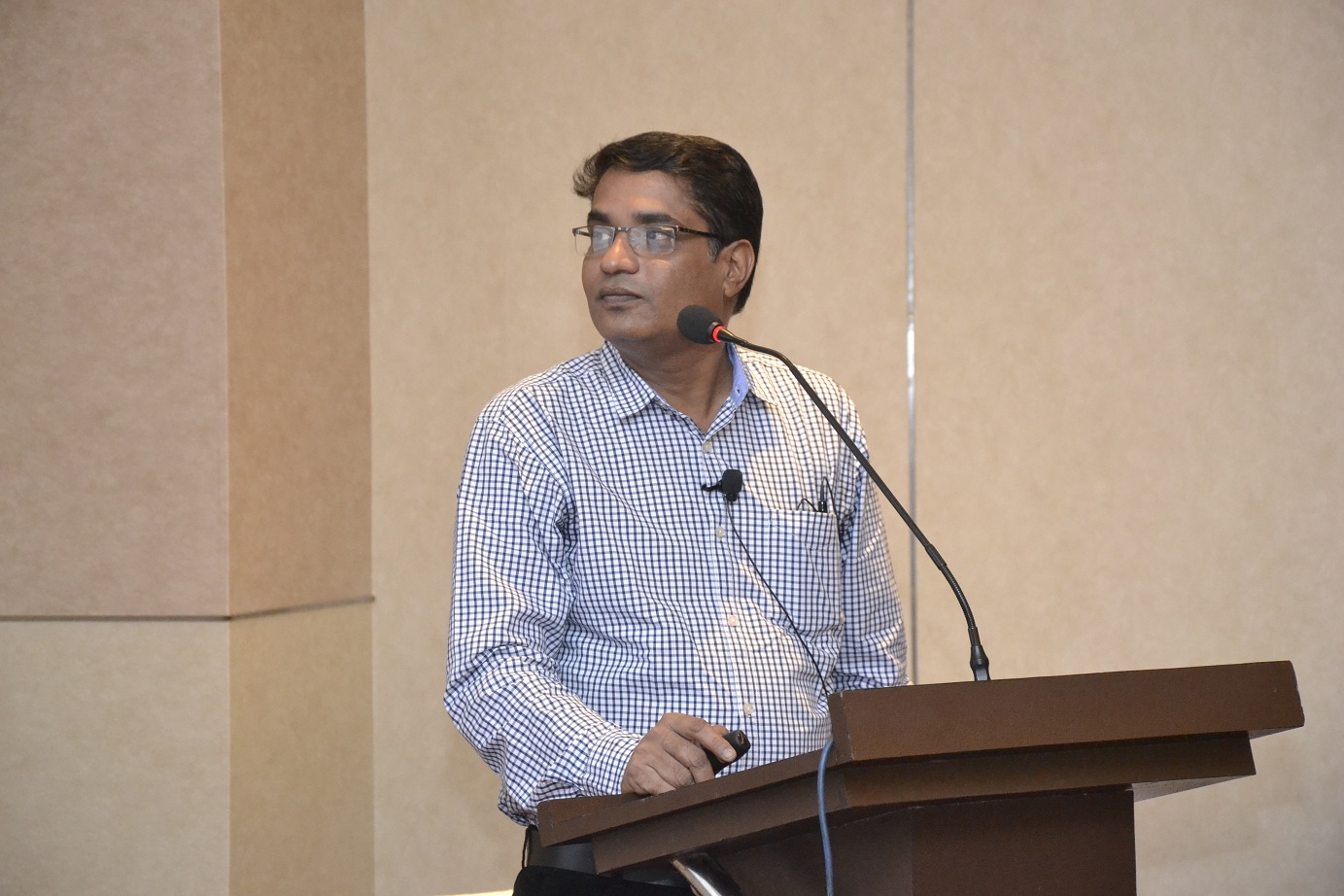
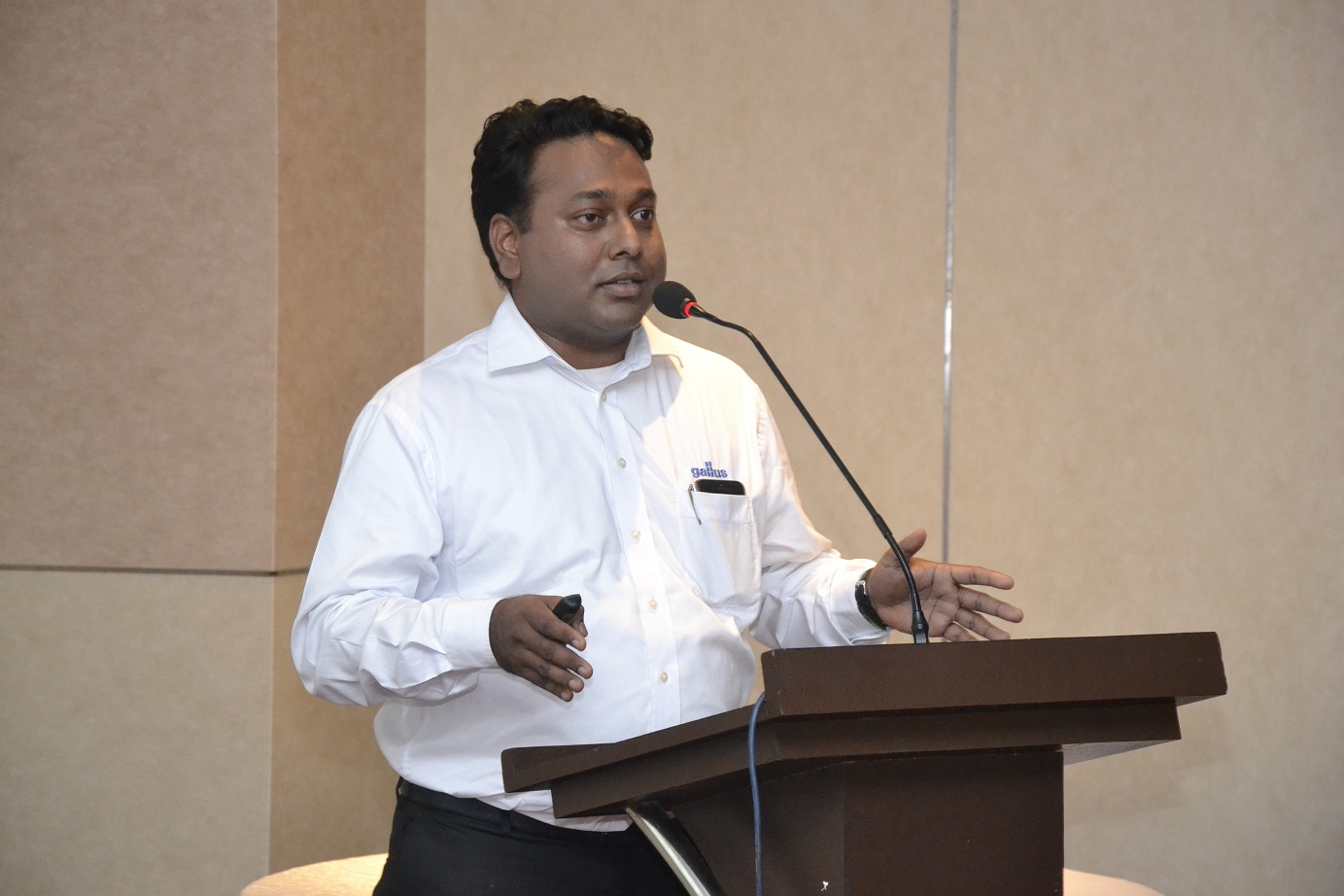
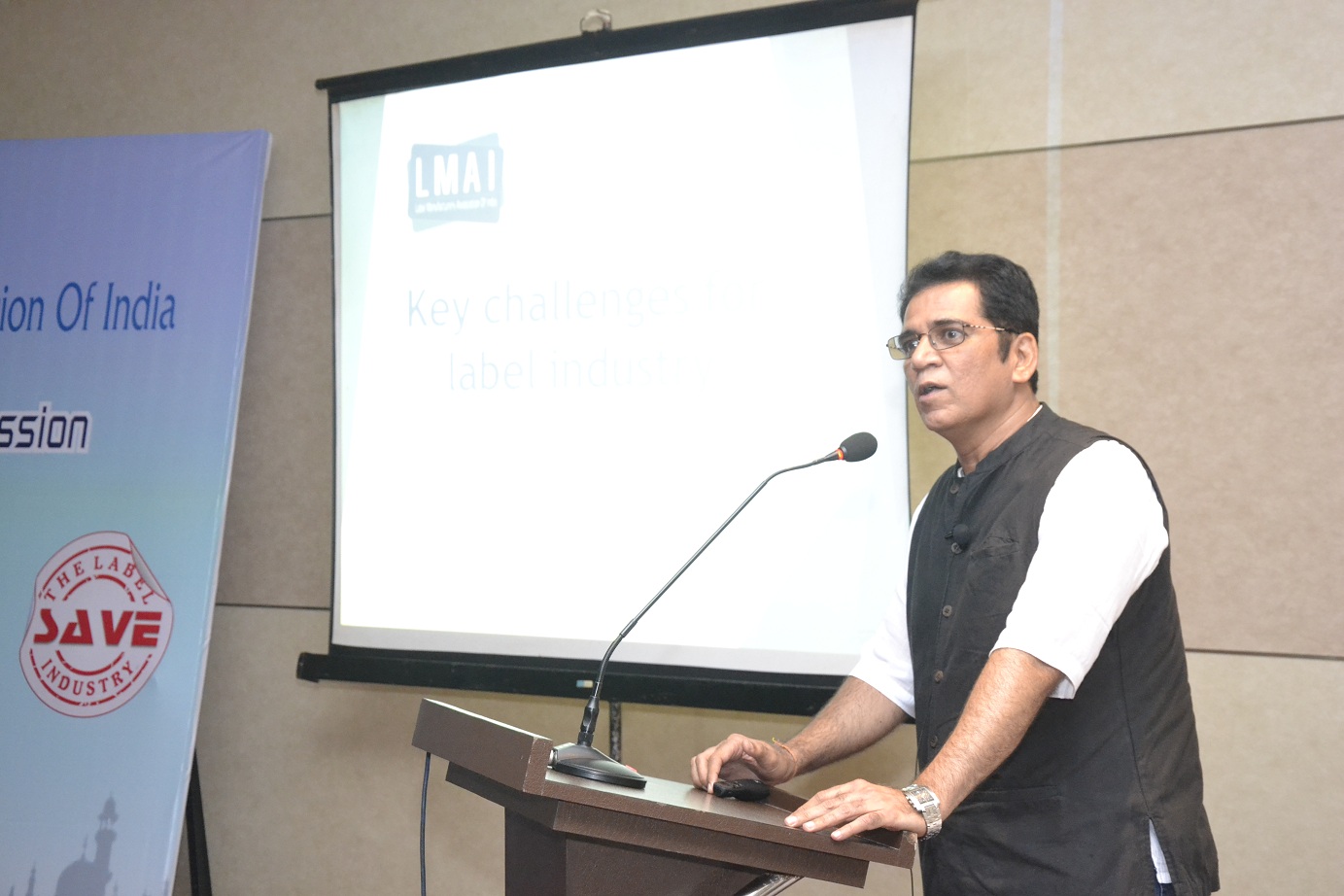
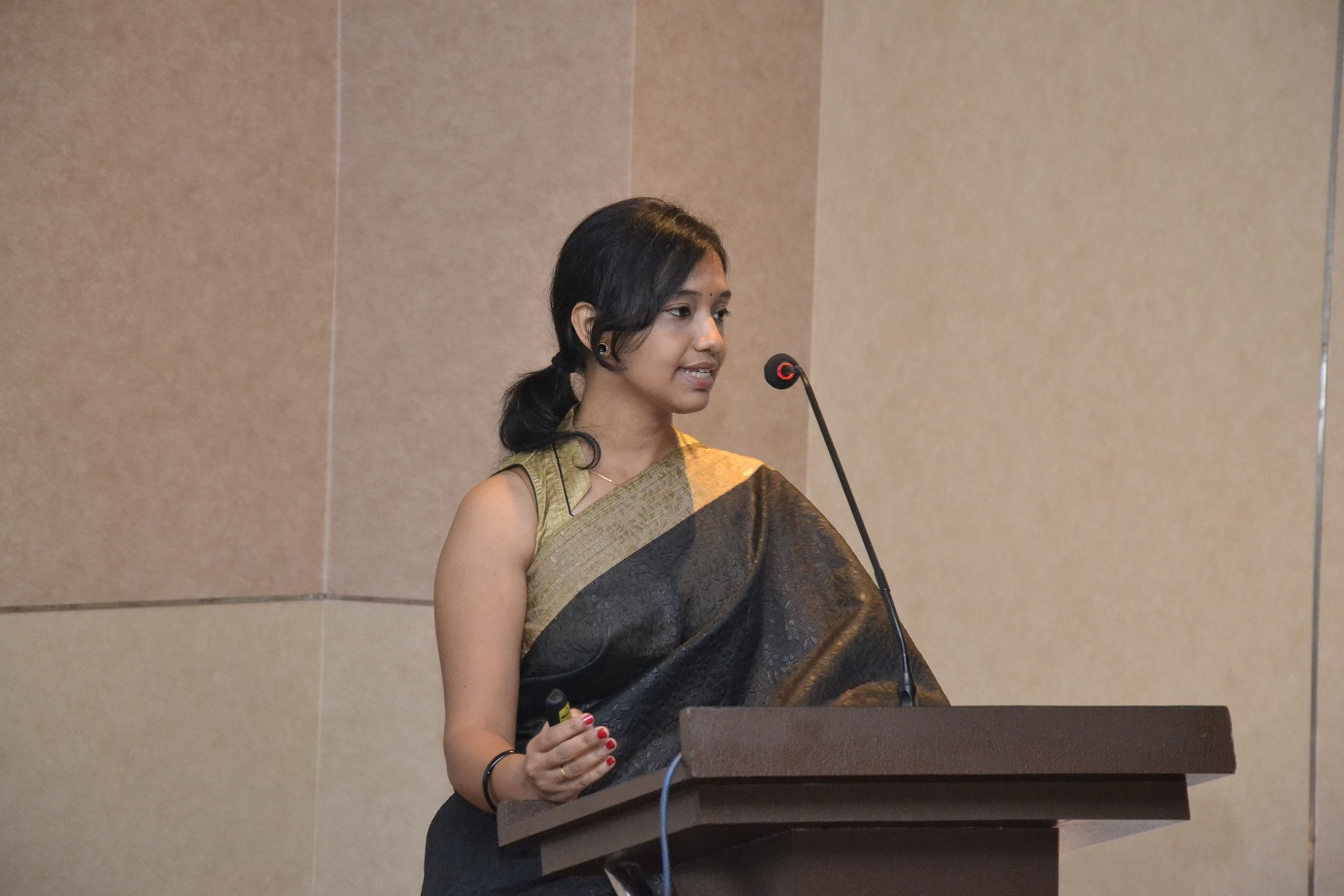
The Technical workshop was attended by 125 delegates. Speaking at the event Khushal Patel from Shailesh Kumar Sharma, senior manager-technical, Flint Group India, enlightened the delegates on the quality aspects of inks as well of the role of UV light in curing. He also mentioned that the present UV curing scenario was undergoing transformation leading to the implementation of LED UV technology as a more stable and futuristic one. Other presentations were made by Arun HS of Esko Graphics and Vikas Sharma of Yes Bank.

BST explained the importance of 100%defect detection in label printing and how it improves customer confidence in label suppliers. He explained in detail the defect detection process, its technology and dwelled on the choices available. Sanjeev Atre of PGI technologies Aurangabad


Add caption


nostalgically narrated the path traversed in the last 14 years from being a narrow web label printers to becoming the only internationally recognized tooling manufacturer from India. His journey he stated, into the production of tooling was inspired by none other than LMAI past president Manish Desai of Mudrika Labels. He spoke about the usage and requirements of good toolings in label conversion and the pitfalls if care is not taken in selecting the toolings like magnetic cylinders and print cylinders. Laxminarayanan of Rotometrics spoke on the Precision in Rotary Die cutting Clearance. He explained in depth the importance of the clearance which is the difference between the height of the blade and the height of the bearers and that this is what controls the depth of the cut. To determine the proper clearance the exact thickness or caliper of the liner is required. He also explained how die cutting takes place dwelling on blade height, blade angle and the impact of liner thickness on a perfect die-cut or a through cut.
 
Jade Grace-Labelexo
Surprise visitors at this event were Labelexpo Managing Director Lisa Milburn and show director Jade Grace. Jade went on stage to give information on the upcoming Labelexpo, later this year in Greater Noida. Leading printers from South India who came to the show were Raveendran from Seljegat Sivakasi, Narasimha Subramanium from Essae technologies Bangalore, Dhanasekar from Protocol Solutions Chennai, Subba Reddy from SGRE Bangalore, besides many others. Printers who travelled to attend this event from other parts of the country included Sanjay Purandre of Shree Ganesh Graphics Mumbai, Anurag Mohan from Interact Kolkata and Arun Gupta from Wonder Polymers Delhi. 
 
The workshop ended with networking cocktails and dinner.


Anil Sharma
On 23rd of April LMAI organized yet another event, this time to felicitate Anil Sharma, Managing Director, South Asia & Sub Saharan Africa, Avery Dennison Materials Group who is shifting to Avery, Singapore from New Delhi to handle bigger responsibilities, at Hotel Courtyard Marriot, Andheri, Mumbai. The event was attended by leading printers from across the country. Speaking at the event, Sandeep Zaveri reminisced about the support that Anil Sharma had extended to LMAI during his six year tenure in India. He remarked about the LMAI-Avery partnership for various events for the benefit of the Indian label industry and thanked him for his endeavours in growth of labels in the country. In response Anil spoke on his transformation from managing a soap business at Hindustan Lever to the label and packaging industry. He went on to dwell on the fast developments, changes and innovations in the print and label industry. 
 
 
Some of those who paid glowing tributes to Anil included Past President LMAI Vivek Kapoor, former General Secretary R L Deshpande, Gururaj Ballarwad of Wintek, and Kuldip Goel of Any graphics. Some of the other leading label printers present at the event were Amar Chhajed from Webtech-Huhtamaki, Sanjeev Sondhi from Zircon Technologies, etc. Supplier members included Ajay Mehta of SMI and Amit Sheth Label Planet besides others. Pankaj Bhardwaj, director for South Asia, labels & packaging materials at Avery who will be taking Sharma’s place at Avery’s India operation assured LMAI, continued support.


LMAI also used the occasion to launch the maiden issue of their magazine Label Legacy that has been compiled by joint efforts of many members and the editorial board. The quality of the magazine and its content were appreciated by all. The magazine design and printing is the result of painstaking effort of Kuldip Goel of Anygraphics, where the magazine was printed.


LMAI has yet another Technical Workshop coming up on the 14th of May 2016 at Hotel Novotel, Ahmedabad. Sandeep Zaveri is a man on the move, making LMAI an interactive pan national association creating bonds and platform within the industry to share thoughts and technological developments with industry peers. Platforms that bring the industry constituents together contribute to the growth in the industry. We already look forward to more news from the President!

The above article maybe reproduced or published by magazines giving credit to author.
 
Written by Harveer Singh Sahni, Managing Director, Weldon Celloplast Limited, New Delhi, India May 2016
 
Twenty eight years ago in July 1988 I wrote an article titled,"The story of Ink" for a Times of India Publication,  At that time I was a leading producer of fountain pen inks under the brand "Weldon". Today as a part of the global label industry I endeavour to write a three part series under the same title extending it to inks used in "Label Printing". I reproduce in original, the article that I wrote 28 year ago as the first part of the proposed series!
 
From the dawn of civilization, man has been making concerted efforts to develop deferent modes of long distance communication from the scalp cries, drum horn and flute signaling of North American Indians to the present day electronic communication he has come a long way in the field of communication. Still, writing remains one of the most widely used and potent forms of expression.


The skill of writing grew out of the early civilization’s quest for a way to communicate efficiently. Before the advent of a systematic scnpt, man used various ingenious techniques to make himself known. Monuments were, for instance, erected on graves not so much to glorify the dead but to perpetuate their memory. One of the commonest devices used by our forefathers to remind themselves of tasks to be performed was to tie knots in a handkerchief. The Ecuadorian Cara tribes put pebbles of different shapes colors and sizes in a small wooden box to record numbers or events. The Lu-tze on the Chinese Tibet frontier is believed to have at one time called their enemies to battle by dispatching a message in the form of pieces of chicken. Three pieces of chicken fat and chili all wrapped in red paper; the meaning of this message: “prepare to fight at once”
Systematic and conscious writing started in the middle of the 4th millennium B.C. and with it started a demand for improved writing materials. The first written words are found etched on stone, later the Egyptians invented papyrus or parchment from which the name paper is derived. Before the invention of paper in A.D. 105 by Tsai-lun, a minister of agriculture in the court of Ho Ti, the Chinese wrote on silk and thin fibers of wood and grass.
 
As for writing instruments, a reed cut like a quill pen came into use late in Egyptian
history while bronze pens appeared in the Roman period.  Chinese and Japanese writings were however done with a small brush or a hair pencil. The quill, the English pen (Derived from the Latin word Penna meaning feathers), the French plume and the Germen feder were used by Europeans till as late as the first quarter of the 19th century. With the birth of writing, papyrus and the pen, appeared also the “writing ink. Ink, the term for any writing fluid, got its name from the old French word “Encaustum”. That name referred to encaustic wax painting but was applied to iron gall ink, presumably due to its caustic, eroding action on vellum made from calf skin.
 
The earliest ink was made from carbon and all writing was done with it, through the classical times and it still continues to be used in the East. Those inks were made from carbon soot (Lamp black). Carbon black suspensions in water with shellac are still used and sold as Indian Ink, Chinese ink or Drawing ink. In the earlier times illuminating inks were sold as water soluble cakes, similar to the water colours of today. These were actually sold in organic pigments like Red Ochre, Yellow Ochre, Gypsum, (white), Malachite (green) and blue frit. Writing inks of today are a far cry from those early concoctions. Ink making which is still an art, has also been caught up in the hi-tech wave and today we have specialized inks of the finest quality for every type of pen; Fountain pens. Ballpoint pens and Porous tip pens.
 
 Fountain Pen Inks:    
 
There are two main types of these inks .The water fast blue – black inks and the easily washable dye-based inks. The water fast inks are solution containing Ferrous Sulphate, Tannic or Gallic acid with small quantities of mineral acid and soluble dye.  It is widely believed that iron writing inks originated in early medieval times. Iron inks were used to write on parchments in the 7th and 8th centuries Iron inks were developed further with the advent of skins as writing materials. In the beginning gall extract was derived from gall nuts. The extract was blended, with wine, vinegar, ferrous sulphate and   gum. The ink thus formulated was subjected to prolonged fermentation and the atmospheric oxidation led to the formation of blue-black precipitates. The first English ink factory established by Stephen in 1834 used a revolutionary ink making procedure which truncated the role of fermentation and eliminated the time consuming process of oxidation. The soluble pale ferrous salts get oxidized into insoluble blue black precipitates within the paper fibers after writing. Therefore, blue-black ink is used to maintain records. A good writing ink should be a fine, odorless, non-poisonous fluid, stable in glass, non corrosive to metel pens and fountain pen plastics. It should have good colour that does not get washed away on prolonged soaking in water. All these qualities are present in iron gall inks.
 
Washable inks are simple solutions of dyes. They contain a certain amount of gum as a thickener and to restrict feathering. Man’s desire to develop writing instruments did not end with fountain pens. In 1889, A Werner patented a primitive type of the ball-pen. The find revolutionized stationery business and reduced fountain pens to antiquity. Already in the developed countries it is hard to find a bottle of fountain pen ink. In 1936 the French introduced a more advanced ball pen in which a manually operated pressure device allowed the application of a column of ink against the rotating ball. J J Biro, improved upon this with his Biro pen in 1939 and during the war years these pens were manufactured in Argentina. With the arrival of the ball pen started the development of ball pen inks
 
Ball Pen Inks:
 
A special type of ink is required for ball point pens. One of the earliest makes
patented by Werner in 1898 consisted of a solution of lamp black in castor oil. The main requirement for ball point pens are that the ink should be stable, it should not clog, it should flow freely when slight pressure is applied to the ball tip and when the ball rotates at the same time it should not leak. One of the most important requirements is that it should be absolutely free from any particles because the smallest particle may scratch the rotating ball, hindering ball rotation and thereby, either rendering the pen useless or giving a very bad writing. The ink is fed by a capillary tube through the clearance between the ball and its housing. It leaves a thin layer of ink on paper as the ball rotates. Since the ink film applied on paper is very thin, the ink has to be highly concentrated.
The early oil- based ball pen Ink are not much in use now. These inks consisted of solutions of dyes in oleic acid. The viscosity and wetting of ball was improved by adding ester gum and castor oil.  As the specifications and requirements of these inks became more exacting, glycol- based quick drying inks based on resins in alcohol-type solvents came into vogue around 1951 and have been extensively developed in the last two decades. They dry better, smear less and have little tendency to transfer on most grades of paper. Materials used successfully for these inks include glycols soluble pthalo cyanine dyes etc. Recently an erasable type of ball point pen ink has been patented. This is essentially a two-phase system. One consisting of the solid colorant is the discontinuous phase and the other consisting of cohesive properties is the continuous homogeneous phase. When writing upon paper the continuous phase precipitates and blocks the pores of the paper thereby not allowing the colorant to penetrate and bind with the fibers of paper. The colored layer thus formed can be easily eased without damaging the paper surface.
 
Porous tip pen inks:
These inks must remain moist and must be of the non-evaporating type. They generally dry by absorption in paper.  A humectant (glycols glycerine, etc.) is used in their formulation. However as a variety of writing instruments are being designed a generalized ink can’t be formulated. For each type of system specific inks have to be formulated after studying the material of construction of the writing instrument, its writing point and the surface to be written upon. At times the atmospheric conditions of places where the pens have to be sold have also to be taken into consideration.
 
To the end, it would not be out of place to mentions that ink making, even though it incorporates the best technology, yet remains an art in the hands of the ink makers.
 
 
Harveer Singh Sahni Partner Weldon Sales Corporation July 1988. Presently Managing Director Weldon Celloplast Limited, New Delhi Posted on Blog April 2016
Pamex is the flagship event of New Delhi based All India Federation of Master Printers (AIFMP) which has been held for 23 years. AIFMP represents 59 affiliate associations across India and aims to be the country’s pre-eminent organization in developing cooperation among national, regional and global print specialists.
 
The scope of the show
 
Waiting for the chief guest before inauguration
The topics that Pamex 2015 attempted to cover were print, package converting, narrow web printing and corrugated packaging. The venue in Mumbai where the show was held from 9–12 December at Bombay Exhibition Centre (BEC) was widely spread out in a huge hall with over 300 exhibitors. Altogether 20,441 registered visitors came to the show and a total footfall over the four days of exhibition was over 40,000. It was interesting to see the fairly large show area buzzing with visitors from the very first day!


Udhav Thakeray inaugurating the show
The two major Mumbai printers associations, The Mumbai Mudrak Sangh (MMS) and theMaster Printers Association (BMPA) supported this event. MMS was the affiliate partner organizing the International Technology Conference on the periphery of the show. It was their President Tushar Dhote who toured across large areas in the state conducting road shows which brought in many visitors to the show and the conference, creating unprecedented success. Even though the show is largely aimed at offset printers one could see the narrow web label segment also visible both in terms exhibitors and visitors. At Pamex, one could sense that the printers are now ready to experiment with the integration of various print technologies and attempt various segments of printed and packaging products to register growth.
Bombay 
 
Label printing in a lower profile


Since it was primarily a show for commercial printers and large suppliers to the print industry who cater to the commercial printing, narrow web printing and the packaging segments kept their exhibits in the narrow web segment in a lower profile even though concerned managers were present to attend to specific customers. HP who had a large presence exhibiting digital printing equipment for commercial printing exhibited digitally converted labels and lamitubes on their stand. A. Appadurai, country manager – Indigo and inkjet solutions, HP India, personally explained the digital conversion of labels and packaging. The company also hosted a knowledge session for cosmetics brand owners and agencies at its stand, showcasing the possibilities in labels and packaging using HP digital printing technology.


Printing and converting on display


Other companies in the digital printing equipment segment present at the show included Epson, Xerox, EFI, Konica Minolta, Ricoh, and Canon. Guy Gecht, Chief Executive Officer of EFI, a leader in customer-focused digital printing innovation was present at their stand to launch the Matan QW inkjet printer, with “white ink” feature, showcased for the first time in the region.


Affordable label die cutting machine with slitting
on display at RK Label machine stand
Ink supplier Flint showcased their new UV LED ink called EkoCure, demonstrating this at the stand of UV Graphics. In addition, Flint also exhibited their range of UV cleaners, flexo inks and press room chemicals. Even though global label substrates supplier Avery Dennison did not have their own stand their team lead by Pankaj Bhardwaj, Commercial Director was present and promoting their solutions for digital printing for sheet fed machines at a stand shared with their distributor. Chennai based Monotech Systems Limited who is a channel partner for UK based Focus Label Machinery and UVRay Italy for UV lamps were displaying their JETSCI VDP inkjet label printing machine. Ahmedabad based R. K. Label Printing Machinery showed their entry level rotary die cutting machine with slitting arrangements, well suited for barcode and plain labels. According to Naresh at their stand, they would soon be launching their indigenously produced nine colour rotary label press. They sell 25 label presses per year out of which 10–12 are rotary and the rest are flat bed printing and die cutting machines. They will exhibit their new equipment at Labelexpo India 2016.
 
The Mumbai based Label Planet group headed by the LMAI (Label Manufacturers Association of India) founder and director Amit Sheth were offering a range of products at their stand. These included Orthotec Label presses of Taiwan, Weigang label presses of China, Packers Ram punching equipment of Korea, Cartes label equipment from Italy and UV digital inks from Inktec USA. Amit Sheth said, “We are also launching Dilli UV presses from Korea with whom we have a strategic partnership”. Manish Hansoti, managing director S Kumar Multi Products, Ahmedabad, was happy to be displaying the only running label press at his stand in Pamex 2016. S Kumar is the Indian agent for Chinese press manufacturers Zonten. The press on display was a six colour tower type machine with cold foil. Manish said, “By Labelexpo India 2016, the Zonten press population will grow to 50!” He further added, “We are soon launching a full servo model”. Mumbai headquartered Genius Flexo machinery Pvt. Ltd. lead by Vijay Pareek were exhbiting information on various products of their foreign principals offered by them. These included MPS and Codimag label presses, Pamarco aniloxes, Rantec plate mounter, Eye C inspection systems and Polymount sleeves. Another label press distributor Standard Printers Providers, who are veterans in this line, were offering the Taiwan made Taiyo label presses. The father/son team consisting of J Sachdev and Gaurav Sachdev did not wish to divulge the number of Taiyo presses installed in the country. Morsef Machines agents for Tangshan Wanjie, China were displaying information on label presses offered by their principals. Bodhi Professional Solutions launched VeriPak 3D, a complete 3D visualisation tool for graphics professionals in the print, packaging and labelling industry. Provin Technos who represent Spanish label press manufacturers Rotatek were present in a big way but information on the label press was limited to signage only.
 
Leading label printers from across the country were seen visiting the Pamex exhibition including Narendra Paruchuri of Pragati Hyderabad, Raveendran of Seljegat Sivakasi, Gururaj of Signode Bangalore, Manjunath of Global Graphics Bangalore, Kuldip Goel of Anygraphics Noida, Sanjeev Sondhi of Zircon and all the leading Mumbai printers. One of the reasons for a high number of label printers was that the LMAI was holding a networking event on one of the evenings and for which the label printing fraternity had congregated in Mumbai.
 
The conference programme 
 
On the side lines of Pamex at the same venue a conference titled “International Technology Conclave” was held. The conference was attended by over 200 delegates. It started with an inspirational keynote address from Manoj Mehta past President of AIFMP and the Director of Manipal Utility Packaging Solutions, which is a part of the Manipal Technologies group who have substantial interest in the label printing business. Manoj Mehta gave his ten commandments which he called, “Dus Ka Dum” meaning “Power of Ten”, for printers to be efficient, growing and profitable. A. AppaDurai of HP India gave an insight into the benefits and comparable advantages of inkjet digital printing. He dwelled on many issues that are a deterrent in many printers decision to invest in digital printing equipment. 
 
Paolo Grasso, export area manager of Italian label press manufacturer Omet and Harveer Sahni of

Weldon Celloplast who represent Omet took the stage next to speak on, “In-line converting with multiple printing technologies”. Harveer Sahni, traced the evolution of label printing from simple flat bed copper block printing, as it gradually reached the stage of in-line combination or hybrid printing and converting, using various processes and how the narrow web has gone wider to integrate into the packaging segment. Paolo Grasso then carried it forward giving details of the equipment and its capabilities to employ printing processes like gravure, flexo, offset and screen inline on the same press along with decoration and finishing like cold foil, hot foil, lamination, embossing, die cutting and slitting or sheeting all in a single pass reducing wastages and saving on manpower.


LED-UV has been attracting the attention of printers in all segments of printing whether offset or label or digital. Vinay Kaushal director of Provin Technos enlightened the audience on this emerging technology. According to him, “In Europe, the use of UV lamps with mercury is banned. Hence, LED UV is the only possible technology solution for the future as it is a green technology.” He added, “It is a myth that LED UV inks are expensive. The cost of these inks is comparable to regular inks.”
Printed electronics is another area which is growing rapidly with advancements in technology enabling printing of circuits on flexible materials in roll form to bring down cost of production as also the size and weight of modern day electronic devices. According to Wikipedia, “Printed electronics is a set of printing methods used to create electrical devices on various conventional substrates. Printing typically uses common printing equipment suitable for defining patterns on material, such as screen printing, flexography, gravure, offset lithography and inkjet. By electronic industry standards, these are low cost processes. Electrically functional electronic or optical inks are deposited on the substrate, creating active or passive devices, such as thin film transistors; capacitors; coils; resistors. Printed electronics is expected to facilitate widespread, very lowcost, low-performance electronics for applications such as flexible displays, smart labels, decorative and animated posters, and active clothing that do not require high performance levels.” Ashutosh Tripathi, team leader at National Centre for Flexible Electronics, IIT Kanpur spoke on the future growth potential of printed electronics that is likely to escalate to a level of USD 330 billion by 2027 opening immense opportunities in this line.
 
The conference was organized quite well with the content being very diverse and informative. There has been a thought process that the conference venue should be different from the exhibition venue as the speakers and delegates are tempted to take time off in between their visit to the exhibition.
 
A well-attended show
 
As initially mentioned, the exhibition was well attended right from the first day. However, more working printing presses would have added to the value that this successful show has created. This satisfying result will surely attract more companies to come forward to exhibit in an effort to gain a foothold in a growing market such like India. Despite this, the show compensated in many ways as there was a lot of ancillary and complementing equipment on display to keep the printers busy and involved. The level of satisfaction in visitors and exhibitors indicate that the 2017 edition of Pamex, which will be held 18–21 December, will be bigger and better.
Hopefully it will also have more label industry participation.
 
Written Exclusively for Narrow WebTech Germany by Harveer Sahni, Managing Director, Weldon Celloplast Limited, New Delhi-110008 December 2015. 
The article maybe published with the permission of Narrow WebTech Germany giving credit to them and to the author